Four weeks from the midterms, the president reversed years of attacks on mail-in voting — while a new poll put his approval at a record-low 32 percent and Democrats ahead on the generic ballot.
Published 6 October 2026 · 06:00 GMT
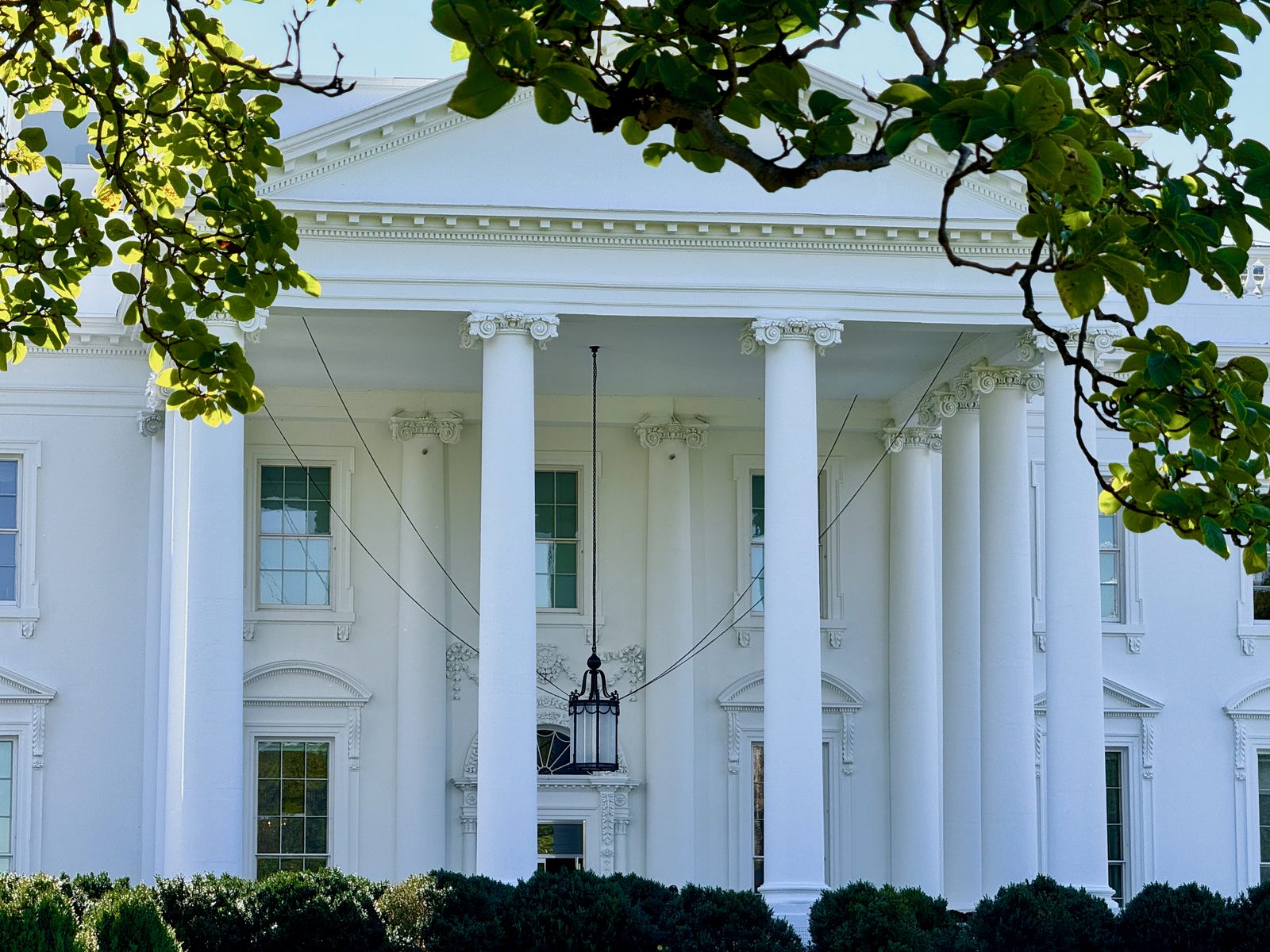
Four weeks from Election Day, Donald Trump did what he has spent years refusing to do: he told his own supporters to vote by mail. “You can do either,” he said Monday on the White House South Lawn — before flying to Nebraska, where he signed a diesel-tax order on stage.
Inside the Pinnacle Bank Expo Center in Grand Island, Nebraska, on Monday night, President Donald Trump turned a signature into the evening's main event. White House aide Natalie Harp carried the executive order up to the podium; Trump signed it at the lectern, then tossed the Sharpie into the cheering crowd. The order defers collection of the federal excise tax on red-dye diesel through the end of the year. Trump said it would save the average trucker more than $100 every time they fill up and ‘drive down the cost of all goods, including groceries very substantially’ — a claim aimed squarely at the truckers and farmers across the United States who have watched diesel prices climb past six dollars a gallon.
Hours earlier, on the White House South Lawn before departing for Nebraska, Trump had made news of a different sort. Asked about the coming congressional midterms on November 3, he encouraged his supporters to vote by mail — a striking change of tone for a president who has for years described mail-in voting as a practice rife with fraud. “They can vote by mail if they want, because we seem to have no choice because a lot of people want to vote by mail, but a lot of very good people also want to vote in-person,” he said. “You can do either.” The comments followed a weekend campaign video in which he told Republicans: “Vote early, vote by mail or vote in-person on Election Day, November 3rd,” so the party could win ‘a midterm victory that is too big to rig.’
‘We seem to have no choice’ — four weeks from Election Day, even the fiercest critic of mail-in voting has decided to use it.
Four weeks from Election Day, the two gestures belong to one strategy: a campaign trailing in the polls is reaching for every lever at once — turnout, wallets, and the electoral map. A Reuters/Ipsos poll completed Monday held Trump's approval at 32 percent, a record low, while registered voters preferred Democrats 44 to 37 percent on the generic ballot. And the campaign's geography tells its own story: Trump's rally tour through conservative states, and Vice President JD Vance's Monday trip to Alaska, are not the itinerary of a party at ease.
In a close election, the mechanics of voting are the campaign. For years, some Republicans have worried aloud that the party's attacks on mail-in voting were suppressing its own voters — particularly rural conservatives, a core of Trump's base, who can live far from polling stations. Telling those voters to bank their ballots early is, in cold electoral terms, free turnout insurance. It also lands after a legal defeat: the administration tried to tighten mail-in voting rules heading into the midterms, but the Supreme Court in September declined to let the Postal Service enforce the new restrictions. With that route narrowed, the message has shifted from restricting the method to maximizing its use.
The short answer is that this is not the first reversal. Trump urged his supporters to vote by mail in 2024, and he has repeatedly voted by mail himself — even as he called mail ballots ‘inherently corrupt’ and made claims, which courts and election officials have repeatedly rejected, that his 2020 defeat was the product of fraud. The longer answer is arithmetic. When a campaign believes it is behind, every banked vote is worth more than a lecture about method, and early votes cannot be lost to a rainstorm on Election Day. The White House has also been sending voter-registration emails from a government account in recent days, and Defense Secretary Pete Hegseth has directed that service members — who tend to vote Republican — get time off to vote.
The through line is a decade-long argument about how America votes. Trump built part of his political identity on the claim that mail-in ballots invite cheating — a claim he repeated on Monday even while urging their use, telling reporters ‘there is a lot of cheating in vote by mail, a lot of cheating all over,’ and singling out Maricopa County, Arizona, where officials said a vendor mistakenly mailed 3,100 early ballots before the official deadline. His administration then tried to convert the rhetoric into rules, pushing to tighten mail-in voting ahead of the midterms. The September Supreme Court decision blunted that effort. Monday's message — use the system, don't just denounce it — is what a campaign sounds like when the courts have spoken and the clock is running.
Bad — but polls are a snapshot, not a verdict. The Reuters/Ipsos survey, conducted online over six days among 4,506 American adults with a margin of error of about two percentage points, found Trump's approval unchanged at 32 percent, the lowest of his political career. The details are worse for Republicans: just 24 percent of Hispanic Americans approve of his performance, the lowest in either of his terms — a remarkable turn for a group that gave him nearly half its vote in 2024, up from roughly a third in 2020. Registered voters preferred Democrats 44 to 37 percent; among independents, Democrats led 37 to 21 percent, with 28 percent undecided. Among Hispanic registered voters, 52 percent plan to vote Democratic against 26 percent Republican — the largest Democratic advantage since Trump took office. The context, per Reuters, is an economy strained by high inflation linked to the war with Iran — and by a September jobs report that missed expectations.
Strip away the stagecraft and the order is a tax deferral, not a tax cut. Red-dye diesel is chemically identical to highway diesel but sold tax-free for off-road use — farms, construction equipment — with the dye letting inspectors spot illegal highway use. Trump's order waives the off-road requirement and defers the federal excise tax, 24.3 cents a gallon according to the U.S. Energy Information Administration, through year's end, with no interest or penalties; it also directs the Treasury to explore wiping out the deferred bill and urges states to match the relief. The White House fact sheet put the federal saving at about $60 on a 250-gallon fill — the $100 figure requires states to follow along. The backdrop is stark: diesel averaged $6.32 a gallon on October 5, according to AAA, and has sat above $6 since September 11, driven by the U.S.-Israel war on Iran and Ukrainian strikes on Russian refineries. Experts told USA Today the move would have limited effect on prices — a tax pause cannot conjure refining capacity. But as campaign theater goes, a president signing fuel relief in farm country weeks before voting needs no expert validation to land.
Read through five dimensions, Monday was a single story wearing two costumes. Geopolitically, the war with Iran has become a domestic tax: inflation and fuel prices are the transmission belt from foreign policy to the ballot box. Economically, the diesel order is an admission — prices, not promises, will decide the midterms, and the battle over the Federal Reserve chair has already shown how little room the White House has left on rates. Demographically, the Hispanic numbers are the poll's loudest alarm: the coalition that powered 2024 is fraying at its newest edge. Historically, the president's party almost always loses midterms, and Trump's weekend warning — that a Democratic win would bring ‘an economic depression, much like 1929’ — is the classic stakes-raising of a party playing defense. Structurally, ‘we seem to have no choice’ may be the most honest sentence of the campaign: mail-in voting is now permanent infrastructure in American elections, and even its fiercest critic has decided to use it.
Four items will decide whether Monday mattered. First, the early-vote bank: Nebraska began mailing ballots on September 28, and both parties will now race to lock in votes before November 3 — watch whether Republican mail returns actually rise. Second, the 28 percent of independents still undecided: they are the election. Third, the map's stress points — Alaska, where a New York Times poll had Democrat Mary Peltola up seven points on Senator Dan Sullivan even as other surveys called it even, and where Vance's visit came paired with a $150 million federal power-line announcement. Fourth, the stakes-framing: Trump's promise, in a Truth Social video, of $5,000 for every American adult if Republicans keep Congress — alongside a $20 million taxpayer-funded ad push — will test whether cash promises move a 32-percent approval. In Nebraska, Trump closed with the line that explains the whole tour: “When I am on the ballot, people show up and we always win. I am asking you to do me a favor and pretend I am on the ballot.”
In Western capitals and newsrooms, the reversal reads as cold electoral pragmatism: a campaign that believes it is losing banks votes early instead of lecturing supporters about method. The Supreme Court's September refusal closed the restriction route, so the message adapted. The polls are read as a referendum on prices — fuel, groceries, inflation — rather than on democracy itself.
The diesel order fits the same frame: a targeted, stage-managed affordability gesture aimed at rural voters weeks before they vote. Analysts note the tension — a president warning of a 1929-style depression while promising $5,000 checks — as classic late-campaign stakes-raising, and caution that four weeks of early voting can still move the 28 percent of undecided independents.
In Moscow and Beijing, the episode is read less as a campaign tactic than as another exhibit in the story of American institutional distrust: a sitting president urging the use of a voting method he calls corrupt, days after his own administration tried to restrict it. State-aligned commentary frames the contradiction as evidence that American elections are managed narratives rather than settled procedures.
For Beijing in particular, what matters is continuity: whichever party holds Congress will shape tariffs, technology controls, and the posture toward the Iran war that is driving fuel prices. The mail-voting drama is watched as political theater; the diesel order and the Alaska energy announcements are watched as policy signals.
From capitals in Africa, Latin America, and South Asia, the American argument over how ballots travel looks like a luxury debate: the fight is over convenience, not access. What registers instead is the price signal — $6.32 diesel in the United States transmits through freight, food, and fertilizer costs everywhere, and a midterm decided on fuel prices will shape the trade and aid postures that developing economies live with.
The Hispanic voter numbers land differently south of the border: the swing of Latino voters toward Trump in 2024, and now away again, is read as a reminder that diaspora politics move in both directions — and that Washington's immigration and tariff choices have constituencies far beyond its borders.
On Monday, October 5, before departing for a Nebraska rally, Trump told reporters his supporters could vote by mail: ‘They can vote by mail if they want, because we seem to have no choice... You can do either.’ It followed a weekend campaign video urging Republicans to ‘vote early, vote by mail or vote in-person on Election Day, November 3rd.’ He added that he still prefers in-person voting and repeated his claims of cheating in mail voting.
Election Day is Tuesday, November 3, 2026. All 435 House seats and roughly a third of Senate seats are contested, deciding control of Congress for the final two years of Trump's term. Early and mail voting is already underway in many states — Nebraska began mailing ballots on September 28, and both parties are racing to bank votes before November 3.
Thirty-two percent, according to the Reuters/Ipsos poll completed October 5 — a record low, unchanged from September. Only 24 percent of Hispanic Americans approve, the lowest of either of his terms. Registered voters preferred Democrats 44 to 37 percent on the generic ballot. The online poll surveyed 4,506 adults over six days, with a margin of error of about two points.
Red-dye diesel is chemically identical to highway diesel but sold tax-free for off-road use such as farming and construction; the dye lets inspectors catch illegal highway use. Trump's October 5 executive order waives the off-road requirement and defers the 24.3-cent-per-gallon federal excise tax through year's end. Experts told USA Today it would have limited effect on prices, which averaged $6.32 a gallon.
