 MAGNA BUREAU
The Wire
Spain votes on 29 November with Feijóo ahead; and Vox holding the keys to government
Pedro Sánchez called a snap election on housing and bet his premiership on an epic comeback. The polls say the conservatives will win; but only with the far right, and only just.
Key points
- Spain votes on Sunday 29 November in a snap general election, its sixth in eleven years, called by Prime Minister Pedro Sánchez on 5 October after parliament rejected his government’s emergency housing decrees. <span class=”src”><a href=”https://www.bbc.co.uk/news/articles/cxr5g4lyp94no” target=”_blank” rel=”noopener”>BBC</a> (17 Nov 2026)</span>
- The People’s Party leads most polls on about 31 per cent and roughly 130 of the 350 seats in the Congress of Deputies; the Socialists trail on about 27 to 30 per cent, and Vox polls 18 to 19 per cent. <span class=”src”><a href=”https://www.theweek.in/news/world/2026/11/16/spain-general-election-right-wing-majority-projected-as-sanchez-calls-snap-vote.html” target=”_blank” rel=”noopener”>The Week</a> (16 Nov 2026)</span>
- A party or coalition needs 176 seats for an absolute majority. The PP and Vox together are projected at about 190 seats; the only combination the polls put over the line. <span class=”src”><a href=”https://www.theweek.in/news/world/2026/11/16/spain-general-election-right-wing-majority-projected-as-sanchez-calls-snap-vote.html” target=”_blank” rel=”noopener”>The Week</a> (16 Nov 2026)</span>
- Two rail disasters have killed 115 people: 69 at Urda on 28 October and 46 in a derailment in January. The transport minister resigned after the October crash. <span class=”src”><a href=”https://www.bbc.co.uk/news/articles/cxr5g4lyp94no” target=”_blank” rel=”noopener”>BBC</a> (17 Nov 2026)</span>
- Former transport minister José Luis Ábalos is serving a 24-year prison sentence for accepting kickbacks; party figure Santos Cerdán awaits trial for alleged bribery; Sánchez’s wife faces trial and his brother has been banned from public office for nine years. <span class=”src”><a href=”https://www.bbc.co.uk/news/articles/cxr5g4lyp94no” target=”_blank” rel=”noopener”>BBC</a> (17 Nov 2026)</span>
ONE EVENT. THREE READINGS.
From London and Madrid, the race reads as a referendum on eight years of Socialist rule and on the man who has embodied it.
The BBC’s profiles frame Feijóo as the capable administrator, thirteen years running Galicia, in public office since 1991, against a prime minister described as a political survivor facing his toughest election yet.
What this reading highlights: The Guardian’s analysis stresses the historic stakes: a PP–Vox deal would return the far right to government for the first time since the return to democracy.
The Western coverage also dwells on the paradox the polls contain, a PP lead in voting intention alongside a personal preference for Sánchez, and on the corruption cases that stripped away his early image as an anti-corruption crusader.
From New Delhi, the coverage is structural rather than personal.
The Week reads the election as the product of three interlocking pressures; a housing market where rents rose 87 per cent against wages up 28 per cent, a rail network that killed 115 people in two disasters, and a migration crisis in Ceuta that the right has turned into a campaign weapon.
What this reading highlights: Its reporting stresses the arithmetic over the personalities: the PP and Vox together near 190 seats, the only combination projected to command a majority, and a left too divided to repeat its 2023 feat of uniting against the far right.
The east lens also picks up what the Western profiles pass over; the energy bind, with Algerian gas at a third of supply even as Algiers froze trade after 2022.
Sources: The Week (1)
From Doha and Islamabad, the story is the housing revolt and the border.
Al Jazeera’s reporting of the snap announcement centres the parliament’s rejection of the housing decrees and the polls pointing to a PP-led coalition with Vox support.
What this reading highlights: The Thursday Times, reporting from Madrid, stresses the same hinge: the PP first but short of a majority, Vox as the indispensable partner, Sánchez selling the contest as a choice between a progressive government and a right that would roll back social gains.
The south lens reads the Ceuta episode and the “Moroccan candidate” attack as the campaign’s most combustible thread; a European election in which North Africa is a protagonist, not a backdrop.
Sources: Al Jazeera (1), The Thursday Times (1)
Sources by lens: 2 West, 1 East, 2 Global South. See every source
THE POINT OF CONVERGENCE
On the core sequence; Pedro Sánchez called a snap election on 5 October after parliament rejected his government’s emergency housing decrees; Spain votes on 29 November; the People’s Party leads every published poll except the state-run CIS; and the PP and Vox together are the only combination projected to clear the 176 seats needed for a majority in the 350-seat Congress.
WHAT REMAINS CONTESTED
On what the election is about; Sánchez frames it as a choice between his progressive government and a right that would roll back social gains, while his opponents frame it as a referendum on corruption and on what they call sanchismo; the pollsters also disagree on the gap, with the CIS alone projecting a Socialist lead against a two-to-five-point PP lead elsewhere.
The story
Why did a housing vote bring down the government?
Spain votes on Sunday 29 November in a snap general election, its sixth in eleven years, after Prime Minister Pedro Sánchez dissolved parliament on 5 October. The trigger was a parliamentary defeat two days earlier: the Congress rejected his government’s emergency housing decrees, with the conservative People’s Party (PP), the far-right Vox and the Catalan pro-independence party Junts voting them down. Sánchez, prime minister since 2018, called the vote eight months early, betting that the housing crisis, the issue that sank his decrees, is also the ground where he can still win. “We need to renew people’s support,” he said in a televised address, promising what he calls “an epic comeback of a progressive Spain”.
The 15-day official campaign opened on 13 November and runs to 27 November, with a ban on publishing opinion polls in the final days. Nearly 39 million Spaniards are eligible to vote for the 350 members of the Congress of Deputies and 209 senators. Polling stations open at 9:00 and close at 20:00. The question on the ballot is whether eight years of Socialist-led rule end here; and whether, for the first time since Spain’s return to democracy after the death of Francisco Franco, the far right enters national government. Sánchez called the snap vote after his minority government, the Socialists governing with the left-wing Sumar alliance, lost the parliamentary majority it had held since Junts moved into opposition nearly a year ago.
What do the polls actually say?
Every published poll except one puts the PP first. The 40dB pre-electoral survey for El País and Cadena SER, fieldwork 2–4 November among 2,000 voters, gave the PP 31.9 per cent, the Socialists 29.9 per cent and Vox 18.0 per cent, converting to roughly 129, 119 and 61 seats. Its 18 November tracking put the PP at 131 seats, the Socialists at 122 and Vox at 55. A Sondaxe poll for La Voz de Galicia put the PP at 130 seats, the Socialists at 106 and Vox at 65. The pattern is stable: the PP first on about 130 seats, the Socialists on about 110, Vox on about 63; and the PP and Vox together on roughly 190 seats, above the 176 needed for an absolute majority in the 350-seat Congress.
The one exception is the state-run Centre for Sociological Research (CIS), the only pollster projecting a clear Socialist lead. And the polls contain a warning for the right: the same 40dB tracking found Sánchez still leads Feijóo by ten points as the preferred prime minister, and Abascal by sixteen. Polls are snapshots, not results, and the gap between the two big parties has narrowed to two points in the latest 40dB fieldwork.
“We need to renew people’s support,” he said in a televised address, promising what he calls “an epic comeback of a progressive Spain”.
The gaps the campaign has not closed
Whether the PP and Vox actually clear 176 seats on the night. Every projection puts them close, but the range runs from just above the line to comfortably over it, and a result a few seats short would leave Feijóo negotiating with the same small regional parties Sánchez relied on. Whether Vox enters the cabinet or merely supports a PP government from outside parliament. Feijóo says he prefers a PP government alone and has not ruled out a coalition “under strict conditions and red lines”; but what those red lines exclude has never been spelled out. Whether Junts, with just seven seats, becomes kingmaker again, and what price its leader Míriam Nogueras would demand. And whether progressive voters, disappointed by a left that is now split between the Socialists, the Frente Amplio and a Podemos running separately, turn out at all.
Why this vote reaches beyond Spain
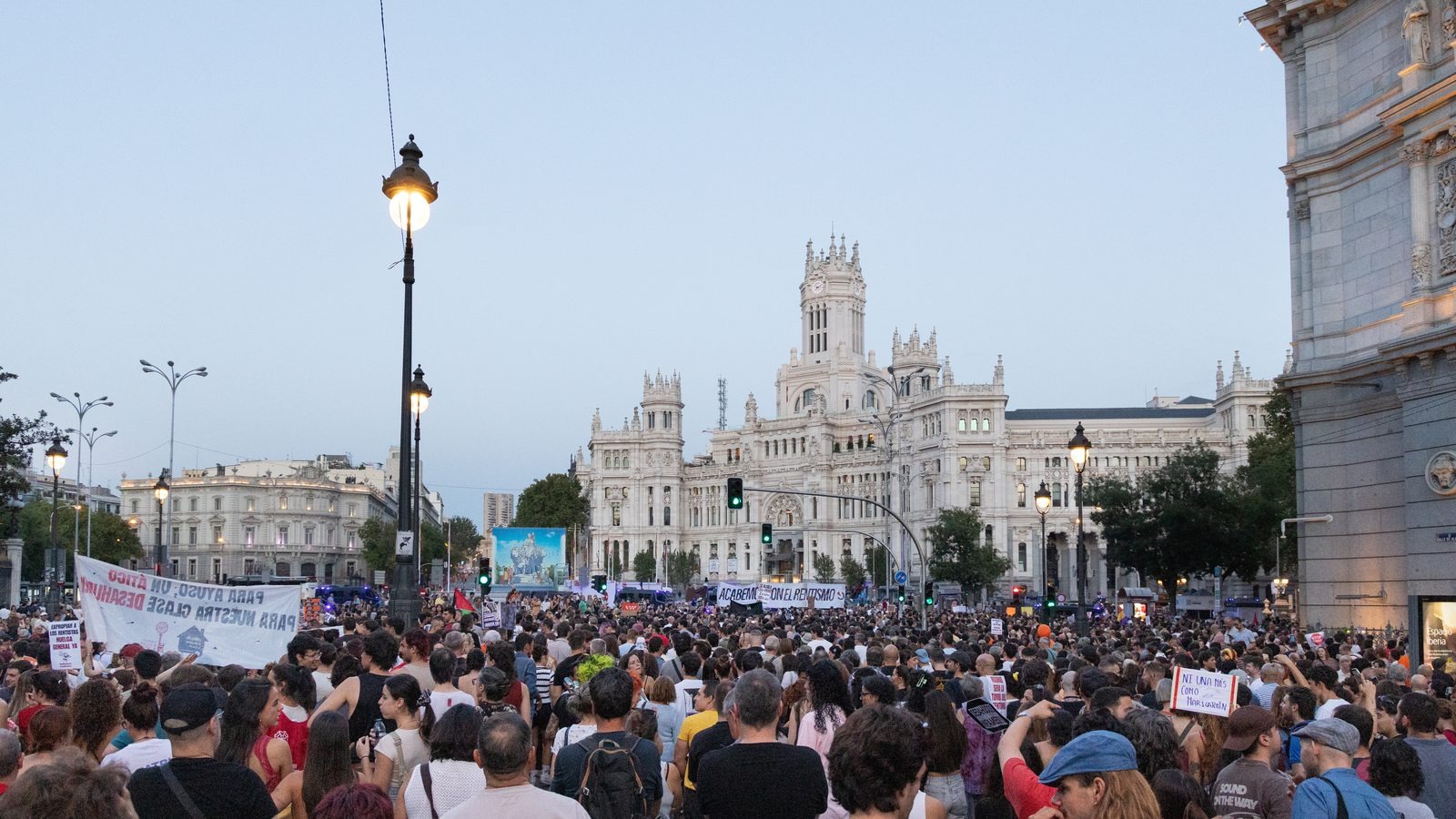
Because it would put the far right in national government for the first time since the Franco era; a Rubicon for Spanish democracy and a signal across Europe. Because housing has become Spain’s defining domestic question: nearly 56 per cent of citizens call it a leading national problem, rents have risen 87 per cent in a decade while wages rose only 28 per cent, and the Bank of Spain warns of an immediate shortfall of 750,000 homes. The housing revolt that filled the streets of Madrid, Barcelona and Valencia, catalysed by the eviction of Maricarmen Abascal, an 87-year-old tenant forced out by an investment fund, is the anger Sánchez hoped to ride and the anger that may now remove him.
And because the campaign has dragged Spain’s most sensitive relationships into the open: in July, 70,000 to 80,000 migrants overwhelmed the defences of the Ceuta exclave; Feijóo opened his campaign there, accusing Morocco of orchestrating the crisis, while Vox branded Sánchez “the Moroccan candidate”. Yet Algeria, which froze trade after Sánchez endorsed Morocco’s autonomy plan for the Moroccan Sahara in 2022, still supplied nearly 34 per cent of Spain’s gas in the first half of 2026 via the Medgaz pipeline.
How did Sánchez lose the initiative?
Sánchez called this election on his own timing and on his chosen ground, housing, and then watched the campaign become a referendum on everything else. The corruption cases against his inner circle and family will not go away: José Luis Ábalos, his former transport minister, is serving a 24-year prison sentence for accepting kickbacks; leading party figure Santos Cerdán awaits trial for alleged bribery and denies wrongdoing; his wife Begoña Gómez faces trial over alleged influence peddling and embezzlement, and his brother has been banned from public office for nine years. The rail disasters compounded the damage: 69 people died at Urda on 28 October, nine months after a derailment killed 46, and the transport minister resigned.
Feijóo’s pitch is deliberately narrow: management. “It’s called management: and it’s what I know how to do,” he tells voters. In office continuously since 1991, he ran Galicia for thirteen years, and he has turned his one obvious weakness, that he does not speak English, into a slogan of its own: “I don’t know English, but I know how to govern.” The risk for the PP is the price of its majority: it now governs with Vox in four regions, and a national deal would hand Abascal, who promises the navy on the borders, “remigration” and a doctrine of “national priority”; leverage no Spanish far-right leader has ever held. The surge of Vox is the story within the story: a party polling a fifth of the vote, poised to nearly double its representation.
What happens the morning after 29 November?
Three clocks start. The first is the investiture: if the PP and Vox clear 176 seats, Feijóo must decide within weeks whether Vox ministers sit in his cabinet or whether he governs with their parliamentary support; a choice that will define his premiership before it begins. The second is Catalonia: Junts’ president Carles Puigdemont, in self-imposed exile since the failed 2017 independence bid, plans to return to Spain after the election, and its seven seats could still decide a hung parliament. The third is Europe: a PP–Vox government would arrive as the EU debates its next budgets and as the Gibraltar treaty faces its December ratification vote; and as Spain’s energy dependence on Algerian gas collides with a campaign that accused Morocco of orchestrating a border crisis.
Whoever governs inherits the same arithmetic; a 750,000-home shortfall, a rail network under investigation, and a parliament where 176 is the only number that matters.
What to watch before polling day
Four things. First, the 40dB tracking and the final polls before the 24 November blackout; whether the gap keeps narrowing or the right bloc pulls clear. Second, the televised leaders’ debates, where Feijóo’s English and Sánchez’s record will both be tested in front of voters who still prefer Sánchez personally. Third, turnout: the left’s fate depends on whether disappointed progressive voters stay home, as the polls suggest they might, or rally against a Vox in government. Fourth, the count itself on the night of 29 November; and the days after, when the arithmetic of 176 decides whether Spain gets a government, a coalition, or another election. The campaign’s final stretch will show whether Sánchez’s promised comeback has any ground left to stand on.
What we agree on, and what remains open
Established
- On the core sequence; Pedro Sánchez called a snap election on 5 October after parliament rejected his government’s emergency housing decrees.
- Spain votes on 29 November.
- The People’s Party leads every published poll except the state-run CIS.
- The PP and Vox together are the only combination projected to clear the 176 seats needed for a majority in the 350-seat Congress.
Contested
- On what the election is about; Sánchez frames it as a choice between his progressive government and a right that would roll back social gains, while his opponents frame it as a referendum on corruption and on what they call sanchismo.
- The pollsters also disagree on the gap, with the CIS alone projecting a Socialist lead against a two-to-five-point PP lead elsewhere.
Still open
- Whether the PP and Vox actually clear 176 seats on the night.
- Whether Vox would enter the cabinet or support a PP government from outside.
- What price Junts would demand for its seven seats.
- Or whether disappointed progressive voters turn out at all.
What to watch
Questions, answered
Sánchez dissolved parliament on 5 October, eight months early, after the Congress rejected his government’s emergency housing decrees on 2 October. The PP, Vox and Junts voted them down. He bet that housing, the issue that sank the decrees, was also the ground where he could win, promising an epic comeback of a progressive Spain.
Yes, for the first time since Spain’s return to democracy after Franco. Polls put the PP first but short of a majority, and the PP and Vox together at about 190 seats, above the 176 needed. Feijóo has not ruled out a coalition under strict conditions. The PP already governs with Vox in four regions.
The PP leads on about 31 per cent and roughly 130 seats, the Socialists trail on 27 to 30 per cent and about 110 seats, and Vox polls 18 to 19 per cent. The state-run CIS is the only pollster projecting a Socialist lead. Sánchez still leads Feijóo by ten points as preferred prime minister.
Nearly 56 per cent of citizens call housing a leading national problem. Rents have risen 87 per cent in a decade while wages rose only 28 per cent, and the Bank of Spain warns of a 750,000-home shortfall. Mass protests and a general strike followed the eviction of an 87-year-old tenant, Maricarmen Abascal.