As election nears, Spain’s Sanchez struggles to rally a disillusioned left
Pedro Sanchez called a snap election betting that anger over housing and fear of the far right would unite the left behind his Socialists. Two weeks out, the polls have not moved, the streets are angrier at his government than at his opponents, and a conservative–far-right alliance looks the most likely next government.
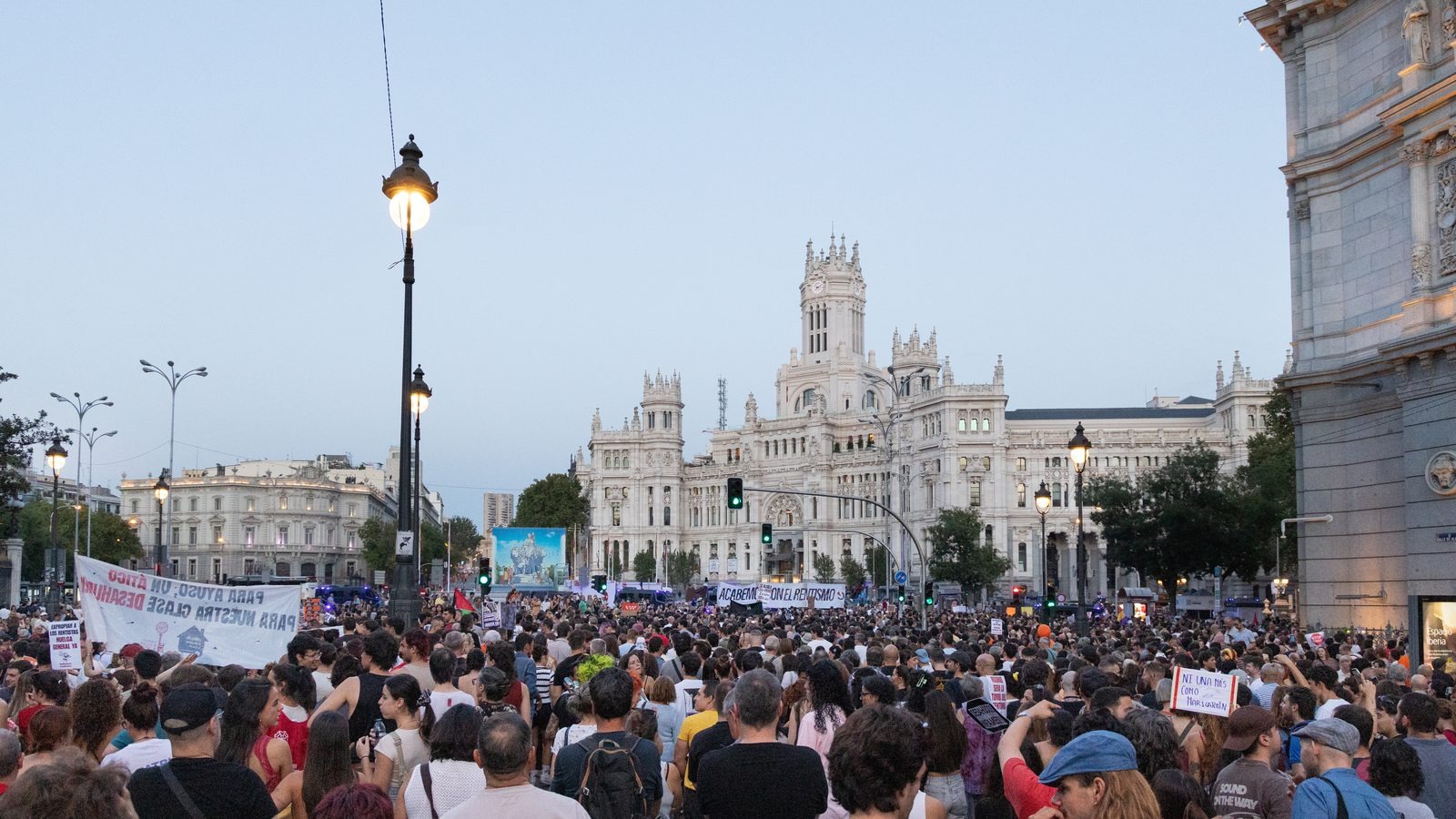
Key points
- Pedro Sanchez called a snap general election for 29 November after parliament rejected his minority government’s housing decrees; the vote had originally been scheduled for 2027. Reuters / Le Monde
- Polls put Sanchez’s Socialist Party (PSOE) at 26–29%, around the level recorded before he called the election, and a People’s Party–Vox alliance is seen as the most likely next government. 1
- Spain held its first general strike in 14 years on Wednesday 11 November, called by the UGT and CCOO unions and tenants’ associations over housing; the unions put turnout at more than three million. Reuters / Al Jazeera
- The protests were set off by the eviction on 23 September of Maricarmen Abascal, 87, from the Madrid flat she had lived in for 70 years after a sharp rent rise; she died in October. Le Monde / Al Jazeera
- Spain has a deficit of about 750,000 homes, set to grow past one million by 2028, according to the Bank of Spain; the average rent of €1,176 is about 98.7% of a young person’s average monthly salary. Bank of Spain / Youth Council of Spain
Three readings of the same result
Same facts, different frames. Each reading names its outlets and what it emphasizes.
The Western reading, carried by Reuters and Le Monde, treats the campaign as a referendum on incumbency that Sanchez is losing despite choosing the terrain.
The emphasis falls on the polls that have not moved, the broken left-unity talks and the arithmetic of a PP–Vox majority.
Key detail Le Monde adds the counterweight: Spain’s economy is forecast to grow 2.5% in 2026, and unemployment has fallen from 14.55% to 10.18% since Sanchez took…
The East Asian reading, in The Hindu, CNA and the Straits Times, follows the same facts but frames them as a governance story about delivery rather than ideology.
The coverage dwells on the strike’s scale, the housing deficit figures from the Bank of Spain and the sequence of institutional failure; decrees drafted, decrees rejected, parliament dissolved.
Key detail For readers in fast-growing Asian economies wrestling with their own housing crises, the Spanish story reads as a warning: a state that can build high-speed…
The Global South reading, heard in Al Jazeera’s own reporting from the streets, starts with the people the statistics describe.
Its notebooks quote protesters in their own words, young workers paying hundreds of dollars for a few square metres, families priced out of the cities where they work, and treat the general strike as a demand for dignity rather than a campaign event.
Key detail Al Jazeera also records what the Western wires pass over: Sanchez never explicitly endorsed the strike, his junior coalition partner Sumar demanded the interior minister’s…
Sources by lens: 2 West, 3 East, 2 Global South. See every source
The story
A snap election built on housing anger is running into anger at the government itself
When Pedro Sanchez called a snap election last month, the bet was straightforward. Anger over housing and fear of the far right, he reasoned, would rally every shade of the left behind his Socialists. The housing revolt that forced the election had filled the streets for weeks, and Sanchez made it the centre of his campaign, telling his first rally that every generation has its own struggle and that for this one, the struggle is housing.
Two weeks before polling day on 29 November, the bet is not paying off. Interviews and polls reported by Reuters on 13 November suggest many potential supporters are too furious about the status quo and the perceived failings of Sanchez’s own government to oblige. Backing for his party still hovers around the 26–29% level recorded before he called the election, and without a shift in the next two weeks, an alliance between the conservative People’s Party and the far-right Vox is seen as the most likely next government.
What the polls, the strike and the parliament vote actually show
The sequence of events is not in dispute. The spark was the eviction on 23 September of Maricarmen Abascal, an 87-year-old Madrid pensioner, from the flat she had lived in for 70 years, after her corporate landlord raised the rent sharply; Al Jazeera reports a fivefold increase on a rent of €500 a month. Televised images of her forced removal shocked the country, protest camps sprang up in city squares, and her death in October turned a housing protest into a national uproar.
Sanchez’s minority government rushed to present two emergency decrees offering tenants greater protection against evictions and the automatic renewal of contracts. Parliament rejected them on 2 October, and Sanchez dissolved the Cortes and called the snap election for 29 November, bringing forward a vote scheduled for 2027. The general strike that followed was the first in 14 years: on Wednesday 11 November, the two biggest unions, the UGT and the CCOO, backed by tenants’ associations, staged a 24-hour walkout under the slogan wages, housing, prices. The unions put turnout at more than three million people, and 115 people were arrested, mainly during evening clashes in Barcelona and Madrid.
The morning after the strike, parliament passed housing reforms limiting evictions and real-estate speculation, the first decree carried by 35 votes to 34. Their duration depends on the election: the People’s Party has said it will repeal them if it takes power. The arithmetic is equally stark. More than a million voters are still undecided, and last month’s talks among Spain’s left-of-centre parties to form a united platform broke down, leaving disgruntled leftist voters to choose between the Socialists, abstention, or a smaller party that might let the right in.
The turnout, the undecided and the fate of the new housing laws
The size of Wednesday’s mobilisation is itself contested. Reuters, reporting on 13 November, put the unions’ figure at more than three million, while CNA, reporting the day before, carried a unions’ figure of four million. No official count exists.
Nor is it clear how the undecided will break. Political consultant Ivan Redondo, a former campaign strategist for Sanchez, told reporters that just four in five left-leaning Spaniards backing the Socialists in small provinces could turn things around; a narrow path that depends on voters who have spent weeks protesting against the government now voting for it. Pollster Paco Camas of Ipsos notes that Vox is attracting some disillusioned left-wing voters with narratives about defending hard work and protecting Spanish culture, which suggests the protest vote has somewhere else to go.
Finally, nobody can say whether the housing reforms passed on 12 November will last: ratified by an interim lower house, they depend on the election result, and the People’s Party has promised repeal. The same uncertainty hangs over the campaign’s other wounds, two deadly train crashes, corruption convictions in Sanchez’s inner circle and a rush of migrants into Ceuta, whose full cost will only be known on the night of 29 November.
Spain is testing whether a housing revolt elects a government or removes one
This election matters beyond Spain because it is the sharpest test yet of a pattern spreading across Europe: a housing crisis that no incumbent government has solved, meeting an electorate that no longer accepts that the crisis is someone else’s fault. Sanchez governed through it, and the protesters’ central complaint is not that he ignored housing but that his government did not do enough while rents doubled and evictions continued. That is a harder charge to answer than opposition, because it comes from his own side.
The stakes are also institutional. A People’s Party government backed by Vox would be the first time the far right enters national government in Spain, and it would arrive promising to repeal the housing protections passed this week and to tighten borders and deregulate. For the European Union, which has watched far-right parties enter government in several member states, Spain would confirm that the cordon is no longer holding at the national level.
A prime minister who chose the battlefield is losing the argument on it
Sanchez has built his career on audacious gambles, and this one followed the same logic as the others: seize the issue, set the date, force everyone to fight on your ground. Housing was the right issue to choose; it is the one subject on which the left, the unions and the tenants’ movement agree, and the one on which the right has the least to offer. The mistake was assuming that agreement on the issue meant agreement on the government. The protests that made housing the election issue were led by movements further to his left, and they have moved well beyond accommodation, as Reuters put it. Their slogan in the streets is not a vote for Sanchez. It is, in the words of Tenants Union spokesperson Alicia del Rio, that voting is not enough.
The deeper problem is structural. Sanchez governs a minority coalition whose junior partner, Sumar, is itself demanding resignations from his cabinet, while the left outside parliament is organised, angry and unwilling to be herded. The breakdown of the left-unity talks last month removed the one mechanism that could have turned protest energy into votes, and the electoral system punishes fragmentation hardest in the small provinces where Redondo says the election will be decided.
What happens to Spain, and to Europe’s left, if the polls are right?
First, the housing reforms passed on 12 November would be repealed within months, and the tenants’ movement that forced them would face a government openly hostile to its demands. The protest camps that have occupied city squares since September would become the opposition’s street, not the government’s ally, and the confrontation between the movement and the state would sharpen rather than ease.
Second, a PP–Vox government would change Spain’s European posture. Vox’s agenda of tighter borders, deregulation and cultural confrontation would put Madrid at odds with Brussels on migration and climate, and give the far right a large southern European government. The rise of Vox has already redrawn Spanish politics; entering government would redraw it permanently.
Third, the result would be read across Europe as a verdict on a strategy: whether a centre-left government can survive by calling elections on the issues its opponents fear most. If Sanchez loses on housing, the lesson other incumbents will draw is that choosing the battlefield is not enough when your own record is the thing on trial.
Two weeks, a million undecided voters and one question
The campaign now runs for two more weeks, and the decisive question is whether the million-plus undecided voters break late for the Socialists or stay home. Sanchez will keep hammering housing and the far-right threat; the People’s Party will keep pointing at the train crashes, the corruption cases and the Ceuta rush, betting that the record speaks louder than the promises. The deadly train crash that scarred the autumn remains fresh in voters’ minds, and the opposition will not let it fade.
Watch the small provinces, where a few thousand votes decide seats, and watch turnout among the young renters who marched on Wednesday: if they vote in the numbers they marched in, the polls could still be wrong. Polling day is 29 November, and the count that night will settle whether Spain’s housing revolt elects a government or removes one.
What we agree on, and what remains open
Established
- Pedro Sanchez called a snap election for 29 November after parliament rejected his housing decrees, the left is divided and disillusioned, and the polls have barely moved since he called the vote.
Contested
- On whether the housing revolt helps or hurts Sanchez; he argues the election is a referendum on housing, while the unions and tenants’ movements leading the protests say the anger is aimed at his own government’s record.
Still open
- How many people actually joined the strike, whether the undecided voters will break for the Socialists in the final two weeks, or whether the housing reforms passed on 12 November will survive the election.
What to watch
Questions, answered
Sanchez called the vote for 29 November after parliament rejected his minority government’s two emergency housing decrees on 2 October. The decrees would have given tenants greater protection against evictions and automatic renewal of contracts. With the measures blocked, he dissolved the Cortes and brought forward an election that had been scheduled for 2027.
Polls put Sanchez’s Socialist Party at 26–29%, around the level recorded before he called the election, with no significant movement despite weeks of campaigning. Without a shift in the final two weeks, an alliance between the conservative People’s Party and the far-right Vox is seen as the most likely next government, though more than a million voters remain undecided.
On Wednesday 11 November, Spain held its first general strike in 14 years, called by the UGT and CCOO unions and tenants’ associations under the slogan wages, housing, prices. It protested soaring rents, evictions and the cost of living. The trigger was the September eviction of 87-year-old Maricarmen Abascal, whose death in October turned the housing crisis into a national uproar.
On 12 November, the day after the strike, parliament passed measures limiting evictions and real-estate speculation, with the first decree carried by 35 votes to 34. The reforms extend protections for tenants deemed by social services to be in a precarious position. The People’s Party says it will repeal them if it wins the election, so their survival depends on the result.