Spain grinds to a halt in its first general strike in 14 years, with housing on the ballot
Workers across Spain stopped work on Wednesday in the country’s first general strike in 14 years, turning the housing crisis into a national shutdown 18 days before a snap election.
Key points
- A 24-hour general strike began at midnight on Wednesday 11 November 2026, the first in Spain since 2012, called by the UGT and CCOO unions over housing and the cost of living, 18 days before a snap general election on 29 November. 1
- The unions claim 90 percent participation in ports and car plants, with total stoppages at Volkswagen’s factory in Navarre and SEAT’s in Barcelona; the employers’ lobby, the CEOE, calls turnout low and uneven. 2
- The trigger was the September eviction of Maricarmen Abascal, 87, from the Madrid flat where she had lived for seven decades; she died in hospital weeks later, and a five-week occupation of Madrid’s Puerta del Sol square followed. 3
- Spain is short about 750,000 homes, a gap the Bank of Spain expects to pass one million by 2028; a 50-square-metre Madrid flat averaged €1,170 a month in October, against an average gross salary of about €2,460. 2
- Prime Minister Pedro Sánchez backs the strike and called the snap election after parliament rejected his housing package; the Partido Popular’s Alberto Núñez Feijóo calls the strike nonsense and the unions mafia and trash, and his party leads the polls. 1
Three readings of the same result
Same facts, different frames. Each reading names its outlets and what it emphasizes.
A prime minister betting his future on a strike.
Western coverage has fastened on the strangeness of the politics: a sitting prime minister backing a general strike against conditions his own government has presided over.
Key detail The BBC’s reporters in Madrid framed the day around that paradox, noting that Sánchez and his ministers encouraged workers to stop work while the opposition…
Asia reads a cost-of-living revolt with a diaspora on its streets.
Coverage from Asia has read the strike through the people caught in it rather than the politics above it.
Key detail The Philippine network GMA reported the day as a warning to the tens of thousands of Filipinos living and working in Spain, carrying the consulate’s…
A street movement that forced an election.
Al Jazeera’s framing starts where the Western accounts end: with the movement.
Key detail Its reporting traces the strike to the streets; the September eviction of Maricarmen Abascal, the five-week occupation of Madrid’s Puerta del Sol square, where…
Sources by lens: 4 West, 1 East, 3 Global South. See every source
The story
How did Spain come to a standstill?
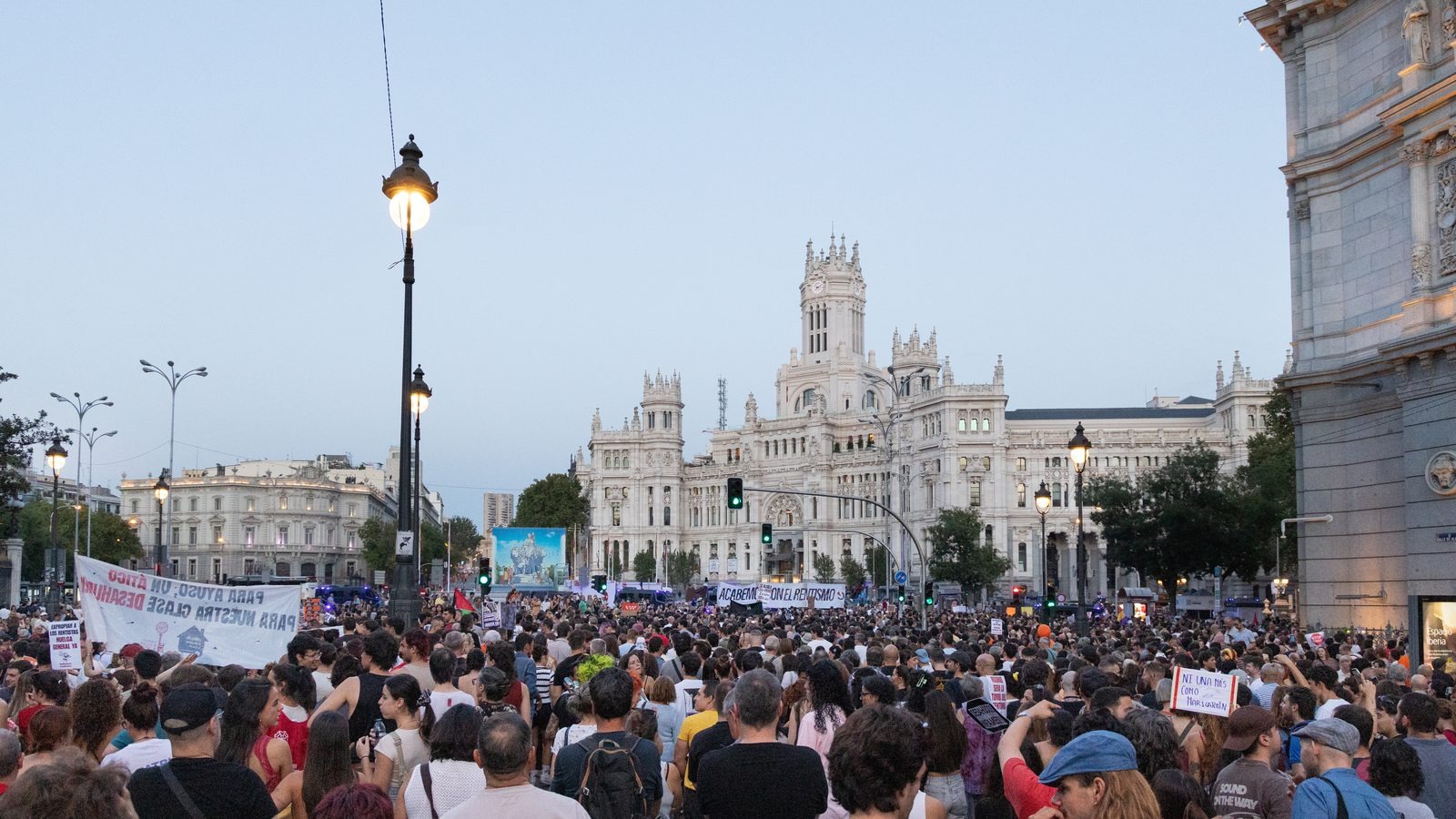
Spain stopped work on Wednesday in its first general strike in 14 years. The 24-hour walkout, called by the country’s two largest unions, the UGT and the CCOO, began at midnight and ran through a day of picket lines, closed factories and disrupted transport, 18 days before a snap general election on 29 November. It is the first nationwide stoppage since the 2012 austerity strikes under Mariano Rajoy; and this time the trigger is housing: soaring rents, evictions and a shortage the Bank of Spain puts at about 750,000 homes. The unions, backed by tenants’ associations, say the strike is about wages that can pay for a home, after months of housing protests that filled Madrid’s streets. Prime Minister Pedro Sánchez, who called the snap election after parliament rejected his housing package, has openly backed the stoppage; a prime minister cheering on a general strike. The opposition Partido Popular calls it staged. By midday the picture was contested: the unions claimed massive participation, employers called it low, and the afternoon marches were still to come.
What do the numbers say about turnout and disruption?
The unions reported their strongest figures from the ports and the car plants: 90 percent participation in both, they said, with total stoppages at Volkswagen’s factory in Navarre and SEAT’s in Barcelona. They pointed to a 10 percent fall in electricity demand as evidence that energy-hungry industry had stopped. The employers’ organisation, the CEOE, answered that participation was “low and uneven” and the power drop smaller than the 14 percent of the last strike; neither side has published audited figures. The disruption is not in dispute. Barcelona’s metro ran no trains outside peak hours; Madrid’s cut service to half its normal level, rising to 80 percent at peak times. Traffic halted on several main roads in Madrid and Catalonia; the interior ministry said dozens had been arrested, and Spanish reports said estate agencies had seen attacks on their offices. At Madrid’s Mercamadrid market, the CCOO said police fired pepper spray at pickets and arrested one of them, with 13 people needing medical attention. The trigger; the eviction of an 87-year-old Madrid pensioner from her flat of seven decades; is not in dispute either. Two storms, Charles and Bruna, added to the chaos: the weather agency AEMET issued alerts for 14 regions, threatening the afternoon marches.
The employers’ organisation, the CEOE, answered that participation was “low and uneven” and the power drop smaller than the 14 percent of the last strike; neither side has published audited figures.
What is still unclear as the day unfolds?
The strike’s real weight will only be known once the marches have happened and the official figures land. Neither the unions’ 90 percent nor the employers’ “low and uneven” is an audited count, and Spain has no single official measure of strike participation: the picture must be assembled from transport data, electricity demand, factory reports and the size of the afternoon crowds; crowds the storms may thin. It is also unclear how many arrests will turn into charges, or how serious the Mercamadrid injuries were. The political unknowns are larger. The strike was called to force housing to the centre of the campaign, and it has done that for a day; whether voters reward Sánchez for backing it, or punish him for a country brought to a halt, will only show in the polls. The government plans to push part of its housing package through the Diputación Permanente, the body standing in for the dissolved parliament, on Thursday; but the text is not yet public. And the deepest unknown is whether a single day of stoppage changes anything about the 750,000-home shortage.
Why a housing strike could decide an election
Spain is the eurozone’s fourth-largest economy, and it votes in 18 days. The strike matters because it has done what months of argument could not: it has made housing the question of the election. The numbers explain why. A 50-square-metre flat in Madrid cost an average of €1,170 a month in October, according to Idealista, against an average gross salary of about €2,460; nearly half a typical pay packet for half a small flat, far above the 30 percent of income that housing experts treat as affordable. For young Spaniards it is worse: the average rent of €1,176 is about 98.7 percent of a young person’s average monthly salary, according to the Youth Council of Spain. Sánchez called the snap election after parliament rejected his housing decrees, gambling that voters angry about rents would blame the opposition rather than his government’s record. The strike is his gamble made visible. The risk is symmetrical: if the stoppage looks like a success, Sánchez owns the housing issue; if it looks thin, violent or staged, the Partido Popular and Vox, who lead in the polls, will say the prime minister manufactured a crisis to hide corruption cases and a deadly train crash. Either way, nobody in Spain is talking about anything else today.
A strike the government wanted; and the opposition calls staged
The most unusual fact about this strike is who wanted it. General strikes are normally called against governments; this one was called with the government’s blessing, by unions whose cause the prime minister has adopted as his campaign. That inversion explains everything else: why Sánchez praised the strikers in a video message, recalling that the eight-hour day, pensions and public healthcare “were collective conquests”; why his ministers encouraged workers to down tools; and why the Partido Popular’s leader, Alberto Núñez Feijóo, called the whole thing “nonsense” and the unions “mafia” and “trash”. Both sides are describing the same day, and both may be right about part of it. The strike is a genuine expression of a real crisis, the rent figures alone prove that, and a calculated political instrument, timed 18 days before a vote Sánchez called because he could not pass his housing measures. The precedent cuts against him: the 2012 strikes were called against a conservative government and damaged it. A strike called with a government’s blessing has no precedent; which is why both camps fight over the turnout numbers: the only verdict before the ballots.
What the strike sets in motion
Three things follow from today, whatever the turnout. First, the housing measures: the government plans to push part of its package through the Diputación Permanente on Thursday, and the CCOO is demanding at least 1.5 million price-controlled homes in the coming years, a protest demand turned into a legislative test. Second, the data war: unions and employers will spend the next days arguing over participation, electricity demand and factory output, and the official figures, when they come, will be read as a verdict on the strike and on Sánchez. Third, the campaign: it formally begins on Friday, and the strike has set its terms, housing first, corruption and the train crash second, unless the PP and Vox reverse that order. There is a risk beyond the election, too: if the strike is judged a success, tenants’ movements across Europe will study it as a template; if it is judged thin, the lesson will be that even a country stopped for a day cannot move the housing maths.
What to watch in the next 48 hours
Watch Thursday first: whether the Diputación Permanente approves the housing measures, and in what form. Watch the marches: the crowds in Madrid and Barcelona this afternoon, and whether the storms thin them. Watch the numbers: the official participation and electricity data. Watch the polls: whether housing stays the campaign’s centre, or the PP’s charge that the strike was staged takes hold. And watch Friday, when the formal campaign begins. The election is on 29 November; the strike was the campaign’s first day.
What we agree on, and what remains open
Established
- On 11 November 2026 Spain held its first general strike since 2012, called by the UGT and CCOO over housing and the cost of living.
- The 24-hour stoppage disrupted transport and industry across the country.
- The trigger was the September eviction of 87-year-old Maricarmen Abascal, who died weeks later.
- The country votes in a snap general election on 29 November.
Contested
- How many workers actually struck; the unions claim 90 percent in ports and car plants, the employers’ lobby calls turnout low and uneven.
- Whether the strike helps Prime Minister Sánchez or hands the election to the Partido Popular and Vox.
- Whether the prime minister’s backing is solidarity with workers or a calculated electoral manoeuvre.
Still open
- The audited participation figures.
- How large the afternoon marches in Madrid and Barcelona were, with storms Charles and Bruna overhead.
- Whether the Diputación Permanente approves the housing measures on Thursday.
- Whether the strike moves the polls before 29 November.
What to watch
Questions, answered
Spain’s two largest unions, the UGT and the CCOO, called a 24-hour general strike for 11 November 2026 over the housing crisis and the cost of living. It is the first nationwide stoppage since 2012. The unions, backed by tenants’ associations, demand wages that can pay for a home, 18 days before a snap general election on 29 November.
The eviction in September of Maricarmen Abascal, an 87-year-old Madrid pensioner, from the flat where she had lived for seven decades. She died in hospital weeks later. Her forced removal, filmed and widely shared, set off nationwide demonstrations, including a five-week occupation of Madrid’s Puerta del Sol square, and pushed the government to call a snap election.
Unions claim 90 percent participation in ports and car plants, with total stoppages at Volkswagen’s Navarre factory and SEAT’s in Barcelona. Barcelona’s metro ran no trains outside peak hours and Madrid’s cut service by half. Employers dispute the scale, calling turnout low and uneven, and neither side has published audited figures yet.
It has already changed the campaign: housing, not corruption or the Toledo train crash, is now the central issue. Prime Minister Pedro Sánchez is betting the strike helps him; the Partido Popular, which leads the polls, calls it staged. The answer will come from the turnout figures, Thursday’s parliamentary vote and the polls before 29 November.