Spain's prime minister announced an early general election from the Moncloa Palace on Monday, gambling that the housing crisis which broke his parliamentary majority can instead deliver him a bigger one. The vote on November 29 could put the far right in central government for the first time since democracy returned.
Published 5 October 2026 · 09:19 GMT
Pedro Sánchez ended a weekend of what his Moncloa Palace staff called “reflection” with a gamble that will define Spanish politics for a generation. In a televised address to the nation on Monday, the 54-year-old Socialist prime minister announced a snap general election for November 29 — cutting short a legislature he had intended to run until 2027 — after his minority government's flagship housing decrees were killed in parliament on Friday.
“The time has come for the Spanish people to decide what future you want for yourselves and for your country,” Sánchez said, arguing that only a renewed mandate could break the deadlock. The two royal decree laws — strengthened protection against evictions and restrictions on speculative purchases of homes, including a moratorium on evictions and a ban on so-called vulture funds — were defeated when Junts, the Catalan nationalist party, joined the conservative Popular Party (PP) and the populist right-wing Vox in voting against them.
If the timetable proceeds as expected, the decree dissolving parliament will be published on Tuesday, opening the 54-day period required by electoral law and setting the November 29 date in stone. Sánchez, prime minister since 2018, is betting that the issue which exposed his government's weakness in parliament — housing, now the most potent political subject in Spain — can instead become the engine of his comeback at the ballot box.
The mechanics of Friday's defeat are unusually clear. The decrees, tabled by the ruling PSOE and its left-wing partner Sumar as the government's answer to the housing crisis, needed a parliamentary majority that no longer exists. Junts — whose support Sánchez once counted on — presented previously unmentioned objections late on Thursday and voted no alongside the PP and Vox. The Basque nationalist PNV voted against one of the two decrees. Voting in favour: Podemos, the Catalan republican left ERC, EH Bildu, Compromís, the Galician BNG and Coalición Canaria.
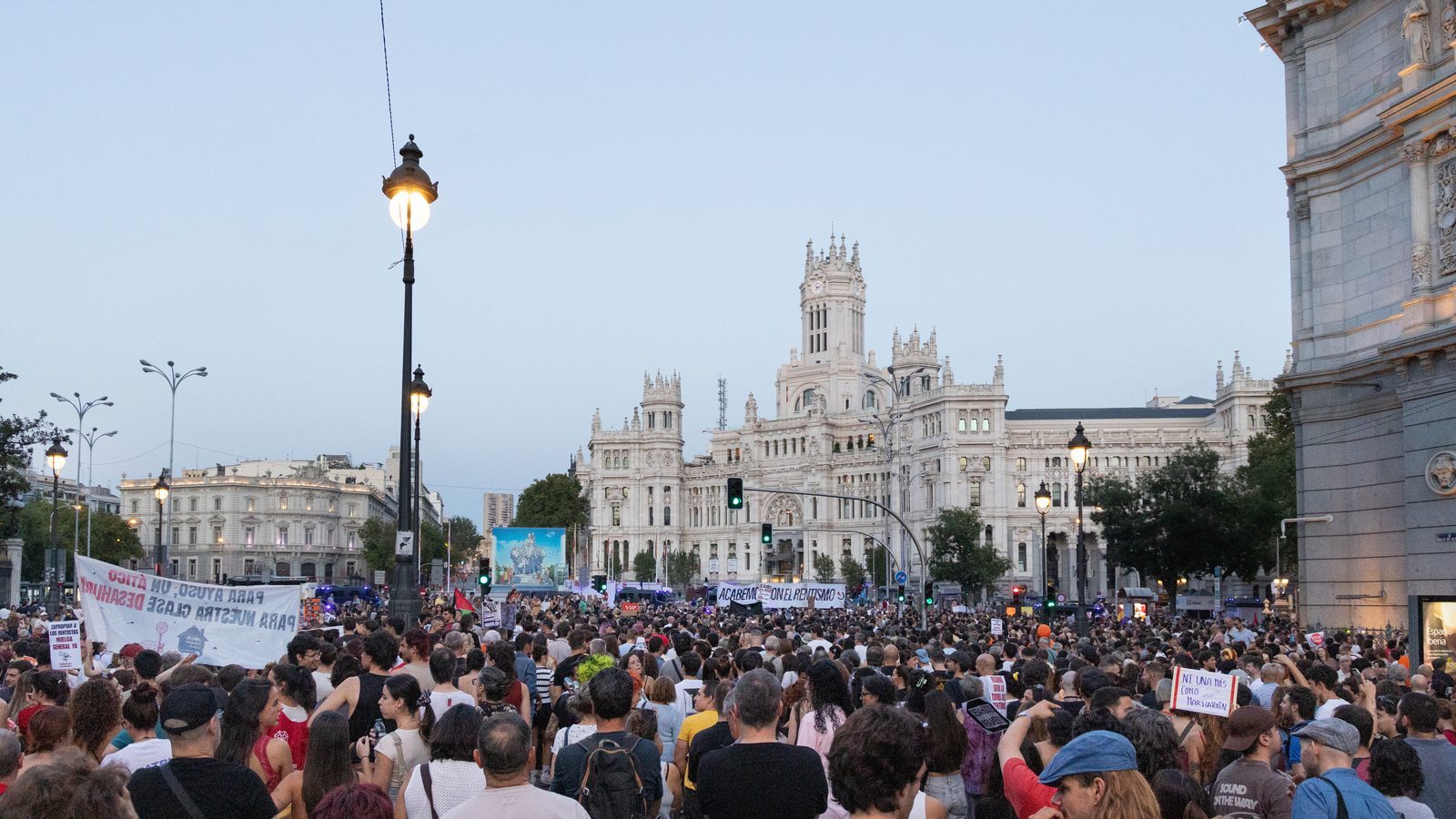
The street pressure behind the crisis is equally documented. Tens of thousands of protesters took to the streets last week demanding lower rents, an end to evictions and stronger tenant protections; hundreds have camped for days in Madrid's central Puerta del Sol; and a march in the capital on September 26 drew the crowds whose images — covered in our earlier reporting on Spain's housing revolt — have become the visual shorthand of the revolt.
What Sánchez said on Monday is also on the record. He admitted his government had “made mistakes and have not managed to do everything we set out to do,” acknowledged that some supporters were dissatisfied, and said he needed “to renew and broaden public support to undertake the necessary reforms so that citizens can reduce these levels of inequality.” His stated aim: “to secure a much broader, progressive majority” in parliament. The polls, however, are brutal: the Socialists trail on roughly 26–31%, and the likeliest outcome of a November vote is a PP-led government sustained by Vox.
Almost everything that matters. Sánchez is gambling that housing — the issue that destroyed his majority — can be turned into the issue that rebuilds it, by framing the election as a referendum on who can fix the crisis. Whether voters reward that framing, or punish him for presiding over the crisis in the first place, is unknowable this far out. The Socialists hope housing is one of the few issues on which they can still mobilise their base; the opposition argues the Friday vote proves precisely the opposite — that Sánchez no longer has a workable majority and Spain needs a government capable of governing.
Junts' endgame is opaque: the Catalan nationalists torpedoed the decrees and may calculate that a right-wing government in Madrid strengthens their leverage — or they may simply have wanted the housing fight to happen on their terms. And the arithmetic of any PP–Vox arrangement is untested at national level: a far-right party has never held power in Spain's central government since the return of democracy, and nobody knows what price Vox would extract, or what it would cost the PP in the centre.
Because housing has become the defining political crisis of urban Europe, and Spain is where it just broke a government. From Lisbon to Berlin to Amsterdam, voters who cannot afford rents are redrawing electoral maps; Sánchez's decision to stake his survival on the issue turns November 29 into the continent's first real referendum on whether the housing emergency rewards incumbents who promise action or punishes them for failure. Every European capital will read the result.
It matters institutionally, too. Sánchez has governed since 2018 without ever securing a stable majority — his third government has not passed a budget since 2023, despite Spain's strong economic performance. A legislature that limps without budgets, killed by shifting parliamentary arithmetic, is a stress test for the post-Franco constitutional order itself. And the possible outcome — Vox in central government — would put a far-right party inside the EU's fourth-largest economy, with consequences for migration policy, climate commitments and the bloc's internal balance of power. For context on the country at stake, see our Spain country profile and our France country profile for the view from across the Pyrenees.
Strip away the drama and the bet is coldly rational. Sánchez's parliamentary arithmetic was dead: no budget since 2023, a different ad-hoc majority for every vote, and now the flagship domestic policy of his government publicly executed by an alliance stretching from Catalan nationalists to the far right. Limping to 2027 meant two more years of slow humiliation, with every defeat televised. An election converts a position of certain parliamentary weakness into a lottery ticket — and Sánchez has won long-odds lotteries before, most recently in 2023 when he called a snap vote after bruising regional defeats and survived through the Catalan amnesty deal.
The deeper logic is about issue ownership. Housing is the one crisis where the Socialists can plausibly claim to be the tenants' party against a PP–Vox bloc that voted with vulture funds — or so the Moncloa framing goes. The risk is symmetrical: if voters conclude that eight years of Sánchez produced the crisis, the election becomes a punishment beating, and the man who called it to escape humiliation walks into a historic defeat. Either way, Friday's vote proved the old parliament could not govern Spain; November 29 asks whether a new one can.
The immediate casualty is legislation: with parliament dissolved, Spain enters a caretaker period in which no new housing measures can pass — the very crisis that triggered the election goes untreated for at least 54 days, and the Puerta del Sol camp is unlikely to disperse. Markets, so far calm on Spain's strong growth numbers, will start pricing political risk if polls confirm a fragmented result with no clear investiture path.
Then come the knock-on effects. A PP–Vox government would reposition Spain inside the EU — tougher on migration, cooler on climate ambition, more transactional on fiscal rules — at precisely the moment the bloc is negotiating its next budget cycle. Catalan politics resets entirely: Junts' bet that chaos in Madrid increases its leverage will be tested against a right-wing government with no interest in negotiation. And whichever way it falls, the result will be cited across Europe as the verdict on whether housing crises topple left governments, right governments, or simply governments.
The formal machinery moves first: the dissolution decree expected on Tuesday starts the 54-day clock, candidate lists close, and Spain enters one of the shortest, most intense campaigns in its democratic history. Housing will dominate — the Socialists will run as the party that tried to protect tenants, the PP as the party of governability, Vox as the party of order, and the Catalan and Basque nationalists as the brokers everyone needs and nobody trusts.
Watch three things. First, whether the Puerta del Sol camp and the tenant movements endorse, embarrass or ignore the Socialists — their stance will decide if housing is Sánchez's weapon or his wound. Second, whether Vox moderates its demands enough to make a PP pact presentable, or prices itself out of government. Third, the final polls: if the Socialists close the gap, Sánchez's gamble looks like genius; if the gap widens, he will have called the election that ended his career. Spain votes on November 29. Europe holds its breath.
Western coverage — from The Times to CNN — reads the call as a high-stakes wager by a weakened incumbent. The emphasis falls on the paradox: a prime minister trailing in the polls, dogged by corruption allegations against senior party figures over the past year, choosing to shorten his own time in office. The dominant Western question is whether Sánchez, who has repeatedly confounded predictions by assembling fragile alliances from the far left to Catalan separatists, can pull off one more escape — or whether November 29 finally installs the PP–Vox government the polls have long predicted, with all that means for the European mainstream's cordon sanitaire.
From the East, the Spanish crisis is read less as a Sánchez story than as a European-system story: another Western democracy where financialised housing markets have outrun democratic management, and where a parliament fragments into a dozen mutually vetoing blocs. Eastern commentary tends to stress the structural reading — that no Spanish prime minister, left or right, has a workable answer to rents that rise faster than wages — and to note, with interest, how quickly a domestic cost-of-living revolt translated into a constitutional event. The lesson drawn is about governability, not personalities.
The Global South recognises the pictures instantly: the Puerta del Sol camp could be a plaza in Lima, Casablanca or Jakarta. From this vantage point, Spain's crisis is the Northern mirror of a universal urban emergency — rents devouring wages, vulture funds buying whole neighbourhoods, young people locked out of ownership. Southern coverage stresses the shared mechanics rather than the Spanish peculiarities, and notes the irony with some satisfaction: the housing financialisation models exported from the North are now devouring Northern governments. What Madrid decides on November 29 will be watched in every city where tenants are organising.
The election is set for November 29, 2026, announced by Prime Minister Pedro Sánchez on October 5. He called it after parliament rejected two housing royal decree laws on October 2 — measures on eviction protection and curbs on speculative home purchases. Junts joined the PP and Vox in voting them down, killing the minority government's flagship domestic policy and, in Sánchez's telling, proving the current parliament cannot govern.
Two royal decree laws tabled by the PSOE and its left-wing partner Sumar: strengthened protection against evictions, restrictions on speculative purchases of homes, a moratorium on evictions and a ban on so-called vulture funds buying up housing. Supporters — Podemos, ERC, EH Bildu, Compromís, BNG and Coalición Canaria — were not enough; Junts, the PP, Vox and (on one decree) the Basque PNV voted them down.
The decree dissolving parliament is expected to be published on Tuesday, October 6, opening the 54-day period required by Spain's electoral law — which lands the vote on November 29. Parliament is dissolved, so no new housing legislation can pass during the caretaker period. After the vote, the usual investiture arithmetic begins: the winning bloc must assemble a parliamentary majority to form a government.
It is the likeliest outcome on current polling. The Socialists trail on roughly 26–31%, and analysts see a PP-led government sustained by Vox as the probable result — which would put a far-right party in Spain's central government for the first time since the return of democracy. What price Vox would extract, and what it would cost the PP in the political centre, is the great unknown of the campaign.
