Pedro Sánchez has called a snap general election for November 29 after his housing decrees were defeated in parliament. Polls point to a conservative People’s Party government backed by a surging Vox — which would put the hard right in power for the first time since Franco’s death in 1975.
Published 12 October 2026 · 18:00 GMT
On a bright Madrid morning, 24-year-old computer programmer Alberto Muñoz wears the red-and-gold wristband of Vox supporters and speaks of his fury at Prime Minister Pedro Sánchez ’s migration policy. He is one face of a swelling revolt: eight years ago Vox was a fringe party; now polls suggest it will double its parliamentary seats when Spain votes on November 29, and a survey for El País projects the conservative People’s Party and Vox winning 198 seats together — 22 more than the 176 needed for a majority. Sánchez, one of Europe’s last leftist leaders, has called the snap vote as an audacious gamble, betting that anger over the housing crisis will eclipse corruption scandals, the Ceuta migration crisis and the Catalan amnesty that have battered his government. If the polls are right, the hard right returns to national power in Spain for the first time since Francisco Franco’s death in 1975.
For a man whose opponents say he only survives, Pedro Sánchez has chosen his weakest moment to fight. On Monday, the Socialist prime minister announced snap general elections for November 29, dissolving a parliament that had just humiliated him by voting down his two flagship housing decrees. His term was due to run until July 2027; he has cut it short by more than a year while trailing in nearly every opinion poll.
His term was due to run until July 2027; he has cut it short by more than a year while trailing in nearly every opinion poll. It was, in his telling, an act of democratic renewal. “We need to renew people’s support,” he said from the Moncloa Palace, seeking “a much larger progressive majority in Parliament.” Ahead lies the most consequential election in Spain’s democratic history.
“This is an election between corruption and decency, between decline and prosperity, between a government that aspires only to survive and a country that is thinking about its future.” — Alberto Núñez Feijóo, leader of Spain’s conservative People’s Party
The numbers explain the gamble — and its danger. A survey by El País, conducted September 25–28 by 40dB for the newspaper and Cadena SER, put the conservative People’s Party (PP) first on 31.6 percent, ahead of the Socialists on 27.4 percent and Vox on 18.4 percent. The seat projection was starker: the PP and Vox together would take 198 seats, comfortably above the 176-seat absolute-majority line, while the Socialists would fall to 112 seats from the 121 they won three years ago.
Other polls tell variations of the same story. A survey for RTVE, the state broadcaster, projected Vox nearly doubling its group from 33 to 65 seats — the only party to substantially increase its support, with the PP’s vote flat and every left-wing party losing ground. Sigma Dos, for El Mundo, estimated the PP on 32.6 percent and 140 seats, Vox on 18.3 percent and 63 seats, the PSOE on just 25.6 percent and 103 seats. Together the two right-wing parties would clear the majority threshold with room to spare.
One discordant note: the state-run Centre for Sociological Research (CIS) placed the Socialists first in September, on 31 percent to the PP’s 25.5 percent and Vox’s 16.6 percent. But the CIS is widely seen as sympathetic to the government, and even its figures give Vox a strong third place. A poll is a snapshot, not a result — but every snapshot points to the same horizon. Our Spain country profile tracks the country’s political and economic indicators through the campaign.
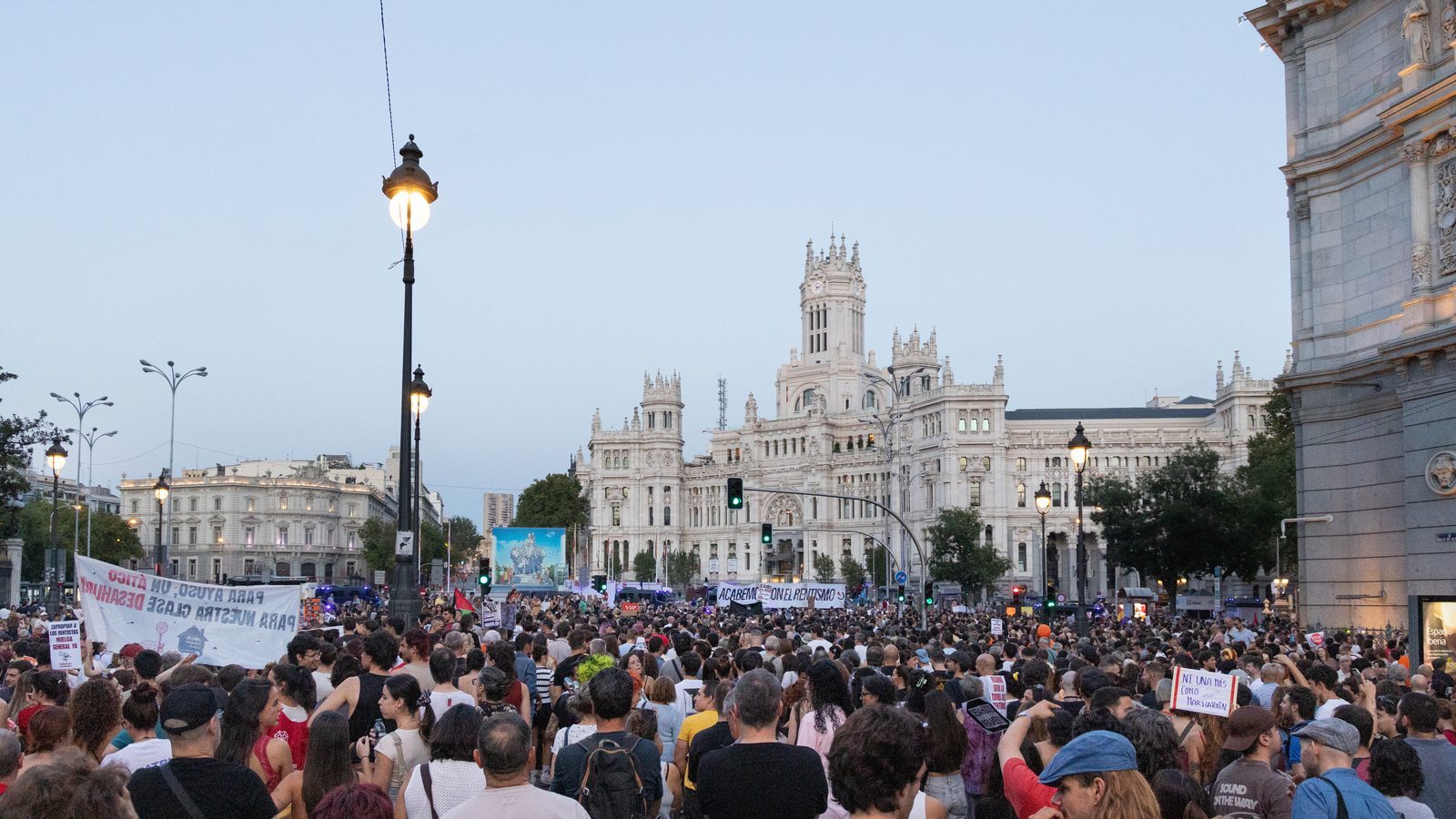
The first crisis is housing, and it is the one Sánchez is trying to turn into his weapon. Rents and prices have soared in Madrid, Barcelona and the coastal cities, driven by tourism, short-term lets and a chronic shortage of new homes. Then came Maricarmen: the eviction of 87-year-old Maria del Carmen Abascal from the Madrid flat where she had lived for seven decades inflamed the country and filled the streets with tens of thousands of protesters. She died this month. When Congress rejected two bills protecting tenants from eviction, Sánchez decided to ride the tide of anger into an election.
Sánchez says the defeated measures would protect the most vulnerable and bring order to a “deeply dysfunctional market” warped by speculation; the acting government later forced them through by other means. His calculation is that fury over rents can eclipse everything else. Observers are less sure: even before he announced the election, most voters told pollsters they would back the PP and Vox.
The second crisis is corruption — the oldest wound in Spanish politics, now reopened around Sánchez himself. Several judicial investigations have targeted people close to the PSOE and the prime minister, including his wife. Two former party organisation secretaries have served prison time. Sánchez’s wife, Begoña Gómez, faces influence-peddling investigations; his brother has been investigated too. Sánchez denies all wrongdoing and defends his family’s innocence. But the drip of cases feeds the image of a government that, as PP leader Alberto Núñez Feijóo puts it, “aspires only to survive.”
The third crisis arrived by sea. At the end of July, tens of thousands of Moroccan migrants crossed into Ceuta, Spain’s enclave in North Africa, in one of the largest irregular arrivals in the city’s history. The episode dominated political debate for two months, and the government’s handling was widely seen as a failure. It handed Vox its most potent theme — as 24-year-old supporter Alberto Muñoz put it, what he hates about Sánchez is “how keen he is to allow more migrants into our country.”
The fourth crisis is territorial. To stay in power after the inconclusive 2023 election, Sánchez secured the backing of the Catalan nationalist party Together for Catalonia — and paid with the May 2024 amnesty for the separatists behind the failed 2017 independence bid. Part of his own camp criticised the law, and it alienated voters for whom Spain’s unity is non-negotiable. Even former Socialist premier José Luis Rodríguez Zapatero is now a liability: in September he told a judge that jewellery found in his office safe during an influence-peddling probe — worth over €1.2 million — was a 2007 gift from Saudi Arabia’s King Abdullah.
Vox’s surge is not only a story of crises; it is a story of generations. Steven Forti, an expert on the far right at the Autonomous University of Barcelona, says the party has learned the modern European playbook: like its French, German and Italian counterparts, Vox distances itself from the Franco dictatorship while keeping its symbolic doors open. When leader Santiago Abascal once called Sánchez’s government the “worst for the past 80 years”, Forti called it “dog whistle politics: you do not make an explicit reference to the dictatorship.”
“Young people are attracted to Vox by a feeling of rebellion against the established parties, nationhood and antimigrant feeling,” Forti says. “If the polls are right, they will be in power with the PP, but what matters is what ministries they control.” The inversion is striking: the party of Franco nostalgia is carried by voters born decades after the dictator’s death, for whom the PP is the establishment and Vox the revolt. “There is hope for Spain with these elections,” Vox spokesman José Antonio Fuster told Al Jazeera.
The right, unlike the left, arrives united. The PP has already formed four regional governments with Vox and the two parties share power in about 100 councils — a rehearsal for national government the left cannot match. Antonio Alonso, who lectures in international relations at Madrid’s CEU San Pablo University, calls the asymmetry decisive: “The far left is split into so many different groups it will be hard to mobilise them as one front. Meanwhile, the right with the PP and Vox is more unified.”
Pedro Sánchez, 54, has been prime minister since 2018, when he ousted Mariano Rajoy in Spain’s first successful no-confidence motion. He has never won a majority; he has survived through fragile coalitions from the far left to the separatist right, calling snap elections in 2019 and July 2023 — a gamble that paid off. But his third term has been legislatively barren: divisions among his partners have left Spain without an approved budget since 2023, even as the economy outperformed the developed world.
Alberto Núñez Feijóo, the PP leader, will make the election a referendum on what he calls a corrupt and exhausted government. “This is an election between corruption and decency, between decline and prosperity, between a government that aspires only to survive and a country that is thinking about its future,” he said after the snap vote was announced. He has pledged 200,000 homes a year and tax cuts. On announcement night, the PP posted “At last” on X, with a video set to the EU anthem.
Santiago Abascal, the Vox leader, is the man whose price will decide everything. His party has doubled its projected vote since 2023, and in any PP-led government it would set the terms on migration, national unity and culture. Abascal as prime minister is unlikely — Feijóo’s PP would be the senior partner. But as Forti warns, the real contest is over ministries: which portfolios Vox controls will decide whether Spain gets a conservative government with a noisy junior partner, or a genuinely hard-right government in conservative clothing.
For Europe, the stakes go well beyond Madrid. Sánchez leads one of the continent’s last left-leaning governments, as the far right advances in France, Germany, Italy, Austria and Finland — the same populist wave behind the mass demonstrations marking three years of war in Gaza. Spain has been among the eurozone’s strongest economies, and Sánchez has built an international profile on Palestinian statehood. His removal would silence one of Brussels’ most reliable progressive voices just as the EU needs unity on trade and defence.
In the regions where the two parties already govern together — Extremadura, Aragón, Castilla y León and Andalusia, previously Valencia and Murcia — Vox has pushed the PP toward tougher migration policies, denounced the EU Green Deal, replaced violence-against-women policies with a broader “intra-family” framing, and rolled back LGBTQ+ protections. Applied nationally, that agenda would shift Spain’s positions on migration, EU budgets and climate — and seat the far right at the European Council table.
Then there is the question Brussels whispers about: Vox’s foreign-policy instincts. Its nationalism, hostility to the EU’s green and migration agenda, and what critics call its indulgence toward Moscow would complicate European sanctions and defence spending. Feijóo, who set his victory video to the EU anthem, would be the counterweight — but the weaker the PP performs, the more leverage Vox holds. With major elections due in 2027 in France, Italy and Poland, a hard-right breakthrough in Madrid would carry the populist wave into southern Europe’s heart.
W
e
s
t
e
r
n
c
a
p
i
t
a
l
s
a
r
e
r
e
a
d
i
n
g
t
h
e
S
p
a
n
i
s
h
p
o
l
l
s
a
s
t
h
e
p
o
s
s
i
b
l
e
f
a
l
l
o
f
o
n
e
o
f
E
u
r
o
p
e
’
s
l
a
s
t
l
e
f
t
i
s
t
g
o
v
e
r
n
m
e
n
t
s
,
a
n
d
t
h
e
r
e
a
c
t
i
o
n
i
n
B
r
u
s
s
e
l
s
i
s
q
u
i
e
t
a
l
a
r
m
.
S
á
n
c
h
e
z
h
a
s
b
e
e
n
a
r
e
l
i
a
b
l
e
p
r
o
g
r
e
s
s
i
v
e
a
l
l
y
—
o
n
P
a
l
e
s
t
i
n
i
a
n
s
t
a
t
e
h
o
o
d
,
m
u
l
t
i
l
a
t
e
r
a
l
i
s
m
a
n
d
t
h
e
g
r
e
e
n
a
g
e
n
d
a
—
a
n
d
h
i
s
r
e
m
o
v
a
l
w
o
u
l
d
t
i
l
t
t
h
e
E
u
r
o
p
e
a
n
C
o
u
n
c
i
l
f
u
r
t
h
e
r
t
o
w
a
r
d
t
h
e
n
a
t
i
o
n
a
l
i
s
t
r
i
g
h
t
,
a
l
o
n
g
s
i
d
e
g
o
v
e
r
n
m
e
n
t
s
i
n
I
t
a
l
y
a
n
d
e
l
s
e
w
h
e
r
e
.
T
h
e
b
u
s
i
n
e
s
s
p
r
e
s
s
s
t
r
e
s
s
e
s
a
s
e
c
o
n
d
f
e
a
r
:
S
p
a
i
n
h
a
s
b
e
e
n
a
m
o
n
g
t
h
e
e
u
r
o
z
o
n
e
’
s
s
t
r
o
n
g
e
s
t
p
e
r
f
o
r
m
e
r
s
,
a
n
d
i
n
v
e
s
t
o
r
s
p
r
i
z
e
t
h
e
p
r
e
d
i
c
t
a
b
i
l
i
t
y
o
f
a
m
a
i
n
s
t
r
e
a
m
c
o
n
s
e
r
v
a
t
i
v
e
P
P
,
b
u
t
V
o
x
’
s
p
r
i
c
e
i
n
m
i
n
i
s
t
r
i
e
s
c
o
u
l
d
i
n
j
e
c
t
v
o
l
a
t
i
l
i
t
y
i
n
t
o
m
i
g
r
a
t
i
o
n
p
o
l
i
c
y
,
E
U
b
u
d
g
e
t
t
a
l
k
s
a
n
d
c
l
i
m
a
t
e
c
o
m
m
i
t
m
e
n
t
s
.
T
h
e
w
e
s
t
e
r
n
l
e
n
s
t
h
e
r
e
f
o
r
e
f
r
a
m
e
s
N
o
v
e
m
b
e
r
2
9
a
s
a
s
t
r
e
s
s
t
e
s
t
o
f
t
h
e
E
U
’
s
l
i
b
e
r
a
l
o
r
d
e
r
,
o
n
e
t
h
a
t
F
r
a
n
c
e
,
I
t
a
l
y
a
n
d
P
o
l
a
n
d
m
a
y
f
a
c
e
i
n
t
h
e
i
r
o
w
n
2
0
2
7
e
l
e
c
t
i
o
n
s
.
F
r
o
m
M
o
s
c
o
w
’
s
v
a
n
t
a
g
e
p
o
i
n
t
,
a
P
P
–
V
o
x
v
i
c
t
o
r
y
i
n
M
a
d
r
i
d
w
o
u
l
d
b
e
r
e
a
d
a
s
a
n
o
t
h
e
r
c
r
a
c
k
i
n
t
h
e
E
u
r
o
p
e
a
n
U
n
i
o
n
’
s
u
n
i
t
y
—
a
n
d
R
u
s
s
i
a
n
s
t
a
t
e
m
e
d
i
a
h
a
s
a
l
o
n
g
h
a
b
i
t
o
f
a
m
p
l
i
f
y
i
n
g
f
a
r
-
r
i
g
h
t
s
u
c
c
e
s
s
e
s
a
s
p
r
o
o
f
t
h
a
t
t
h
e
l
i
b
e
r
a
l
o
r
d
e
r
i
s
c
o
l
l
a
p
s
i
n
g
.
V
o
x
’
s
n
a
t
i
o
n
a
l
i
s
m
,
i
t
s
h
o
s
t
i
l
i
t
y
t
o
t
h
e
E
U
’
s
g
r
e
e
n
a
n
d
m
i
g
r
a
t
i
o
n
a
g
e
n
d
a
,
a
n
d
i
t
s
s
o
f
t
e
r
l
i
n
e
t
o
w
a
r
d
R
u
s
s
i
a
t
h
a
n
t
h
e
S
p
a
n
i
s
h
m
a
i
n
s
t
r
e
a
m
m
a
k
e
i
t
a
n
a
t
u
r
a
l
o
b
j
e
c
t
o
f
i
n
t
e
r
e
s
t
i
n
t
h
e
K
r
e
m
l
i
n
’
s
i
n
f
o
r
m
a
t
i
o
n
s
t
r
a
t
e
g
y
,
w
h
i
c
h
p
o
r
t
r
a
y
s
e
v
e
r
y
E
u
r
o
p
e
a
n
e
l
e
c
t
i
o
n
a
s
a
r
e
f
e
r
e
n
d
u
m
o
n
B
r
u
s
s
e
l
s
.
A
n
a
l
y
s
t
s
i
n
t
h
i
s
l
e
n
s
c
a
u
t
i
o
n
a
g
a
i
n
s
t
o
v
e
r
-
r
e
a
d
i
n
g
:
F
e
i
j
ó
o
i
s
a
n
A
t
l
a
n
t
i
c
i
s
t
c
o
n
s
e
r
v
a
t
i
v
e
w
h
o
c
a
m
p
a
i
g
n
e
d
t
o
t
h
e
E
U
a
n
t
h
e
m
,
a
n
d
a
P
P
-
l
e
d
g
o
v
e
r
n
m
e
n
t
w
o
u
l
d
r
e
m
a
i
n
i
n
s
i
d
e
N
A
T
O
a
n
d
t
h
e
s
a
n
c
t
i
o
n
s
r
e
g
i
m
e
.
B
u
t
e
v
e
n
f
r
i
c
t
i
o
n
a
t
t
h
e
m
a
r
g
i
n
s
—
o
v
e
r
d
e
f
e
n
c
e
s
p
e
n
d
i
n
g
o
r
e
n
e
r
g
y
p
o
l
i
c
y
—
w
o
u
l
d
b
e
b
a
n
k
e
d
i
n
M
o
s
c
o
w
a
s
a
w
i
n
.
A
c
r
o
s
s
t
h
e
G
l
o
b
a
l
S
o
u
t
h
,
S
p
a
i
n
’
s
e
l
e
c
t
i
o
n
i
s
w
a
t
c
h
e
d
t
h
r
o
u
g
h
t
h
e
p
r
i
s
m
o
f
m
i
g
r
a
t
i
o
n
a
n
d
d
o
u
b
l
e
s
t
a
n
d
a
r
d
s
.
T
h
e
C
e
u
t
a
c
r
i
s
i
s
—
t
e
n
s
o
f
t
h
o
u
s
a
n
d
s
o
f
M
o
r
o
c
c
a
n
m
i
g
r
a
n
t
s
c
r
o
s
s
i
n
g
i
n
t
o
t
h
e
S
p
a
n
i
s
h
e
n
c
l
a
v
e
i
n
J
u
l
y
—
a
l
r
e
a
d
y
s
t
r
a
i
n
e
d
M
a
d
r
i
d
’
s
r
e
l
a
t
i
o
n
s
h
i
p
w
i
t
h
R
a
b
a
t
,
a
n
d
a
V
o
x
-
e
m
p
o
w
e
r
e
d
g
o
v
e
r
n
m
e
n
t
p
r
o
m
i
s
i
n
g
m
a
s
s
d
e
p
o
r
t
a
t
i
o
n
s
w
o
u
l
d
h
a
r
d
e
n
E
u
r
o
p
e
’
s
s
o
u
t
h
e
r
n
b
o
r
d
e
r
f
u
r
t
h
e
r
,
w
i
t
h
d
i
r
e
c
t
c
o
n
s
e
q
u
e
n
c
e
s
f
o
r
y
o
u
n
g
A
f
r
i
c
a
n
s
a
t
t
e
m
p
t
i
n
g
t
h
e
c
r
o
s
s
i
n
g
.
S
o
u
t
h
e
r
n
c
o
m
m
e
n
t
a
t
o
r
s
a
l
s
o
n
o
t
e
t
h
e
i
r
o
n
y
:
S
á
n
c
h
e
z
,
c
e
l
e
b
r
a
t
e
d
i
n
t
h
e
W
e
s
t
f
o
r
r
e
c
o
g
n
i
s
i
n
g
P
a
l
e
s
t
i
n
i
a
n
s
t
a
t
e
h
o
o
d
,
i
s
b
e
i
n
g
d
e
v
o
u
r
e
d
a
t
h
o
m
e
b
y
t
h
e
s
a
m
e
m
i
g
r
a
t
i
o
n
p
r
e
s
s
u
r
e
s
h
i
s
g
o
v
e
r
n
m
e
n
t
c
o
u
l
d
n
o
t
m
a
n
a
g
e
.
F
o
r
t
h
e
G
l
o
b
a
l
S
o
u
t
h
,
t
h
e
l
e
s
s
o
n
o
f
M
a
d
r
i
d
i
s
t
h
a
t
E
u
r
o
p
e
’
s
m
o
r
a
l
p
o
s
t
u
r
i
n
g
a
b
r
o
a
d
c
o
l
l
a
p
s
e
s
t
h
e
m
o
m
e
n
t
i
t
s
o
w
n
b
o
r
d
e
r
p
o
l
i
t
i
c
s
t
u
r
n
—
a
n
d
t
h
a
t
t
h
e
f
a
r
r
i
g
h
t
’
s
r
i
s
e
i
s
,
a
b
o
v
e
a
l
l
,
a
m
i
g
r
a
t
i
o
n
s
t
o
r
y
.
Parliament rejected his minority government’s two flagship housing decrees on October 2, amid mass protests over rents and evictions. Rather than limp on toward 2027 with no majority and no budget since 2023, Sánchez dissolved the Cortes and called a November 29 vote, gambling that fury over housing will mobilise the left and eclipse the corruption and migration scandals dogging him.
Polls say it is the most likely outcome. An El País survey projects the PP and Vox winning 198 seats together, well above the 176-seat majority line, and an RTVE survey projects Vox doubling from 33 to 65 seats. The two parties already govern together in four regions and about 100 councils, so a national coalition — or a PP government sustained by Vox votes — has a tested template.
Several judicial investigations have targeted people close to the PSOE and the prime minister, including his wife Begoña Gómez, who faces influence-peddling inquiries, and his brother, also investigated. Two former party organisation secretaries have served prison time. Sánchez has repeatedly denied any wrongdoing by his party and defended his family’s innocence, but the cases feed the opposition’s ‘corruption versus decency’ framing.
It would end one of the EU’s last left-leaning governments and give the hard right a seat at the European Council for the first time since 1975. Expect a harder Spanish line on migration, resistance to the EU Green Deal — Vox has already pushed regional PP governments to denounce it — and friction over budgets and defence spending, just as Brussels needs unity on trade and security.
