 MAGNA BUREAU
The Wire
Sánchez defies the polls as Spain’s rivals make their final pitch
Spain’s party leaders held their final rallies on Friday ahead of Sunday’s snap election, with Prime Minister Pedro Sánchez insisting he cannot lose; while the polls put the conservative People’s Party narrowly ahead and Vox within reach of power.
Key points
- Spain votes on Sunday 29 November 2026 in a snap general election called by Pedro Sánchez on 5 October, eight months early, after parliament rejected his government’s housing measures. 3
- Almost 39 million Spaniards are eligible to vote; the conservative People’s Party holds a narrow lead in the polls, with no surveys published since Monday under Spanish electoral law. 1
- Sánchez told supporters he could not imagine losing, betting on a late mobilisation of left-wing voters against a PP–Vox coalition he calls a project of “regression”. 2
- Vox, which won 33 seats in 2023, hopes to almost double its representation; its final rally filled a bullring in Valencia. 1
- Andalusia, with 61 of the 350 seats in parliament, is the decisive battleground; a PP–Vox coalition already governs the region. 1
ONE EVENT. THREE READINGS.
Western coverage reads the race as a test of whether an incumbent can survive his own record.
The BBC, reporting from Valencia, framed the final day as a clash between Sánchez’s confidence and the polls, noting that the prime minister leads one of Europe’s few left-wing governments and that France votes for a president in five months.
What this reading highlights: The emphasis in London and Paris is on the arithmetic: a PP win without a majority hands Vox the keys to government, and the far right’s entry into national power would be the first since the end of Franco’s dictatorship in 1975.
Sources: BBC (1)
Coverage from the East looks past the rallies to the forces that forced the vote.
India’s The Hindu, reporting from Madrid, found a left disillusioned with its own government: polls put the Socialists at 26–29%, the housing protests have moved beyond accommodation, and an alliance of the PP and Vox is seen as the most likely next government.
What this reading highlights: Singapore’s CNA, covering the televised debates, stressed the same hinge; Feijóo is predicted to win the most seats on 29 November but without a majority, leaving Vox as kingmaker.
The Eastern reading is structural, not personal: a cost-of-living revolt that began with an eviction has become a referendum on eight years of Socialist rule.
The Spanish campaign sounds familiar: a cost-of-living revolt, a migration flashpoint and a left defending social rights against a nationalist right.
Al Jazeera’s coverage, built on AFP, Anadolu and Reuters reporting, stresses that Sánchez has staked his global profile on defending immigration and criticising Israel, while his opponents promise a harder line; including “remigration” and “national priority” for welfare.
What this reading highlights: The channel also carries an explainer on what the election means for Morocco, a reminder that the vote is watched closely across the Strait of Gibraltar, where the summer crossing into Ceuta and the future of Spanish–Moroccan relations hang on the result.
Sources: Al Jazeera (1)
Sources by lens: 1 West, 3 East, 1 Global South. See every source
THE POINT OF CONVERGENCE
Spain holds a snap general election on Sunday 29 November 2026; the final rallies took place on Friday 27 November; the People’s Party leads the polls narrowly and no polls have been published since Monday.
WHAT REMAINS CONTESTED
Whether Sánchez can mobilise enough left-wing voters to defy the polls, or whether a PP–Vox coalition will take power; the polls point one way, the prime minister’s camp insists on the other.
The story
What did the final rallies reveal about a deadlocked Spain?
Spain’s party leaders closed their campaigns on Friday 27 November with final rallies that laid bare the choice voters face on Sunday. Prime Minister Pedro Sánchez, defiant in Madrid, told supporters he could not imagine losing. The conservative Alberto Núñez Feijóo, narrowly ahead in the polls, promised a new era of “truth, decency and good governance” in Seville. And the far-right Santiago Abascal filled a bullring in Valencia, telling thousands of supporters that the Sánchez government had “betrayed” Spaniards. The campaign was fought above all over housing, the crisis that forced a snap election eight months early, and in the shadow of two deadly train crashes, corruption cases and a summer surge of migrants into Ceuta. Almost 39 million Spaniards are eligible to vote on Sunday 29 November, in the country’s fifth general election in ten years. No opinion polls have been published since Monday, under the Spanish law that bans their publication in the final five days, so the final rallies were fought on conviction as much as on numbers.
The numbers, the map and the stakes behind Sunday’s vote
The shape of the race is clear, even if the result is not. The People’s Party (PP) holds a narrow lead, but without a majority it would need the support of Vox, the anti-immigration party that won 33 seats in 2023 and hopes to almost double that number. Sánchez’s Socialists (PSOE) have polled at 26–29% through the campaign, and the prime minister is betting that left-wing voters who stayed home in past contests will turn out in large numbers. Andalusia is the decisive battleground: the southern region holds 61 of the 350 seats in parliament, more than any other, and it is already governed by a PP–Vox coalition; as are Extremadura, Aragón and Castilla y León. Feijóo chose to close his campaign in Seville, while Sánchez held his final rally in Madrid and Abascal closed in Valencia. The four-way television debate on Thursday night exposed the fault lines: on housing, Feijóo promised a million new homes over four years while Sánchez insisted housing should be a right, not an object of speculation and profit. The debate also produced its sharpest exchange when Feijóo told Ada Colau, who leads the left-wing Frente Amplio, to keep quiet, using the diminutive “calladita”, and Sánchez demanded “a little respect”, accusing him of sexism. The struggle to rally a disillusioned left has defined Sánchez’s campaign from the start.
The conservative Alberto Núñez Feijóo, narrowly ahead in the polls, promised a new era of “truth, decency and good governance” in Seville.
What Sunday’s count still has to settle
Nobody knows whether the left’s late mobilisation is real or wishful thinking. Sánchez insists his party’s internal data shows the Socialists winning the most votes, but no independent poll has been published since Monday, and the published surveys before the ban consistently put the PP ahead. Turnout is the great unknown: commentators expect a high turnout, and Sánchez’s entire strategy depends on voters who usually stay home, the young, the renters, the disillusioned, deciding that the threat of a PP–Vox government is reason enough to vote. It is also unclear what price Vox would demand for supporting a Feijóo government, and whether the PP leader could govern with looser “parliamentary support agreements” instead of a formal coalition. The fate of the housing emergency measures, rejected by parliament in October, and the aftermath of the October rail disaster both depend on who forms the next government.
Why housing decided this election, and why Europe is watching
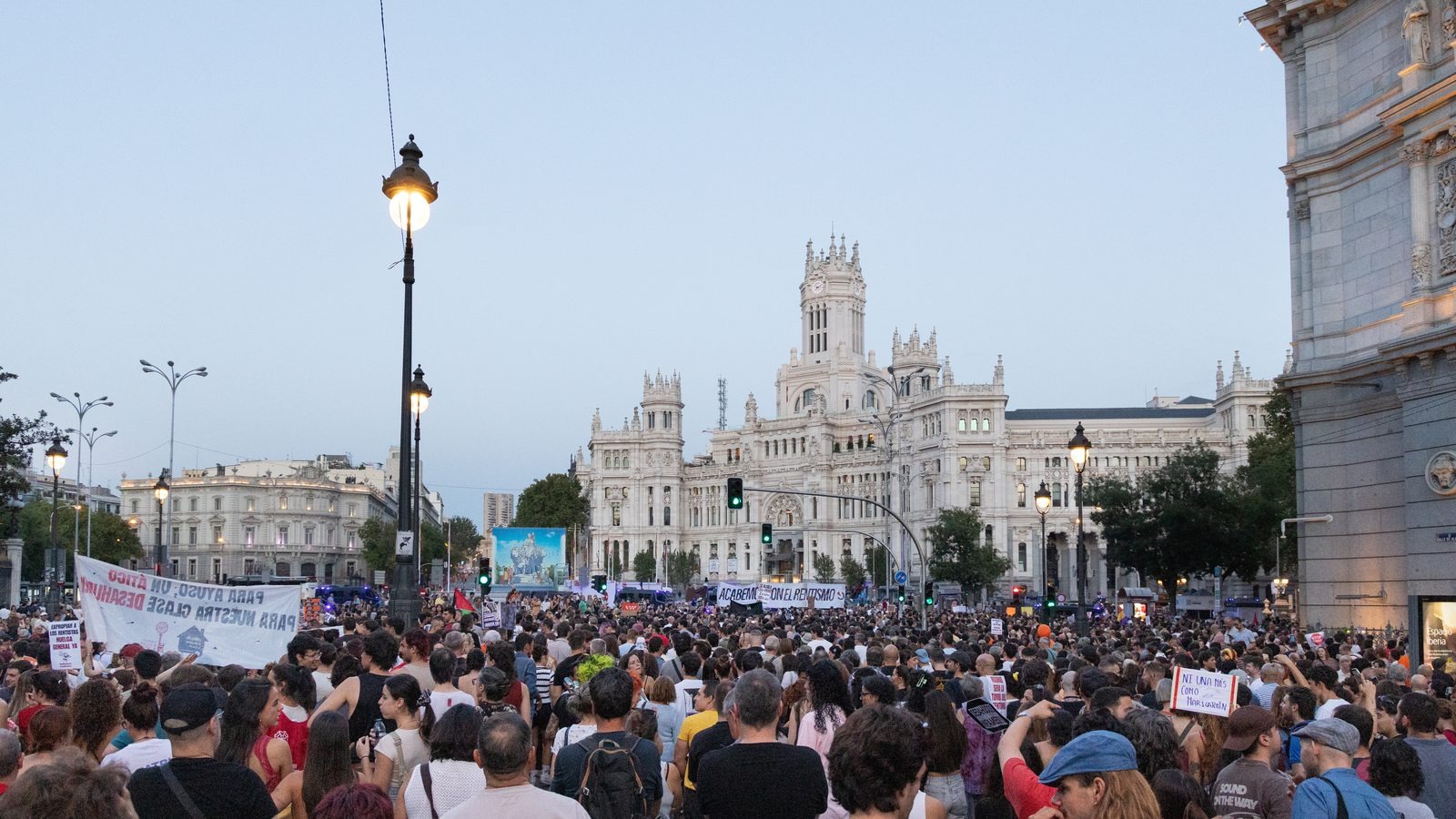
This election matters beyond Spain because it was called over the issue now straining democracies across Europe: housing. The snap vote followed the eviction of 87-year-old Maricarmen Abascal in September and her subsequent death, which set off protests that grew into a general strike on 11 November, the first in 14 years, that unions said brought more than three million people onto the streets. When parliament voted down the government’s emergency housing measures, Sánchez called the election, betting that anger over housing and fear of the far right would rally the left. The bet has not clearly paid off: many left-wing voters blame his own government for the crisis. For Europe, the stakes are continental. With France’s presidential election five months away, two of the continent’s biggest economies could move to the right in quick succession. A PP–Vox government in Madrid would join a growing bloc of hard-right governments in the European Union and test whether the centre-left can still win on its record. The question of whether housing could decide the vote has run through the whole campaign.
Sánchez’s bet: a surge, or a last stand?
Sánchez has made escaping hopeless positions a hallmark of his career, and this campaign is the purest test of it. His strategy has three parts: frame the election as a choice between “regression and progressivism”; turn the housing crisis into a moral cause, telling voters that “every generation has its own struggle; for us, that struggle is housing”; and count on fear of Vox to bring abstainers back. The weakness is that the second part collides with the first: the housing revolt was a revolt against his government’s record, and the movements that filled the streets are to his left, not behind him. Interviews in Madrid found voters who call his government “a government of slower regression” and lawmakers urging voters to choose smaller left parties instead. If the left fragments, the PP–Vox bloc wins by default. Sánchez’s gamble is that the final 48 hours will concentrate minds; that voters furious with him will still prefer him to the alternative. It is a gamble he has won before, in 2023, when he cut the gap and stayed in power. The question is whether the country that gave him that reprieve still exists.
What a PP–Vox government would change first
A PP–Vox government would move first on the issues Vox campaigned on: immigration, welfare and the culture wars. Vox’s platform promises “national priority”, Spanish citizens first for welfare, and “remigration” for foreigners deemed not to be contributing to the economy. Its secretary general’s call at the Valencia rally for “less burka and less halal” signalled the tone a coalition partner would set. On housing, Feijóo’s promise of a million homes over four years would replace Sánchez’s emergency measures, which the right voted down. On Europe, a Madrid government aligned with the hard right would stiffen the EU’s migration stance and complicate the bloc’s climate agenda. And for Morocco, the change would be watched with care: the Ceuta crossing and the wider migration file are central to Rabat–Madrid relations, and a government that campaigned on border control would face immediate pressure to show results.
How Sunday night will unfold
Saturday is the day of reflection, when campaigning is banned and the country waits. Polls open on Sunday morning for almost 39 million voters, and the count begins as stations close in the evening. The first question will be turnout: a surge would favour Sánchez’s bet, a flat figure would confirm the polls. The second will be Vox’s seat count; near-doubling from 33 would make Abascal the kingmaker, whatever Feijóo prefers. The third will be the left’s fragmentation: whether the Socialists held their vote or bled to smaller parties. If no bloc wins a majority, Spain faces days of bargaining, with the PP seeking support agreements from Vox and the left attempting the kind of multi-party arithmetic that kept Sánchez in power in 2023. The Bureau will report the result as the count lands, with the verified seat numbers and what they mean for the government that follows. The October rail disaster and the eviction that sparked the protests will shape the next government’s first weeks either way.
What we agree on, and what remains open
Established
- Spain holds a snap general election on Sunday 29 November 2026.
- The final rallies took place on Friday 27 November.
- The People’s Party leads the polls narrowly and no polls have been published since Monday.
Contested
- Whether Sánchez can mobilise enough left-wing voters to defy the polls, or whether a PP–Vox coalition will take power; the polls point one way, the prime minister’s camp insists on the other.
Still open
- The final seat arithmetic; with 350 seats and a fragmented parliament, who can assemble a majority, and whether Vox’s surge or left-wing abstention decides it.
Questions, answered
Spain votes on Sunday 29 November 2026 in a snap general election called by Prime Minister Pedro Sánchez on 5 October, eight months before the vote was due. He called it after parliament rejected his government’s emergency housing measures, which followed mass protests over the eviction of an 87-year-old pensioner. It is the country’s fifth general election in ten years.
The conservative People’s Party, led by Alberto Núñez Feijóo, holds a narrow lead in the polls, but no surveys have been published since Monday under the Spanish law that bans poll publication in the final five days before a vote. Sánchez insists his party’s internal data shows the Socialists winning the most votes, while published polls put his party at 26–29%.
Vox, led by Santiago Abascal, won 33 seats in 2023 and hopes to almost double that number. If the People’s Party wins the most seats without a majority, Vox becomes kingmaker: Feijóo would need its support to govern, whether through a formal coalition or looser parliamentary support agreements. That would bring the far right into national government for the first time since Franco’s dictatorship ended in 1975.
The eviction of 87-year-old Maricarmen Abascal in September, and her death afterwards, set off protests against a housing crisis that grew into a general strike on 11 November, the first in 14 years. Unions said more than three million people marched. When parliament voted down emergency housing measures, Sánchez called the snap election, and housing has dominated the campaign ever since.