Two weeks after her stretcher eviction from a Madrid flat she had rented for seventy years, María del Carmen Abascal has died in hospital. Her case filled Puerta del Sol with tents and forced a snap election. The tenants' union calls her death a turning point.
Published 7 October 2026 · 23:51 GMT
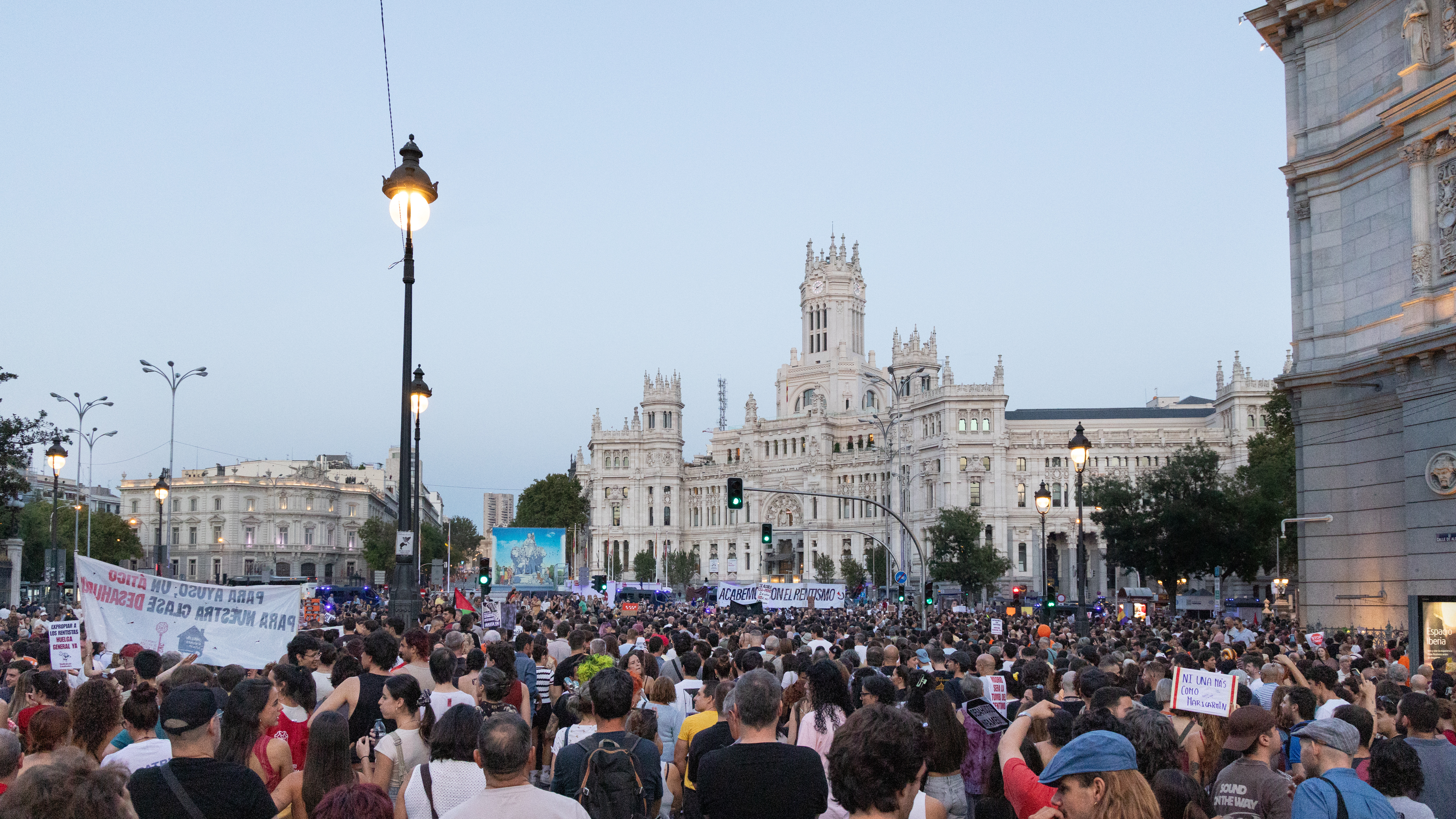
María del Carmen Abascal was 87 years old and had lived in the same Madrid flat since 1956, paying a regulated rent of 500 euros a month out of a pension of about 1,400. On September 23 she was carried out of her home on a stretcher by court officers while hundreds of supporters crowded the street around her building trying to stop the eviction. Two weeks later, on October 7, the Madrid Tenants' Union announced that she had died at the city's Gregorio Marañón hospital, where she had been treated for exhaustion since the eviction. The union said an agreement had been reached that would have let her return home after leaving hospital, but that this solution had come too late.
Her landlord, a private investment company linked to the firm Urbagestión, had raised her rent from 500 to 2,650 euros a month, a sum she could not afford after years of legal disputes and several earlier attempts to remove her. The image of an 87-year-old woman taken on a stretcher from a flat she had occupied for seven decades turned a routine, if brutal, housing case into a national symbol within hours.
We know the shape of the case in unusual detail because the union documented each step. Maricarmen left the property on a stretcher, attended by Samur emergency medical staff, and went straight to hospital. Days later she recorded a video message from her bed urging supporters to keep fighting: "Please fight," she told them, sending "a very big hug." Her death was announced by the union on October 7, and that night demonstrators marched in Madrid chanting "Maricarmen lives, the fight goes on," while the Puerta del Sol camp held a minute of silence.
We also know the political reactions. Prime Minister Pedro Sánchez posted condolences on X, writing that he sent a hug to all those who feel the loss as their own. Territorial policy minister Ángel Víctor Torres said Maricarmen had become a symbol of what is happening to many families, young and old, struggling to obtain a home or stay in one. The union called her case "a turning point in the history of this country" and said the cost of reaching this point in the housing debate had been too high.
What we do not know starts with the medical record: no detailed cause of death has been released beyond the exhaustion she suffered after the eviction. We do not know whether the negotiated return-home contract would have survived contact with reality, what its exact terms were, or how long she might have waited for discharge.
We also do not know how the story will be told once the campaign begins. Housing now sits at the center of Spanish politics, but elections have a way of crowding the agenda: the migrant crisis in Ceuta and the corruption cases around the Socialist Party have not gone away. Whether Maricarmen remains the emblem of the campaign or becomes one reference among many will tell us how durable the symbol really is.
It matters because one eviction rearranged Spanish politics. Spain's housing crisis had been building for years: rents in Madrid and Barcelona climbing far faster than wages, young people locked out of ownership, older tenants on old regulated leases squeezed by new owners. Maricarmen's case gave that slow crisis a face, a name, and a slogan that fit on a banner.
The political sequence is what makes this more than a protest story. The Sol encampment and the marches pressured Sánchez's minority government into emergency housing decrees, including eviction curbs and rent limits. Parliament rejected them last week. Sánchez then called a snap election for November 29, two years before the due date, in a calculated shift: on housing he can ride popular anger at rents, while on the Ceuta migrant crisis and the corruption files he is on defense. A pensioner's eviction is now the hinge of a national election, and the housing revolt that brought Sánchez to this point is the campaign's unavoidable backdrop.
Spain evicts thousands of people a year; most never make the news. Maricarmen's case had the three ingredients symbols are made of. First, the image: a stretcher, an 87-year-old, a lifelong home, all in one frame that needed no caption. Second, the numbers: 500 to 2,650 euros is arithmetic anyone can grasp, and a pension of 1,400 made the verdict obvious. Third, the organization: the Madrid Tenants' Union was ready, with a slogan, a camp, and a network, so the outrage had somewhere to go within hours.
The union's achievement was to convert grief into infrastructure. The Puerta del Sol encampment was not spontaneous combustion; it was the visible end of years of tenant organizing that finally found a story the whole country could carry. That is also the risk: symbols concentrate attention, and attention moves on. The union knows it, which is why its statement after her death reached past mourning to politics, calling the case a turning point and daring the country to prove it.
The second-order effects are already visible beyond Spain. Tenant movements across Europe, from Lisbon to Berlin, face the same rent squeeze and the same investor-owned housing stock; "Ni una Maricarmen más" is a slogan built for export, and housing organizers are built for imitation. Expect the template, a single emblematic eviction turned into a national campaign, to be studied and copied.
Inside Spain, the pressure now runs toward regulation. The rejected decrees, eviction curbs, automatic contract renewals, rent pressure limits, will return in some form no matter who wins on November 29, because no party can campaign on housing for two months and then shelve it. Landlords and investors, meanwhile, are pricing political risk into Spanish residential assets for the first time. And the strike wave rolling across France suggests the anger is continental, not Spanish, with student protests turning confrontational on the same cost-of-living grievances.
Watch four things. First, the street: whether the Sol camp holds through the campaign or disperses, and whether the funeral and memorial marches grow into a permanent mobilization. Second, the decrees: what housing measures each party puts in its November 29 platform, and whether the rejected eviction curbs return under a new name. Third, the courts: whether the return-home agreement's collapse triggers any legal reckoning over the eviction process itself. Fourth, the symbol: whether Maricarmen stays at the center of the campaign or is gently retired once the parties have what they need from her. The tenants' union has promised the fight goes on. Elections will test whether the country agrees.
Western coverage treats Maricarmen as the human ledger of a European housing emergency: an 87-year-old removed on a stretcher becomes the lead image for a continent where rents have outrun wages for a decade. The frame is accountability. Who let a regulated tenancy of seventy years end this way, and why did it take a death to force an election? The reporting lingers on the institutions: the courts that ordered the eviction, the parliament that rejected the decrees, the prime minister betting his survival on the housing card.
Eastern coverage reads the story as a stress test of the Western social model: a market that prices an 87-year-old pensioner out of the home she occupied for seventy years is presented as deregulation reaching its logical end. The frame is systemic rather than personal. Where Western outlets focus on Maricarmen's face, this lens focuses on the ownership chain behind the rent hike and asks what a housing system built on investor returns can ever guarantee the vulnerable.
Southern coverage reads Maricarmen through inequality and dignity: the right to a home as a basic claim, and an old woman's stretcher as proof that markets do not self-correct toward justice. The lens also notes the migration thread running under the Spanish debate, the Ceuta crisis Sánchez is trying to escape, and reads the snap election as a familiar maneuver: when the street finds a symbol, power changes the subject to the calendar.
María del Carmen Abascal was an 87-year-old Madrid pensioner, known across Spain simply as Maricarmen. She had lived in the same flat on Alcalde Sáinz de Baranda street, in the Retiro district, since 1956, paying a long-regulated rent of 500 euros a month from a pension of about 1,400. After new owners raised her rent to 2,650 euros, she became the human face of Spain's housing crisis.
The image of an 87-year-old woman carried from her lifelong home on a stretcher, while hundreds of supporters tried to block the bailiffs, electrified a country already furious about rents. Within days, hundreds of tents filled Puerta del Sol in Madrid, marches spread to other cities, and the slogan 'Ni una Maricarmen más' turned one case into a national movement against evictions and soaring housing costs.
After the eviction, her family, her lawyer and the Madrid Tenants' Union negotiated with the company that owned the flat, linked to Urbagestión, and reached a deal for a new rental contract that would have allowed Maricarmen to move back once she left hospital. The union said the solution came too late, after what it called a torturous process, and she died before she could return.
The protests piled pressure on Pedro Sánchez's minority government to pass emergency housing measures, including eviction curbs and rent limits. When parliament rejected the decrees last week, Sánchez called a general election for November 29, two years early, betting that housing, where he can harness popular anger over rents, is better terrain than the migrant crisis in Ceuta and corruption cases dogging his party.
