Three years after the October 7 attacks, Gaza's health ministry puts the toll at 74,250 dead and 175,278 injured. A ceasefire agreed in October 2025 has not stopped the strikes, millions remain displaced, and the war has spilled far beyond the Strip.
Published 7 October 2026 · 23:51 GMT
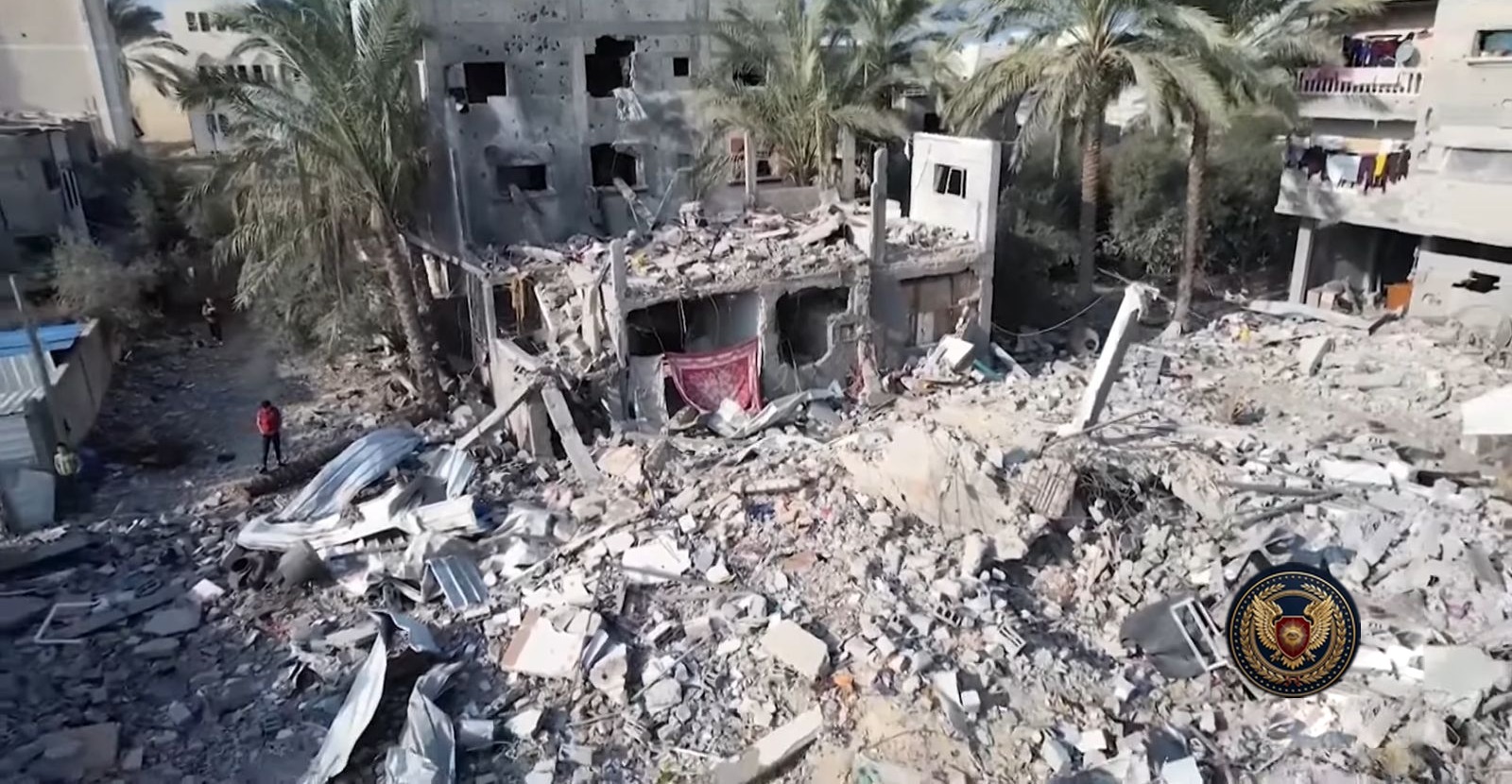
Three years after the October 7 attacks, Gaza is a landscape of rubble. On October 7, 2026, the Strip's health ministry put the toll at 74,250 Palestinians killed and 175,278 injured since the war began. Al Jazeera's "Jerusalem Daily," presented by Reem Takieddine, summed up the anniversary in one line: more than 74,000 dead, including over 21,000 children, millions displaced, and a war that has expanded beyond the Strip.
The numbers arrived with images. On October 1, mourners gathered in Gaza's al-Yarmouk neighborhood for a mass funeral after 105 bodies were recovered from beneath the rubble of the al-Taj residential block, destroyed three years ago. Satellite imagery published this week shows whole districts flattened beyond recognition. The UN Development Programme estimates that 8,000 to 10,000 bodies are still buried under the ruins, uncounted in any official total.
We know the scale because the counting, however contested, has been relentless. About one in every 30 people in Gaza has been killed, roughly 3 percent of the pre-war population of 2.1 million, half of them under 18. More than 175,000 have been injured, about one in 13. A conservative WHO estimate says roughly a quarter of the injured have life-changing injuries requiring long-term rehabilitation, and a quarter of those are children. Gaza's few remaining health facilities are overwhelmed and running on dwindling supplies.
We also know the ceasefire's record. Since the October 10, 2025 agreement took effect, the health ministry reports 1,467 dead and 5,161 injured in continued Israeli strikes, with four dead and eleven injured in the last 24 hours alone. The ministry says 836 bodies have been recovered from areas Israeli forces withdrew from, now deployed along the so-called "yellow line" that covers more than half of the Strip. Five Israeli soldiers have been killed in attacks in the same period. And the strikes have continued week after week, including drone attacks that Israel describes as targeting militants.
What we do not know begins under the rubble. The ministry counts only deaths recorded at hospitals or officially registered; the thousands still buried, and the missing, are absent from the 74,250. We do not know how many of the dead were combatants: the ministry does not distinguish civilians from fighters in its figures, though it says around half were women and children, and UN agencies and independent experts treat its numbers as generally reliable.
We do not know what the ceasefire means anymore. The US insists it is holding; the strike count says otherwise. We do not know the fate of the remaining captives taken on October 7, 2023, nor the terms on which the war's regional fronts, from Lebanon to Yemen to Iran, will settle. And we do not know who will pay for reconstruction, or on what political terms a single block gets rebuilt.
It matters because this is now one of the deadliest conflicts of the century for children, and because it has redrawn the region. The war that began in Gaza expanded into a regional confrontation: Israeli strikes across Lebanon, Syria, Yemen and Iran, Iranian retaliation, and a Red Sea shipping crisis. Three years on, the anniversary finds the map changed. Countries including the United Kingdom have recognized Palestinian statehood. Hamas released a video this week of its late leader Yahya Sinwar striding through the rubble of Rafah, reciting poetry about freedom, a message aimed as much at its own base as at its enemies.
It matters also because of the precedent being set in real time. A ceasefire that permits near-daily strikes, 325 days with attacks out of 361, is a ceasefire in name only, and every party to future conflicts is watching what the label now covers. The US position, that the agreement holds despite the body count, will be cited for years. And the American military buildup in the region signals that Washington expects the failure to be managed, not fixed.
The numbers are the argument. 74,250 dead is a health ministry figure, compiled under bombardment, and every side weaponizes the uncertainty around it. But the uncertainty cuts both ways: the undercount from the rubble is structural, while no serious independent audit has produced a lower credible total. UN agencies and independent experts treat the ministry's figures as generally reliable, and the ratios, one in 30 killed, one in 13 injured, describe a societal wound regardless of the exact integer.
The more revealing number may be 325 of 361. A ceasefire violated on 325 days is not a ceasefire with violations; it is a war with a press release. The "yellow line," covering more than half of Gaza, formalizes what the strike map already showed: the agreement redrew control rather than ending killing. That is the analysis Washington will not state plainly, and the reason the anniversary's dominant image is not a negotiating table but a mass funeral in al-Yarmouk, 105 bodies recovered from one block, three years after the bombs fell.
The second-order consequences will outlive the war. Gaza's population is young, about one million under 18, and a generation is growing up amid rubble, displacement, and hunger; the WHO's rehabilitation figures describe a disabled generation that will need decades of care the Strip cannot currently provide. The health system's destruction, which the ministry calls systematic and Israel calls collateral, has erased capacities built over decades.
Regionally, the war normalized a tempo of cross-border strikes that would once have meant open war: Lebanon, Syria, Yemen, Iran, all folded into one theater. Diplomatically, the statehood recognitions mark a permanent shift in the conflict's legal framing, whatever they change in practice. And the funerals keep coming, in Gaza and beyond, each one a data point in a radicalization ledger that both sides will be reading for years.
Watch four things. First, the ceasefire's fiction: whether Washington keeps certifying an agreement that the strike count contradicts, or whether a major strike forces a formal collapse. Second, the captives: the fate of those still held from October 7, 2023 remains the war's unresolved moral center and its likeliest trigger for escalation. Third, reconstruction: no donor conference, no trust fund, no political framework exists at the scale of the destruction, and the "yellow line" suggests control will be negotiated before a single block is rebuilt. Fourth, the law: the international cases grind on, slow but cumulative. Three years in, the only certainty is that the anniversary will keep coming, and the rubble will keep being counted.
Western coverage treats the anniversary as a ledger with two columns: the 1,139 killed in Israel on October 7, 2023 and the hostages still held, set against 74,250 dead in Gaza and a ceasefire that leaks. The frame is accountability and aftermath. Was the intelligence failure ever reckoned with? Can a democracy price catastrophic failure at the ballot box? And what does recognition of Palestinian statehood, now joined by Britain, actually change in reality? The through-line is a search for an ending: a deal, a day after, a definition of victory that no longer convinces even its authors.
Eastern coverage reads the anniversary through resistance and realignment: the war as the event that broke the old order's claim to rule-based restraint, and the Global South's mass mobilization as the decade's defining political fact. The frame is structural. American weapons, American vetoes, American insistence that a ceasefire with 1,467 dead is holding: this lens presents the war as the exhibit for a multipolar argument, and the statehood recognitions as the diplomatic yield of endurance.
Southern coverage reads Gaza as the open wound of the international system: three years of bombardment, a famine shaped by blockade, and a legal order that indicted but could not restrain. The frame is moral and historical, colonialism's long shadow over the mandate years, the Nakba's living memory in the camps. This lens keeps the camera on the displaced, on the children who make up half the Strip, and asks what the world's institutions are for if not for this.
Gaza's health ministry reported on October 7, 2026 that 74,250 Palestinians have been killed and 175,278 injured since October 7, 2023. That includes more than 21,000 children, about one in every 30 people of the pre-war population. The ministry counts only deaths recorded at hospitals or officially registered, so the true toll is likely higher: the UN Development Programme estimates 8,000 to 10,000 bodies remain buried under rubble.
A ceasefire took effect on October 10, 2025, after Israel and Hamas accepted a proposal put forward by US President Donald Trump. On paper it halted the heaviest fighting. In practice, Israeli strikes have continued near-daily: Gaza's health ministry says 1,467 Palestinians have been killed and 5,161 injured since it took effect, and an Al Jazeera analysis found attacks on 325 of the past 361 days. The United States insists the ceasefire is still holding.
Fighters from Hamas's armed wing, the Qassam Brigades, and other Palestinian groups attacked southern Israel, killing about 1,139 people and taking roughly 240 captive. Israel responded with a bombing campaign and a total blockade of Gaza, later expanding operations across the region. Hamas marked this week's third anniversary by defending the attack, saying it returned the Palestinian cause to the world's attention.
Gaza's health ministry says most of the Strip's hospitals have been destroyed or put out of service after three years of what it calls systematic attacks on the health system. Israel accuses Palestinian armed groups of using hospitals as military bases; the ministry rejects this as a weak pretext for destroying health infrastructure built over decades. The WHO estimates about a quarter of the 175,000 injured have life-changing injuries needing long-term rehabilitation.
