
A fourth winter in tents: Gaza's displaced families brace for wind, rain and floods
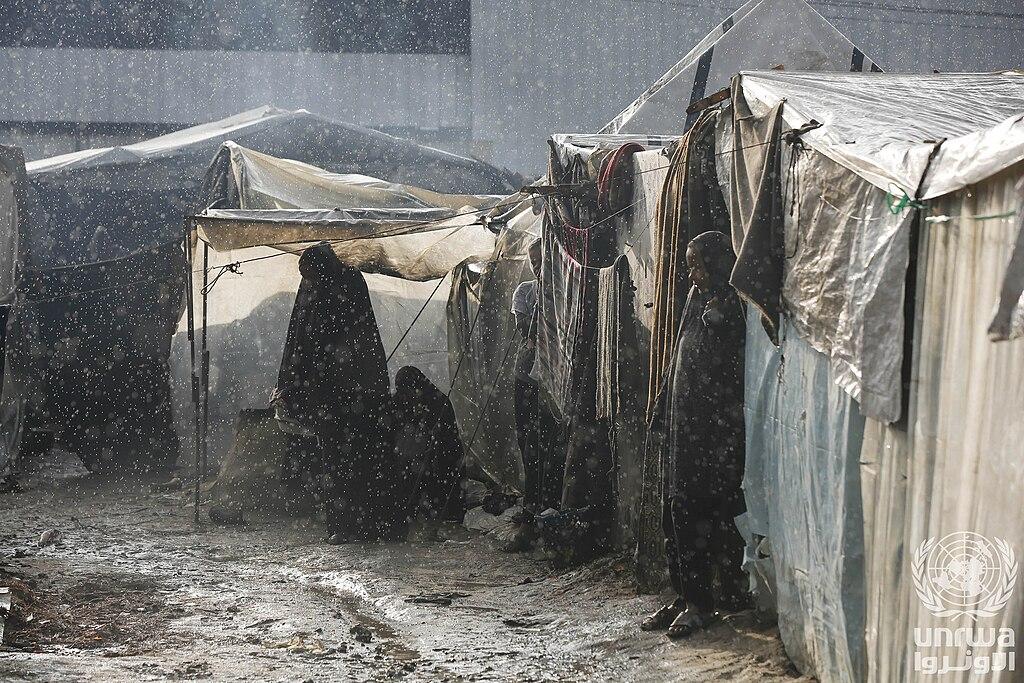
On a beach camp in western Gaza City, families are patching torn tarpaulins before the storms arrive. UN agencies say 294,250 families need winter shelter help and supplies cover only about 18 percent of them, while Gaza City's drainage runs at roughly a fifth of its former capacity.
Published 28 October 2026 · 12:20 GMT
The summary
On a beach camp in western Gaza City, families are patching torn tarpaulins before the storms arrive. UN agencies say 294,250 families need winter shelter help and supplies cover only about 18 percent of them, while Gaza City's drainage runs at roughly a fifth of its former capacity. Mohammed al-Jamal, 60, is securing his family's worn-out tent on a beach displacement camp in western Gaza City as a storm approaches from the sea, ahead of a fourth winter in displacement.
The three lenses
- WestWest; Western reporting, led by Reuters and carried by The Times of Israel, has framed the winter crisis through the IOM's Geneva warning: nearly two million people in need of shelter, only 17 percent of winter needs met, and a strengthening El Niño threatening heavier rain.
- EastEast; Eastern coverage, including The Straits Times in Singapore and Press TV in Iran, has carried the same UN warnings with a sharper accent on the physical danger: unsafe buildings, blocked kits and tents that should have been replaced.
- Global SouthSouth; Southern coverage has stayed closest to the ground.
Key facts
- Mohammed al-Jamal, 60, is securing his family's worn-out tent on a beach displacement camp in western Gaza City as a storm approaches from the sea, ahead of a fourth winter in displacement. Al Jazeera (Oct 28, 2026)
- At least 294,250 families in Gaza need winter shelter assistance, but available supplies can only partially assist about 52,000 families, roughly 18 percent of those in need, according to OCHA. OCHA (Oct 15, 2026)
- More than 65 percent of displaced households live in tents or makeshift shelters, and more than half of those shelters are in poor or very poor condition, according to a Shelter Cluster survey. Al Jazeera (Oct 28, 2026)
- The Norwegian Refugee Council said on October 5 that at least 500 truckloads of shelter materials were awaiting entry or procurement, and that at the current pace it would take more than seven months for them to enter Gaza. NRC (Oct 5, 2026)
- Gaza Municipality says more than 85 percent of Gaza City's infrastructure has been damaged and its rainwater drainage system is operating at about 20 percent of its previous capacity. Al Jazeera (Oct 28, 2026)
What are families doing as the first winter storms approach?
Mohammed al-Jamal, 60, is trying to fasten the nylon sheets of his family's worn-out tent on a beach displacement camp in western Gaza City, pulling tarpaulin tight against rain and wind coming in from the sea. He and his sons patch what they can and hope it holds. A replacement tarpaulin costs between 120 and 150 shekels, about 37 to 47 dollars, in local markets; money the family does not have. “We are trying to prepare as much as we can to protect ourselves from the water and the wind,” he said. “But once the storm comes, everything gets torn apart, and we have to start all over again.”
It is a ritual repeated across the Strip. Khitam Salman, 39, displaced from Beit Lahiya and now living near the beach, says one of her family's tents has collapsed four times while they were sleeping inside it. Yosra Mesleh, 45, displaced from Gaza City's Nassr neighbourhood after her home was destroyed, is preparing for her second winter in a tent. Last winter, rainwater came inside and reached the bedding, with nowhere dry to sit, cook or eat. Winter temperatures in Gaza can fall to 7 degrees Celsius, and coastal wind and rain make it feel colder still.
What do the UN and aid agencies count as the winter gap?
The numbers behind the patching are stark. OCHA counts at least 294,250 families in need of winter shelter assistance; available supplies can only partially assist about 52,000 of them, roughly 18 percent. More than 65 percent of displaced households live in tents or makeshift shelters, according to a Shelter Cluster survey, and more than half of those shelters are in poor or very poor condition. About 1.5 million of Gaza's 2.3 million people live in tents or makeshift shelters, and more than 80 percent of buildings have been destroyed or damaged since the war began in October 2023.
The pipeline explains why the gap is not closing. The NRC said on October 5 that at least 500 truckloads of shelter materials were awaiting entry or procurement, and that at the current pace it would take more than seven months for them to enter. Only 15 trucks a week carrying items Israel designates as dual-use are allowed in from Jordan. The IOM said on October 9 that only about 17 percent of winter needs were met, with some 8,600 of its emergency kits turned away as dual-use. UN teams assessing Khan Younis on October 19 and 20 found more than 650 families at risk, including 160 in a former rainwater pit threatened by flooding with rain and sewage.
What remains unknown before the rains arrive in force?
The largest unknown is the weather itself. The UN weather agency expects a possibly record El Niño that could bring heavier rainfall to Gaza, but nobody can yet say how heavy this winter's downpours will be, or whether the first major storm arrives before any meaningful quantity of shelter material clears the crossings. A second unknown is access: whether the weekly dual-use truck rate rises, whether the 8,600 blocked IOM kits move, and whether donors close the 186.6 million dollar shortfall in the 283 million dollar minimum winter shelter response, of which only about 34 percent has been provided or pledged.
A third unknown is what happens inside the camps when water rises. Gaza Municipality says emergency cleaning and maintenance work has begun, but rubble, damaged drainage, and shortages of heavy machinery, fuel and maintenance materials constrain it. How many families in the highest-risk sites will be voluntarily relocated, how many tents will actually be replaced rather than re-patched, and what the toll in illness, exposure and building collapse will be, are all still to be counted.
Why does a fourth winter in tents matter beyond the camps?
Because winter in Gaza is no longer a seasonal hardship layered on top of displacement; it is a second disaster arriving on a landscape stripped of its defences. Gaza City's rainwater drainage operates at about 20 percent of its previous capacity, according to the municipality, and more than 85 percent of the city's infrastructure has been damaged. Damaged roads, drainage and sewage systems mean rainwater mixes with wastewater and swamps the camps, turning a leaking tent into a health risk. OCHA counts some 950,000 displaced people at medium-to-high flood risk, more than 400,000 of them at high risk, and about 44,000 people living in more than 2,300 structurally unsafe buildings.
The vulnerability is concentrated where it hurts most. An assessment of households including people with disabilities, surveyed in September, found three-quarters living in tents, 58 percent of them needing urgent repair, and nearly half already suffering severe leakage that damages wheelchairs, medical mattresses and hearing aids. Food assistance is shrinking at the same time: the World Food Programme has cut its Gaza assistance by about a third, citing a need for 450 million dollars to sustain operations from October 2026 to March 2027, with recipients falling from 1.6 million to 1.1 million and daily hot meals from 250,000 to 150,000.
How should the seven-month pipeline figure be read?
The figure that matters most in this story is not a percentage but a rate. Five hundred truckloads in the pipeline, cleared at 15 trucks a week, is more than seven months of waiting under the best conditions, longer than the winter itself. That arithmetic is why aid agencies describe the crisis as man-made rather than meteorological: the rain is seasonal and expected, but the entry rate is a policy outcome. NRC Secretary General Jan Egeland's formulation, “this is not an unavoidable natural disaster”; is a claim about that rate, and it is the claim Israel's security argument has to answer. Dual-use classification sweeps in timber, tools, rope and cement alongside tents and tarpaulins, so even repair, not just new shelter, is throttled.
The funding gap compounds the entry gap. With only about a third of the 283 million dollar minimum response funded, agencies cannot buy their way around the bottleneck even where entry is possible, and the WFP's simultaneous food cuts show the same squeeze in a second sector. Until one of those two rates changes, trucks per week or dollars pledged, the winter forecast is, in effect, already written in the pipeline figures.
What could this winter set in motion beyond the camps?
The first second-order effect is health. When drainage runs at a fifth of capacity and sewage mixes with floodwater, respiratory and skin infections spread through crowded camps, and children, the elderly and people with disabilities absorb the worst of it. The second is renewed displacement: families flooded out of low-lying sites, or moved voluntarily from cliff-edge and pit sites in Khan Younis, join an already overcrowded search for safer ground, while access restrictions on 65 percent of Gaza's territory, noted by OCHA, leave few places to go.
The third effect is political. Each winter that arrives with the same unmet figures erodes confidence in the ceasefire’s humanitarian promises, and each storm that tears the same tents feeds the argument, made by the families themselves, that announcements of caravans and materials are false promises. The fourth is donor fatigue in reverse: the WFP's cuts and the shelter shortfall land in the same season, forcing agencies to choose between feeding people and sheltering them.
What are the next verifiable steps to watch?
Watch the crossings first: whether the weekly dual-use truck rate rises above 15, whether the 8,600 IOM kits move, and whether the 500-truckload pipeline shortens in NRC's next update. Watch the weather second: the first major storm will test, in a single night, whether Gaza City's emergency drainage work and the Khan Younis relocations were enough, and OCHA's situation reports will count the families flooded, moved or newly in need. Watch the money third: any movement toward the 186.6 million dollar shelter shortfall, and whether WFP food coverage stabilises or falls further below one million recipients a month.
Watch the families last, because they are the earliest warning system the story has. Al-Jamal follows the weather reports and prepares whenever a storm warning comes; Salman counts the collapses; Mesleh counts what she still needs; tents, tarpaulins, cooking utensils, gas. If their next accounts describe tarpaulins arriving rather than tearing, the winter will have turned.
The three lenses
West Lens:
West, Western reporting, led by Reuters and carried by The Times of Israel, has framed the winter crisis through the IOM's Geneva warning: nearly two million people in need of shelter, only 17 percent of winter needs met, and a strengthening El Niño threatening heavier rain. The emphasis falls on the institutional arithmetic, kits blocked, percentages unmet; and on Israel's stated position, that security concerns justify the curbs and that reconstruction cannot begin until Hamas disarms. The reporting keeps the two explanations for the shortfall side by side, attributing the restriction argument to Israel and the access argument to the agencies, without settling between them.
East Lens:
East; Eastern coverage, including The Straits Times in Singapore and Press TV in Iran, has carried the same UN warnings with a sharper accent on the physical danger: unsafe buildings, blocked kits and tents that should have been replaced. The Straits Times highlighted the September collapse of a war-damaged six-storey building in Gaza City that killed 21 people, including 12 children, as the reason families in damaged buildings face a double risk this winter; flooding below and collapse above. Press TV, meanwhile, has foregrounded the Palestinian Ministry of Social Development's finding that about 90 percent of tents have become torn and unfit after two years of exposure.
South Lens:
South, Southern coverage has stayed closest to the ground. Al Jazeera's October 28 feature gives the winter its names and voices, al-Jamal patching tarpaulin on the beach, Salman sleeping under a tent that has collapsed four times, Mesleh asking not for towers but for tarpaulins, tents and a dignified life. Al Mayadeen's reporting of the October 20 UN warning has stressed the same figures from the other end: 950,000 people facing flood risk, and food assistance being cut at the same moment.
The consensus
- What we agree on
- What we agree on: displaced families in Gaza are entering a fourth winter in tents and makeshift shelters that cannot keep out wind and rain; 294,250 families need winter shelter assistance and current supplies only partially cover about 52,000 of them, roughly 18 percent.
- What we don't agree on
- What we disagree on: why shelter supplies are not reaching families at scale; UN agencies and aid groups point to Israeli entry restrictions on dual-use materials and to underfunding as the binding constraints, while Israel cites security concerns for its curbs and says large volumes of aid enter Gaza daily.
- What we know
- What we know: the scale of the shelter deficit, the condition of the tents, the drainage collapse in Gaza City, the 500-truckload pipeline and the seven-month clearance arithmetic, and the flood-risk assessments in Khan Younis.
- What we don't know yet
- What we do not know: how heavy this winter's rains will be under a strengthening El Niño, whether crossing throughput or funding improves before the first major storm, and how many families will actually be moved or re-sheltered in time.
- What we expect
- What we expect: repeated storm damage to the same tents, renewed flooding in low-lying sites, further warnings from OCHA and the Shelter Cluster as the rains arrive, and continued argument over entry restrictions until the pipeline visibly shortens.
Questions, answered
What does a fourth winter in tents mean for Gaza's displaced families?
It means a fourth consecutive cold season living in tents and makeshift shelters that were designed to last six to twelve months, not three years. The tents are torn, leak, and collapse in storms; winter temperatures can fall to 7 degrees Celsius and feel colder in coastal wind and rain. Families patch the same shelters storm after storm, with bedding and belongings repeatedly soaked.
How many families need winter shelter help, and how many are covered?
OCHA counts at least 294,250 families needing winter shelter assistance in Gaza. Available supplies can only partially assist about 52,000 of them, roughly 18 percent. More than 65 percent of displaced households live in tents or makeshift shelters, and more than half of those shelters are in poor or very poor condition, according to a Shelter Cluster survey.
Why are shelter materials not getting into Gaza faster?
Israel classifies tents, tarpaulins, timber, tools and other shelter materials as dual-use items, and allows only 15 trucks a week carrying such goods in from Jordan. At least 500 truckloads are awaiting entry or procurement, and the Norwegian Refugee Council says clearing them at the current pace would take more than seven months. Funding is also short, with only about 34 percent of the 283 million dollar minimum response provided or pledged.
What are the flood risks beyond the tents themselves?
Gaza City's drainage runs at about 20 percent of its former capacity, so rainwater mixes with sewage and swamps camps. UN teams found 160 families in Khan Younis living in a former rainwater pit at risk of flooding, five other low-lying sites sheltering about 750 people, and a cliff-edge site where erosion could collapse the ground under tents. About 44,000 people also live in more than 2,300 structurally unsafe buildings.
Sources
- Al Jazeera (Oct 28, 2026)
- OCHA (Oct 15, 2026)
- NRC (Oct 5, 2026)