Five dead and dozens missing as Hurricane Simon churns off Mexico and storm Rachel floods Baja California — capping the most energetic Pacific hurricane season ever recorded.
Published 13 October 2026 · 18:00 GMT
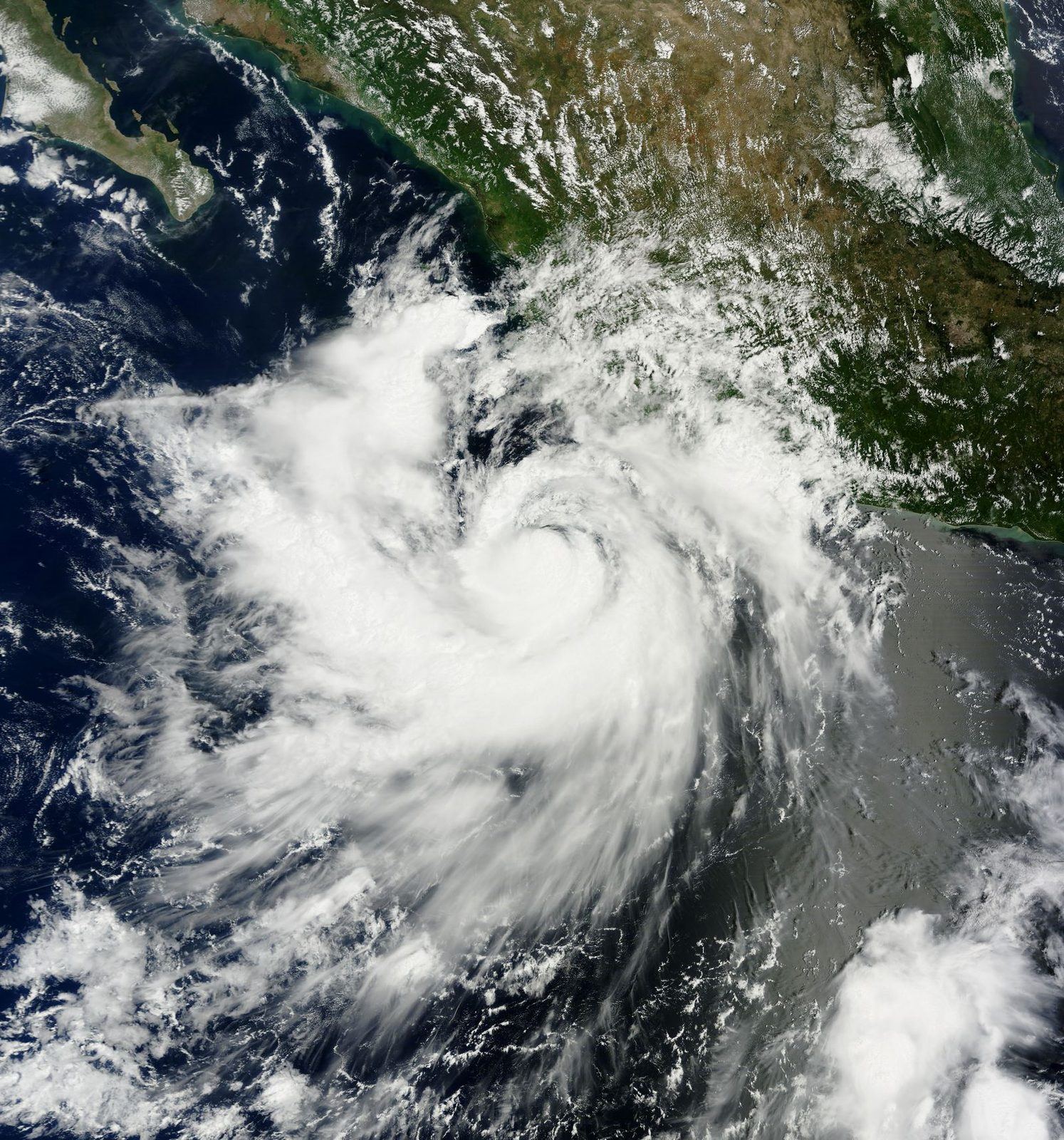
Johana Nuriulu woke in Ensenada to a roar like ocean waves — far too loud for midnight. Outside, a dry creek had become a river, sweeping cars and furniture downstream: storm Rachel's parting gift. Hours later, Hurricane Simon was still at sea, and nobody on Mexico's Pacific coast knew where it would strike.
The death toll climbed through Monday. In Guerrero, Governor Evelyn Salgado confirmed that Albino Moreno Jimenez, 71, died when a retaining wall collapsed under days of rain in Chilpancingo, where he had been feeding his animals on the western edge of the city. In Baja California, four members of one family — two of them children — were recovered from floodwaters on the outskirts of Ensenada after storm Rachel's remnants overwhelmed a normally dry creek bed. At least six people remained missing late Monday, and officials said the toll could rise.
The two storms are one season's one-two punch, arriving in opposite directions. Rachel is already gone — a post-tropical cyclone that made landfall early Sunday near Ensenada with winds of 95 kilometers per hour before carrying record rainfall into the American Southwest. Simon is the one still out there: a Category 2 hurricane with maximum sustained winds near 155 kilometers per hour (100 mph), centered about 90 kilometers west-southwest of Cabo Corrientes in Jalisco, drifting northwest at a crawl of 5 kilometers per hour, according to the National Hurricane Center's Monday evening advisory.
Five dead, dozens missing — and the Pacific's most violent season on record is not over yet.
Simon has not made landfall, and forecasters are no longer sure it will make a direct one — but that is the wrong way to read the danger. Hurricane warnings remained in effect from Punta San Telmo in Michoacan to Punta Mita in Nayarit. The NHC warned of isolated rainfall totals up to 30 inches (762 millimeters) in parts of Michoacan, Colima, Jalisco and Nayarit — rain that can kill long after the wind dies down. Fabian Vazquez, director of Mexico's meteorological service, told AFP to expect waves up to nine meters (30 feet) and severe wind damage along the coast. Mexico's national civil protection coordinator, Laura Velazquez, said the official forecast put a landfall near Mazatlan, Sinaloa, later this week as a Category 1 hurricane. Mexico's Pacific states are bracing for the worst of it.
In Guerrero, Simon has already written its name. Twenty municipalities reported damage, according to state authorities: 112 homes damaged, 150 businesses flooded and 60 cars swamped, plus a landslide that destroyed a house in Acapulco. The Spanish newspaper El Pais reported that a cliff diver died in Mazatlan after jumping into the sea Saturday night amid dangerous surf; officials have not confirmed any link to Simon.
Puerto Vallarta, the Jalisco resort city of nearly 300,000 residents that spent the weekend braced behind boarded storefronts, woke Monday to clear skies and a rainbow, an AFP team observed. Its international airport suspended operations until Tuesday morning. The Mexican Navy activated emergency personnel in Colima and restricted maritime traffic along the Pacific coast, closing ports to smaller vessels. AccuWeather senior meteorologist Tyler Roys said Simon could deliver the most significant hurricane impact to this stretch of coast since Lidia in 2023, which damaged thousands of homes and devastated crops in Jalisco.
Rachel's damage is of a different kind — water, not wind. The state prosecutor's office in Baja California identified the four dead in Ensenada: Ivonne Regina Teran Burgos, 13; Ericka Ivonne Burgos Teran, 35; Silvia Lucero Burgos Teran, 30; and Aaron Vega Burgos, 4. The 13-year-old's body was recovered Sunday near the La Bufadora road; the other three on Monday. Six people were still missing, including a father and son who went fishing Saturday near San Felipe and never returned, according to state civil protection coordinator Ignacio Lozoya. Military helicopters lifted 32 people — 22 of them foreigners, 13 of them youths — from a flooded ranch in Ensenada; some were missionaries, including Germans and Americans. It was the second storm to punish this coastline in weeks, after Hurricane Polo and Tropical Storm Nolo battered the same waters late last month.
Baja California Governor Marina del Pilar Avila said some 14,000 federal and state personnel had been deployed across the state, with six temporary shelters open. Emergency operators handled more than 4,000 calls and carried out over 200 rescues. Schools were suspended in the hardest-hit municipalities.
On Sunday, Simon tipped the eastern and central Pacific past the all-time record for accumulated cyclone energy (ACE) — the measure meteorologists trust most, because it combines how strong storms get with how long they last. The previous record, set in 2018, was about 318 ACE units; independent analysis put this season above 323 by Monday, and the NHC's own tally reached roughly 325.5 by Tuesday. Twenty-one named storms have formed. Ten became hurricanes. Nine reached major-hurricane strength — Category 3 or higher.
The fuel is a strong El Nino, which warms Pacific waters and weakens the wind shear that normally tears young storms apart. The result has been a season of long-lived monsters: Genevieve became the first Category 5 in the basin since Kristy in 2024; Lowell reached Category 5 intensity twice, a feat not seen since Ioke in 2006; and Polo carried 290 km/h winds off the Mexican coast late last month. The same warm Pacific delivered a string of Hawaiian strikes — Hurricane Lala flooded the Big Island in August, killing a 93-year-old woman and destroying some 100 homes; Lowell struck Kauai and Niihau, knocking out power to roughly 90 percent of Kauai's customers and killing at least two; and Nolo brought another round of flooding and landslides in late September.
The season's strangest statistic is the contrast across the continent. As the Pacific set records, the Atlantic was nearly silent — and then, the same weekend Simon and Rachel struck Mexico, the Atlantic finally produced its first hurricane of the season: Isaias, which made landfall near Destin, Florida, as a Category 2, killing four people and leaving hundreds of thousands without power. Two oceans, two disasters, one weekend — read our earlier report on Isaias's trail through the American Southeast.
The geopolitics of the weekend is a study in shared vulnerability. Rachel crossed a border: its remnants tore apart a boardwalk in Long Beach, pushed Las Vegas to its wettest October day since 1947 (1.08 inches of rain), flooded streets in the shadow of the Strip, and forced the evacuation of ultramarathon runners stranded in Utah's canyons. In Washington, emergency declarations were approved for Florida and Alabama while the president said preparations were "under control." In Mexico City, President Claudia Sheinbaum used her Monday morning briefing to urge precautions against Simon. Disasters do not check passports; the response systems that answer them run on parallel tracks across the United States and Mexico alike.
The economics runs deeper than the emergency budgets. Manzanillo, squarely in Simon's forecast cone, is Mexico's largest port and its main gateway for trade with Asia. Puerto Vallarta is a tourism engine of nearly 300,000 residents plus millions of annual visitors — its shuttered airport alone, even for a day, ripples through airlines, hotels and the informal economy that feeds them. In Guerrero, one of Mexico's poorest states, the 150 flooded businesses are small shops and stalls with no insurance adjuster waiting in the wings; the losses will simply be absorbed by families. Climate risk is priced in pesos and paid by people who never signed the contract. Demographers add a harder edge: between the Sierra Madre and the sea, hillside communities live in housing that was never built to withstand this kind of water.
Simon is expected to remain a hurricane through midweek, moving slowly northwest before turning toward the coast — with landfall possible near Sinaloa later this week, most likely as a weaker storm but carrying its heaviest rains inland. The NHC warned that life-threatening flooding and mudslides remain possible even if the center never comes ashore; a slow storm is a rain machine, and these slopes — where steep mountains rise within sight of the ocean — are landslide country.
In Baja California, the search continues for the missing, and officials expect the death toll to rise as waters recede and cut-off communities are reached. The rain alert along the Pacific coast stays in place. And the season is not finished: with several weeks remaining before the official November 30 end, the Pacific's ACE total could climb further, in a year that has already forced forecasters to rewrite what "record" means. For the coastal towns between the mountains and the sea, the forecast for the rest of October is simple: keep watching the water.
The American weather apparatus reads the weekend as a data event first. The NHC's advisories — wind speeds, ACE tallies, a center crawling 90 kilometers offshore — frame risk as a forecast problem, and the western press reads Mexico's response through that grid: warnings issued, ports closed, an airport suspended, 14,000 personnel deployed.
What the West notices is the symmetry: an El Nino-warmed Pacific delivering a record season while the Atlantic stays strangely quiet until Isaias breaks the silence the same weekend. The lesson it draws is technocratic — better models, faster warnings, stronger building codes for the hillside towns between the Sierra Madre and the sea.
China's state press, which tracked Simon from Friday as a forecast story, reads the Pacific season as a climate fact rather than a drama: tropical activity above average, driven by a strong El Nino, with the numbers — 21 named storms, record ACE — stated plainly and the toll reported without adornment.
From this angle the meaningful actor is the state: Mexico's navy closing ports, 14,000 personnel in Baja California, the president at her morning briefing. The question the eastern reading asks is not whether the storm is unprecedented but whether the machinery of response was equal to it.
The southern press counts the dead by name and the missing by neighborhood. Al Jazeera's reporting and Mexico's own media keep the camera on Chilpancingo and Ensenada: a 71-year-old feeding his animals when a wall gave way; a family of four — two of them children — found in a creek bed near the La Bufadora road.
For the Global South this is not an anomaly to be modeled but a pattern to be survived. Guerrero is one of Mexico's poorest states; its 150 flooded businesses are family shops with no insurance. The season's violence is read as the bill arriving — and arriving, as always, first and heaviest on those with the least.
At least five deaths have been confirmed: one in Guerrero, where 71-year-old Albino Moreno Jimenez died when a retaining wall collapsed in Chilpancingo during Hurricane Simon; and four in Baja California, where post-tropical storm Rachel killed four members of one family — two of them children — near Ensenada. At least six people remained missing late Monday, and officials said the toll could rise as floodwaters recede.
As of Monday evening, Simon was a Category 2 hurricane about 90 kilometers west-southwest of Cabo Corrientes in Jalisco, drifting northwest at just 5 km/h with winds near 155 km/h. Forecasters expect it to remain a hurricane through midweek and turn toward the coast later this week, possibly making landfall near Mazatlan, Sinaloa, as a Category 1 — though its heaviest rains will strike regardless.
Accumulated cyclone energy (ACE) combines how strong tropical storms get with how long they last, giving meteorologists the truest measure of a season's violence. The eastern and central Pacific surpassed the 2018 record of about 318 units on Sunday, reaching roughly 325.5 by Tuesday. A record ACE means the ocean produced not just more storms, but longer-lived and more intense ones — exactly what a warming Pacific delivers.
After battering Baja California, Rachel's remnants traveled north as a post-tropical cyclone into Southern California and the Southwest. Waves tore apart a boardwalk in Long Beach; Las Vegas recorded its wettest October day since 1947; flash floods stranded ultramarathon runners in Utah; and some 7,000 customers lost power in California. The storm showed how a Mexican landfall can become an American emergency days later.
