 MAGNA BUREAU
The Wire
Uganda begins Africa’s first mRNA Ebola vaccine trial; and children go first
Uganda has opened Africa’s first clinical trial of an mRNA vaccine against the Bundibugyo strain of Ebola, testing Moderna’s candidate in 224 volunteers aged from one to 65 as the outbreak in neighbouring Congo passes 12,000 confirmed cases.
Key points
- On 27 November 2026, Uganda launched Africa’s first clinical trial of an mRNA vaccine against the Bundibugyo species of Ebola, run by the state-run Uganda Virus Research Institute in collaboration with Moderna. Uganda Virus Research Institute
- The Phase I study will enrol about 224 healthy volunteers aged from one to 65, and will be the first trial of the vaccine candidate in children aged one and above. 2
- The Uganda study is the second human trial of the candidate, designated mRNA-1469-P102, after Moderna began its first human trial in Canada in August 2026 in adults aged 18 to 65. 3
- The Coalition for Epidemic Preparedness Innovations is providing Moderna with up to $58.5 million to support development of the Bundibugyo vaccine candidate. 3
- In the Democratic Republic of Congo, 12,021 confirmed Ebola cases had been recorded as of 24 November 2026, including 5,904 deaths, in the second-largest Ebola outbreak on record. 5
ONE EVENT. THREE READINGS.
Western coverage treats the trial as a scientific milestone with a procurement tail.
Reuters, reporting from Kampala, leads on the first, Africa’s first mRNA Ebola trial, the children’s first, and moves quickly to the machinery around it: the Canadian precedent, the DRC trials to come, and the question of whether an existing vaccine built for a different Ebola strain can be repurposed.
What this reading highlights: The Geneva angle runs in parallel: Gavi’s advance purchase commitment, signed on 24 November, is framed as the market mechanism that turns a promising candidate into doses in arms.
The Western lens is institutional, regulators, funders, stockpiles, and its blind spot is the same: the people at the centre of the outbreak appear mainly as numbers in a toll.
Sources: Reuters (1), Gavi (1), European Centre for Disease Prevention and Control (1)
Eastern reporting keeps the state and the system in the frame.
Xinhua’s account, carried by Bernama, leads with the joint statement, the regulatory approval and the trial’s formal designation, mRNA-1469-P102; the paperwork of a sovereign health system running its own trial, not receiving one.
What this reading highlights: The East also carries the other half of the vaccine race: the ChAdOx1 candidate developed by Oxford and India’s Serum Institute, which will enter DRC trials alongside Moderna’s shot and already has Gavi’s purchase commitment behind it.
The Eastern reading is structural, manufacturing capacity in the Global South, public institutions setting the terms, and it treats the trial as evidence that epidemic science is no longer a Western export.
Sources: Bernama (1)
Southern outlets start where the outbreak is.
Al Jazeera’s report leads with the trial and the DRC toll in the same breath, and TRT World frames the story around the epicentre in eastern Congo, where two experimental vaccines are about to be tested on contacts and high-risk groups.
What this reading highlights: The Southern lens is human before it is technical: an African institute leading, Ugandan regulators approving, African children first in line for a vaccine against an African outbreak.
The question Southern coverage keeps asking is the one the trial itself poses; whether this time the science arrives where the dying is, rather than years later, somewhere else.
Sources: Al Jazeera (2), TRT World (1)
Sources by lens: 3 West, 1 East, 3 Global South. See every source
THE POINT OF CONVERGENCE
On 27 November 2026 Uganda launched Africa’s first clinical trial of an mRNA vaccine against Bundibugyo Ebola; the Uganda Virus Research Institute runs the Phase I study with Moderna; it will enrol about 224 volunteers aged one to 65, testing safety and immune response, including in children for the first time.
WHAT REMAINS CONTESTED
Whether the mRNA platform can move fast enough to matter in this outbreak, the trial measures safety and immune response, not protection, and DRC results are months away, or whether the parallel ChAdOx1 candidate, already backed by a Gavi purchase deal, is the likelier near-term answer.
The story
What did Uganda actually start; and why is it a first?
Uganda has begun Africa’s first clinical trial of an mRNA vaccine against Ebola. The state-run Uganda Virus Research Institute (UVRI) said on Friday that screening and enrolment are under way for a Phase I study of Moderna’s candidate, designated mRNA-1469-P102, against the Bundibugyo species of the virus; the strain behind the outbreak raging across the border in the Democratic Republic of Congo. The study will enrol about 224 healthy volunteers aged from one to 65, and follow them for roughly a year after injection. It is the second human trial of the candidate, after Moderna began its first in Canada in August, and the first anywhere to test the vaccine in children. The trial follows approval by Ugandan regulators, UVRI said in a joint statement issued in Kampala. Uganda knows this virus at first hand: its own Bundibugyo outbreak this year counted 20 confirmed cases and two deaths before the health ministry declared it over on 28 July.
Why do children come first in this trial?
The trial’s design is its message. Phase I studies test safety and immune response, not protection; and this one is built around the group Ebola hits hardest and reaches last. Moderna’s candidate already entered human testing in Canada in August, in healthy adults aged 18 to 65; the first participant was dosed on 3 August in Truro, Nova Scotia. Interim findings from that study led the World Health Organization’s independent Technical Advisory Group on Candidate Vaccines Prioritisation to recommend the candidate for evaluation in the DRC under the Phase 2/3 Tumaini ring vaccination trial. In Uganda, the study will for the first time measure safety and immune response in children from the age of one. “Children are often among those hardest hit when Ebola strikes, yet they are too often the last to benefit from new vaccines,” said Richard Hatchett, chief executive of the Coalition for Epidemic Preparedness Innovations, which is helping fund the work. CEPI is providing Moderna with up to $58.5 million for the Bundibugyo programme. Pontiano Kaleebu, UVRI’s executive director and the trial’s lead investigator, said the study would support the response in the DRC and strengthen preparedness for future outbreaks.
Children are often among those hardest hit when Ebola strikes, yet they are too often the last to benefit from new vaccines.
What the trial cannot answer yet
Nothing in this trial shows yet whether the vaccine protects anyone. A Phase I study answers two questions only: is the candidate safe, and does it trigger an immune response. Efficacy, whether vaccinated people avoid disease, will be tested in the DRC, where the candidate joins the Tumaini ring trial among contacts of cases and people at high risk. How long any immune response lasts is unknown; volunteers will be followed for about a year. So is the regulatory path: no vaccine against Bundibugyo is licensed anywhere, and any deployment would need trial results, regulatory approvals and World Health Organization policy recommendations first. It is also unproven whether Merck’s Ervebo, the licensed vaccine against the Zaire strain of Ebola, offers any cross-protection against Bundibugyo; scientists are testing that question now, drawing on a stockpile of 500,000 doses.
Why a children’s trial changes the arithmetic of the outbreak
The DRC outbreak is the reason this trial cannot wait. Government data released on Thursday put confirmed cases at 12,021, including 5,904 deaths; the second-largest Ebola outbreak on record, with a case fatality close to one in two. The count has risen sharply since the outbreak passed 10,000 confirmed cases. It was declared in mid-May in Ituri province and has since spread to eight of Congo’s 26 provinces, while fighting in the east disrupts the response. There is no licensed vaccine and no approved treatment for Bundibugyo; containment still depends on surveillance, isolation and infection control. That is the gap the Uganda trial is built to close; and the choice to start with children is the point. In past Ebola epidemics, children were the last group tested and the last protected; this trial reverses that order deliberately, generating the paediatric data regulators will need before any wider use. For Uganda, the stakes are also national: the virus crossed its border once this year already, and the memory of its own 20-case outbreak, ended in July, is fresh.
What would success actually change?
Three things are being tested in Uganda, and only one of them is a vaccine. The first is the mRNA platform itself: the technology that delivered Covid-19 vaccines in months is now being aimed at a pathogen the market ignored, because Bundibugyo kills thousands, not millions, and mostly poor people. The second is the financing model. CEPI’s $58.5 million and Gavi’s advance purchase commitment, money promised before proof, are designed to solve the exact failure that left Bundibugyo without a vaccine for nearly two decades: nobody pays for a vaccine against a disease with no rich-country market. The third is the trial design. Testing children first, in the country next door to the outbreak, compresses a sequence that usually takes years, adults first, rich countries first, children last, into a single study. If the candidate proves safe and immunogenic, the template travels: the same platform, the same funding, the same children-first order could be aimed at the next outbreak before it becomes a record-breaker.
What follows if the model works; and if it does not?
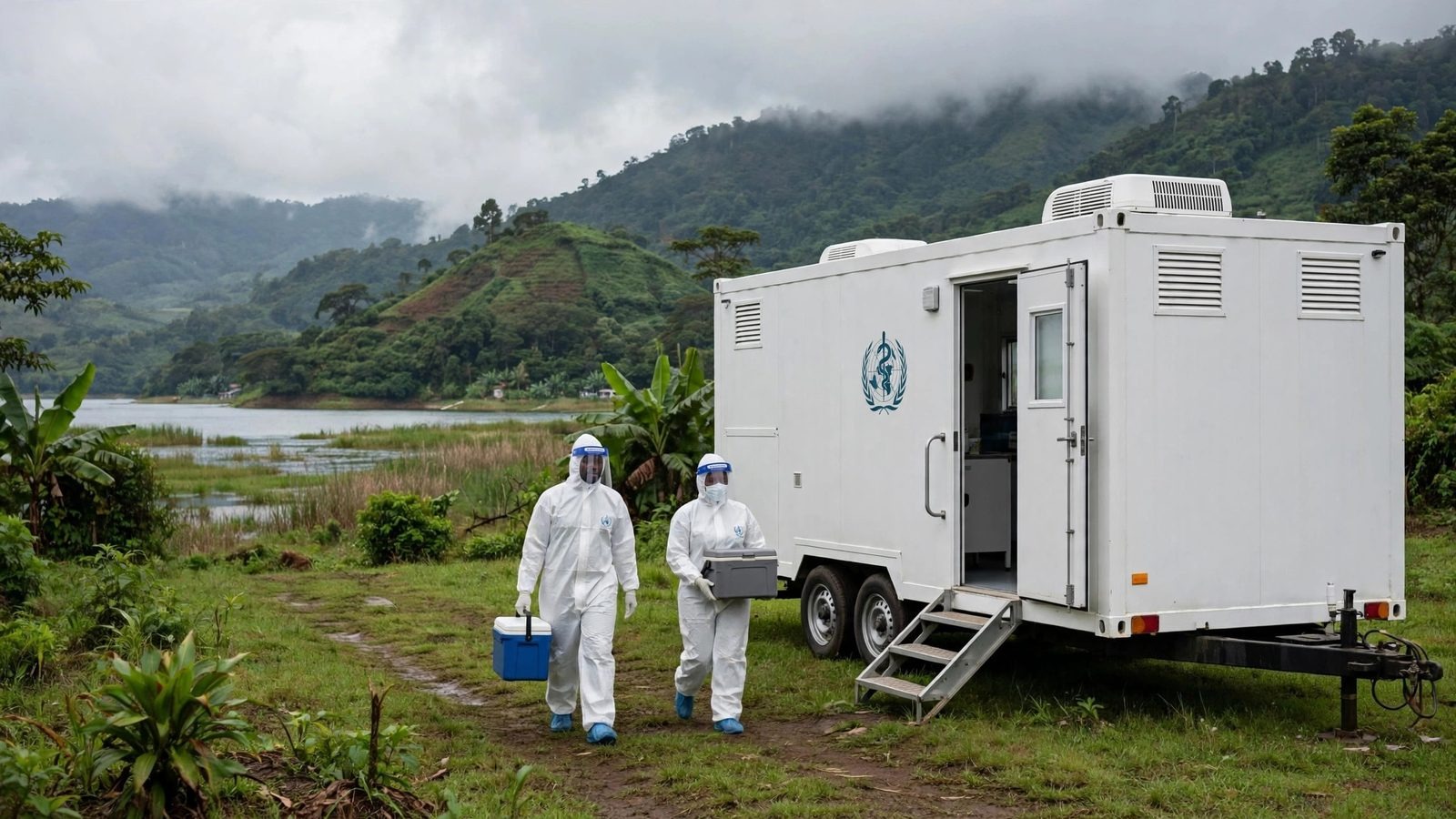
If it works, the consequences run beyond Ebola. A proven mRNA path for a neglected pathogen would give health agencies a standing playbook: platform, funding, advance purchase, paediatric data from the start. African trial capacity, UVRI running a first-in-children study to international standards, becomes an asset other countries and funders can build on, rather than a gap to be filled from outside. And the Gavi model, buying doses before approval, could be reused for the next outbreak instead of negotiated from scratch. If it stalls, the costs are concrete. The DRC toll is rising by roughly 450 confirmed cases a week, and the response is already strained by insecurity in the east. In the meantime the response leans on field tools such as the mobile laboratories tracing the virus in the east. The fallback is ChAdOx1, which has its own trial to pass, and Ervebo, whose cross-protection is unproven. A slow or negative result would leave the world’s second-largest Ebola outbreak with containment alone; and the financing model that underwrote this trial facing its first hard question.
What happens in the DRC on Monday?
On Monday 30 November, the focus shifts across the border into the Democratic Republic of Congo. Two experimental vaccines are due to begin testing in the outbreak’s epicentre in the east, Moderna’s mRNA candidate and the Oxford–Serum Institute ChAdOx1 shot, among contacts of cases and people at high risk of infection. Gavi’s director of global health security, Emanuele Capobianco, has said he hopes the trials conclude in early 2027, and that a successful result could move deployment up by months. The doses are, in effect, already bought: Gavi’s commitment covers up to 1.5 million ChAdOx1 doses, and the Serum Institute has already manufactured the drug substance for more than half a million. What is not bought is the outcome; trial results, regulatory approvals and WHO recommendations still stand between the commitment and the arms. The WHO and Africa CDC this week unveiled an updated continental preparedness plan running to May 2027. Uganda’s own trial will run for about a year; its first answers, on safety and immune response, will arrive long before the DRC’s final verdict.
What we agree on, and what remains open
Established
- On 27 November 2026 Uganda launched Africa’s first clinical trial of an mRNA vaccine against Bundibugyo Ebola.
- The Uganda Virus Research Institute runs the Phase I study with Moderna.
- It will enrol about 224 volunteers aged one to 65, testing safety and immune response, including in children for the first time.
Contested
- Whether the mRNA platform can move fast enough to matter in this outbreak, the trial measures safety and immune response, not protection, and DRC results are months away, or whether the parallel ChAdOx1 candidate, already backed by a Gavi purchase deal, is the likelier near-term answer.
Still open
- Whether the vaccine protects against Bundibugyo disease.
- How long any immune response lasts.
- When regulators could authorise use.
- Or whether Merck’s Ervebo, built for the Zaire strain, offers any cross-protection against Bundibugyo.
What to watch
Questions, answered
Bundibugyo is a rarer species of the Ebola virus, distinct from the Zaire strain behind the 2014–16 West Africa epidemic. The licensed Ervebo vaccine protects against Zaire only. Because Bundibugyo outbreaks were smaller and rarer, no company had a commercial reason to develop a vaccine, so none was licensed when the current DRC outbreak, the second-largest on record, was declared in May 2026.
It is Moderna’s experimental mRNA vaccine candidate against the Bundibugyo virus, designated mRNA-1469-P102 in the Uganda trial. It uses the same messenger RNA platform as Moderna’s Covid-19 vaccine. The Uganda study is a Phase I trial in about 224 healthy volunteers aged one to 65, measuring safety and immune response, and it is the second human trial after one that began in Canada in August 2026.
Children are among those hardest hit when Ebola strikes, yet they are usually the last to benefit from new vaccines, because trials test adults first. Uganda’s study reverses that order: it is the first trial of this candidate in children from the age of one, generating the paediatric safety and immune-response data regulators will need before the vaccine could ever be used more widely.
Not soon. Two candidates begin trials in the DRC on Monday 30 November, and Gavi’s health-security chief hopes they conclude in early 2027. Doses would follow only after successful trial results, regulatory approvals and World Health Organization recommendations. Gavi has already committed to up to 1.5 million doses of the Oxford–Serum Institute candidate, so supply could move fast once those conditions are met.