The World Bank commits $93 million to Africa's Ebola fight as the DRC toll passes 9,000 cases — while Kenya's second confirmed infection shows how fast the virus crosses borders.
Published 15 October 2026 · 18:00 GMT
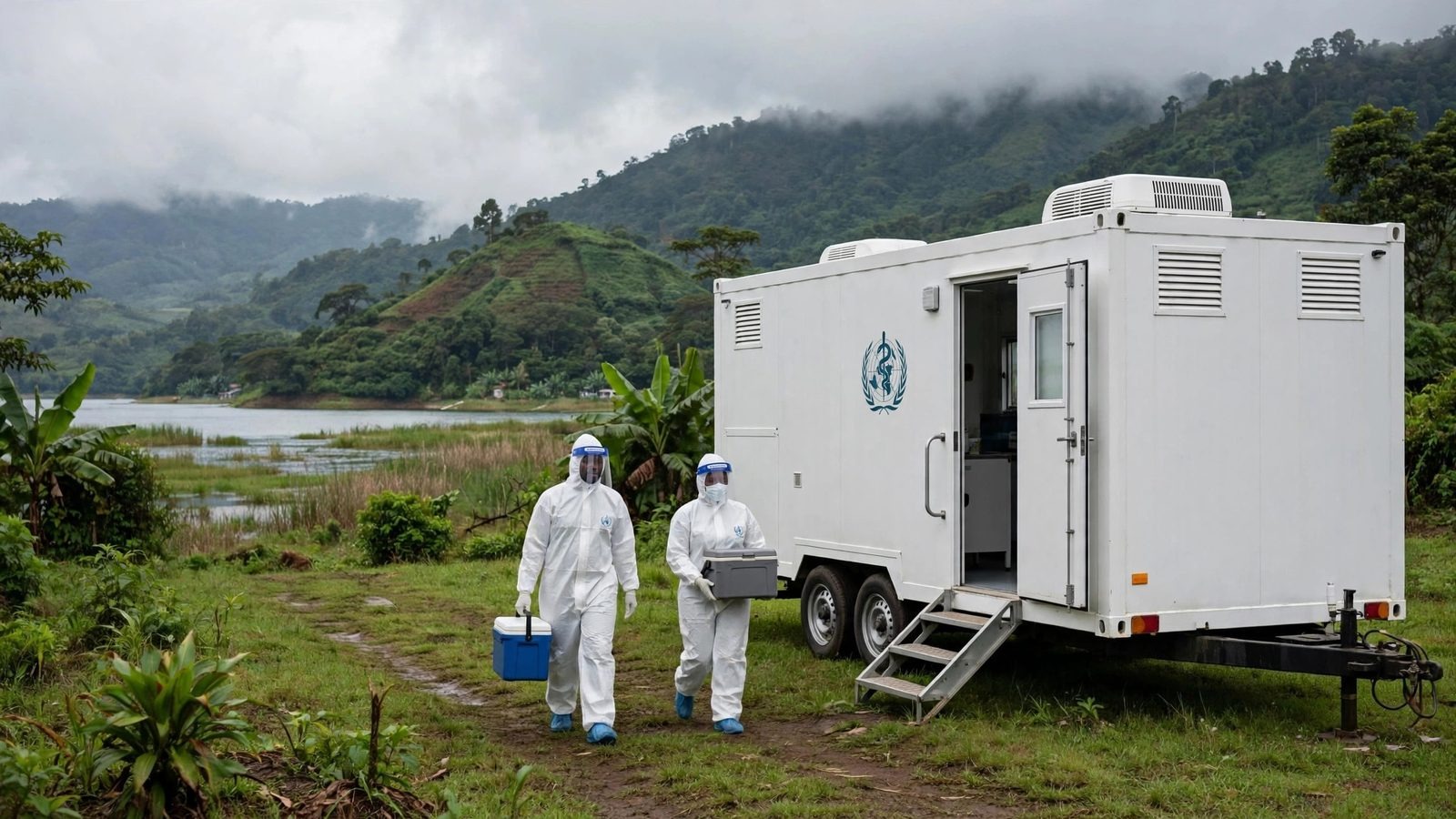
He was already in quarantine when the fever came. The 39-year-old Kenyan — a close family member of the country's first Ebola patient — developed symptoms on Wednesday under daily monitoring. Kenya's second Ebola case was no surprise. It was a test of whether a system built for this exact moment would hold.
The World Bank announced on Tuesday an additional $93 million in financing to strengthen Ebola response efforts across Africa, as the Democratic Republic of the Congo battles one of the largest outbreaks on record. The money, announced in Washington and reported on Thursday, divides into two streams: $80 million for the DRC's national response and $13 million for emergency preparedness and cross-border coordination in 11 regional countries. With it, the World Bank Group says its total commitments to this Ebola emergency have reached $426.6 million — a sum that says plainly how seriously the institution now treats the crisis.
In the DRC, the $80 million is meant for the unglamorous machinery of outbreak control: disease surveillance, laboratory testing, patient care, and infection prevention in clinics. It will also keep essential maternal and child healthcare running in Ituri province, the outbreak's epicenter, where Ebola has swallowed clinics whole. The regional $13 million flows through the World Bank's Health Emergency Preparedness, Response and Resilience program, with the Africa CDC, ECSA-HC and IGAD coordinating across borders.
Money cannot buy a vaccine that does not exist — but it can buy the surveillance that finds the next case in time.
The scale is sobering. Figures published late Tuesday by the DRC health ministry — reported Wednesday — put confirmed cases at 9,066 and deaths at 4,381, a case fatality ratio of 48.3 percent. That is nearly one death for every two confirmed infections. Transmission has reached 65 health zones across seven provinces — Ituri, North and South Kivu, Haut-Uélé, Bas-Uélé, Tshopo and South Ubangi — with Ituri alone carrying roughly three-quarters of the caseload.
Kenya's second case, confirmed on Wednesday, is the one that has concentrated minds. The patient is a 39-year-old man, a close family member of Kenya's first case, who was already under mandatory quarantine with daily monitoring when symptoms appeared — which is precisely how the system is supposed to work. The first case, confirmed on October 6, was the country's first-ever Ebola infection: a Kenyan resident returning from the DRC via Uganda, who later died. Both cases are the Bundibugyo strain of the virus.
The World Health Organization's Director-General, Dr. Tedros Adhanom Ghebreyesus, issued a statement after the second confirmation, and the WHO said there were no signs of a wider outbreak in Kenya. That is the critical distinction: Kenya has imported cases, not an epidemic. But with the DRC's transmission raging across provinces, the region is watching every contact in quarantine.
Bundibugyo is a rare species of the Ebola virus, first recognized in Uganda, and it is lethal in a specific way: it kills roughly half the people it infects — a case fatality ratio near 48 percent in this outbreak — yet it has no licensed vaccine and no specific treatment. The established Ervebo vaccine targets the Zaire strain of Ebola, a different species; emerging evidence suggests it may offer some cross-protection against Bundibugyo, but the degree of protection remains unclarified. Clinical trials are underway, including the CEPI-backed Tumaini Phase 2/3 vaccine trial in final preparation — but trials are not treatments.
The absence of a vaccine turns every case into a race against detection. About 60 percent of the outbreak's cases are community deaths — people dying outside treatment centers — the WHO's incident manager in the DRC said this week, a sign that many infections are still going undetected while patients are alive. Where treatment centers are full or distrusted, patients stay home, and the virus moves with them. In that landscape, laboratories matter as much as wards: the World Bank says its program has delivered 104 diagnostic platforms and 70,000 tests for Bundibugyo, and detection timelines improved from ten days to one or two days by September.
The outbreak was declared in the Democratic Republic of the Congo on May 15, 2026, and it has grown into the country's most severe Ebola episode on record and the second-largest Ebola epidemic anywhere, behind only the 2014–2016 West Africa outbreak. Ituri and North Kivu bear the heaviest burden, with new health zones still being added — the Dakwa health zone in Bas-Uélé province was the latest. The epidemic moves through a landscape shaped by armed conflict, displacement, dense remote communities, and heavy cross-border movement — precisely the conditions in which a virus hides.
Trust is the scarce resource. Health workers face community mistrust, attacks on transit and treatment sites, and response staff stretched thin; some estimates put confirmed cases at only about a third of true infections, with the rest uncounted. When families do not bring the sick to treatment centers — and when staff go unpaid — contact tracing collapses, and chains of transmission run unseen. Money can build laboratories. It cannot, on its own, rebuild trust.
And Ebola is not the only crisis crowding DRC clinics: cholera cases are spiking in the country even as health workers fight Ebola, the Eastleigh Voice reported this week. Two epidemics at once split the same nurses, the same beds, the same community outreach teams. Preparedness funding is meant to build systems that survive simultaneity — because simultaneity is what the DRC keeps getting.
Kenya is the fourth country to record a case linked to this outbreak. Uganda saw 20 infections and two deaths earlier this year before declaring its outbreak over, with the official declaration noted on July 28, 2026. A doctor who returned to France from the DRC tested positive in June with no further spread, and imported cases were also reported in Germany, the WHO's rapid risk assessment noted. The pattern is consistent: long, porous borders with heavy movement, and travelers who fall sick after crossing. WHO assesses the risk to countries sharing land borders with the DRC as high — and screening at a formal border crossing cannot catch a traveler who crosses informally.
Kenya's response is what the playbook prescribes. After the first case on October 6, health authorities listed 122 contacts; by October 11, 108 of them were in quarantine and had not developed symptoms, the European Centre for Disease Prevention and Control reported. Daily monitoring meant the second case was caught at symptom onset, not days later — early detection that improves his odds and narrows the circle of new contacts. Regionally, the $13 million is aimed at exactly this layer: digital health screening at key points of entry, stronger laboratory systems, and coordination so that one country's suspect case becomes the region's shared information.
Put the money in plain terms. The World Bank's program in the DRC has already cut Ebola detection times from ten days at the outbreak's start to one or two days by September 2026, deployed national technical experts to Bunia, delivered 340 tons of medicines and medical equipment, and financed surveillance vehicles. “Health emergencies don't wait and neither did we,” said Albert Zeufack, the World Bank's Division Director for the DRC. The new money extends that logic: more diagnostics, faster detection, sustained patient care — the mechanics of an outbreak response that must now run for months.
And the response is explicitly wider than Ebola wards. In Ituri, financing keeps maternal and child healthcare services open so the outbreak does not multiply risks for women and newborns, and it supports livelihoods and safe schooling for children in affected communities. This is the ledger behind the headline: an epidemic measured not only in cases and deaths but in the clinic visits that do not happen, the babies not delivered safely, the school terms lost. The $80 million buys a chance that Ebola does not claim those, too.
Read through five dimensions, the story has a familiar shape. Geopolitically, regional coordination through the Africa CDC and regional blocs is the only defense on a continent of open borders. Economically, this is financing logic, not charity — concessional money protecting trade corridors, labor markets and health systems from a costlier catastrophe. Demographically, dense border towns and young mobile populations move faster than contact tracers. Historically, outbreak funding arrives in surges after spillover, rarely before. Structurally, there is no licensed vaccine for a rare strain because the market never priced it — so public money must.
What to watch now: whether Kenya's contact list produces a third case, how fast the CEPI Tumaini trial moves from preparation to enrollment, whether the cholera spike in the DRC forces a triage of attention, and whether the $13 million regional program makes screening at border crossings more than a performance. The virus has momentum. The question is whether the response — money, monitors, laboratories — can finally outrun it.
Dounia Filali is a columnist at Magna Bureau.
For Western capitals, the story is risk management at a distance: a $93 million World Bank package, an imported case in France in June contained with no spread, and a strain of Ebola for which Western medicine has no licensed vaccine. The interest is containment before the virus boards a plane — surveillance, screening, and trials that may one day produce a Bundibugyo vaccine. The DRC's 9,066 cases matter most as a number to keep from growing.
The Western reading also sees an institutional lesson: outbreak funding surges after spillover — Kenya's second case, the France case, the Germany case — and rarely before. The money is real, but it is reactive. For a continent of open borders, the question asked in Western policy rooms is whether $13 million for regional preparedness buys prevention, or merely a better-documented emergency.
The Eastern reading centers on state capacity and regional architecture: the Africa CDC, ECSA-HC and IGAD coordinating across borders, Kenya's quarantine-and-monitor system catching a second case at symptom onset, Uganda declaring its outbreak over in July. For the East, the $93 million is less about charity than about the functioning of regional public-health machinery — and the Bundibugyo strain's lack of a vaccine is a technology gap to close, not a reason to wait.
There is also a trade and mobility dimension: eastern DRC's border economies run on movement — goods, traders, families — and closing borders is not an option. The Eastern question is practical: can digital screening at points of entry and stronger laboratories keep movement flowing without carrying the virus with it.
The Global South reading is about sovereignty and simultaneity: the DRC fighting Ebola and cholera at once with the same nurses and beds, Ituri's clinics trying to keep maternal and child care alive, and a $93 million package that must protect livelihoods and schooling, not only count cases. The outbreak is not an abstraction here — it is the clinic down the road, the border town's market, the school term.
The Southern question is blunt: why does the world mobilize when the virus reaches Kenya, France or Germany, while 9,066 cases in the DRC took five months to command this attention? The financing is welcome — but the history of outbreak funding says the Global South should read the calendar, not just the amount.
The World Bank announced $93 million in additional financing on October 13, 2026: $80 million for the Democratic Republic of the Congo's national Ebola response and $13 million for emergency preparedness and cross-border coordination in 11 regional countries. Including earlier support, the World Bank Group's total commitments to this Ebola emergency have reached $426.6 million. The funding targets surveillance, laboratory testing, patient care, infection prevention, and protecting maternal and child health services in Ituri province.
Kenya has confirmed two Ebola cases. The first, confirmed on October 6, 2026, was the country's first-ever Ebola infection: a Kenyan resident who had traveled from the DRC via Uganda and later died. The second, confirmed on October 14, is a 39-year-old man, a close family member of the first patient, who was already in mandatory quarantine under daily monitoring when symptoms appeared. The World Health Organization says there are no signs of a wider outbreak in Kenya.
Bundibugyo is a rare species of the Ebola virus, first identified in Uganda, and it is driving the current DRC outbreak. Its case fatality ratio is about 48 percent, meaning nearly one death for every two confirmed infections. There is currently no licensed vaccine or specific treatment for the Bundibugyo strain, although clinical trials, including the CEPI-backed Tumaini vaccine trial, are underway. The standard Ervebo vaccine targets the different Zaire strain of Ebola.
The outbreak has reached seven provinces and 65 health zones: Ituri, North Kivu, South Kivu, Haut-Uélé, Bas-Uélé, Tshopo and South Ubangi. Ituri, in the east, is the epicenter and accounts for roughly three-quarters of confirmed cases, while North Kivu carries the second-heaviest burden. The World Bank's $80 million for the DRC includes maintaining maternal and child healthcare in Ituri, one of the hardest-hit areas.
