
Congo's Ebola outbreak tops 10,000 cases as the virus spreads further across Africa
Congo's public health institute put confirmed cases at 10,060 with 4,887 deaths on October 27, 2026, making this the largest and deadliest Ebola outbreak in the country's history, and the fastest-growing on record, as Kenya, Nigeria and Uganda confront cases carried across borders.
Published 27 October 2026 · 12:12 GMT
The summary
Congo's public health institute put confirmed cases at 10,060 with 4,887 deaths on October 27, 2026, making this the largest and deadliest Ebola outbreak in the country's history, and the fastest-growing on record, as Kenya, Nigeria and Uganda confront cases carried across borders. Congo's public health institute put confirmed Ebola cases at 10,060, with 4,887 deaths, in its latest situation report on October 27, 2026. The outbreak is caused by the rare Bundibugyo species of Ebola, for which there is no approved vaccine or treatment.
The three lenses
- WestFrom Washington and Europe, the story reads as a race against a clock that keeps shortening.
- EastFrom Singapore, India and the wider Asian information environment, the story reads through the wire and the warning together.
- Global SouthFrom Johannesburg, Accra and the African press itself, the story reads first through its costs in the affected areas.
Key facts
- Congo's public health institute put confirmed Ebola cases at 10,060, with 4,887 deaths, in its latest situation report on October 27, 2026. Reuters (Oct 27, 2026)
- The outbreak is caused by the rare Bundibugyo species of Ebola, for which there is no approved vaccine or treatment. DT Next (Oct 27, 2026)
- Kenya has reported nine cases after a man who travelled from Congo via Uganda died in Nairobi. Reuters (Oct 27, 2026)
- Nigeria became the fourth African country to report a case last week; how the patient contracted the virus is still under investigation. Reuters (Oct 27, 2026)
- Uganda reported 20 cases in May and June, was declared Ebola-free by the World Health Organization in August, and now quarantines returning citizens with Congo travel history for 21 days. Reuters (Oct 27, 2026)
- African health ministers hold a virtual summit on October 28 to strengthen the continent's collective response. DT Next (Oct 27, 2026)
What pushed the count past 10,000?
The number crossed the threshold in the latest situation report from Congo's public health institute, published on Tuesday, October 27, 2026. It put confirmed cases at 10,060 and deaths at 4,887; nearly half of everyone confirmed to have caught the virus. The outbreak, caused by the rare Bundibugyo species of Ebola, was announced in mid-May, and in barely five months it has become the largest and deadliest Ebola outbreak in Congo's history, surpassing the 2018-2020 epidemic. It is now the second-largest and second-deadliest Ebola outbreak ever recorded, behind only the 2014-2016 West African epidemic, which infected more than 28,600 people and killed more than 11,000, mainly in Guinea, Liberia and Sierra Leone. The Associated Press, reporting from Bunia in Ituri province, calls it the fastest-growing Ebola outbreak in history; and notes that, in the time since it was declared, it has produced at least three times the cases and deaths that the West African epidemic had produced at the equivalent point. The milestone matters because it arrived together with a second fact: the virus is no longer a Congolese story alone.
Where has the virus travelled beyond Congo?
Earlier this month, Kenya reported its first case and has since announced nine cases in total, after a man who had travelled from Congo via Uganda died in Nairobi. Last week, Nigeria became the fourth African country to report an Ebola case. The patient, the wife of a Swiss diplomat, had not travelled to Congo; the Swiss government said she was believed to have contracted the virus in Uganda, and she and her husband were flown to hospitals in Switzerland on Monday. Uganda itself reported 20 cases in May and June, mostly imported from Congo, but the World Health Organization declared the country Ebola-free in August, and Ugandan officials say it currently has no Ebola cases. On Sunday, Uganda's health minister said Ugandan citizens returning with a history of travel to Congo would be quarantined for 21 days. The Bureau has followed the regional thread from the start, including the imported case that reached Kenya and Kenya's subsequent linked cases. What is also known is what responders are up against: armed conflict, poor roads, and violence from residents fuelled by mistrust and misinformation, all of which make it harder to persuade people to report symptoms and accept care in communities that have endured years of violence and repeated epidemics. And there is a medical fact that shapes everything else: the Bundibugyo virus has no approved vaccine or treatment, so the response rests on isolation, contact tracing, safe burials and supportive care.
What remains unresolved about the Nigeria case?
The central unanswered question is where the Nigerian patient was infected. The Swiss account points to Uganda; Uganda's health ministry says the woman travelled to eastern Congo for business before transiting through Uganda in early October without symptoms, and stresses that travelling through Uganda does not establish where she contracted the virus. Nigerian authorities, for their part, have identified 44 contacts for monitoring while the patient remains in isolation. The investigation is still open, and until it closes, the transmission chain behind the first Nigerian case is an inference, not a fact. A second uncertainty is arithmetic: Reuters counts Nigeria as the fourth African country with a case, while the Associated Press tally counts five countries, including countries with no active cases at the moment. The difference turns on whether a country counts because transmission happened there or because a patient was treated or transferred there; and the two tallies should not be mixed. A third uncertainty is the true scale inside Congo itself. The 10,060 figure counts confirmed cases; the Associated Press reports that most of the first cases outside Congo were confirmed long after people started showing symptoms or after travelling, which means surveillance has been catching the virus late. How many infections are still uncounted is not something any published situation report can answer.
Why does this milestone alarm health officials?
Because three records now point in the same direction. It is the deadliest outbreak in Congo's history, the fastest-growing ever recorded, and, in the Africa Centres for Disease Control and Prevention's warning of October 21, the most geographically widespread Ebola outbreak in history, reaching three regions of Africa. By that date, before the 10,000 milestone, the epidemic had already claimed more than 4,600 lives in Congo and spread to eight of its 26 provinces. A virus that once burned inside one country's forests is now testing the surveillance, border screening and hospital isolation systems of several countries at once, and each crossing exposes the same weakness: a case confirmed days after symptoms began, or after a journey across a border, is a case whose contacts have already scattered. The milestone also reframes the calendar. Five months from declaration to 10,000 cases is a pace no previous outbreak has set, and it leaves responders with less time between each escalation, between a first imported case, a cluster, and a national response, than the West African epidemic ever allowed. That is why the Africa CDC's director-general, Jean Kaseya, framed the moment as a continental test rather than a Congolese one, calling for urgent international support.
How a virus without a vaccine changes the response
The Bundibugyo species is what makes this outbreak different in kind, not just in size. With the better-known Zaire species, responders have a vaccine to ring around each case; with Bundibugyo, they do not, and the Associated Press is explicit that no approved vaccine or treatment exists. That removes the fastest tool in the kit and puts the whole weight on the slowest ones: finding cases early, isolating them, tracing every contact, and conducting burials safely; all in places where roads are poor, armed conflict continues, and trust in outsiders is thin. The geography compounds the medicine. The outbreak's centre of gravity is eastern Congo, a region where health workers already operate inside a conflict zone, and the cases that matter most for the continent are the ones that travel: a man who dies in Nairobi after passing through Uganda, a patient whose route runs through three countries before a diagnosis. Each such case is a reminder that border screening catches symptoms, not infections, and that a 21-day quarantine, the period Uganda has now imposed on returnees with Congo travel history, is only as strong as the honesty of travel histories and the capacity to enforce them. None of this means the outbreak is uncontainable: Uganda's own trajectory, from 20 cases in May and June to a World Health Organization Ebola-free declaration in August, shows that imported clusters can be stopped. But Uganda's success also shows the price; rapid detection, isolation and follow-up, repeated without a gap.
What happens next at the borders?
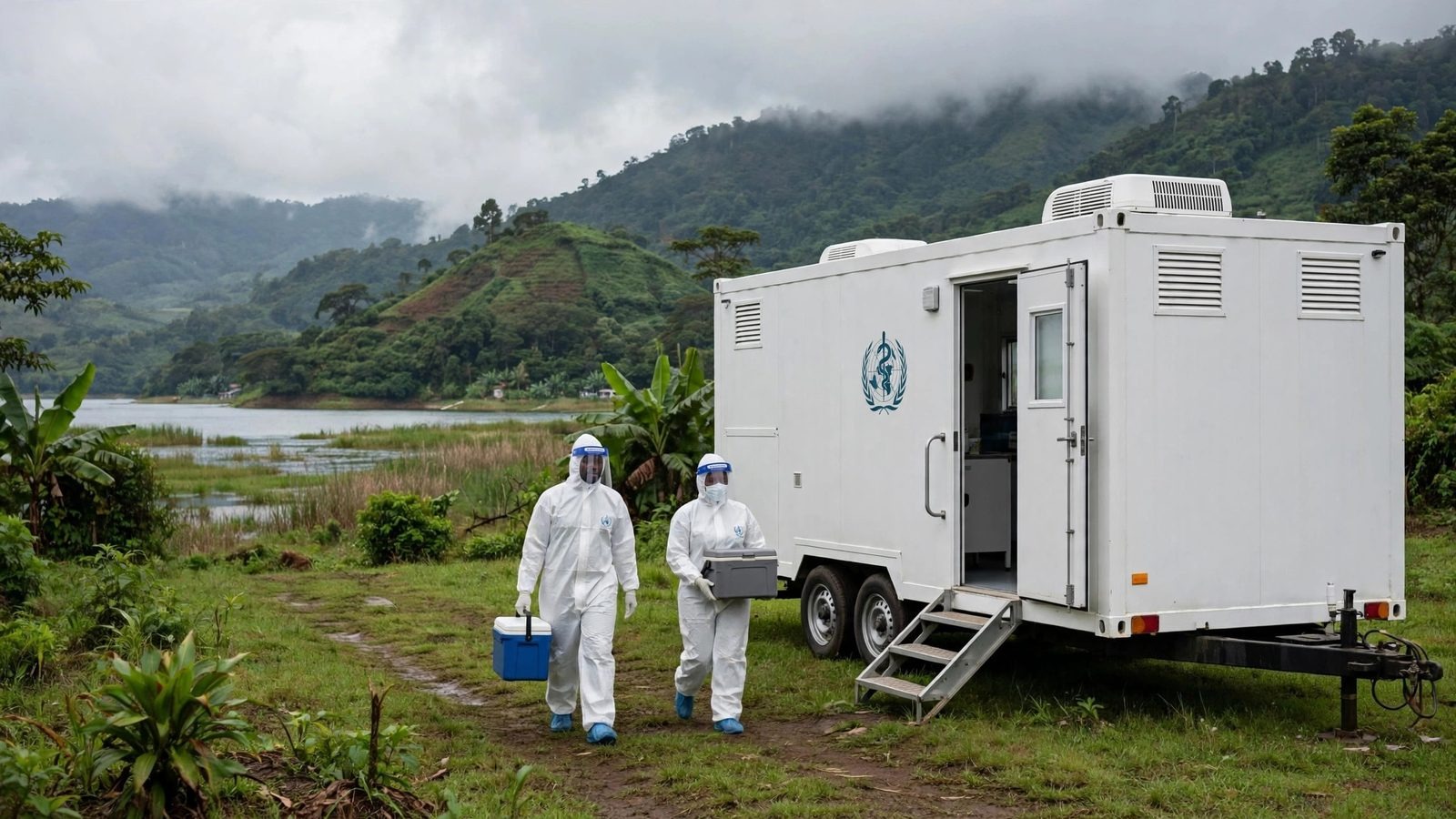
The second-order effects are already visible in policy, not just in case counts. Uganda's 21-day quarantine for its own citizens returning from Congo is a measure with a human cost: traders, drivers and families who cross that border for a living now face three weeks of isolation for a journey that may have taken a day, and the willingness to declare travel honestly will decide whether the rule works or drives movement underground. Kenya's nine cases put its own border posts and hospitals under the same strain, and Nigeria's 44 monitored contacts show how one case multiplies into dozens of people whose movements, work and families are suddenly constrained. The Bureau's earlier reporting on mobile laboratories in eastern Congo and on the financing mobilised around Kenya's cases shows the other side of the ledger: diagnostics and money move, but they move slower than people do. Beyond the immediate neighbours, the risk is reputational as much as medical. Countries that report a case promptly, as Kenya and Nigeria have, invite travel scrutiny and economic friction; countries that hesitate invite a worse outcome. The incentive structure, in other words, punishes transparency in the short term and rewards it only if the continent's response, coordinated this week, is visibly collective rather than a patchwork of national border closures.
When will the region's ministers decide?
On Wednesday, October 28, African health ministers hold a virtual summit to strengthen the continent's collective response. The Africa CDC's director-general, Jean Kaseya, has set the terms plainly: Ebola is crossing borders, and the response must move faster, with stronger coordination, greater solidarity and decisive political leadership. What to watch after the summit is concrete, not rhetorical: whether border screening and information-sharing between Congo, Uganda, Kenya and Nigeria visibly tighten; whether Nigeria's 44 contacts complete monitoring without secondary cases; whether Uganda's quarantine is applied consistently; and what the next situation report from Congo's public health institute shows; whether the curve past 10,000 is bending or still steepening. The Nigeria investigation is the other clock running. Until health officials can say where that patient was infected, every neighbouring country is planning against an unknown route, and the distinction between a case imported by travel and a case acquired locally remains the most consequential unanswered question in the outbreak. The milestone of 10,000 cases is a count of the past five months. The summit, the contact lists and the next situation report will say whether the next five months look like containment or like spread.
The three lenses
West Lens:
From Washington and Europe, the story reads as a race against a clock that keeps shortening. Western wire reporting has centred on the hard numbers, 10,060 cases, 4,887 deaths, and on the comparison with the West African epidemic, treating the milestone as proof that the old containment playbook is being outrun. The emphasis falls on what is missing, a vaccine, a treatment, reliable surveillance, and on the diplomatic machinery, from the World Health Organization's declarations to the movement of patients to European hospitals, that activates when an African outbreak touches Western citizens.
East Lens:
From Singapore, India and the wider Asian information environment, the story reads through the wire and the warning together. CNA's carrying of the Reuters milestone report sits alongside the Asian press's attention to the Africa CDC's October 21 alarm, and the emphasis falls on systems: whether regional bodies, border controls and quarantine rules can hold a virus that has already shown it can cross three countries before a diagnosis. The framing is less about any single country's toll than about whether the continent's collective response, meeting virtually this week, can move faster than the virus.
South Lens:
From Johannesburg, Accra and the African press itself, the story reads first through its costs in the affected areas. South African and pan-African reporting carries the same milestone numbers but pairs them with the conditions that produced them: conflict, poor roads, mistrust and misinformation in eastern Congo, and the strain on Kenya's and Nigeria's health systems as imported cases arrive. The emphasis is on solidarity as a practical matter, shared surveillance, shared laboratories, shared political leadership, because a virus that crosses from Congo into Uganda, Kenya and Nigeria cannot be stopped by any one country's border alone.
The consensus
- What we agree on
- What everyone agrees on: on October 27, 2026, Congo's public health institute put confirmed Ebola cases at 10,060 with 4,887 deaths, passing 10,000 cases in an outbreak caused by the rare Bundibugyo species that was announced in mid-May.
- What we don't agree on
- Where accounts differ: the emphasis varies; Reuters stresses the milestone and the regional spread through Kenya and Nigeria, the Associated Press stresses speed, calling it the fastest-growing Ebola outbreak in history, and the Africa CDC stresses geography, calling it the most geographically widespread outbreak on record.
- What we know
- What is known: the outbreak has surpassed Congo's 2018-2020 epidemic; Kenya has nine cases; Nigeria reported a case last week; Uganda had 20 cases in May and June and was declared Ebola-free in August; and there is no approved vaccine or treatment for Bundibugyo Ebola.
- What we don't know yet
- What is not yet known: where the Nigerian patient contracted the virus; how many cases are going undetected because early cases were confirmed long after symptoms appeared; and whether border screening and quarantine will hold the outbreak inside its current footprint.
- What we expect
- What to expect: the African health ministers' virtual summit on October 28; the next situation report from Congo's public health institute; the results of Nigeria's contact monitoring; and Uganda's enforcement of its 21-day quarantine for returnees with Congo travel history.
Questions, answered
How many Ebola cases has Congo confirmed, and how many people have died?
Congo's public health institute put confirmed cases at 10,060 with 4,887 deaths in its latest situation report on October 27, 2026. That makes this the largest and deadliest Ebola outbreak in Congo's history, and the second-largest ever recorded behind only the 2014-2016 West African epidemic.
Which countries outside Congo have reported Ebola cases in this outbreak?
Kenya has reported nine cases after a man who travelled from Congo via Uganda died in Nairobi. Nigeria became the fourth African country to report a case last week. Uganda had 20 cases in May and June but was declared Ebola-free by the World Health Organization in August and says it currently has no cases.
Is there a vaccine or treatment for this strain of Ebola?
No. The outbreak is caused by the rare Bundibugyo species of Ebola, for which there is no approved vaccine or treatment. The response therefore rests on early detection, isolation, contact tracing, safe burials and supportive care, which is why conflict, poor roads and mistrust make containment so difficult.
What happens at the African health ministers' summit on October 28?
African health ministers meet virtually on October 28, 2026, to strengthen the continent's collective response. Africa CDC director-general Jean Kaseya has called for faster action, stronger coordination, greater solidarity and decisive political leadership, arguing that Ebola is crossing borders and the response must move faster too.