The independent MP for Indi, 65, underwent a second amputation on Wednesday after Monday's deliberate ramming outside her electorate office; 43-year-old Brendan Nugent faced three charges in a Wangaratta courtroom as police weigh attempted-murder charges — and Australia confronts political violence.
Published 21 October 2026 · 20:00 GMT
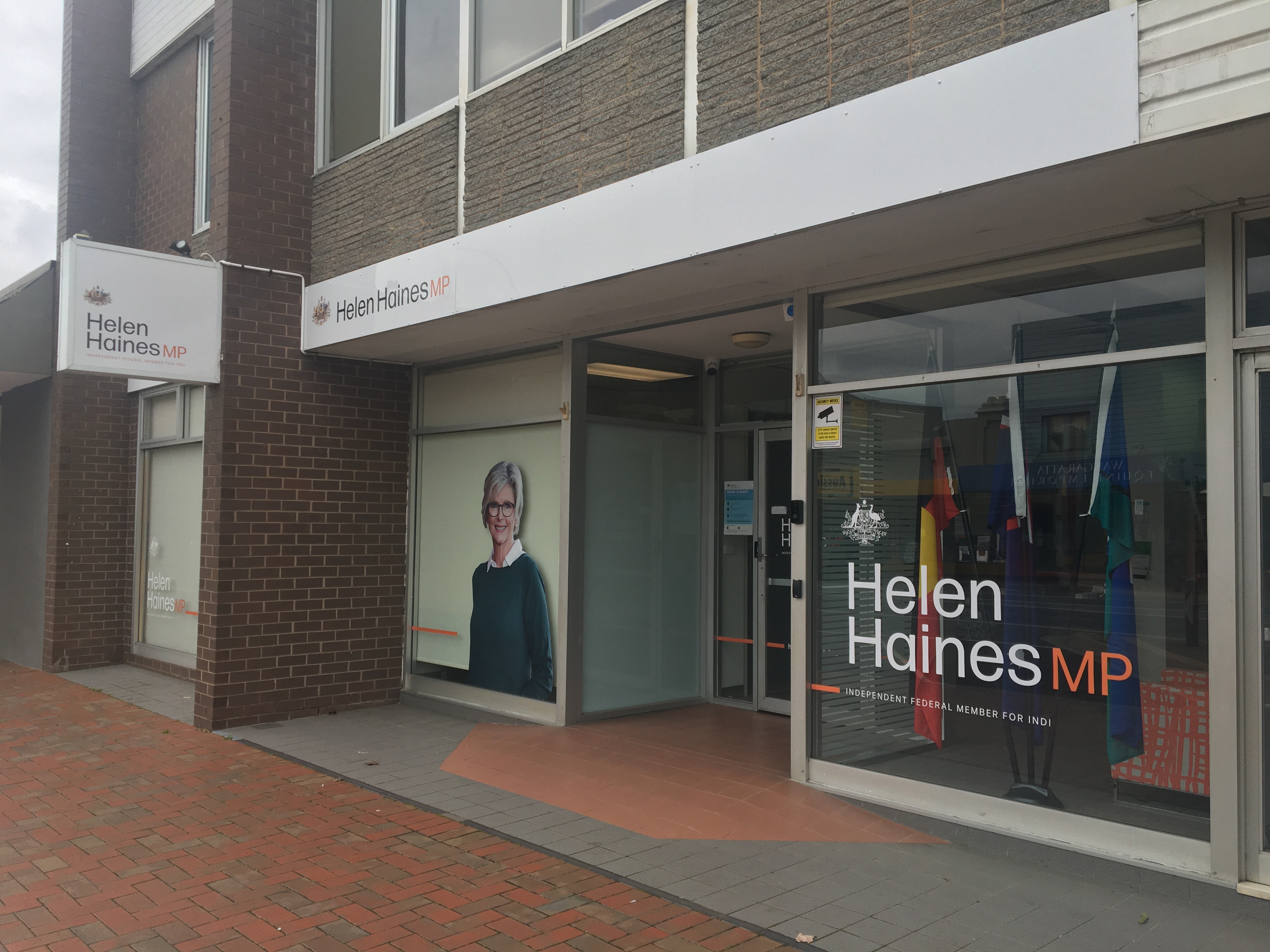
On Wednesday, 21 October 2026, the family of Helen Haines delivered the news Australia had been dreading since Monday afternoon: surgeons in Melbourne had been unable to save the independent MP's right leg. Her left leg had been amputated on Monday night, hours after a white Toyota Land Cruiser deliberately rammed her outside her electorate office in Wangaratta, north-east Victoria. Her husband of nearly forty years, Phil Haines, told a press conference at The Alfred hospital that Helen was alive and stable — her heart and her mind, he said, in "good shape" — but that her road to recovery would be long and difficult.
Hours earlier, in a courtroom some 240 kilometres away, the man accused of driving that Land Cruiser faced justice for the first time. Brendan Nugent, 43, appeared in the Wangaratta Magistrates' Court charged with three serious offences over what police describe as a targeted attack — and was remanded in custody until February. This dispatch follows our earlier reporting on the attack itself; what follows is the verified record of everything that has changed since.
At about 3.35pm local time on Monday, 19 October, Helen Haines — 65, the independent federal member for the rural Victorian seat of Indi — was standing at the rear of her parked car outside her electorate office on Murphy Street in Wangaratta, unloading items from the boot. A white Toyota Land Cruiser drove past her, performed a U-turn, and rammed her, pinning her against her own vehicle. According to Home Affairs Minister Tony Burke, witnesses reported the driver reversed and struck her a second time.
Bystanders rushed to help. Ricky Jefferies, a barber whose shop sits next door to Haines's office, pulled the driver from the Land Cruiser and pinned him down until police arrived; others — Jacklyn Black, Cody Lepoidevin and Jacob Evans, who applied a tourniquet from his car medical kit — tended to Haines as she lay severely injured. Even then, witnesses said, she thanked them; she spoke about her grandchildren. Police recovered a knife from inside the attacker's vehicle.
Haines was airlifted to Melbourne, where surgeons amputated her left leg on Monday night and spent two days trying to save her right. On Wednesday morning they conceded the fight. Her husband said the family had been overwhelmed by thousands of messages of support, and asked that donations go to Save the Children, a charity his wife supports, rather than flowers.
The suspect, Brendan Nugent, 43, from the nearby town of Tarrawingee, is described as an environmental campaigner — and, in the detail that has stunned the community, as a friend of the Haines family for more than two decades. His father, Rod Nugent, released a statement calling Haines "a deeply respected, valued and much loved member of our local community" and the attack "devastating and unfathomable". In court on Wednesday, Nugent did not apply for bail and did not enter a plea. He faces charges of dangerous driving causing serious injury, intentionally causing serious injury, and the federal offence of causing harm to a Commonwealth public official, which carries up to ten years in prison; court filings add cannabis cultivation and possession charges. His lawyer, Chirag Patel, told the magistrate his client suffers from idiopathic transverse myelitis, a rare spinal-cord condition, and was recovering from concussion. He is due back in court on 4 February 2027.
The central unknown remains the motive. Victoria Police, the Australian Federal Police, the domestic intelligence agency ASIO and the joint counter-terrorism taskforce are jointly investigating, and while police describe the attack as targeted and deliberate, they insist it was an isolated incident with no wider threat to the public. Federal Police Commissioner Krissy Barrett said there had been no specific intelligence warning of a threat to Haines.
Police have not named one, and investigators have not ruled out graver charges: attempted murder and even terrorism-related offences remain, in the words of one report, "on the table". Some outlets have pointed to social-media accounts said to belong to Nugent carrying strident political posts; police have confirmed no connection between those posts and the attack, and no motive should be inferred from them. Similarly, the medical conditions raised by Nugent's lawyer — transverse myelitis, concussion, possible undiagnosed mental-health issues — are defence claims made at a first hearing, not findings of any inquiry. Until investigators speak, the "why" of Murphy Street is an open file.
Violent attacks on politicians are vanishingly rare in Australia — a country where federal MPs, state premiers and even prime ministers routinely shop, buy coffee and attend community events with little visible security. That ordinariness is precisely why Monday's ramming has landed with such force: it punctured a national self-image. Prime Minister Anthony Albanese, who described the attack as a "deliberate act", has repeatedly linked it to what he calls an ugly, polarised political climate, warning that "the temperature has undoubtedly been increased" — a theme he returned to as the investigation widened.
The numbers behind the anxiety are real. Al Jazeera's reporting notes that nearly one person is charged each week in Australia for targeting members of parliament, as online abuse and threats against elected officials keep climbing. Haines's case will now become the reference point for a national debate that was already simmering: how does a democracy keep its representatives accessible — the Saturday market, the main-street office with the door open — without leaving them exposed?
To understand the shock, understand the victim. Helen Haines is not a factional warrior but a former nurse, midwife and rural-health academic — a doctorate from Sweden's Uppsala University on childbirth — who entered parliament in 2019 on the back of the "Voices for Indi" community movement, succeeding fellow independent Cathy McGowan in a traditionally conservative rural seat. Her signature achievement is the National Anti-Corruption Commission, which she pursued for years through successive governments until it opened in 2023: an institution built, in her words, to restore the trust "so many Australians have lost". She also channelled funds to housing, rail and health infrastructure for a region she argued the cities had sidelined.
Geopolitics first: Australia's political culture of low-security accessibility is an outlier among wealthy democracies, a legacy of compulsory voting, vast electorates and an egalitarianism that treats MPs as neighbours first. Demographics second: Haines's Indi is a sprawling rural seat where the MP's visibility is the job — the funerals, the school fetes, the main-street office. History third: the country carries recent scars — two police officers were shot dead in nearby Porepunkah last year, an atrocity Haines herself helped the community absorb, as Victoria's police commissioner acknowledged this week. The accelerant, finally, is the same everywhere: social feeds where, as Albanese put it, people write things they would never say face to face. The ramming on Murphy Street sits at the intersection of several of the Bureau's five dimensions: a local act, a national mirror, and one more data point in a global pattern of rising threats against elected officials.
Read against Australia's country profile, the paradox sharpens: a high-trust, high-functioning democracy whose very openness is now its vulnerability. The policy question is not whether to protect MPs — it is how to do so without severing the accessibility that makes independents like Haines possible.
The second-order effects are already moving. Parliamentary security arrangements for MPs — historically light — face a formal review, and the joint investigation's eventual findings on motive will determine whether Nugent faces attempted-murder or terrorism-related charges, each carrying far heavier penalties than the current counts. For Indi, a practical question looms: with Haines facing months of rehabilitation, Australia's parliament must reckon with how a vast rural electorate is served while its member fights to walk again. And institutionally, the National Anti-Corruption Commission — her legacy project — will now operate in a parliament reminded, brutally, of what its integrity champions risk.
Three tracks to watch. First, the investigation: police must establish a motive — or formally conclude none can be — and decide on graver charges. Second, the courts: Nugent remains in custody until the 4 February 2027 hearing, where the prosecution's case will take shape. Third, the patient: Haines's rehabilitation at The Alfred will be long, in her husband's words, and difficult — but the woman who spent three decades delivering rural babies and seven years dragging an anti-corruption commission into existence has never been short of resolve. Australia will be watching whether its democracy can protect the openness that made her.
West — the democracy-under-strain frame. Western outlets have treated Wangaratta as a stress test for a Western democracy: the BBC's reporting from the town dwelt on community grief and the "this is not us" refrain, Reuters foregrounded the rarity of such attacks and the counter-terrorism response, and The Times noted that Governor-General Sam Mostyn is keeping King Charles III — Australia's head of state — regularly updated, a constitutional detail that underscores how seriously the state takes an attack on a Commonwealth official.
East — the quiet wire. No independent East Asian reporting on this week's developments surfaced during verification: targeted searches of CNA, The Hindu, NHK, Kyodo, the Straits Times and the SCMP found no original East-outlet coverage, and this cycle's fetched East digests did not carry the story. Where the story travelled in Asia it did so on Western wires.
South — the global pattern. Al Jazeera English's video report placed Wangaratta inside a worldwide pattern: elected officials facing rising threats, with Australia charging nearly one person a week for targeting MPs. From the Global South vantage, the story reads as a democratic stress test with a mirror image — in much of the world, political violence is a routine hazard of public life; Australia's shock at its arrival is both a measure of what the country has preserved and a warning about what it now risks losing.
On Monday 19 October at about 3.35pm, independent MP Helen Haines, 65, was unloading her car outside her Wangaratta electorate office when a white Toyota Land Cruiser U-turned and rammed her, pinning her against her vehicle; witnesses say the driver reversed and struck her a second time. Bystanders detained the driver until police arrived, and she was airlifted to a Melbourne hospital.
Brendan Nugent, 43, from Tarrawingee near Wangaratta, is described as an environmental campaigner and — remarkably — a friend of the Haines family for over twenty years. He faces dangerous driving causing serious injury, intentionally causing serious injury, and harming a Commonwealth public official, which carries up to ten years, plus cannabis charges. He sought no bail and returns to court on 4 February 2027.
'Targeted' describes the act: investigators say the driver deliberately aimed the Land Cruiser at Haines, twice. 'Isolated' describes the threat picture: police, the AFP and ASIO say there is no evidence of accomplices, a wider plot, or ongoing danger to the public. Anti-terrorism officers are involved as a precaution while the motive remains unknown.
Nugent is remanded in custody until the Wangaratta Magistrates' Court hearing on 4 February 2027. Before then, investigators must settle the motive question and decide whether to add attempted-murder or terrorism-related charges. Separately, Haines begins a long rehabilitation at The Alfred hospital in Melbourne, while parliament reviews security arrangements for MPs.
