Australia's prime minister says the car that critically injured independent MP Helen Haines outside her Wangaratta office performed a U-turn before striking her — 'a deliberate act,' he told ABC News — as counter-terrorism investigators join the case and the 43-year-old suspect faces a mental-health assessment before any police interview.
Published 20 October 2026 · 05:28 GMT
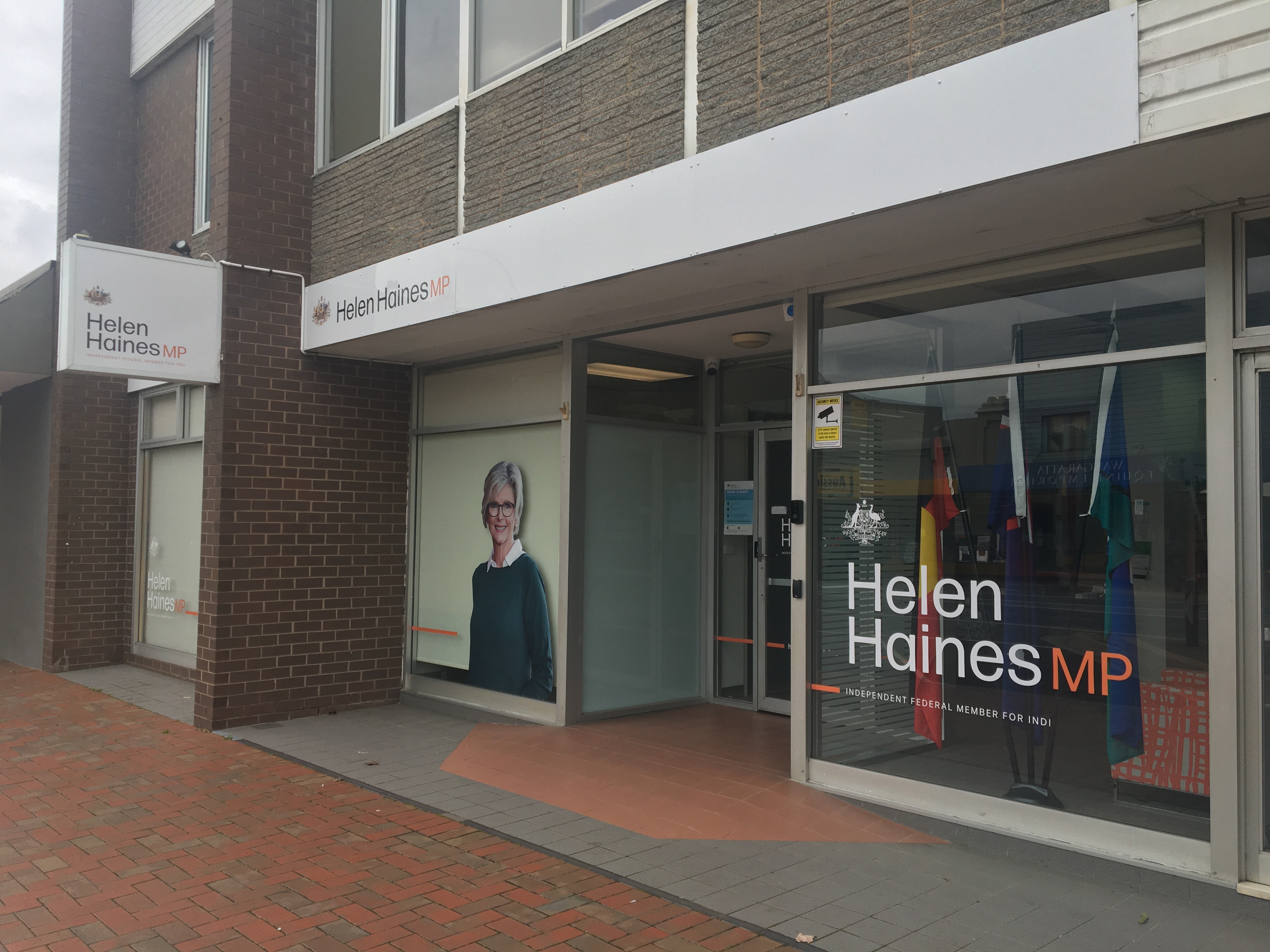
On Monday afternoon, October 19, independent federal lawmaker Helen Haines was getting items from the boot of her car outside her electorate office on Murphy Street in Wangaratta — a regional Victorian city of about 30,000 — when a white Toyota Land Cruiser struck her at about 3:35pm local time. Haines, 65, the member for Indi since 2019, suffered critical injuries and was airlifted to Melbourne's Alfred Hospital, where she underwent emergency surgery overnight.
The decisive new detail arrived on Tuesday morning: Albanese told ABC News the vehicle had performed a U-turn before hitting her — passing where Haines stood, turning around, and driving back toward her. “It's clear that there was a deliberate act here,” Albanese said. “This wasn't an accident, someone just skidding off the road.” The prime minister's account, drawn from early investigative findings, reframes the incident as what the country's leader describes as a deliberate attack on a sitting member of parliament.
The Bureau covered the initial attack on October 19 — see our October 19 coverage of the attack.
The driver. Police arrested a 43-year-old man at the scene after bystanders detained him. Guardian Australia has named him as Brendan Nugent of Tarrawingee, a rural town about 12 kilometres east of Wangaratta. He is known to police and will undergo a mental-health assessment before any police interview. A knife was found inside the Toyota Land Cruiser and seized.
The second strike allegation. Home Affairs Minister Tony Burke told ABC Radio that witnesses said the attacker reversed and struck Haines a second time before a bystander pulled him from the car — a witness claim police have not independently confirmed.
The bystander. Ricky Jefferies, a barber whose shop sits near the scene, ran out after hearing what he described as “a loud bang with no brakes.” He restrained the driver, took a knife from the man's pocket and threw it away. “My wife will be disappointed if I'm injured,” he later told journalists, deflecting the hero label Albanese pinned on him: “that person is a hero today.”
The investigation. The Joint Counter-Terrorism Team has been activated, with the Australian Federal Police, Victoria Police and the domestic intelligence agency ASIO investigating jointly. AFP Commissioner Krissy Barrett said “at this stage it appears this is an isolated incident” with no known further threats. Police are considering potential charges including causing harm to a public official — up to ten years’ imprisonment — while working to establish a motive.
Her condition. Haines remains in critical condition. The ABC and the Sydney Morning Herald, citing unidentified sources, reported she has lost one leg and that doctors are working to save the other. No official source has confirmed those reports; the Bureau treats them as attributed media claims, not fact.
The threat backdrop. Burke cited AFP statistics showing reports of harassing and threatening behaviour toward senior office-holders rose from 951 to 1,067 within a year — more than a thousand in the 2025–26 financial year — which Albanese linked to a coarsening of political discourse. “We all have a responsibility to turn the temperature down,” the prime minister said.
The motive. Nobody — not the prime minister, not the AFP, not Victoria Police — has established why the driver targeted Haines, or whether she was targeted at all rather than struck in a disturbed episode. Albanese has been explicit: “We don't know what the motivation is.” Until the suspect is interviewed, every theory about political grievance is speculation, and the Bureau will not print it.
The relationship, if any. Police said they were examining whether the driver and Haines were known to each other. No answer has been given.
The second strike. Burke's account — reversed, struck again — comes from witnesses relayed by a minister, not from the police investigation's findings. Confirmation is pending.
The injuries. The leg-amputation reports rest on unidentified sources. Haines's family has asked for privacy; the hospital has confirmed only that she remains critical.
The charges. No charges have been announced. The mental-health assessment comes first; the interview second; the charging decision third.
Violent attacks on politicians are vanishingly rare in Factbook: Australia — where federal lawmakers and even prime ministers are routinely seen in supermarkets and coffee shops, chatting with voters under minimal security. That openness is the operating system of Australian politics, and it depends on a background condition of safety that Monday’s events have cracked.
Haines is not a random target of opportunity in the symbolic sense. She is a former nurse and midwife who entered parliament in 2019 through the “Voices for Indi” community movement — the first independent in Australian history to succeed another independent, Cathy McGowan, in the same seat — and she made her name on integrity: working with the Labor government to establish a National Anti-Corruption Commission, championing climate action and regional housing. An attack on a figure known for decency and diligence, in the words of Wangaratta's mayor, lands differently than an attack on a polarising partisan.
And the U-turn matters beyond the forensics. It is the evidentiary hinge of the whole case: the difference between a traffic tragedy and a political attack, between a police matter and a national-security matter. When a prime minister calls it deliberate on the second morning, the state is telling citizens the background condition has changed.
Three things stand out. First, the U-turn is the whole case in miniature. Without it, this is a collision with a knife in the car; with it — a driver passing his target, turning, and returning — it is intent made visible. That is why Albanese led with it on Tuesday morning.
Second, the counter-terrorism activation is doing quiet work. It may be procedural — standard when a public official is attacked and motive is unknown — or it may reflect something investigators have not said. The Bureau notes the ambiguity without resolving it: the AFP's simultaneous “isolated incident” line cuts against the idea of a network, while ASIO's presence keeps the political-motive hypothesis formally alive. Both can be true while the motive is unknown.
Third, the Jefferies intervention is the civic variable the statistics miss. Threat counts (951 to 1,067) describe a deteriorating background; a barber running toward a running engine describes the foreground — the bystander density that still, in Wangaratta on a Monday afternoon, converts horror into restraint within seconds. Australia's open-politics model survived Monday because of people like him as much as because of police.
Albanese told ABC News that early investigations showed the driver passed Haines — who was at her car boot — then “did a U-turn in order to get back to where Helen Haines was.” He called it “very clear” that this was deliberate, refused to speculate on motive, and said he had spoken with Haines's husband Phil the previous night. On Sunrise he called the attack a “test of our character.”
Nearly everything that determines what this was. Motive is unknown. Whether driver and victim knew each other is unanswered. Whether the alleged second strike in reverse actually happened awaits police confirmation rather than ministerial relay. The mental-health assessment must precede the interview, and the interview must precede any charge. The counter-terrorism team's formal role — procedure or evidence-driven — is undisclosed. Until those land, the honest position is the prime minister's own: it was deliberate; why is not yet known.
Security for MPs. Albanese has already flagged that security arrangements are organised around threat levels — and that the threat level has visibly risen. Expect a review of electorate-office security, personal protection assessments for regional MPs, and a budget conversation nobody in Canberra wanted this year.
The discourse debate. The prime minister’s “turn the temperature down” line will now be tested against demands for harder measures: platform accountability, threat-monitoring resourcing, maybe legislation — and the 951-to-1,067 figure will be quoted in every one of those debates.
The integrity legacy. Haines's signature achievement — the National Anti-Corruption Commission — now has a human story attached to its champion. Whatever the motive proves to be, her colleagues will invoke her name in integrity debates for years.
The international mirror. Australia has long marketed its accessible politics as a democratic virtue. One U-turn on a country street in Victoria has put that virtue under the hardest examination it has faced in a generation — and the world's cameras, from Doha to London to Singapore, are watching how Canberra answers.
The sequence is fixed: mental-health assessment, then police interview, then a charging decision. The AFP has promised updates; Victoria Police's Major Collision Investigation Unit remains on the case. Her family and the Alfred Hospital will update her condition — unattributed injury reports remain claims until confirmed.
Beyond the case itself, watch for three things: a formal security review for federal MPs, particularly regional independents; the political fight over online hostility Albanese has opened; and — if charges are laid and a trial follows — the first full public account of why a 43-year-old man from Tarrawingee drove at Helen Haines. That answer will determine whether October 19, 2026 is remembered as a crime story or a turning point. This article was written by the Editor-in-Chief.
Western coverage — led by Australia's own ABC, the Reuters wire, CNN and the Guardian — frames the story as an assault on democratic norms. The emphasis falls on rarity, on Albanese's “turn the temperature down” appeal, and on the institutional response: the counter-terrorism activation, ASIO's involvement, and whether MPs' famously light security footprint survives this. The Times folded it into a global pattern, noting Albanese’s warning about heightened risk “not just here in Australia” but internationally.
At verification time, no original reporting from East-information-environment outlets — CNA, The Hindu, NHK, Kyodo — had surfaced on the U-turn development; targeted searches returned nothing. India-based aggregators (Devdiscourse, NewsPoint) carried the story only as Reuters syndication — the same evidence chain, not an independent one. The Indian-Australian outlet Kendra News covered it with a community-safety angle.
Global South coverage centred on two poles. Al Jazeera's October 20 report led with the AFP's “isolated incident” assessment — the rule-of-law signal that there is no wider threat — while South Africa's Daily Maverick carried the U-turn development itself. The Peninsula Times (South Africa), running the AFP wire, foregrounded Wangaratta's grief: Mayor Irene Grant’s account of a town of 30,000 in “utter disbelief.”
On Monday afternoon, October 19, 2026, independent MP Helen Haines, 65, was struck by a white Toyota Land Cruiser outside her electorate office in Wangaratta, Victoria, while getting items from her car boot. She suffered critical injuries, was airlifted to Melbourne's Alfred Hospital, and underwent emergency surgery overnight. A 43-year-old man was arrested at the scene by bystanders. Police, the AFP and ASIO are investigating jointly, with the counter-terrorism team activated.
On Tuesday morning, Anthony Albanese told ABC News that early investigations showed the car passed Haines, performed a U-turn, and drove back toward her as she stood at her car boot. 'It's clear that there was a deliberate act here. This wasn't an accident, someone just skidding off the road,' he said. The U-turn is the key evidence: it shows the driver returning to his target rather than losing control.
Police have arrested a 43-year-old man, identified by Guardian Australia as Brendan Nugent of Tarrawingee, near Wangaratta. He is known to police and was detained at the scene by bystanders, including local barber Ricky Jefferies, who also removed a knife from the man's pocket. A knife was seized from the vehicle. He will undergo a mental-health assessment before any police interview; no charges have been announced.
No. AFP Commissioner Krissy Barrett said on Tuesday that 'at this stage it appears this is an isolated incident' and that there were no known further threats associated with the attack. Victoria Police said the wider community was not at risk. The counter-terrorism activation is precautionary while the motive — still unknown — is investigated.
Extremely rare. Federal lawmakers, state leaders and even prime ministers routinely appear in public with minimal security — a defining feature of Australian politics. But threats are rising: AFP statistics cited by Home Affairs Minister Tony Burke show reports of harassing and threatening behaviour toward office-holders climbed from 951 to 1,067 in a single year, which is why Albanese urged Australians to 'turn the temperature down.'
