The 65-year-old independent MP for Indi was struck by a four-wheel drive outside her Murphy Street office in Wangaratta on Monday afternoon. A 43-year-old man is in custody, a knife was recovered from the vehicle, and a joint investigation involving the AFP and ASIO is now under way.
Published 19 October 2026 · 09:16 GMT
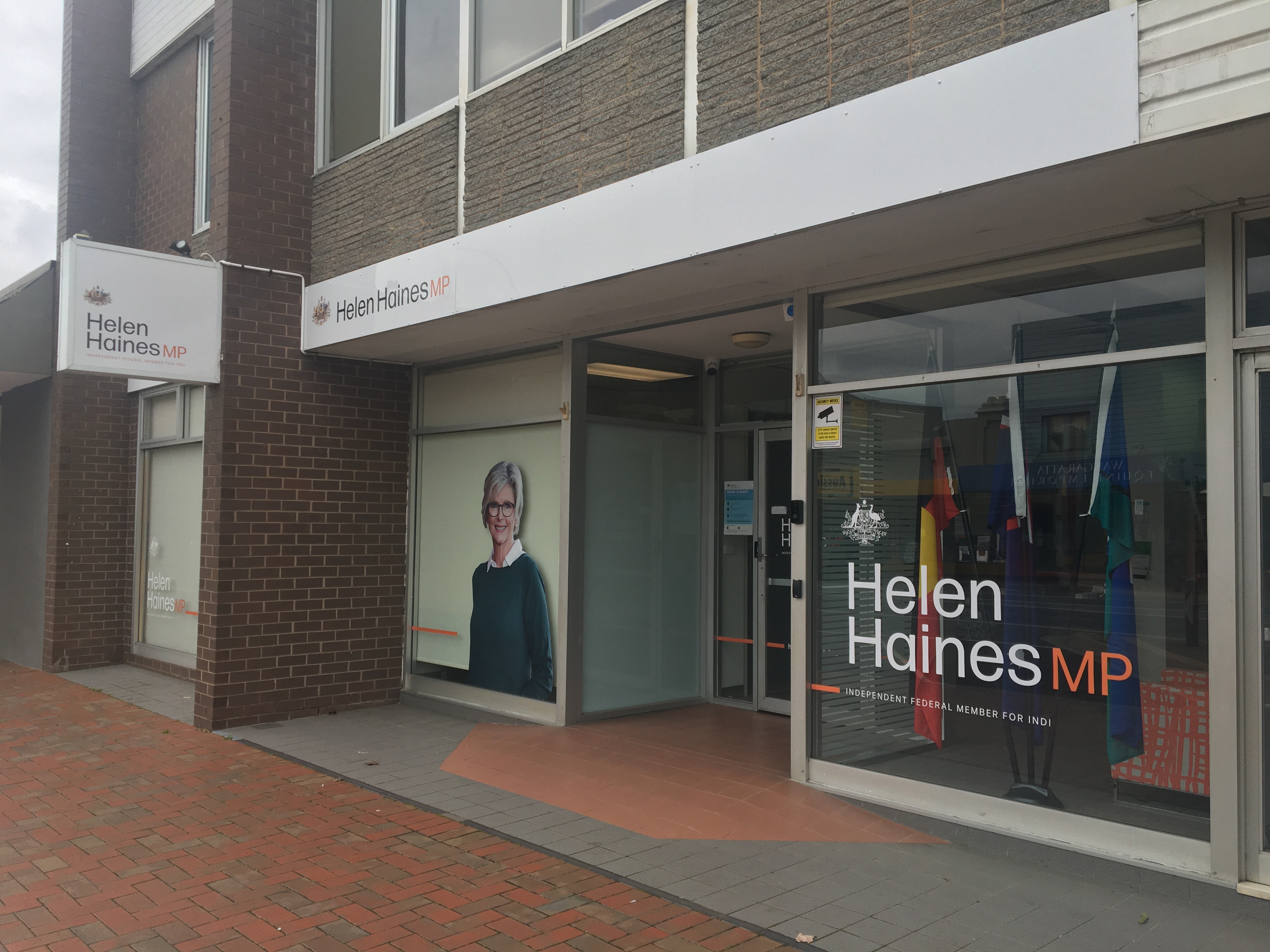
On Monday afternoon, October 19, 2026, independent federal MP Helen Haines was struck by a white Toyota LandCruiser outside her electorate office on Murphy Street in Wangaratta, north-east Victoria, at about 3:35pm local time. The 65-year-old member for the federal seat of Indi was unloading items from the boot of her car in a parking bay when the four-wheel drive hit her, pinning her against the vehicle and inflicting severe lower-body injuries that left her in critical condition.
Police said a 43-year-old man was arrested at the scene, detained by a passerby after exiting the LandCruiser. A knife was found inside the vehicle. The man is being interviewed to determine whether the act was deliberate. Victoria Police said there was no further threat to the public.
Ms Haines was taken to North East Health in Wangaratta, with reports indicating an airlift to Melbourne was being arranged. Prime Minister Anthony Albanese confirmed the incident on Monday evening, describing it as a “serious incident” and announcing a major joint investigation involving Victoria Police, the Australian Federal Police, ASIO and the joint counter-terrorism taskforce. “All of our thoughts are with Helen, her family, her friends, her team, and her community at this extremely difficult time. We are praying for her full recovery,” Mr Albanese told journalists.
The established facts are these. The incident happened in the parking area outside Ms Haines’s own electorate office — not in Canberra, not at a rally, but at the ordinary working address of a regional MP on an ordinary Monday afternoon. Acting Superintendent Ashley Mason of Victoria Police told a press conference that a 43-year-old suspect had been arrested and that police saw no continuing threat to the public. Mr Albanese said it was too early to determine the motive for the attack, while confirming that the joint investigation would draw in the AFP, ASIO and the counter-terrorism taskforce — a deployment that signals investigators are not treating this as a routine traffic collision.
Ms Haines’s family released a statement on Monday afternoon confirming she was receiving medical care. “This afternoon, our beloved Helen was involved in an incident outside her Wangaratta Electorate Office, and is receiving medical care. We thank the swift assistance of bystanders and the dedicated health workers who assisted her, and police for their response,” the statement read. “Our family, and Helen’s staff, will be making no further comment at this time, and ask that their privacy be respected by the public and media. Please keep Helen in your thoughts.”
We do not know the motive — police and the Prime Minister both say it is too early to determine. We do not know whether the act was deliberate; that is the central question of the investigation. We do not know the identity of the 43-year-old suspect, what he was doing in Wangaratta, or what charges he will face. We do not know the precise current medical status of Ms Haines beyond “critical injuries” and the family’s account that she is receiving care. And we do not know what the knife found in the vehicle signifies — weapon of intent, or a coincidence awaiting explanation.
A sitting federal parliamentarian was struck by a vehicle outside her own office in broad daylight. Attacks on elected officials of this kind are vanishingly rare in Australia, a country whose history of political violence is mercifully thin — and the choice of target makes this case impossible to read as random. Electorate offices are among the most exposed points in Australian democracy: open storefronts on main streets, deliberately accessible, staffed by a handful of people, with no security screening. The MP who works there is expected to be reachable. That is the job.
Ms Haines is no backbencher of passing notice. The independent member for Indi sits in the tradition of the rural and “teal” independents who have reshaped Australian politics since 2019: elected on community campaigns, holding regional seats the major parties once took for granted, and wielding outsized influence in a parliament where crossbench votes decide legislation. She represents a swathe of north-east Victoria — farming country and regional towns at the heart of Australia’s A$422bn resource and agricultural economy — and her brand is accessibility: the nurse-turned-MP who lives on a small farm in the electorate and keeps her office door open.
The political world has been here before, elsewhere. When a foiled assassination plot against Poland’s prime minister surfaced, it forced a continent-wide reckoning with how democracies protect their elected leaders. Australia now faces its own version of that question — not as theory, but with one of its MPs in a hospital bed.
Read through the 5D lens, three forces are colliding at once: the physical vulnerability of the regional MP, the signaling power of the state’s response, and the information vacuum in which speculation now breeds.
The first force is structural. Australia’s 227 federal parliamentarians run electorate offices as open-door civic spaces: no perimeter, no magnetometer, no close-protection detail for a backbench MP in Wangaratta. That openness is not an oversight — it is the operating theory of representative democracy in a country that still believes its politicians should be reachable. A vehicle used as a weapon turns that theory into a liability overnight, because the defense that works for a parliament building cannot be retrofitted onto every main-street office in the country.
The second force is the response itself. ASIO, the AFP and the joint counter-terrorism taskforce do not deploy for traffic accidents. Their presence in the investigation — confirmed by the Prime Minister — is the clearest signal yet that investigators are weighing whether this was a deliberate, possibly politically motivated attack. The knife recovered from the vehicle, the passerby who detained the driver, and the open question of intent all sit in that frame. If the evidence firms up toward a deliberate attack on an elected official, the case moves from a collision investigation to the national-security apparatus — and the political temperature rises with it.
The third force is the vacuum. With the motive unknown and the suspect unnamed, the story is being written in real time by whoever fills the silence first. That is why the speed and unity of the official response mattered: the Prime Minister’s evening press conference, the police’s “no further threat” assurance, and the family’s dignified statement were all moves to keep the narrative anchored to verified fact. The contrast with rare enforcement sweeps elsewhere — where the state demonstrates it can act — is instructive: in Australia’s case, the state is demonstrating it already is.
The first-order effect is medical: an MP in critical condition, an investigation in motion. The second-order effects will decide what Australian politics looks like next year. If the attack proves deliberate, every electorate office in the country becomes a security question — and the answer cannot simply be “more guards,” because the rural-independent model that Haines embodies runs on accessibility. Fences around MPs change who becomes an MP: fewer community nurses, more career politicians with security details.
There is also the copycat arithmetic. Political violence is contagious; each incident lowers the threshold for the next. The speed of the official response — the arrest, the joint taskforce, the prime ministerial podium — is partly deterrence theater, and theater has a function: it tells the next would-be attacker that the state is watching. Whether that deterrence holds will be measured not in press conferences but in the quiet months that follow.
The 43-year-old man remains in custody, being interviewed as investigators determine whether the act was deliberate and what charges follow. Remand hearings and a charging decision are the next milestones — and the joint investigation’s composition (Victoria Police, the AFP, ASIO, the counter-terrorism taskforce) means its findings will land with national-security weight. Medically, all eyes are on the anticipated airlift to Melbourne and the family’s updates. Politically, expect a security review of MPs’ electorate offices to be announced within days, and a parliament-wide debate on the cost of keeping representatives reachable in an age of rising threats.
The Western information environment, led by Reuters’ on-the-ground reporting, frames the incident as a democratic-security shock: a deliberately aimed strike on an elected official, a prime minister forced to a podium on a Monday evening, and the immediate question of whether Australia’s open-door parliamentary culture can survive. The through-line is institutional: Albanese’s “serious incident” language, the ASIO and AFP deployment, and the implicit admission that the country’s political class may need a security rethink it has long postponed. The West reads the passerby’s intervention and the knife in the vehicle as the details that will decide whether this enters the record as an attempted political killing.
The Asian information environment, through Singapore’s CNA, reads the story as a law-enforcement operation in a stable democracy under stress: the time (3:35pm), the place (a Murphy Street parking bay), the arrest (a 43-year-old man, no further threat), the procedure (a joint investigation now under way). The framing is state-centric and procedural — a government demonstrating that its security apparatus functions, with the motive question reported as open rather than answered. For an Asia that watches Australian political stability as a regional constant, the emphasis falls on the machinery holding, not on the fracture.
The Global South information environment reads the incident as a mirror. India’s DispatchTimes, covering the story for its own readers, frames it plainly — an independent woman MP, unloading her car outside her office, struck down in daylight — and lets the facts carry the charge. From this vantage, the story is not about Australian exceptionalism but about a pattern democracies everywhere recognize: the elected representative as the softest target, the main street as the least defensible place, and the question every parliament eventually faces — how much protection before the representative stops being reachable.
At about 3:35pm local time on Monday, October 19, a white Toyota LandCruiser struck Helen Haines, 65, the independent federal MP for Indi, in a parking bay outside her electorate office on Murphy Street, Wangaratta. She was unloading items from her car when she was hit, suffering severe lower-body injuries that left her in critical condition. A 43-year-old man was arrested at the scene, a knife was found in the vehicle, and police are investigating whether the act was deliberate.
Helen Haines is the independent federal member for Indi, a large regional electorate in north-east Victoria. A former nurse, midwife and health researcher, she was elected in 2019 succeeding fellow independent Cathy McGowan and re-elected in 2022 and 2025. She belongs to the crossbench of rural and teal independents who have reshaped Australian politics, holding seats the major parties once took for granted and casting decisive votes in a closely balanced parliament.
No. Prime Minister Anthony Albanese and Victoria Police both say it is too early to determine the motive. A 43-year-old man is in custody and being interviewed. Police recovered a knife from the vehicle and are working to establish whether the act was deliberate. The involvement of the AFP, ASIO and the joint counter-terrorism taskforce indicates investigators are treating the possibility of a politically motivated attack seriously.
The Australian Federal Police and ASIO, Australia’s domestic security intelligence service, do not deploy for routine traffic collisions. Their presence — alongside the joint counter-terrorism taskforce and Victoria Police — signals that investigators are weighing whether the incident was a deliberate attack on an elected official. If that proves to be the case, the inquiry shifts from a collision investigation to a national-security matter.
