Two city buses caught fire and public transport was halted in Kramatorsk and Sloviansk after the Thursday morning strike, a day after Russian attacks on Ukraine's power grid killed 22 in Pryluky.
Published 8 October 2026 · 14:07 GMT
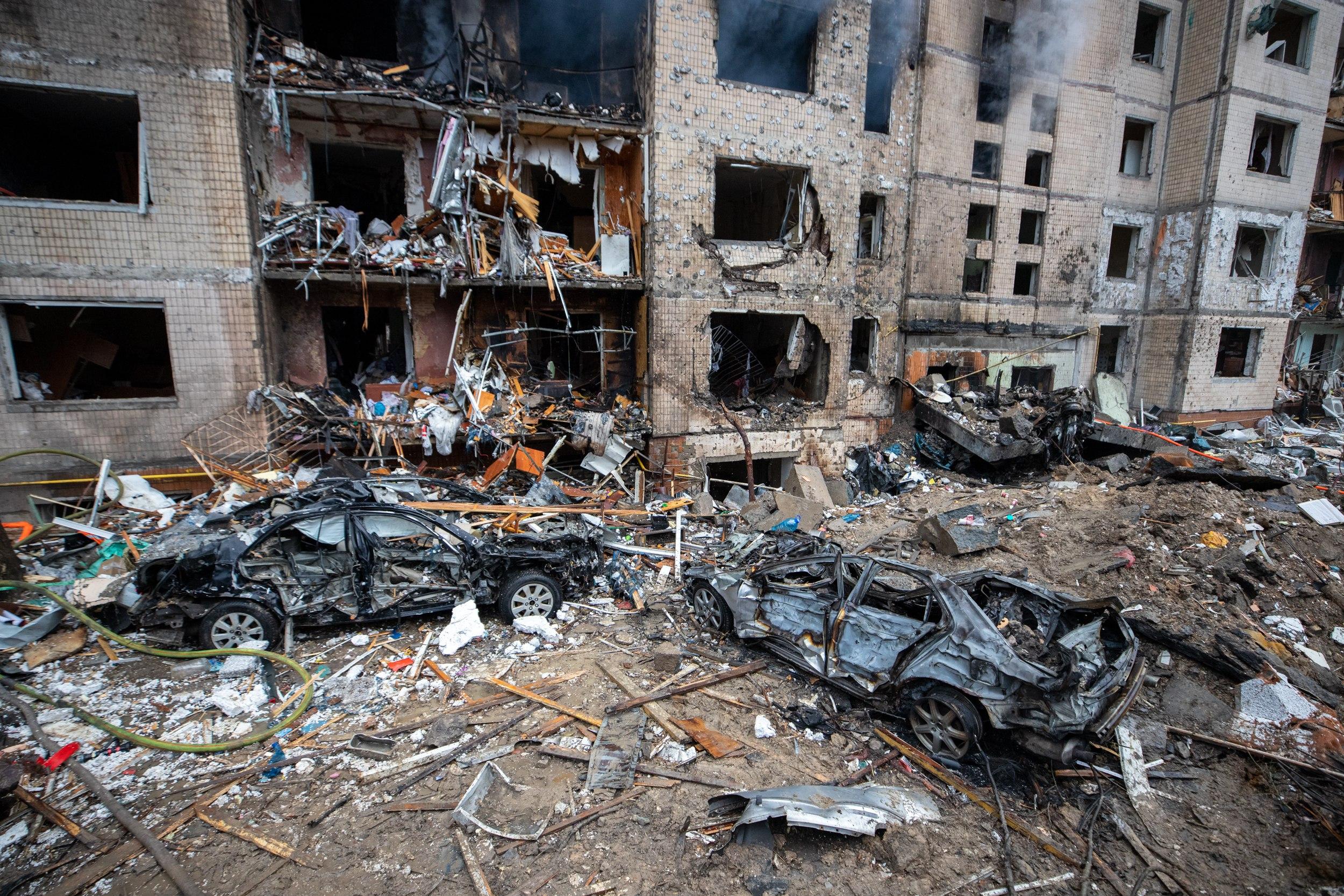
On Thursday morning, a Russian bomb strike hit a street in Kramatorsk, in eastern Ukraine's Donetsk region, at a spot where two city buses were operating. President Volodymyr Zelenskyy described the location as a bus stop. Police images released afterwards showed bodies strewn across a debris-littered street and the charred shell of what had been a bus. The State Emergency Service said the strike caused a fire on two buses and in the surrounding area, and rescue workers moved through the wreckage to help survivors and put out the blaze.
The death toll climbed through the day. Early reports put it at 12 dead and 14 wounded; by afternoon, Ukrainian authorities were reporting at least 30, and by evening the figure stood at at least 33 killed and 18 injured. That made it the deadliest attack from a single strike in 2026, surpassing a mass missile attack on Kyiv in July that killed 33 people across the city in a coordinated barrage. Moscow issued no immediate comment on the Kramatorsk strike.
Several facts are now on the record. First, the target was civilian commuter infrastructure: a street where two city buses were running their routes, at a bus stop by Zelenskyy's account. Second, the strike was part of a wider pre-winter campaign. A day earlier, Russia carried out a massive air attack across Ukraine, primarily targeting the country's power grid; the death toll in the northern town of Pryluky rose to 22, including five children, with at least 54 injured, and blackouts worsened in Kyiv.
Third, the regional response was immediate and sweeping. Vadym Filashkin, head of the Donetsk regional military administration, accused Russia of deliberately targeting civilians, adding that for the attackers a bus full of passengers was an attractive target precisely because a single strike could kill as many people as possible. He ordered the suspension of public transport in Kramatorsk and Sloviansk and urged everyone remaining in the Donetsk region to evacuate to safer parts of Ukraine. Fourth, Zelenskyy warned that Russia will likely escalate daily missile and drone attacks as winter approaches, and appealed to NATO countries for anti-ballistic capabilities, ammunition for combat aircraft and investments in interceptors, saying words of support must take concrete form.
Much remains unconfirmed. The exact munition has not been officially identified: Reuters described a bomb attack, while other reporting pointed to a glide bomb, the converted Soviet-era weapon fitted with satellite-guided wing kits that Russia has been dropping on the Donbas for weeks. Ukrainian authorities have not said whether the buses were the intended target or struck as part of a wider bombardment pattern. The casualty count may still move, as it did through Thursday from 12 to 33. And the strategic intent behind the timing, one day after the grid strikes and deep into the pre-winter escalation, is inferred rather than stated by either side.
Because it collapses the distance between the front line and the daily commute. Kramatorsk is not a contested trench village; it was home to some 150,000 people before the war and, with Sloviansk, Kostiantynivka and Druzhkivka, forms the so-called fortress belt, the backbone of Ukraine's defenses in Donetsk. When public transport stops running there, the city begins to close itself off: workers cannot reach jobs, pensioners cannot reach clinics, and the slow depopulation that evacuation orders aim for accelerates from months to weeks.
It also answers, in the grimmest possible way, the question of what a pre-winter campaign looks like. The day before Kramatorsk, Russian strikes hammered Ukraine's power grid and killed 22 in Pryluky, while the energy system has been under sustained attack for weeks. A grid campaign freezes people; a bus-stop strike terrifies them into leaving. Together they form a two-track pressure on the fortress belt: make the cities unlivable and make them uninhabitable. For Kyiv, the policy consequence is immediate: every such strike renews the argument for more air defense before winter, and for more interceptor ammunition that is already being rationed.
The deeper structure of the Kramatorsk strike is the economics of the glide bomb. A converted Soviet-era bomb fitted with a satellite-guided wing kit costs a fraction of a cruise missile, can be dropped from well behind the front line, and lands with enough precision to matter against a bus stop. Russia has been firing them at Kramatorsk and Sloviansk for weeks, nine in a single day in late August. They are the ideal weapon for a campaign of attrition against cities: cheap, deniable in the fog of war, and terrifying in their randomness.
That economy explains the two-track campaign. Track one is the grid: massive air attacks on power infrastructure that degrade Ukraine's ability to heat, light and run its cities through winter. Track two is the city itself: glide bombs on bus stops, markets and apartment blocks that make daily life unlivable. Neither track takes the fortress belt. Both make holding it more expensive, in lives, in evacuations and in the slow erosion of the civilian base that sustains a garrison city. Filashkin's evacuation appeal is the honest recognition of this math: you cannot defend a city whose buses cannot run.
A city that loses its buses loses its circulatory system. Kramatorsk and Sloviansk are industrial cities whose workers, nurses, teachers and pensioners depend on public transport; suspending it does not just strand people, it converts a functioning city into a place you leave. The evacuation call that follows is the administrative form of what is already happening: the fortress belt holds its ground militarily while its civilian population drains away, which in turn makes the cities cheaper to bombard and harder to supply, a feedback loop that runs in one direction.
There is also a reconstruction shadow. Every bus burned, every route suspended, every resident evacuated is a future cost that will be billed to someone: to Ukraine's state budget, to Western donors, or to no one, which is how cities stay broken. And there is the winter variable. A city without buses in October is a city whose residents must be housed, heated and fed somewhere else by January. The second-order consequence of a bus-stop strike is not measured in the day's toll but in the number of people who decide, this week, that the fortress belt is no longer where their children will grow up.
Four things. First, the casualty count: it moved from 12 to 33 through Thursday and may move again as rescuers clear the wreckage and hospitals report. Second, Moscow's response: silence so far, but a strike this large usually draws either a denial, a claim of a military target, or continued quiet, and the choice will signal how Russia wants this phase read. Third, the grid campaign: the Pryluky toll, the Kyiv blackouts and the Kramatorsk strike form a sequence, and the next 48 hours will show whether the sequence continues or pauses. Fourth, the air-defense ask: Zelenskyy's appeal for anti-ballistic capabilities and interceptor ammunition lands in Western capitals already rationing their own stocks, and the answer will shape how many more winter mornings begin like this one.
The Western lens reads Kramatorsk as a war crime in progress and a test of resolve. In this framing, a glide bomb on a crowded bus stop is not collateral damage but a deliberate instrument of terror, and the response runs through air defense packages, tighter sanctions and the slow machinery of international justice. The lens also absorbs Zelenskyy's warning at face value: winter will bring heavier missile and drone campaigns, and the buses of the Donbas are the first casualties of a season Ukraine must survive on Western interceptors.
This lens tends to treat Russian silence as admission by omission, and to fold the strike into a narrative of strategic bankruptcy: unable to take the fortress belt by maneuver, Moscow punishes the cities it cannot seize. The policy output is familiar and consistent, which is also its weakness: more of the same instruments that have not stopped the glide bombs.
The Eastern lens, such as it is expressed in Russian state-adjacent commentary and sympathetic outlets, treats the strike as an episode in a grinding military operation against a fortified region Russia considers claimed territory. Kramatorsk and Sloviansk are not, in this telling, ordinary cities; they are the last Ukrainian strongpoints in Donetsk, a region Moscow demands Kyiv cede. Civilian casualty claims from Ukrainian officials are received with skepticism and read as information warfare, while Russia's official denial of deliberately targeting civilians is repeated as standing doctrine.
This lens also reads Zelenskyy's appeals as evidence that Ukraine's air defenses are thinning under the pre-winter campaign, and that the pressure on the fortress belt is working. Where the Western lens sees terror, this one sees attrition: a slow, ugly reduction of the Donbas strongholds by every means available, with the evacuation of civilians serving, however grimly, the logic of clearing the battlespace.
The Global South lens sees Kramatorsk through the price of bread and fuel. For much of the world, another deadly strike in the Donbas is background noise in a war that has already been priced into grain markets, fertilizer costs and energy bills, and the moral framing of Western capitals competes with a quieter fatigue: this war has now outlasted many of the emergency measures it caused, and the South's attention is on its own crises, from housing to debt.
But this lens also notices the pattern that Western commentary sometimes skips: the strikes land hardest on the energy system, and energy is the one Ukrainian export the world cannot ignore. A dark, freezing Ukraine in winter is not only a Ukrainian tragedy but a test of whether Europe's energy grid, rebuilt since 2022, can absorb another season of Russian punishment. The South's verdict is pragmatic: fewer statements, more facts, and a watchful eye on whether the war's next phase moves prices again.
On Thursday morning, a Russian bomb strike hit a street in Kramatorsk, in Ukraine's Donetsk region, where two city buses were operating. President Zelenskyy described the location as a bus stop. Police images showed bodies across a debris-littered street and a charred bus shell; the State Emergency Service said two buses and the surrounding area caught fire. Ukrainian authorities later put the death toll at at least 33, with 18 injured, the highest single-strike toll of 2026.
Vadym Filashkin, head of the Donetsk regional military administration, said the security situation had deteriorated so sharply that running buses risked passengers' and drivers' lives. His statement was blunt: the safety of residents of Kramatorsk and Sloviansk comes above all. The halt covers two cities that, together with Kostiantynivka and Druzhkivka, form the so-called fortress belt, the backbone of Ukraine's defenses in Donetsk.
Yes. The Kramatorsk strike came a day after a massive Russian air attack across Ukraine aimed at the power grid, which worsened blackouts in Kyiv and killed at least 22 people, including five children, in Pryluky. Local officials say Moscow has stepped up drone and glide-bomb strikes on Kramatorsk and neighboring cities for weeks; in late August, as many as nine glide bombs were fired at Kramatorsk in a single day.
There was no immediate comment from Moscow on the Kramatorsk attack. Russia denies targeting civilians, though it has repeatedly struck Ukrainian cities, towns and infrastructure since the full-scale invasion began in February 2022. Russia is demanding that Ukraine cede the rest of the Donetsk region still under its control before it stops fighting, a demand Kyiv refuses.
