At least 20 people, including four children in Pryluky, died in an overnight Russian missile and drone assault of about 70 missiles and 130 drones. Kyiv says Moscow timed the carnage to Vladimir Putin's 74th birthday and warns that Russian ballistic missiles remain its gravest threat.
Published 7 October 2026 · 18:00 GMT
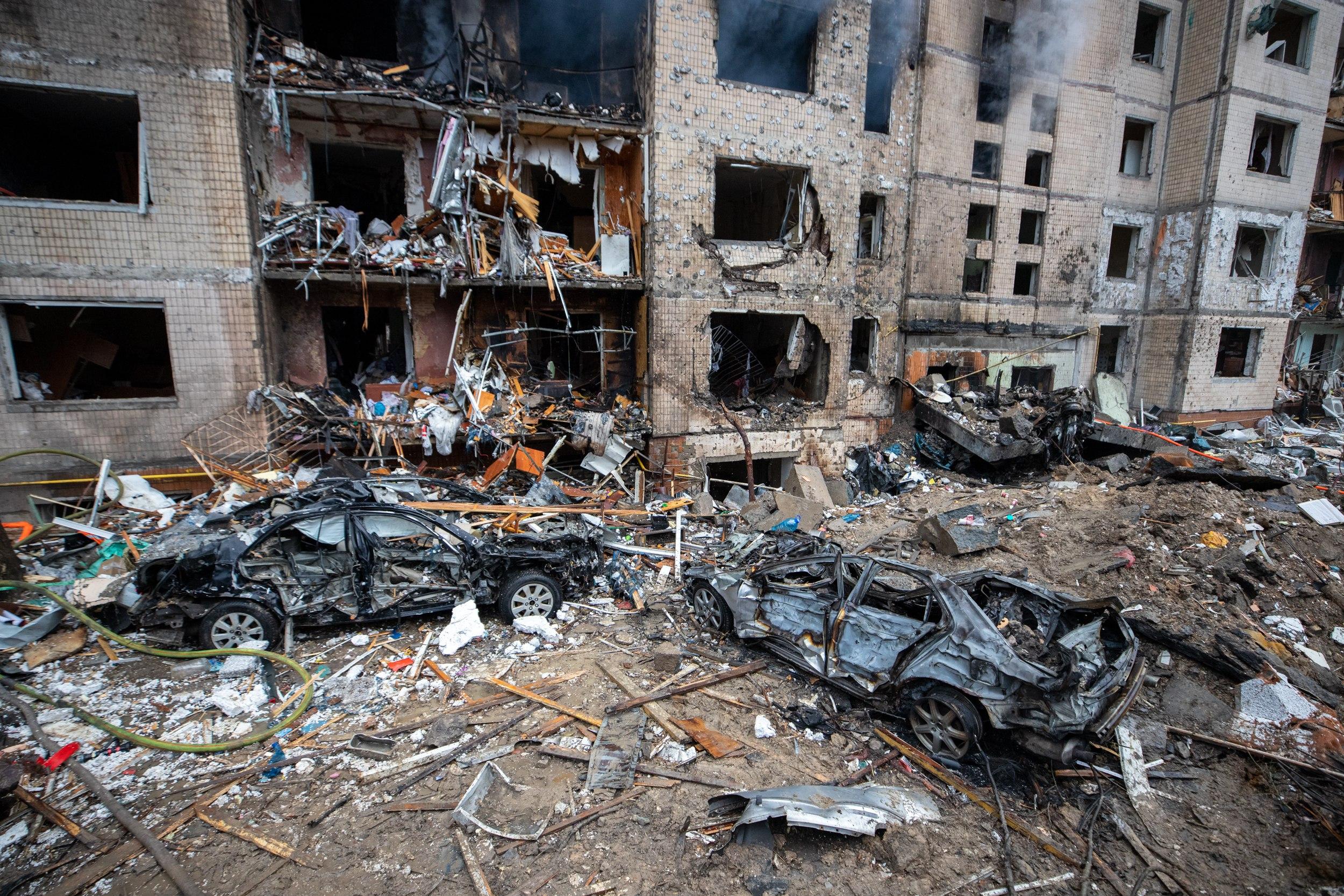
Russia fired one of the biggest aerial barrages of its nearly five-year war against Ukraine overnight, and one missile tore through an ordinary five-storey apartment block in the northern town of Pryluky, killing at least 18 people including four children. President Volodymyr Zelensky condemned what he called one of Russia's 'most vile' attacks, accusing Moscow of striking 'ordinary cities, ordinary life' on the 74th birthday of Vladimir Putin. The Pryluky strike, at about 0330 GMT, left dozens wounded, fifteen people rescued from the rubble and more still unaccounted for. Across Ukraine, at least 20 more people died in the overnight assault, which Kyiv's air force said involved about 70 missiles and 130 drones.
The scale of the overnight assault made it one of the largest of the war. Ukraine's air force said Russia launched 130 drones and 48 cruise missiles alongside ballistic missiles, while EA WorldView reported the total at about 70 missiles, 46 of them jet-powered. Ukrainian units said they intercepted or suppressed 161 aerial targets. Strikes were recorded in Kyiv, Poltava, Dnipropetrovsk, Kharkiv, Chernihiv, Kirovohrad and Zaporizhzhia. In the capital, residents spent hours in deep metro stations as air-raid warnings rolled through the night, and explosions were heard at around 3:15 a.m. local time.
The deadliest single blow fell on Pryluky, a town in the Chernihiv region north of Kyiv. At about 6:30 a.m. local time, 0330 GMT, a missile slammed into one half of a five-storey apartment block, reducing it to a smoking pile of charred concrete and twisted metal while families were asleep. The toll climbed through the day: five killed in the first reports, then nine as police recovered the bodies of three children, then 13, and finally 18 by the afternoon, among them four children. Zelensky named three of them, Oleksandr, Kyrylo and Serhii, all one year old, and eight-year-old Maksym. Fifteen people were rescued, including one child. Dozens were wounded, including seven children, and some residents were still missing.
Moscow calls it a precision strike on the war machine. The rubble of an ordinary five-storey block of flats in Pryluky tells another story.
Zelensky framed the attack as deliberately demonstrative. 'The Russians wanted to strike painfully and demonstratively,' he said, calling it one of the 'most vile' attacks of the war and saying Ukraine had seen it coming: he had warned on Tuesday evening of a 'massive' Russian strike targeting energy infrastructure. On social media he wrote: 'Today, on Putin's birthday, the Russian army presented him with the destruction of a residential block in Pryluky,' adding that 'the continued use of missiles against Ukraine, against our people, our children, is an absolutely deliberate choice of terror.' Foreign Minister Andrii Sybiha went further: 'On Putin's birthday, Russian generals brought him his favourite present: war crimes,' he wrote, adding that 'his ultimate present will be a dock in The Hague,' as Kyiv prepares a Special Tribunal for the Crime of Aggression Against Ukraine.
The carnage spread well beyond Pryluky. In Kyiv, two people died in a fire caused by a strike in the densely populated Darnytskyi district, and an office and warehouse building was destroyed by fire in the Podilskyi district, according to Mayor Vitali Klitschko. Ukrainian police posted images of what they said was an unexploded Russian Iskander missile lying in open land surrounded by Kyiv apartment blocks; BBC Verify confirmed the images were genuine. In Kremenchuk, in the Poltava region, two people were killed and seven injured while emergency crews continued a rescue operation. Zelensky said Russian strikes damaged five apartment buildings in Dnipro and four high-rise buildings in Kremenchuk. Two more people were killed in Oleksandriya, and two were injured in Kharkiv. Zelensky said one of the 'key targets' of the night was Ukraine's energy infrastructure.
Kyiv had warning but could not prevent the toll. Zelensky's unusually direct alert on Tuesday evening urged residents to heed missile warnings and said air defences would do what they could 'within the limits of their available capabilities.' Klitschko had warned a week earlier that the capital should be on a war footing after repeated strikes on bridges and energy infrastructure, a campaign that followed earlier Russian assaults on Ukraine's energy grid. Scheduled power cuts plunged parts of Kyiv into darkness on Tuesday to ease the pressure on the battered grid, and generators cranked into life across the city. Ukraine's parliamentary human rights commissioner, Dmytro Lubinets, wrote on Telegram: 'Another sleepless night, another act of terror, after which people still have to plan their working day despite everything.'
Ukraine answered in kind, at long range. Zelensky said Ukrainian forces struck two oil facilities and a training ground in Russia's Perm, Samara and Astrakhan regions over the past day, adding: 'There was also a response in the Black Sea.' Large fires broke out at a major oil pipeline and storage facility in the Samara region, southeast of Moscow, with satellite fire-detection systems recording multiple hotspots. On Tuesday evening, footage emerged of an oil tanker burning off Sochi on Russia's Black Sea coast: Russia's transport ministry said unmanned boats attacked the Liberian-flagged Aframax Rio, and the crew was rescued. EA WorldView reported the vessel is on Ukraine's sanctions list as part of Russia's so-called shadow fleet. The Black Sea saw a wider escalation on Tuesday, when two civilian vessels were hit in Bulgaria's exclusive economic zone: the Togo-flagged Alfa Watan was struck by a drone and sank about 70 nautical miles east of Byala, and a second grain-carrying vessel was hit, its 18 crew rescued. Zelensky said a joint check with Bulgaria's navy found Russia responsible; Bulgaria's prime minister, Rumen Radev, said it was unclear whether the drones came from Russia or Ukraine.
In Pryluky, the survivors' accounts spoke of an ordinary morning turned to rubble. 'We were at home, sleeping,' Olena Sayun, a 40-year-old massage therapist, told AFP at the scene. 'Our windows blew out. Thank God, we covered the child with our bodies.' Yuliia Shamrai, 31, who works in online marketing and lives near the stricken building, said: 'I don't see any military significance in this at all. Just to break people, the civilian population that was peacefully sleeping.' In Kyiv, bank worker Iryna Rybalchenko spent the night on a metro platform wrapped in a hoodie. 'The whole of Kyiv is in a state of fear,' she told AFP. And Daria Medvedeva, 36, described what the nights do to children: 'The children were absolutely terrified.' Kyiv has faced calls for tighter Western sanctions on Russia after earlier strikes, and this night is expected to sharpen those demands.
By Wednesday evening, rescue operations were still under way in Pryluky, and officials warned the toll could rise as the missing were unaccounted for. Zelensky's government will use the scale of the attack to press Washington and European capitals for more air defence, with Patriot missiles at the top of the list. Kyiv's own long-range campaign against Russian oil will continue in parallel, and the European drone-defence money announced on Wednesday will take time to reach the front. For now, Ukraine heads into winter with its grid battered, its skies contested, and a town in the Chernihiv region digging neighbours out of the concrete.
The Western reading treats the night as a deliberate escalation in terror against civilians, and the birthday framing as its proof. Zelensky's phrase, 'one of the most vile' attacks, is taken at face value: a five-storey apartment block has no place on any credible military target list, and Russia's silence about Pryluky speaks louder than its claims about Fire Point's Flamingo missiles. In this view, Moscow's defence ministry list of military-industrial targets is a standard post-strike alibi, and the BBC-verified Iskander wreckage in a Kyiv residential district fits a pattern of indiscriminate bombardment.
That reading drives the policy prescription: more air defence, more pressure, and accountability. Zelensky's plea for Patriot missiles every day, the European Commission's €1.24 billion drone-defence package, and Foreign Minister Sybiha's promise of a Hague dock for Putin all belong to the same logic. Von der Leyen's line that 'Russia is pursuing a deliberate strategy of terror' is not rhetoric in this lens, it is the operating theory of the war, and the answer is to make the cost of terror unbearable.
In Moscow's telling, the night was a legitimate operation against Ukraine's war machine, and the 'birthday gift' framing is Kyiv's propaganda. Russia's defence ministry said it struck military-industrial targets with high-precision weapons, naming Fire Point's production of Flamingo cruise missiles and long-range drones, facilities that only matter because Ukraine is building a domestic strike industry after firing its first home-made ballistic missile last week. From this side, the energy infrastructure Zelensky calls civilian is the grid that powers that industry, and the timing is explained not by Putin's birthday but by retaliation for Ukraine's own strikes on Russian oil refineries and shadow-fleet tankers.
This lens also disputes the Western legal framing entirely. Sybiha's promised Hague tribunal is, from Moscow's vantage, a non-starter: Russia does not recognise the court's jurisdiction, and it points to Ukrainian drone attacks on Russian cities, including the fatal Moscow-region strike the day before, as evidence that the aerial war runs both ways. The civilian dead in Pryluky, in this reading, are either collateral damage of a strike on a legitimate target nearby or, at worst, the fog of a war Kyiv keeps escalating with Western weapons.
The Global South reads the night first through exhaustion and double standards. Four dead children in Pryluky are a horror by any measure, but in capitals from Jakarta to Dakar to Mexico City, the story lands alongside years of unheeded calls for negotiations and a gnawing sense that Western grief is selective. The same week Ukrainian cities burn, the war also burns oil: Samara's refineries ablaze, tankers attacked in the Black Sea, Bulgaria's waters now a hazard. For importers of energy and grain, the aerial duel means prices, and prices mean politics at home.
This lens is also where diplomacy is missed. No major Global South capital believes Patriot batteries or €1.24 billion drone packages bring the war closer to an end; they see two war economies feeding each other while civilians pay. Turkey's grain-corridor diplomacy is a memory, India's cheap-Russian-oil pragmatism continues, and the verdict from the South is blunt: the powerful will keep trading strikes on birthdays and refineries, and the rest of the world will keep counting the cost in fuel, food and funerals.
At least 18 people were killed in Pryluky when a missile hit the five-storey apartment building, including four children, three of them one year old and one aged eight. Fifteen people were rescued from the rubble and dozens were wounded, including seven children. Some residents were still missing by evening, so officials warned the toll could rise.
The barrage fell on 7 October, Putin's 74th birthday. Zelensky said the Russian army 'presented' Putin with the destruction of the Pryluky building, calling the attack deliberately demonstrative and one of the war's 'most vile.' Foreign Minister Sybiha added that Russia's generals gave Putin 'war crimes' as his favourite present, promising him a dock in The Hague instead.
Partially. Ukraine says it intercepted or suppressed 161 aerial targets overnight, but ballistic missiles remain the hardest to stop, and new jet-powered drones are faster than older models. Zelensky says Patriot missiles are a 'vital necessity' and Kyiv hunts for them daily. The EU announced €1.24 billion for Ukrainian drones and interceptors the same day. More on Ukraine's defences.
Yes. Zelensky said Ukraine hit two oil facilities and a training ground in Russia's Perm, Samara and Astrakhan regions, with more action in the Black Sea, where an oil tanker burned off Sochi. Large fires were also reported at an oil pipeline and storage site in Samara. Two civilian ships were hit in Bulgaria's Black Sea zone; Zelensky blamed Russia, Sofia said the origin was unclear.
