Respiratory illnesses rise in Gaza with worst to come as winter floods arrive, WHO says
Acute respiratory infections are already 33,000 cases above last year’s level, the World Health Organization says, and the worst of the winter has not yet arrived. Nearly one million displaced people are living where the water will go.
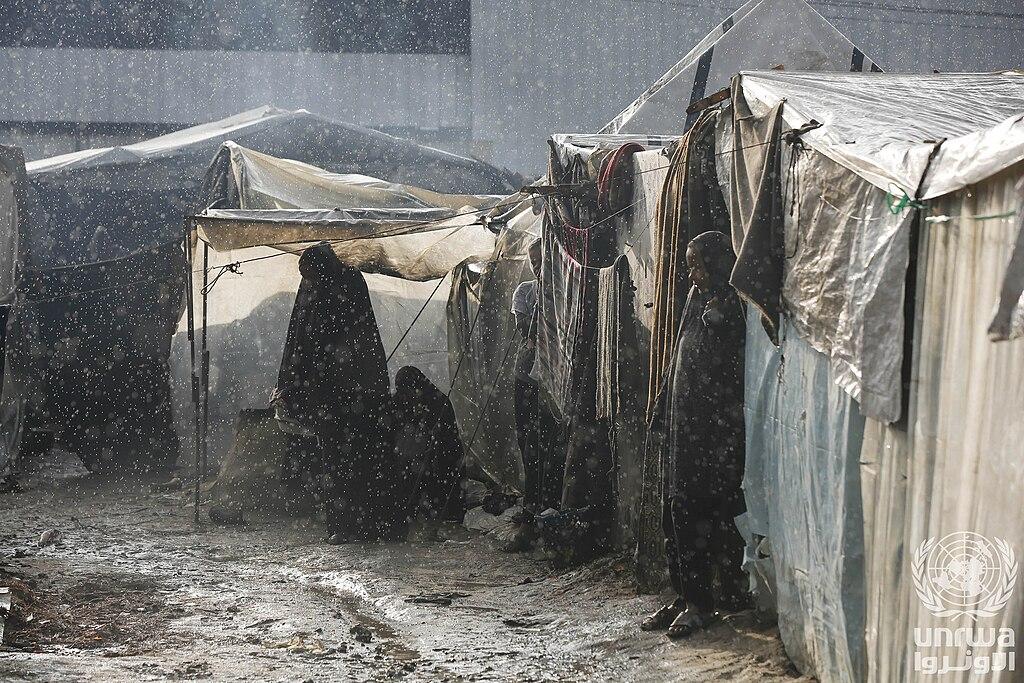
Key points
- The WHO warned on Friday 13 November 2026 of surging respiratory illnesses in Gaza, with worse expected as winter sets in. Reuters via The Hindu, 15 Nov 2026
- Acute respiratory infections are 33,000 cases higher than at the same time last year. WHO, 13 Nov 2026
- Respiratory infections make up 11% of all medical consultations in Gaza. WHO, 13 Nov 2026
- Nearly one million displaced people live in flood-exposed areas; 400,000 are at extremely high risk. WHO, 13 Nov 2026
- A nine-month-old baby, Kinan Ahmed Raqiq, died of severe hypothermia in al-Mawasi, Khan Younis, on 12 November; the first cold-weather death of the winter. Gaza Health Ministry via The National, 13 Nov 2026
Three readings of the same result
Same facts, different frames. Each reading names its outlets and what it emphasizes.
The story reads as a test of whether the ceasefire can hold a humanitarian line.
The Reuters reporting that carries the WHO warning pairs the health numbers with the military’s account, the Yellow Line as a security measure, COGAT’s tents and trucks as evidence of a winterisation plan under way, and leaves the reader to weigh the agency’s figures against the official response.
Key detail The frame is verification: what is documented, what is disputed, and what the next rain will prove.
The same warning reads through the system and the season.
The Hindu and The Japan Times carry the WHO briefing as a health story with a calendar attached: the numbers before winter has set in, the flood exposure of nearly a million people, the standing water and the mould that follow.
Key detail The emphasis falls on the conditions that turn weather into disease, crowding, damp, poor ventilation, and on the months still ahead.
The story reads through the tents themselves.
Al Jazeera’s reporting from Gaza City follows families like Amira Saad’s, whose shelter flooded while her four-month-old baby slept, soaking the mattresses and blankets; The National records the first death of the winter and the sand bank that buried tents in central Gaza.
Key detail The frame is lived consequence: what the numbers mean at night, in the rain, for people with nowhere dry to go.
Sources by lens: 0 West, 3 East, 4 Global South. See every source
The story
What did the WHO warn on Friday; and what has already happened in the camps?
The World Health Organization warned on Friday 13 November 2026 that respiratory illness is surging across Gaza, and that the worst is still to come. Heavy rain has already flooded tens of thousands of tents sheltering displaced Palestinians, and the agency expects cold weather, flooding, overcrowded shelters and poor ventilation to push infection numbers higher still.
“The numbers already show the pressure. Acute respiratory infections are 33,000 cases higher than at the same time last year,” Dr Reinhilde Van De Weerdt, the WHO representative in the Occupied Palestinian Territory, told reporters in Geneva from Jerusalem. Respiratory infections now make up 11% of all medical consultations in Gaza.
The warning arrived days after the first real test of the winter: a nine-month-old baby, Kinan Ahmed Raqiq, died of severe hypothermia in his family’s tent in al-Mawasi, Khan Younis, on the night of 12 November; the first cold-weather death of the season, according to the Gaza Health Ministry.
What do the WHO’s numbers show about who is exposed?
Nearly one million displaced people in Gaza are living in flood-exposed areas, and 400,000 of them are in locations the WHO considers at extremely high risk. About 1.4 million people, 65% of Gaza’s population, live in tents or temporary shelters, according to the UN Office for the Coordination of Humanitarian Affairs, and 94% of the population urgently needs shelter assistance.
The mechanics are plain, and the WHO laid them out without hedging. Damp shelters breed mould and bacteria, which drive respiratory infections, especially in young children. Crowding spreads viruses faster between people. Flood water mixes with sewage and uncollected waste, raising the risk of waterborne disease, while standing water gives mosquitoes and pests new places to breed.
The squeeze has a geography. The WHO said the pressure has worsened as the Israeli military advances the “Yellow Line”, the demarcation established under October’s US-brokered ceasefire, pressing Gaza’s population into an ever-smaller area. “That means people are living in more crowded conditions, where of course the spread between humans of a virus is much more prone to spread,” Van De Weerdt said.
The first storm already showed what the season can do. Gaza’s first winter storm killed five people and flooded 70,000 tents, and a sand embankment collapsed onto tents in central Gaza on 7 November, killing several people, including children. UNICEF said flooding on 9 November alone affected more than 106,000 people.
The Israeli military told Reuters the Yellow Line aims to protect Israeli civilians and army troops from threats, that adjustments to its location follow the ceasefire agreement and international law, and that it is not intended to harm the civilian population. The Israel Defense Forces, it said, “categorically rejects the claim that it operates to deliberately reduce the area available to the civilian population in the Gaza Strip.”
COGAT, the Israeli military agency that coordinates aid, said more than 93,000 tents and over 8,600 trucks carrying tarpaulin sheets, blankets and winter clothing have entered Gaza since the Board of Peace, UN agencies and non-governmental organisations launched the winterisation plan. Equipment for reconstruction, it added, will be permitted to enter only after Hamas has been fully disarmed.
The numbers already show the pressure. Acute respiratory infections are 33,000 cases higher than at the same time last year,
What can nobody yet say about how bad this winter will get?
Nobody can yet say how high respiratory infections will climb, or when they will peak. The WHO’s warning is a direction, not a forecast: the 33,000-case rise and the 11% share of consultations describe where Gaza stands before winter has fully set in, not where it will land in January or February.
It is also unclear how much shelter will survive the season. Tens of thousands of tents have already flooded once; whether replacement tents, tarpaulins and winter clothing arrive fast enough depends on the crossings and on the winterisation plan holding through months of rain; and on whether the health system, already operating at its limits, can absorb a respiratory peak on top of everything else.
Nor is it settled how far the Yellow Line will move. The Israeli military says adjustments follow the ceasefire agreement; the WHO says each advance squeezes more people into less space. What that means for crowding, and therefore for transmission, over the coming months is still an open question.
Why does a respiratory warning carry this much weight in Gaza?
Because in Gaza, a respiratory infection is rarely just a cold. It lands in a population where most people sleep in tents or damaged shelters, where clean water and waste disposal are unreliable, and where the health system has spent three years of war running on generators, spare parts and improvisation. A virus that would mean a week in bed elsewhere can mean a hospital bed that does not exist here; or a child whose body cannot fight both cold and infection at once.
Children carry the sharpest edge of it. UNICEF says 650,000 children need winter aid, including warm clothing and blankets, and it is seeking $97.5 million for its 2026–2027 winter response for 540,000 children and their families across Gaza and the occupied West Bank. At least 11 children died of hypothermia last winter, according to the Gaza Ministry of Health. The nine-month-old who died on 12 November is the first of this winter; the question the WHO is raising is how many follow.
There is also a clock running. This is Gaza’s fourth winter of the war, and the agencies’ own figures show the gap between need and supply widening rather than closing: by September, aid agencies had secured enough winter clothing for just 9,000 households and bedding for 50,000. Winter does not wait for negotiations.
How do weather, war and a shrinking map combine into a health crisis?
Read through the five dimensions, the warning is not really about rain. It is about what rain meets. Geopolitically, the ceasefire’s Yellow Line has redrawn where two million people may live, and every adjustment concentrates them further. Economically, the winterisation plan is a race between tents and trucks on one side and the calendar on the other, with reconstruction equipment held back until Hamas is disarmed. Demographically, the exposed population is overwhelmingly displaced families and children. Historically, this is the fourth winter, and the pattern of the previous three, cold deaths, flooded camps, infections climbing, is already repeating. Technologically, the health system has no slack left: no spare capacity, no buffer stock, no margin for a surge.
That is why the WHO’s language is unusually blunt. “It is shocking that just a few days of rain really showed us what the coming months will bring. And winter has not even fully set in. The worst really is yet to come,” Van De Weerdt said. A few days of rain functioned as a rehearsal, and the rehearsal flooded tens of thousands of tents. The analysis that follows is simple: if a rehearsal does this, the performance will do more.
What changes once the infections peak and the camps flood again?
The first consequence is clinical: clinics already seeing respiratory infections in 11% of consultations will see that share rise, and a health system at its limits will have to choose, quietly and daily, between the newly sick and the chronically ill. The second is logistical: every flooded tent is a replacement that must cross a checkpoint, and every checkpoint delay is a family sleeping wet for another night. The third is political: 53 UN member states have already urged Israel’s incoming government to lift aid restrictions and open all crossings and land routes, and each new death or flooded camp hardens that demand; and the resistance to it.
There is also a slower consequence, the one that outlasts the winter. Children who survive repeated respiratory infections in damp, crowded shelters carry the damage forward; missed schooling, weakened lungs, families spending what little they have on medicine rather than food. A winter like this one does not end in spring; it compounds.
The aid system’s answer, so far, has been to measure success by what actually arrives: a new network aims to fix Gaza’s last mile, tracking deliveries rather than promises. Whether that discipline spreads will shape how many tents and blankets reach the camps before the next storm.
What should we watch for in the coming days and weeks?
Watch the crossings first. The WHO is asking for permission to bring in tents, plastic sheeting, clean water supplies and waste-management materials, alongside laboratory equipment, medical devices, spare parts, generators and fuel. Whether those permissions come, and how fast, will decide how many of the 400,000 people at extremely high flood risk sleep dry. Watch the case counts next: the WHO’s own figures will show whether the 33,000-case rise steepens as the cold deepens. And watch the rain: the drains that failed in the first storm face the next one, and Gaza’s broken drains left 350,000 people under water when the season opened.
What we agree on, and what remains open
Established
- The WHO warned on 13 November 2026 that respiratory illness is surging in Gaza.
- Acute respiratory infections are 33,000 cases above the same period last year, make up 11% of all consultations, and nearly one million displaced people live in flood-exposed areas, 400,000 of them at extremely high risk.
Contested
- On whether the aid entering Gaza is enough; COGAT counts more than 93,000 tents and 8,600 trucks of winter supplies since the winterisation plan began, while the WHO, UNICEF and OCHA describe needs far beyond what has arrived.
- On the Yellow Line, which Israel describes as a security measure and the WHO describes as a squeeze that accelerates transmission.
Still open
- How high respiratory infections will peak, whether tents and winter supplies will arrive fast enough, how far the Yellow Line will move, or whether Gaza’s health system can absorb a winter surge on top of three years of war.
What to watch
Questions, answered
The WHO points to a combination of cold weather, flooding, overcrowded shelters and poor ventilation. As the Israeli military advances the Yellow Line, Gaza’s population is squeezed into less space, so viruses spread faster between people. Damp shelters also breed mould and bacteria, which drive respiratory infections, especially in young children. Respiratory infections now make up 11% of all medical consultations.
Nearly one million displaced people live in flood-exposed areas, and 400,000 of them are in locations the WHO considers at extremely high risk. About 1.4 million people, 65% of Gaza’s population, live in tents or temporary shelters, and 94% of the population urgently needs shelter assistance, according to the UN humanitarian office. Flooding on 9 November alone affected more than 106,000 people.
The Yellow Line is the demarcation established under October’s US-brokered ceasefire, marking the area under Israeli military control. As the military advances it, Gaza’s population is pressed into an ever-smaller area, and the WHO says the resulting crowding accelerates the spread of respiratory viruses. Israel says the line protects civilians and troops and follows the ceasefire agreement and international law.
The WHO is asking for permission to bring in tents, plastic sheeting, clean water supplies and waste-management materials, alongside laboratory equipment, medical devices, spare parts, generators and fuel. The agency says these supplies are needed before the winter peak, when respiratory infections are expected to rise further. It has also warned that Gaza’s health system is already operating at its limits.