Gaza's broken drains leave 350,000 people under water as the first winter storm hits
Seventy thousand tents flooded in twelve hours. Six of Gaza City's eight sewage pumps are destroyed, Civil Defence answered one call in ten, and the equipment that could drain the next storm is still waiting at the border.
Published 11 November 2026 · 11:22 GMT
The summary
About 70,000 tents sheltering displaced Palestinians were flooded within twelve hours of the first major winter storm, affecting roughly 350,000 people, according to Gaza's Government Media Office. Five people, three children and two women, were killed on 8 November when a rain-soaked sand dune collapsed onto tents at a displacement site near Deir al-Balah, according to the UN aid coordination office OCHA.
The three lenses
- WestThe West reads a test of the ceasefire's promises Reuters, reporting from Geneva, framed the story around a single blocked repair: UNICEF's $3 million plan for the Sheikh Radwan basin, worked on with the Israeli authorities and the Board of Peace for a year, and rejected by COGAT in recent days.
- EastThe East reads a warning the region had already issued NHK World Japan reported the landslide deaths in Deir al-Balah and the 70,000 flooded tents as the latest evidence that the humanitarian situation remains severe a year after the ceasefire, citing Palestinian media and UNRWA's estimate that more than one million people need shelter after their houses were destroyed.
- Global SouthThe South reads a siege measured in millimetres of rain Al Jazeera's account, published on Wednesday, is the fullest record of the infrastructure behind the flooding: the destroyed sewage network, the lost drains, the two working pumps, the municipality's single bulldozer.
Key facts
- About 70,000 tents sheltering displaced Palestinians were flooded within twelve hours of the first major winter storm, affecting roughly 350,000 people, according to Gaza's Government Media Office. Government Media Office
- Five people, three children and two women, were killed on 8 November when a rain-soaked sand dune collapsed onto tents at a displacement site near Deir al-Balah, according to the UN aid coordination office OCHA. OCHA
- Gaza's Civil Defence received 2,166 distress calls during the storm and was able to answer only 218, because of fuel shortages and broken equipment. Civil Defence
- More than 700 kilometres of Gaza's sewage network has been destroyed, and Gaza City has lost 2,800 of its 4,800 storm drains, leaving drainage capacity at about 20 per cent. Gaza City municipality
- UNICEF says 950,000 displaced people live in flood-exposed areas, including 400,000 at extremely high risk, almost half of them children. UNICEF
- Israel's military liaison agency COGAT rejected a $3 million UNICEF plan to repair the Sheikh Radwan stormwater basin in Gaza City, according to UNICEF's James Elder. Reuters
The first storm of winter found Gaza with nowhere for the water to go
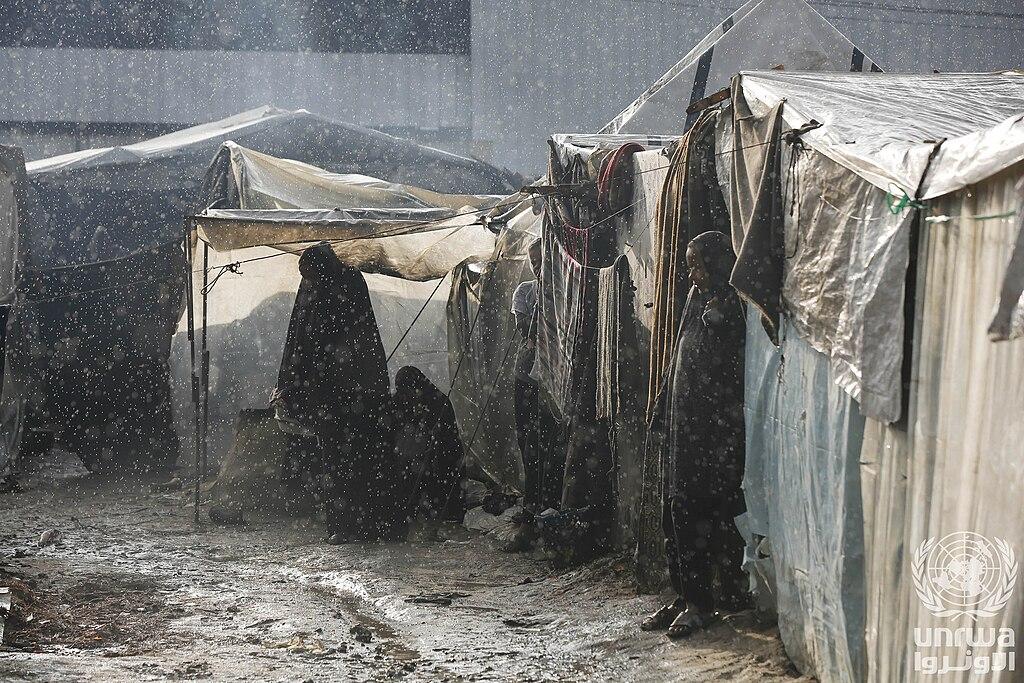
Heavy rain and strong winds reached Gaza on the evening of Friday 6 November, the first major storm of the cold season, and within twelve hours about 70,000 tents sheltering displaced Palestinians were flooded, according to Gaza's Government Media Office. Roughly 350,000 people were affected, water rose to nearly 1.5 metres in some camps, and dozens of walls collapsed. The storm's first night was already the subject of our earlier report on the flooding of the camps, and the picture has darkened since: on the evening of Sunday 8 November, a rain-soaked sand dune collapsed onto tents near the Al Berka reservoir, west of Deir al-Balah, killing five people, three children and two women, and injuring one more. Civil Defence declared its highest emergency level on 7 November, logging more than 2,100 distress calls by Monday. The Government Media Office put the storm's initial damage at about $3 million.
The numbers behind a system that can no longer drain
The flooding is not a matter of rainfall alone. Gaza City received 60 millimetres of rain in twelve hours, about 15 per cent of its annual rainfall, the municipality says; a heavy fall, but not an exceptional one. What turned it into a disaster is the state of the networks underneath the tents. More than 700 kilometres of Gaza's sewage network has been destroyed, the Government Media Office says, and Gaza City has lost about 2,800 of the 4,800 storm drains it had before the war. Six of the city's eight sewage pumps were destroyed and only two restarted, so drainage capacity stands at about 20 per cent, its spokesman Husni Muhanna said. The municipality's own ability to respond has been hollowed out: it has lost about 85 per cent of its fleet, after more than 135 vehicles were destroyed during the war, leaving a single bulldozer, which often breaks down, and two water suction trucks. Within twelve hours of the storm, Civil Defence received more than 2,000 distress calls and could answer only 218, for lack of fuel and equipment. The municipality has prepared an emergency winter plan requiring $1.3 million in materials, but it depends entirely on funding and supplies getting in.
What the next storm will meet, and what nobody can yet count
The full damage from the storm is not yet known. Gaza's authorities have published an initial estimate of about $3 million, but no comprehensive assessment has been completed, and the count of tents damaged beyond use is still rising: OCHA's site-management partners recorded about 17,400 shelters damaged and 6,000 destroyed by 8 November, with more than 3,900 households left with no shelter at all. The death toll from the Deir al-Balah dune collapse is also reported differently; five dead, three children and two women, according to OCHA and local authorities, while NHK's headline reports six —. Nobody can yet say whether the Sheikh Radwan stormwater basin in Gaza City, contaminated with sewage and running on two of its six pumps, will hold through the next rain. UNICEF has sought approval for more than a year to bring in the repair equipment; the $3 million plan was rejected by COGAT in recent days. Whether that equipment is allowed in, and how many of the 150,000 tents waiting outside Gaza cross the border before the next storm, remains open.
A shelter crisis is becoming a public-health crisis
The flooding matters because it converts a shelter crisis into a sanitation crisis, and a sanitation crisis into disease. No wastewater treatment plant in Gaza is currently operational, according to UNICEF, and rainwater mixed with sewage is threatening to overflow from the Sheikh Radwan basin into the streets and tents of Gaza City. The World Health Organization has warned of significant disease risks from flooding, poor sanitation and insufficient health and water services. UNICEF counts 950,000 displaced people living in flood-exposed areas, including 400,000 at extreme risk, almost half children, and 1.7 million displaced people still living in tents, makeshift shelters or damaged buildings. OCHA put the winter shelter need at about 121,000 tents and 1.7 million mattresses, with a $186.5 million winterisation gap. The storm was the first of the season, not the worst of it: the UN's migration agency has warned that El Niño could bring heavier rainfall than usual. What happened in twelve hours of rain is a preview, not an exception.
Three years of destruction, priced in a single weekend of rain
Read through the Bureau's five dimensions, the storm is a stress test with a single result: the infrastructure is the binding constraint on everything else in Gaza. Geopolitically, the dispute over the Sheikh Radwan basin, a $3 million repair, a year of negotiation, a rejection on security grounds, shows how the ceasefire's humanitarian promises are adjudicated item by item, at the border, by a military liaison agency. Economically, the arithmetic is stark: $3 million of storm damage in twelve hours, a $1.3 million municipal winter plan unfunded, a $186.5 million winterisation gap, and a $97.5 million UNICEF appeal, against 2.3 million people whose aid still arrives at a fraction of need. Demographically, the concentration is the danger: about a million people pressed into less than a third of Gaza City, 400,000 of them at extreme flood risk, almost half children. Historically, this is the fourth winter of the same war, and the pattern is now familiar, each autumn brings warnings from the UN, each winter the same flooded tents, each spring a count of what was not delivered. Technologically, the failure is specific: pumps, spare parts, batteries and grease, ordinary municipal supplies Gaza's equipment owners say they can no longer obtain. The storm did not defeat Gaza's infrastructure; it found it already defeated, and priced that defeat in tents. Life continues even so: 250 couples married in a mass wedding in Gaza, three years into the war.
What moves next, and in what order
The first test is the Sheikh Radwan basin itself. If it overflows, sewage will run through the streets and tents of Gaza City, and the disease risk the WHO has warned about will stop being a warning. The second test is structural: more than 2,000 buildings are at risk of collapse, 44,000 people live in buildings judged unsafe, so the next heavy rain is likely to bring casualties not from water but from falling masonry. The third test is logistical. OCHA says more than 150,000 tents are staged outside Gaza while Gaza's authorities say they need 300,000 to 350,000 tents and tarpaulins, 1,000 to 1,500 water pumps and 300 to 500 heavy machines. The fourth test is political: the Gaza Board of Peace has already expressed deep concern over the flooding, and the dispute over the basin repair will now be read as a signal of how the ceasefire's humanitarian terms are being honoured. And the fifth test is the weather. El Niño is expected to bring heavier rain than usual, the next storm will arrive on the same broken drains, and the tents that flooded this weekend are still standing where the water found them.
The week ahead, measured in pumps and tarpaulins
Watch three things. First, whether COGAT reverses or restates its rejection of the basin repair equipment, and whether any pumps or generators cross into Gaza this week; UNICEF has waited more than a year, and the basin will not wait for the next storm. Second, the damage assessment: Gaza's authorities and OCHA's site-management partners will revise the count of destroyed shelters, the households left with nothing, and the casualty figures from the Deir al-Balah collapse. Third, the funding: UNICEF's $97.5 million winter appeal and OCHA's $267.9 million winterisation requirement, with its $186.5 million gap, will show whether the world's response to a flooded tent camp is a press release or a delivery. The next storm will not ask whether the world was ready.
The three lenses
West Lens:
The West reads a test of the ceasefire's promises Reuters, reporting from Geneva, framed the story around a single blocked repair: UNICEF's $3 million plan for the Sheikh Radwan basin, worked on with the Israeli authorities and the Board of Peace for a year, and rejected by COGAT in recent days. UNICEF's James Elder warned toxic sewage could flow into the streets and tents of Gaza City. Le Monde, reporting from Gaza, led with the human arithmetic, 218 of 2,166 distress calls answered, water at 1.5 metres, and recorded OCHA's criticism that Israeli restrictions had hindered preparations for winter, while also carrying COGAT's position that the restrictions turn on security.
East Lens:
The East reads a warning the region had already issued NHK World Japan reported the landslide deaths in Deir al-Balah and the 70,000 flooded tents as the latest evidence that the humanitarian situation remains severe a year after the ceasefire, citing Palestinian media and UNRWA's estimate that more than one million people need shelter after their houses were destroyed. CGTN, drawing on Xinhua and the UN briefing, reported the scale of the aid effort now under way: more than 200,000 people affected, more than 40,000 family shelters damaged, over 900 latrines damaged and nine health facilities hit, with support reaching 750 households by Monday. The eastern reading is consistent: a predictable winter, a warned-about collapse, and an aid system still counting the gap.
South Lens:
The South reads a siege measured in millimetres of rain Al Jazeera's account, published on Wednesday, is the fullest record of the infrastructure behind the flooding: the destroyed sewage network, the lost drains, the two working pumps, the municipality's single bulldozer. The Express Tribune, carrying the Anadolu Agency's reporting, supplied the figure that frames the whole story; 60 millimetres of rain in twelve hours, about 15 per cent of Gaza City's annual rainfall, falling on drainage working at a fifth of its capacity, with 270 camps at risk. From the region's perspective, the storm did not create the crisis; it measured it.
The consensus
- What we agree on
- What we agree on: the first major winter storm flooded about 70,000 tents within twelve hours, affecting roughly 350,000 displaced people; five people were killed when a sand dune collapsed onto tents near Deir al-Balah on 8 November; Gaza City's drainage capacity has fallen to about 20 per cent; and Civil Defence answered 218 of the 2,166 distress calls it received.
- What we don't agree on
- What we disagree on: who bears responsibility for the shelter gap; UNICEF and OCHA point to Israeli restrictions on the entry of pumps, tents and repair equipment, while COGAT says the basin repair plan was rejected on security grounds; whether the blocked $3 million basin repair is the decisive failure or one of many; and the exact toll of the dune collapse, which sources put at five or six dead.
- What we know
- What we know: more than 700 kilometres of Gaza's sewage network has been destroyed; Gaza City has lost 2,800 of its 4,800 storm drains; six of its eight sewage pumps are destroyed and only two have been restarted; the municipality has lost about 85 per cent of its vehicle fleet; and about 950,000 displaced people live in flood-exposed areas, 400,000 of them at extremely high risk.
- What we don't know yet
- What we do not know yet: the full damage assessment from the storm, which Gaza's authorities have not completed; whether the Sheikh Radwan stormwater basin will hold through the next rain; how much of the $1.3 million emergency winter plan can be funded and delivered; and whether the equipment needed to repair pumps and drains will be allowed into Gaza before the next storm.
- What we expect
- What we expect: UNICEF and OCHA to press their winter appeals, worth $97.5 million and $267.9 million; a decision, or a further refusal, on the basin repair equipment; damage and casualty figures to be revised as assessments continue; and the next weather system to test the same broken drains again, with the same tents still standing in the water's path.
Questions, answered
How many tents were flooded in Gaza, and how many people were affected?
About 70,000 tents were flooded or damaged within twelve hours of the storm that began on the evening of 6 November, affecting roughly 350,000 people, according to Gaza's Government Media Office. UNICEF counted more than 106,000 people directly affected, and OCHA estimated that more than 200,000 were affected across the Strip. Water reached nearly 1.5 metres in some camps.
Why did ordinary rain cause so much flooding in Gaza?
Gaza City received 60 millimetres of rain in twelve hours, about 15 per cent of its annual rainfall. The damage came from what the rain met: more than 700 kilometres of sewage network destroyed, 2,800 of 4,800 storm drains lost, six of eight sewage pumps destroyed, and drainage capacity at about 20 per cent. The municipality has one working bulldozer and two suction trucks.
What is the Sheikh Radwan basin, and why does it matter?
The Sheikh Radwan stormwater basin in Gaza City collects rainwater and sewage, and it now runs on two of its six pumps while contaminated with sewage. UNICEF warns it could overflow, sending toxic sewage into streets and tents. A $3 million repair plan, negotiated for a year, was rejected by COGAT, the Israeli military liaison agency, in recent days.
What do Gaza's municipalities say they need before the next storm?
Gaza City's municipality has prepared an emergency winter plan needing $1.3 million in materials and equipment. Across the Strip, the authorities say they need 300,000 to 350,000 tents and tarpaulins, 1,000 to 1,500 water pumps, 300 to 500 heavy machines, plus generators, blankets, mattresses and heaters for the winter.
Sources
- Government Media Office
- OCHA
- Civil Defence
- Gaza City municipality
- UNICEF (9 Nov 2026); three children aged four, five and eight killed with their mother; 106,000 people directly affected; the $97.5 million winter response appeal
- Reuters (10 Nov 2026); UNICEF says Israel blocked repairs to the Sheikh Radwan stormwater basin; the $3 million plan rejected by COGAT; about one million displaced people at medium or high flood risk