Prague’s fight for public TV: hundreds of thousands rally as a renowned presenter prepares to walk away
Organisers said about 400,000 people filled Letná Plain on Sunday to defend Czech Television and Czech Radio against a government plan to scrap the licence fee; as presenter Daniel Stach told France 24 he is ready to leave rather than work under the overhaul.
Key points
- Hundreds of thousands of people rallied in Prague on Sunday 15 November 2026 against the government’s plan to overhaul public media funding. Organisers via BBC, 15 Nov 2026
- Organisers said roughly 400,000 people attended; lead organiser Mikuláš Minář put the figure at 350,000 to 450,000. BBC / CNA, 15 Nov 2026
- The rally, organised by Million Moments for Democracy, filled Letná Plain two days before the 17 November anniversary of the Velvet Revolution. Al Jazeera / The Hindu, 15 Nov 2026
- Daniel Stach, one of Czech Television’s best-known presenters, told France 24 he is prepared to leave the broadcaster rather than work under the proposed changes. France 24, 15 Nov 2026
- The government’s bill would abolish the 205-crown monthly household licence fee, 150 crowns for television, 55 for radio, and fund both broadcasters from the state budget. BBC / Al Jazeera, 15 Nov 2026
Three readings of the same result
Same facts, different frames. Each reading names its outlets and what it emphasizes.
The story reads as a test of media freedom in a European Union member state.
The BBC pairs the scale of the rally, roughly 400,000 people, by the organisers’ count, with the government’s own words: Babiš insisting no one wants to control public media, the coalition arguing broadcasters must cut costs.
Key detail France 24 puts a face on the stakes, with Daniel Stach explaining why he would rather leave than work under the overhaul.
The same Sunday reads through the numbers and the calendar.
CNA reports the 350,000 to 450,000 range given by the lead organiser and the paper hats folded from newspapers; The Hindu, carrying the Associated Press account, sets the protest on Letná Plain two days before the Velvet Revolution anniversary and records the 15 percent cut in plain figures.
Key detail The emphasis falls on the procedure; the 4:36 vote, the nine-hour debate, the committee dates.
The story reads through the crowd itself.
Al Jazeera follows the demonstrators on Letná Park, the newspaper hats in tribute to a children’s-television character, and the organisers’ claim that this may have been the largest public gathering in Czech history.
Key detail The frame is lived consequence: what it means for a country to defend, in the street, the broadcasters it trusts most.
Sources by lens: 4 West, 2 East, 1 Global South. See every source
The story
What happened on Letná Plain on Sunday; and why did so many people come?
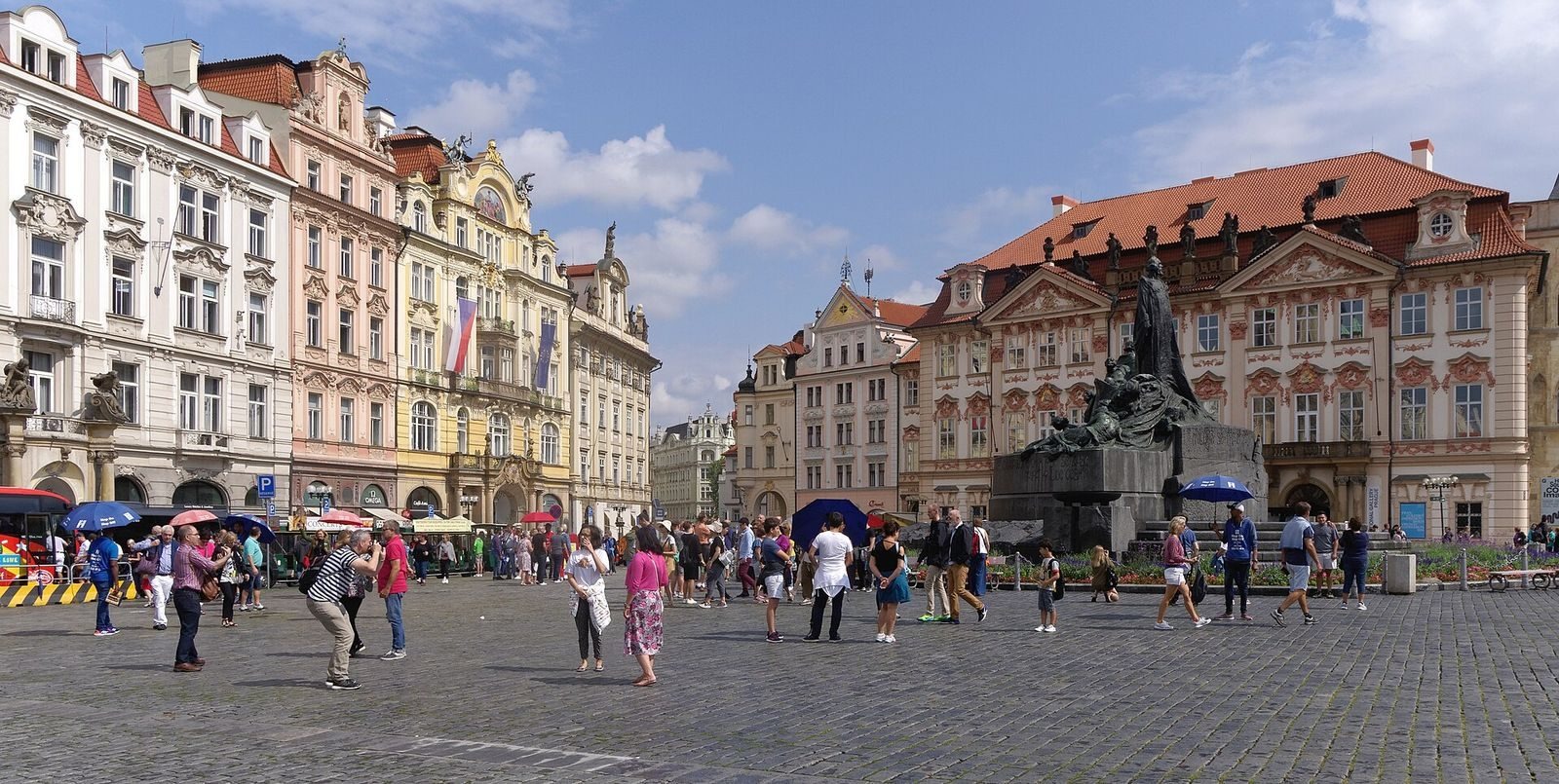
Hundreds of thousands of people filled Letná Plain in Prague on Sunday 15 November 2026, in what organisers called a defence of Czech public television and radio. The rally, organised by the group Million Moments for Democracy, came two days before the anniversary of the Velvet Revolution; on the same ground where the crowds of 1989 gathered to end more than forty years of communist rule.
Organisers said 400,000 people attended; the group’s lead organiser, Mikuláš Minář, put the figure at between 350,000 and 450,000. Many in the crowd wore pointed hats folded from newspaper, a tribute to Večerníček, the animated character from Czech Television’s nightly children’s stories.
Their demand was plain: that the government withdraw its plan to scrap the licence fee that funds Czech Television and Czech Radio. The day’s most watched voice was not a politician; Daniel Stach, one of Czech Television’s best-known presenters, told France 24 he is prepared to walk away from his career rather than work under the overhaul, and he joined the protest himself.
What does the government’s plan actually change?
Czech households currently pay 205 crowns a month for public broadcasting; 150 crowns for television and 55 for radio. The money goes directly to the broadcasters and has underpinned their financial independence since the post-communist transition, generating more than 8 billion crowns a year.
The government’s bill would abolish those fees and fund Czech Television and Czech Radio directly from the state budget instead, while cutting their combined funding by about 15 percent; roughly 1.4 billion crowns a year, leaving about 7.8 billion. The European Broadcasting Union calculates the cut would push Czech Television’s nominal budget back to 2008 levels and Czech Radio’s to 2005 levels.
The bill cleared its first reading at 4:36 in the morning on Saturday 24 October, after a nine-hour overnight debate. Chamber Speaker Tomio Okamura, leader of the far-right Freedom and Direct Democracy party, had set a fixed time for the vote, and more than 60 opposition lawmakers who had signed up to speak never got the floor. That hour, 4:36, has become the protest’s slogan: “Never again 4:36.”
The timetable now runs through parliament. The media committee holds a public hearing on 26 November, takes amendments until the next day, and returns to the bill on 10 December; the full chamber can take it up again from 24 December, and the second reading falls in January. A STEM/MARK survey found 54 percent back abolishing the fees, but 68 percent said public service media should stay away from state control.
That hour, 4:36, has become the protest’s slogan: “Never again 4:36.”
What can nobody yet say about the bill, the money, or the presenters?
Nobody can yet say what the final law will look like. The bill has passed only its first reading, and the government has signalled that changes are still possible; Prime Minister Andrej Babiš has said so himself. Whether the 15 percent cut survives, and how large the state allocation would actually be, will only emerge in committee and at the second reading.
Nobody can yet say whether Daniel Stach will actually leave. He told France 24 he is prepared to walk away rather than work under the overhaul, but he has not resigned and no date has been set. The size of Sunday’s crowd is also, strictly, unconfirmed: the 400,000 figure comes from the organisers, and no police estimate or independent count had been published by Sunday evening.
Why does a funding formula carry the weight of a democratic question?
A licence fee is, on its face, a technical device: a charge on households that keeps a broadcaster’s money at arm’s length from the government of the day. In the Czech Republic it has been something more; the financial wall between Czech Television and Czech Radio and the politicians they report on, standing since the post-communist transition. Remove the wall, the critics argue, and the broadcaster must ask the state each year for the money to hold the state to account.
That is why the dispute has drawn in the institutions that watch over European media. The European Broadcasting Union, the European Federation of Journalists, Reporters Without Borders and the International Press Institute have all criticised the plan. The European Parliament debated media freedom in the Czech Republic in the same week, and EU Justice Commissioner Michael McGrath said national legislation must ensure funding for public service media based on transparent and objective criteria. The question of how European states protect independent institutions has run through European leaders’ talks in Dublin this year as well.
The government answers that the system is outdated and the change is about household costs, not control. “The funding system is changing, no one wants to control public media, no one wants to dictate to them what they should say and do,” Babiš told the Czech News Agency, pointing to France, which removed its licence fee in 2022, and Norway, which abolished its fee in 2020. The critics answer with a different comparison: Hungary, where Viktor Orbán’s government brought state media under tight political control.
What does the 4:36 vote tell us about how this government legislates?
The hour has become the story’s shorthand for a reason. A bill reshaping the funding of the country’s public broadcasters was pushed through its first reading at 4:36 in the morning, after nine hours of debate, with more than 60 opposition lawmakers denied the floor by a timetable set by the Speaker; who is also the leader of the coalition’s far-right partner. The procedure was legal. The protesters’ argument is that it was not legitimate, and that the hour is the evidence.
The vote did not come out of nowhere. In March, Václav Moravec, presenter of the country’s most-watched Sunday political debate for 21 years, resigned live on air, saying he could no longer guarantee the independence of editorial work and critical reflection; and warning against a drift toward “pseudo-balance”. The programme’s head dramaturge, Hana Andělová, had been dismissed in January for resisting the invitation of the SPD leader to the debate, after nine years without one.
Read through the Bureau’s 5D lens, the episode is a stress test of a democratic institution where politics, money and information meet: geopolitically, it places the Czech Republic in Europe’s argument over media freedom; historically, it echoes the Velvet Revolution’s own ground; Letná —.
What changes if the fee goes and the state pays?
The first consequence is arithmetic. A 15 percent cut takes about 1.4 billion crowns a year out of the two broadcasters’ combined budgets, pushing Czech Television’s nominal budget back to 2008 levels and Czech Radio’s to 2005 levels. The broadcasters warn of layoffs, limited production and programme cancellations.
The second consequence is structural. Once the money comes from the state budget, each year’s allocation becomes a political decision, taken by the same coalition the broadcasters report on. The SPD has floated merging Czech Television, Czech Radio and the Czech News Agency into a single state broadcaster. The bill does not do that, but the idea is now in the debate, and Slovakia’s 2024 overhaul of its public broadcaster RTVS is the comparison the critics reach for.
The third consequence is regional. A Czech Republic that funds its public media from the state budget joins a European pattern, France in 2022, Norway in 2020, but with a difference the critics keep repeating: in Prague, the change arrives with a budget cut and after an overnight vote, not as a settled consensus. Across Central Europe, the Czech experiment will be watched as a test of whether public media can stay independent on state money; the same debate running through Poland’s eastern shield and the region’s security choices.
What should we watch for in the coming days and weeks?
Watch the committee first. The media and culture committee holds its public hearing on 26 November, members have until the next day to file amendments, and the committee returns to the bill on 10 December. The full chamber can take it up again from 24 December at the earliest, and the second reading falls in January. The bill’s final shape will be decided there, not on the street.
Watch the presenters next. Daniel Stach has said he is prepared to leave; whether he does, and whether others follow, will say more about the broadcaster’s future than any single vote. Czech Television’s management has said the future of the Sunday debate show will be decided in the coming days; the same show Moravec left in March.
Watch the calendar, too. The protest fell two days before the 17 November anniversary of the Velvet Revolution, and the movement that organised Sunday’s rally has shown it can fill Letná. If the committee stage hardens the bill rather than softening it, the next test will be whether the crowd returns; and whether a government that voted at 4:36 in the morning is willing to listen in daylight. Europe’s institutional calendar turns with it, including the debate over a 2027 NATO summit that will test the continent’s own cohesion.
What we agree on, and what remains open
Established
- On Sunday 15 November 2026, hundreds of thousands of people gathered on Letná Plain in Prague to oppose the government’s plan to replace the licence fee with state-budget funding for Czech Television and Czech Radio.
- Organisers put the crowd at roughly 400,000, and the bill has passed its first reading in parliament.
Contested
- On whether the overhaul threatens editorial independence; the government of Andrej Babiš insists the change is about outdated funding and household costs and will not affect what the broadcasters air, while the broadcasters’ staff, the rally organisers and press-freedom groups say state funding plus a 15 percent cut hands politicians leverage over the newsroom.
Still open
- Whether parliament will keep the 15 percent cut and the state-funding model through the second reading.
- How large the state allocation would actually be.
- Whether Stach or other presenters will follow through and leave.
- Or how big the crowd truly was, beyond the organisers’ estimate.
What to watch
Questions, answered
Hundreds of thousands rallied in Prague because the government wants to abolish the licence fee that funds Czech Television and Czech Radio and replace it with money from the state budget, while cutting their combined funding by about 15 percent. Critics say that would leave the broadcasters dependent on the politicians they report on. The government insists the change is about outdated funding and household costs, not control.
Czech households currently pay 205 crowns a month, 150 crowns for television and 55 for radio, about $9.44, directly to the broadcasters. The bill would scrap those fees and fund both broadcasters from the state budget instead. The state allocation would be about 15 percent smaller, roughly 1.4 billion crowns a year less, pushing Czech Television’s budget back to 2008 levels.
The government’s bill passed its first reading in the Chamber of Deputies at 4:36 a.m. on Saturday 24 October, after a nine-hour overnight debate. Speaker Tomio Okamura had set a fixed time for the vote, and more than 60 opposition lawmakers who had signed up to speak never got the floor. Protesters have turned the hour into their slogan: “Never again 4:36.”
Daniel Stach is one of Czech Television’s best-known presenters. He told France 24 on 15 November that he is prepared to walk away from his career rather than work under changes he says will threaten the independence of public broadcasting. His warning carries weight because it follows the March resignation of Václav Moravec, the host of the country’s most-watched Sunday debate for 21 years.