Ten days before local elections, the Madlanga Commission's evidence has touched the ANC, the EFF, the NCC, the DA and the PA; from Malema's messages to Carrim's arrest. No party can campaign as untouched, and the voters' verdict comes before the commission's own.
Published 25 October 2026 · 20:01 GMT
Ten days before local elections, the Madlanga Commission's evidence has touched the ANC, the EFF, the NCC, the DA and the PA; from Malema's messages to Carrim's arrest. No party can campaign as untouched, and the voters' verdict comes before the commission's own. South Africans vote in local government elections on 4 November 2026; the Madlanga Commission resumes public hearings on 9 November and must submit its final report to President Cyril Ramaphosa by 25 January 2027.
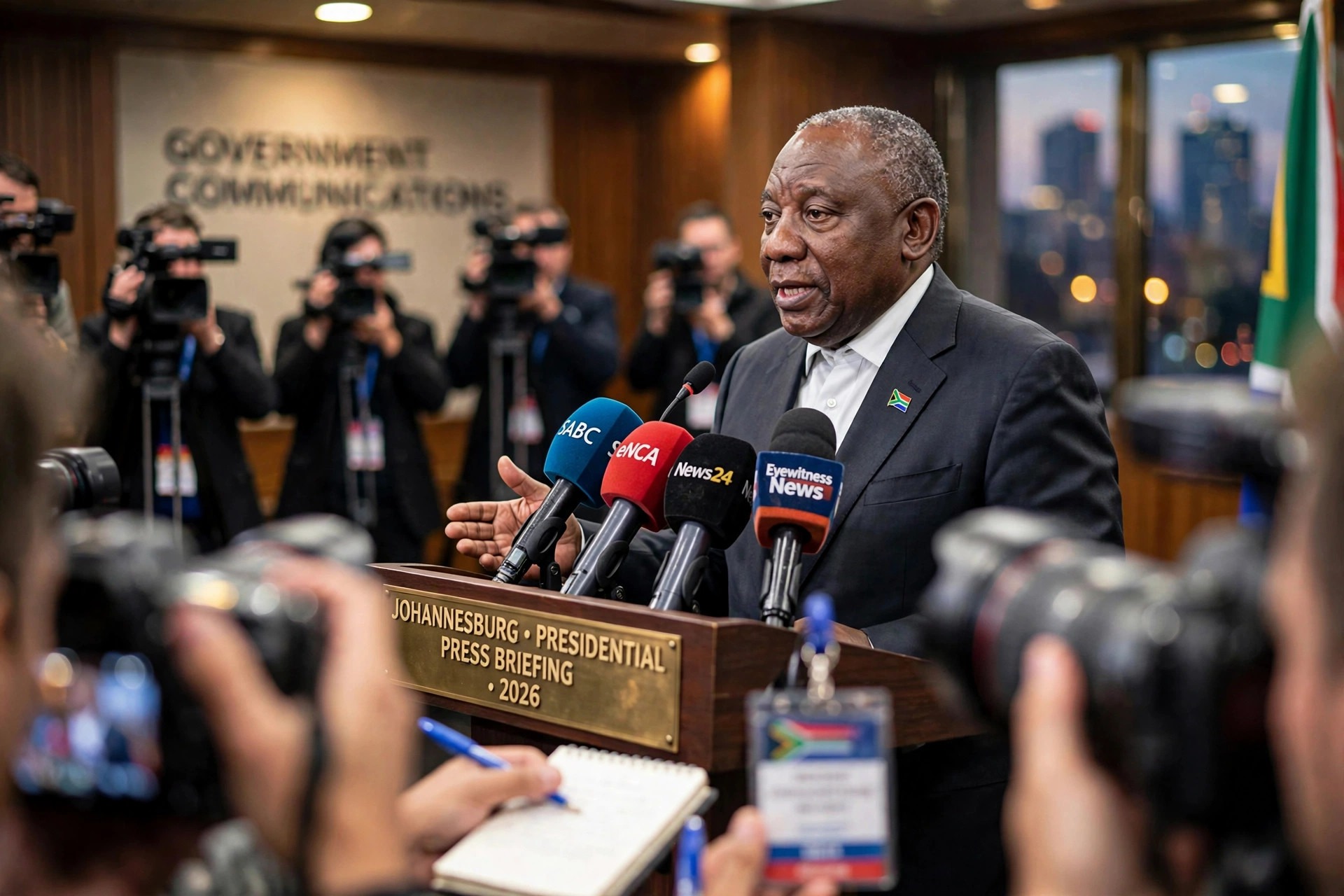
South Africans vote in local government elections on 4 November 2026, and they will do so with a police scandal hanging over every major party. A Daily Maverick survey of the two inquiries into the scandal, the Madlanga Commission of Inquiry and a parallel parliamentary committee, finds that the African National Congress, the Economic Freedom Fighters, the National Coloured Congress, the Democratic Alliance and the Patriotic Alliance have all had names surface in evidence, testimony or criminal charges. The scandal began on 6 July 2025, when KwaZulu-Natal police commissioner Nhlanhla Mkhwanazi publicly alleged that a cartel had infiltrated the criminal justice system, politics and the private sector. President Cyril Ramaphosa established the Madlanga Commission a week later and placed police minister Senzo Mchunu on special leave. Now, with the commission's public hearings paused until 9 November and its final report due on 25 January 2027, the politics of the scandal has become part of the election itself.
The record now runs across five parties. For the ANC, the heaviest names are Mchunu and the businessman Brown Mogotsi. Mkhwanazi alleged that Mchunu was linked to figures involved in infiltrating the police and that criminal suspects influenced him to order the disbandment of a police task team; Mchunu denied wrongdoing but was placed on special leave. Mkhwanazi also alleged Mchunu was connected to Mogotsi, who styled himself as an informant and was accused of acting as an intermediary between Mchunu and alleged organised-crime figure Vusimuzi "Cat" Matlala. Mchunu acknowledged knowing Mogotsi as a "comrade" but did not consider him an associate, and the ANC said in October 2025 that Mogotsi's membership had expired and that it distanced itself unequivocally from organised criminal activity. Mogotsi, in custody since May 2026, faces charges including perjury, defeating the ends of justice and unlawful possession of a firearm over allegations that he staged an assassination attempt on himself in Vosloorus in November 2025, and prosecutors say he tried to bribe the investigating officer; he denies the charges. The newest ANC-linked case is that of North West businessman Suliman Carrim, a former ANC regional treasurer who has admitted dealings with Matlala. Carrim was arrested at OR Tambo International Airport on 15 October 2026 for failing to testify at the Madlanga Commission, and was then added as an accused in a case alleging that he colluded with employees to steal two vehicles belonging to Absa by taking them out of the country using fraudulent documentation. The vehicles were intercepted at the Beitbridge border post on 22 July 2026 while allegedly being moved from Mahikeng toward Malawi, and the National Prosecuting Authority says Carrim faces attempted theft and money laundering charges. For the EFF, the central thread is the relationship between party leader Julius Malema and former Crime Intelligence officer Feroz Khan. Messages allegedly between Khan and tobacco industry figure Mohammadh Sayed, and allegedly between Sayed and Malema, were read at the commission, where it was heard that Malema was meant to ensure Khan's questions reached the former Inspector-General of Intelligence, Setlhomamaru Dintwe, in Parliament; with the alleged aim that Dintwe would lie in his response and be removed. Malema denied any involvement in unlawful activities. Separately, Malema was sentenced on 16 April 2026 to an effective five years' direct imprisonment for unlawful possession of a firearm arising from a 2018 rally in Mdantsane, and was declared unfit to possess a firearm; on 28 September 2026 the Makhanda High Court granted him leave to appeal both conviction and sentence, and he remains out on warning pending the appeal. Khan himself was shot and wounded in Houghton on 28 June 2026, days before he was due to testify; his uncle was murdered in a shooting in October, and Khan was dismissed from the police service on 2 September 2026. He faces a criminal case in Kempton Park linked to unwrought gold and the release of a suspect. The National Coloured Congress thread runs through its leader Fadiel Adams, who told the commission his complaints against senior Crime Intelligence officers were based on documents slipped under his parliamentary office door. Those complaints led to an investigation that saw Crime Intelligence boss Dumisani Khumalo arrested in June 2025 over an allegedly irregular appointment; the then head of the Investigating Directorate Against Corruption, Andrea Johnson, later admitted the case was flawed, resigned in July 2026, and Khumalo and his co-accused were cleared. Adams, who says he was unknowingly entangled in a broader game, was subsequently arrested in a fraud and defeating-the-ends-of-justice case rooted in KwaZulu-Natal. For the DA, Mkhwanazi alleged that MP Dianne Kohler Barnard obtained Crime Intelligence information that should not have been disseminated; she denied leaking information when she testified before the parliamentary committee. The commission also heard that when former Ekurhuleni mayor Tania Campbell of the DA was in office, a dubious memorandum of understanding was signed between the city's metro police and a Matlala company; Campbell said neither she nor the DA had known about it. For the PA, a handwritten statement apparently from an inmate alleged that party leader Gayton McKenzie received drugs from a Matlala associate and supplied consignments to Western Cape gangsters, including William "Red" Stevens, who was murdered in 2021. McKenzie denied the claims, telling the SABC they were "laughable".
The most important unknowns are the ones the commission itself has not yet resolved. The commission has paused its public hearings until 9 November, five days after the elections, and will sit in camera in the meantime to hear evidence that cannot be aired publicly. Suspended minister Mchunu is still to testify in the commission's second phase, and Mkhwanazi is expected to return to the witness stand in the third phase, so the two men at the centre of the original allegations have not yet given their final accounts. Khan is still scheduled to testify in camera at some point, after repeated postponements caused by shootings, hospitalisation and his dismissal, and the commission has already heard evidence against him in his absence; but his own version of the messages, the gold case and the alleged ousting plot has not been tested in open session. Matlala's own appearance, postponed from October, is now expected in December, and the criminal cases against him, Carrim, Mogotsi and Khan remain allegations before the courts, not findings. Whether the commission's final report, due on 25 January 2027, will name politicians as participants in a criminal network or describe a looser pattern of proximity, favours and failed oversight is unknowable until it is written. And the electoral unknown is just as open: whether voters punish all parties equally for a scandal that has touched all of them, or treat it as background noise against service delivery, jobs and local grievances, will only be visible in the results of 4 November.
Local elections are fought on refuse collection, water, roads and safety; and safety is precisely where this scandal lives. When the line between suspected gangsterism and governance becomes as thin as the Daily Maverick describes it, the damage is not only to the parties named but to the idea that the state can police itself. The commission and the parliamentary committee were created to test whether criminals captured parts of the justice system; the fact that their evidence now touches every major party means no party can campaign as the clean alternative without facing its own names in the record. The timing sharpens the point: the commission deliberately paused public hearings because media coverage and livestreaming would be difficult during the election period, yet the pause itself keeps the scandal in the news through the campaign. For voters, the scandal also reframes the familiar local issues; a metro police department that signed a memorandum with a company linked to an alleged crime figure, a Crime Intelligence division whose leadership has been arrested, cleared, dismissed and resigned in turn, and a task team disbanded on allegedly criminal influence are not abstractions when they concern the officers patrolling a ward. The election will therefore act as a first verdict on the scandal before the commission delivers its own.
Step back from the individual names and a pattern emerges that is more troubling than any single charge. The scandal does not belong to one party's corruption; it maps onto the whole political system. The ANC figures appear through proximity to fixers and tender beneficiaries; the EFF figure appears through messages and an alleged parliamentary proxy; the NCC figure appears through complaints that may have been planted; the DA figures appear through leaked information and a municipal memorandum; the PA figure appears through an inmate's handwritten allegation. The mechanisms differ, but the common thread is the same: people and organisations operating at the seam between politics, policing and private interest, where a favour, a leak, a contract or a complaint can be traded. That is why the scandal resists partisan framing; every attempt to weaponise it against one party runs into the record of another. It also explains why the commission's work is so slow: it is not investigating a single conspiracy but an ecosystem, and ecosystems do not yield to a single smoking gun. The deeper significance is institutional. The dismissals of Khan and other senior officers, the resignation of Johnson, the clearing of Khumalo and the suspension of Mchunu show a system that is, at least in part, capable of removing compromised figures. But removals are not reforms, and the commission's final report will be judged on whether it proposes changes, to appointments, to oversight of Crime Intelligence, to the handling of dockets, that outlast the individuals. Until then, the scandal's main product is suspicion, and suspicion is a poor basis for policing consent.
Whatever the election result, the scandal's second-order effects are already moving. First, the police service faces a leadership vacuum and a credibility deficit at the same time: senior Crime Intelligence and organised-crime posts have turned over through dismissal and resignation, and the officers who remain must work under the gaze of a commission that has not yet finished. Second, the criminal cases spun out of the commission, Carrim's vehicle case, Mogotsi's perjury case, Khan's gold case, will test whether inquiry referrals convert into convictions, or whether they stall in the same courts the commission was created to bypass. Third, the political parties will have to decide how to handle their own named figures after the votes are counted: a party that campaigned on clean governance cannot easily retain a treasurer-turned-accused, a leader appealing a prison sentence, or an MP accused of leaking intelligence material. Fourth, the commission's report, due in January 2027, will land in a post-election landscape and will either anchor a reform programme or become another document that governments admire and ignore. The international dimension matters here too: South Africa's partners, investors and fellow BRICS members will read the report as evidence of whether the country's institutions can still correct themselves, and that reading will shape trade, investment and diplomatic weight long after the local ballots are counted.
The calendar is unusually clear. On 4 November, South Africans vote in the local government elections, the first electoral verdict on a scandal that has touched every major party. On 9 November, the Madlanga Commission resumes public hearings, with suspended minister Mchunu's testimony expected in the second phase and Mkhwanazi's return in the third. Carrim's vehicle case is due back in the Musina Magistrates' Court on 30 October, and Mogotsi's case returns on 13 November. Matlala's commission appearance is expected in December. Khan's in-camera testimony remains unscheduled but pending. The commission will spend December and January drafting its final report, due to President Ramaphosa on 25 January 2027. Each of those dates is a checkpoint, and each will either confirm the pattern of accountability the commission has sketched or expose its limits. The election comes first, and it will be read, by parties, by the commission and by the country, as the public's own interim report.
How the West reads a captured-justice warning Read from London, Washington and Brussels, this is a governance stress test with continental weight. South Africa is the continent's most industrialised economy and a G20 member, and Western coverage of the Mkhwanazi affair has consistently framed it as a question of whether institutions built after apartheid can survive capture by criminal networks. The Western lens tends to measure the scandal in institutional terms: commissions appointed, ministers suspended, officers dismissed, courts seized.
What Asia sees in a BRICS partner under strain Read from Beijing, New Delhi and Singapore, the scandal registers differently: South Africa is a BRICS partner, a gateway for Asian trade and investment into Africa, and a fellow traveller in the politics of the Global South. No independent East Asian outlet reporting on this week's cross-party revelations was found during verification, the story is carried by South African outlets and, beyond them, by Western wires, but the Eastern interest is structural rather than editorial. Asian capitals watch South African stability for what it means for supply chains, for the BRICS agenda and for the credibility of South-South institutions when a member's own justice system is on trial.
Why the Global South hears its own echo in Pretoria Read from Johannesburg, Lagos, Nairobi and across the region, this is not an exotic scandal but a familiar one. The Southern lens recognises the pattern instantly: a liberation party defending its record, opposition parties discovering their own entanglements, businessmen who move between boardrooms and dockets, and a commission of inquiry asked to do what politics cannot. The region has seen this script in many capitals, which is why Southern coverage, from South Africa's own press to Lesotho's commentary on Mkhwanazi's stand, treats the commission less as a legal event and more as a democratic one.
It is the judicial commission of inquiry President Cyril Ramaphosa established on 13 July 2025 to test KwaZulu-Natal police commissioner Nhlanhla Mkhwanazi's allegation that a criminal cartel had infiltrated South Africa's criminal justice system, politics and private sector. Chaired by retired Constitutional Court justice Mbuyiseli Madlanga, it hears testimony under oath, runs alongside a parliamentary committee, and must submit its final report by 25 January 2027.
The scandal has touched every major party, the ANC, EFF, NCC, DA and PA, so no party can campaign as untouched by it. Because local elections turn heavily on safety and service delivery, and because the commission paused public hearings precisely to avoid clashing with the campaign, voters will effectively deliver an interim verdict on the scandal before the commission delivers its own report in January 2027.
Carrim, a North West businessman and former ANC regional treasurer, was arrested at OR Tambo International Airport on 15 October 2026 for failing to testify at the Madlanga Commission. He was then added as an accused in a case alleging he colluded with employees to steal two Absa vehicles using fraudulent documentation; the vehicles were intercepted at Beitbridge on 22 July 2026 while allegedly being moved toward Malawi. He faces attempted theft and money laundering charges.
Malema was convicted in October 2025 over a firearm discharged at an EFF rally in Mdantsane in 2018, and was sentenced on 16 April 2026 to an effective five years' direct imprisonment. He was also declared unfit to possess a firearm. On 28 September 2026 the Makhanda High Court granted him leave to appeal both the conviction and the sentence, so he remains out on warning while the appeal is pending.
