A Russian glide bomb on two minibuses killed thirty-three civilians in Kramatorsk while Kyiv went dark, and Ukraine answered with drones two thousand five hundred kilometres deep inside Siberia.
Published 10 October 2026 · 06:00 GMT
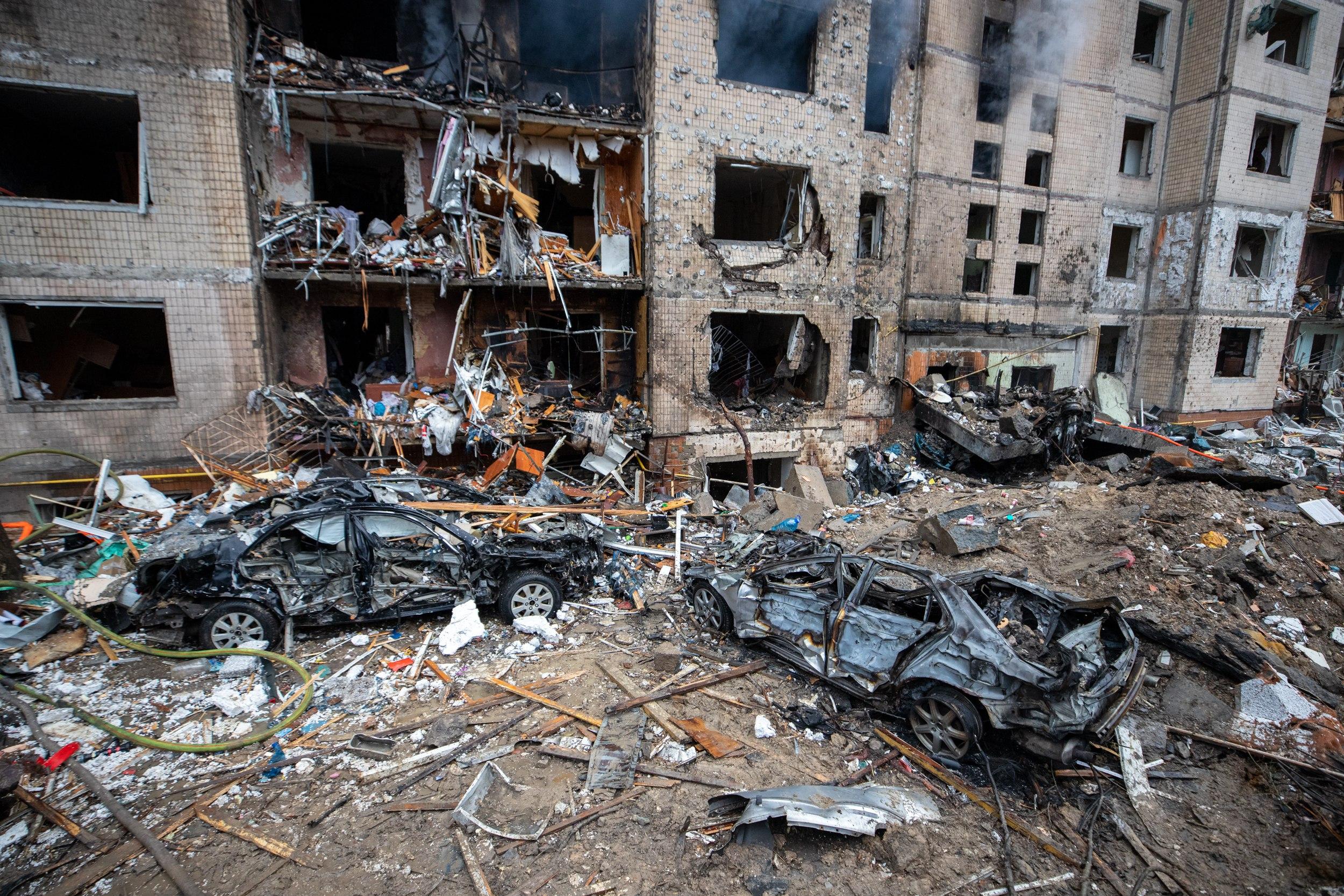
The buses were burning before the sirens finished. On Thursday morning in Kramatorsk, a Russian glide bomb struck two city minibuses at a stop, and what had been an ordinary commute became one of the deadliest single civilian attacks of the year: thirty-three people killed, eighteen wounded, several bodies so mangled they could not be named. Across Ukraine that same week the arithmetic of the war kept compounding. In Kyiv, repeated drone strikes left four dead and nineteen injured, knocked out power and water for whole districts, and halted the metro. And two thousand five hundred kilometres to the east, Ukrainian drones set fire to Russia's largest oil refinery in Omsk. On October 8, America's top diplomat told a Greek newspaper what the smoke already said: a negotiated end to this war is, in his words, currently unattainable.
The last two large cities of northern Donetsk woke to a decision they never chose. Vadym Filashkin, the regional military administration chief, ordered every bus and tram in Kramatorsk and neighbouring Sloviansk off the road, writing that authorities had no right to risk the lives of passengers and drivers. The order came hours after a Russian glide bomb tore into two minibuses in Kramatorsk, killing thirty-three people and wounding eighteen. Zelenskyy said the bomb effectively hit the vehicles themselves; two of the dead could not be identified because their injuries were so severe. Photos released by police showed a charred bus shell, debris scattered across the street, and bodies on the asphalt. Three more civilians were killed the same day in the nearby village of Bilenke, and four others across the Donetsk region that morning.
The attack is among the deadliest strikes on civilians this year, and it landed inside a week that already reeked of escalation. A day earlier, a Russian missile had collapsed a five-storey apartment block in Pryluky, east of Kyiv, killing twenty-two people including five children, with rescue dogs still searching the rubble for the unaccounted. According to the United Nations, more Ukrainian civilians had been killed by August of this year than in all of 2025. The war is entering its fifth year, and the front has barely moved in months. That is the definition of a stalemate, and it is becoming a slaughterhouse.
Kyiv spent the week in the dark. An overnight assault of roughly seventy missiles and drones, one of the heaviest of recent months, preceded days of repeated drone strikes that killed four people and injured at least nineteen in the capital on October 8, according to Mayor Vitali Klitschko. Large districts lost power, water pressure sagged on the right bank because transformers were running on low voltage, and metro trains stopped for hours while commuters filled dark streets. Ukraine's grid operator imposed consumption limits across several regions, and DTEK announced emergency shutdowns in parts of Kyiv Oblast including Brovary, Bucha, Vyshhorod and Boryspil. An AFP photograph of a kiosk vendor fitting a generator in a blacked-out underpass on October 7 became the week's visual emblem: a capital preparing for winter under bombardment.
Kramatorsk and Sloviansk sit about twelve miles from the nearest Russian positions and anchor the fortified belt of northern Donetsk, the last two big Ukrainian-held cities of the oblast, ringed by the drone nets now draped over frontline roads. Filashkin accused Russia of deliberately choosing a full bus precisely because one hit kills the maximum number of people; the Ukrainian account could not be independently verified, and Moscow, as usual, said nothing about the strike while denying it targets civilians. What is verifiable is the pattern: bus stops, apartment blocks and power substations are the terrain of Russia's autumn campaign, the civilian face of pressure on the logistics hub that holds the Donbas line. For a fuller picture of the country being fought over, see the Ukraine factbook.
With drones built at home and patience built over years. Ukraine's Special Operations Forces confirmed that upgraded FP-1 long-range drones, flying a path its command put at roughly three thousand kilometres, struck the Omsk oil refinery in western Siberia on October 8, the second hit after a July 6 strike that forced the plant to halt. Omsk is Russia's single largest refinery, processing about twenty-two million tonnes a year, roughly one fifteenth of national refining capacity, and Ukraine's General Staff says it supplies fuel to the Russian army. Fire Point, the Ukrainian manufacturer, confirmed a hit and a fire; Omsk governor Vitaly Khotsenko acknowledged on Telegram that at least one drone got through his air defences, and residents were queuing at Omsk petrol stations before dawn against the backdrop of a national fuel shortage. Zelenskyy confirmed on October 9 that the armed forces had also struck the Ukhta refinery in the Komi Republic and a second data centre, following an earlier drone attack that knocked out Yandex's largest data centre at Sasovo in Ryazan, a first for Russian digital infrastructure in this war. Russia's defence ministry said its systems intercepted three hundred ninety-nine Ukrainian drones across eighteen regions that night. The damage tally at Omsk remains undisclosed, but the reach is the message: no refinery in Russia is out of range. On the Russian side of the ledger, see the Russia factbook.
The buses burned at noon, the refinery burned at night, and in Lisbon a Secretary of State finally said the quiet part aloud: nobody is negotiating, and the winter is coming.
The economics of the exchange favour no one, but they bite asymmetrically. Russia's campaign against Ukrainian energy infrastructure is a pre-winter strangulation attempt: knock out transmission, transformers and generation before the cold, and force a country of forty million to burn through its reserves. Ukrenergo's consumption limits are the rationing of a grid under siege. Ukraine's answer is attrition from the other end, turning Russia's fuel industry into the casualty list. A single refinery processing one fifteenth of Russia's output, taken offline again, deepens a gasoline shortage that was already sending drivers into queues; the Salavat petrochemical complex in Bashkortostan and a second refinery at Ukhta took fire the same night. Two campaigns, one logic: make the other side's winter unaffordable, and dare its capital to blink first.
Diplomacy, meanwhile, has stopped pretending. US Secretary of State Marco Rubio told the Greek daily Kathimerini on October 8 that ending the war through negotiation is currently unattainable, because Moscow makes full control of the entire Donetsk region a precondition, a demand Kyiv rejects as unacceptable. A day later in Lisbon he called the conflict an extremely dangerous stalemate and warned that deadlocks like this end in one of two ways: negotiations, or escalation that could drag in neighbours, including sabotage inside NATO members. The latest American peace push, launched in early September with envoys shuttling between Kyiv and Moscow, produced only an agreement in principle on a trilateral meeting that a month later still has no date, and Russian deputy foreign minister Sergey Ryabkov said there are currently no plans for US-mediated talks at all. Ukrainian negotiators are expected in the United States this weekend; they arrive with nothing to negotiate.
Watch three clocks. The first is the winter clock: Russian strikes on power lines and transformers have intensified for weeks, and Kyiv's blackout is a preview, not a peak. The second is the fuel clock: Ukraine's deep-strike campaign now reaches every corner of Russia's refining map, the last of the country's eleven biggest gasoline producers has been hit, and shortages compound with each strike. The third is the American clock: Trump's envoys promised progress before the midterms, and Rubio has just told the world the goal is out of reach. When a stalemate becomes this expensive, the sides either negotiate or escalate, and both just demonstrated the second option. The full record of how this week unfolded lives at this article, and the question it leaves is the oldest in war: how many winters can two countries afford before the arithmetic, not the diplomats, ends it.
The Western telling of this week is one of moral arithmetic. Reuters, the Associated Press and the Kyiv Independent converge on the same sequence: thirty-three dead commuters in Kramatorsk, twenty-two dead in Pryluky including five children, four dead in a darkened Kyiv, and, on the ledger's other side, a Ukrainian strike that reached the heart of Russia's fuel industry. Western editors present the civilian toll as deliberate strategy and the Omsk raid as the audacious reply of a nation refusing to die quietly. Zelenskyy's appeal for anti-ballistic systems and interceptor ammunition is relayed without irony: the West's answer to the stalemate is more air defence.
Beneath the outrage, the Western lens carries an uneasy admission. Rubio's declaration that a negotiated end is currently unattainable is quoted in every capital as the obituary of the latest American peace push. The stalemate he describes as extremely dangerous is read in Western newsrooms as a warning aimed partly at Washington itself: the midterm clock is ticking, the envoys produced nothing, and a war that can only end in talks or escalation is demonstrating the second option in real time.
The Eastern telling is inverted and equally confident. Russian state framing treats the Omsk episode as a defence-ministry statistic, three hundred ninety-nine drones intercepted across eighteen regions, with Governor Khotsenko's terse acknowledgment of a single impact on an industrial zone as the only concession that anything burned. The Kramatorsk strike draws no comment from Moscow beyond the standing denial of targeting civilians, and Ukrainian civilian casualties are folded into the standard account of a war Russia describes as existential. In this telling, the deep strikes prove nothing except Ukraine's dependence on Western technical enablement, and the refinery keeps processing.
Where the Eastern lens agrees with everyone else is on the stalemate itself. Russian diplomacy has made its price explicit: full control of the Donetsk region without fighting, a demand Moscow states openly and Washington now quotes as the reason talks are dead. The pre-winter campaign against Ukraine's grid is, in this account, not escalation but pressure calibrated to force capitulation before the cold, the same logic Kyiv applies to Russian fuel. Two sieges, presented as one inevitability.
The Global South telling watches the fire without picking a side. Indian broadcaster Mirror Now, Qatari outlet Al Jazeera and Azerbaijani paper Azernews carry the same images, buses burning in Kramatorsk, a Kyiv underpass lit by generators, and treat both campaigns as symmetrical exercises in making the other side's winter unaffordable. Azernews's straight relay of Rubio's stalemate warning is typical: the South reports Washington's verdict without endorsing it, and the verdict reads less as diplomacy than as admission that the great powers have run out of ideas.
For Southern capitals the stakes are material, not moral. Every refinery fire in Siberia tightens refined-product markets the South buys into, every blackout in Kyiv is a rehearsal for what energy weaponisation means for import-dependent economies everywhere, and the Black Sea drone skirmishes Rubio cited are read as a direct threat to grain and shipping lanes the South depends on. The South's consensus is quiet and unsparing: the war is now a war of attrition against civilians on both sides, and nobody is offering an exit.
On the morning of October 8, a Russian glide bomb struck two city minibuses at a stop in Kramatorsk, in Ukraine's eastern Donetsk region. Thirty-three people were killed and eighteen wounded, several bodies too damaged to identify. Regional authorities halted all public transport in Kramatorsk and neighbouring Sloviansk, accusing Russia of deliberately targeting civilians to maximise casualties.
Russia launched an overnight assault of roughly seventy missiles and drones against Ukrainian energy infrastructure, followed by repeated daytime drone strikes that killed four people and injured at least nineteen in Kyiv on October 8. Large districts lost power and water pressure fell; the metro stopped for hours. Ukraine's grid operator has imposed consumption limits, and emergency shutdowns hit several districts of Kyiv Oblast.
Ukrainian FP-1 long-range drones flew more than two thousand five hundred kilometres to strike the Omsk refinery in western Siberia on October 8, the second hit after July forced a shutdown. Omsk is Russia's largest refinery, processing about twenty-two million tonnes a year. Ukraine's forces also hit the Ukhta refinery, a petrochemical complex at Salavat, and a Yandex data centre, extending an economic attrition campaign against Russian energy and digital infrastructure.
In an October 8 interview with the Greek daily Kathimerini, the US Secretary of State said a negotiated settlement is currently unattainable because Moscow makes full control of the entire Donetsk region a precondition, which Kyiv rejects as unacceptable. He called the war an extremely dangerous stalemate that can end only through talks or escalation, warning that escalation could spread into a wider regional conflict.
