Israeli strike on Nasser Hospital kills six, including a surgeon, in the deadliest attack since the election
Two missiles hit the surgery wing of Nasser Hospital in Khan Younis shortly after midnight on Thursday, killing six people and wounding more than 20, as Israel said it had targeted a Hamas brigade commander whose fate remains unconfirmed.
Key points
- An Israeli airstrike hit the Yassin Building of Nasser Medical Complex in Khan Younis shortly after midnight on Thursday 12 November 2026, killing six people and wounding more than 20. 1
- The dead include surgeon Dr Rizk Abu Shaira, a 13-year-old boy, Jihad Naeem Muhammad Abu Tilikh, and patients who had been scheduled for surgery the following day. 2
- Two missiles struck the upper floors of the building at around 00:39 local time; one failed to explode and remains inside the building, according to Medical Aid for Palestinians. 8
- The Israeli military and Shin Bet said they targeted Muhammad Abu Ismail, commander of Hamas’s Khan Younis Brigade, and accused Hamas of using the hospital as a command centre; his death has not been confirmed. 4
- It was the seventh Israeli strike on the Nasser complex since October 2023; a double strike in August 2025 killed at least 20 people, including five journalists and health workers. 2
Three readings of the same result
Same facts, different frames. Each reading names its outlets and what it emphasizes.
A targeted killing wrapped in a hospital.
Western coverage splits on the two questions the strike poses at once.
Key detail The Times of Israel and the Jerusalem Post lead with the military’s account: a precision strike on a named Hamas brigade commander, carried out with…
The East counts the strike against the ceasefire’s ledger.
Channel News Asia, the Singapore broadcaster, reports the strike as the deadliest single attack since Israel’s elections last month, and sets the military’s claim and Hamas’s denial side by side, with Thursday’s death toll laid out incident by incident.
Key detail The Eastern reading weighs the strike against a ceasefire formally in force since October 2025: more than 1,600 people have been killed since that agreement…
The hospital’s own voice first.
Reporting from the Global South gives the floor to the people inside the building.
Key detail Al Jazeera, reporting from the damaged surgical department, quotes the hospital’s director on the missile that passed vertically through several floors, and stresses that most…
Sources by lens: 4 West, 2 East, 3 Global South. See every source
The story
Two missiles in the dark, into the surgery wing
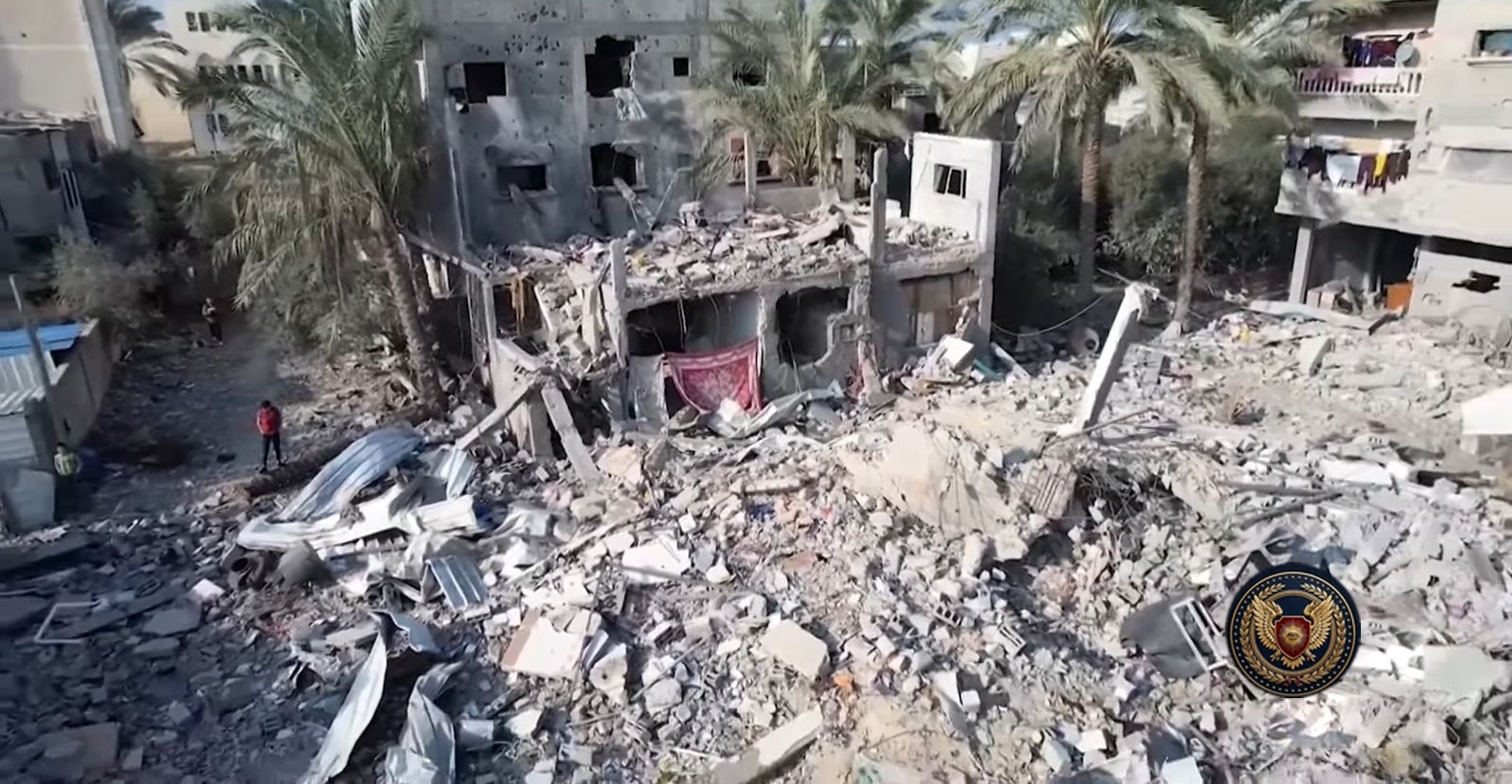
Shortly after midnight on Thursday 12 November 2026, two missiles struck the upper floors of the Yassin Building at Nasser Medical Complex in Khan Younis, southern Gaza. The missiles tore through the surgery department and the intensive care wards, collapsing ceilings, scattering debris across rooms of beds and medical equipment, and cutting power to parts of the complex. Medical Aid for Palestinians, the British charity that supports ten departments at the hospital, said the strike came at around 00:39 local time, and that one missile failed to explode and remained inside the building, a further danger to patients and staff still inside.
Six people were killed, among them a surgeon, a 13-year-old boy and patients admitted for treatment. At least 20 people were wounded, with later counts above 30. Most of those killed and injured were patients, including people scheduled for surgery the following day, according to Al Jazeera’s correspondent in Gaza. The hospital confirmed the six deaths in a statement. It was the seventh Israeli strike on the Nasser complex since October 2023.
The casualty list, the target and the seven-hour silence
The dead have been named in part. Medics identified the surgeon as Dr Rizk Abu Shaira, a prominent general surgeon who had never left his post, colleagues said. The hospital named the 13-year-old boy killed as Jihad Naeem Muhammad Abu Tilikh, and relatives named a 53-year-old man, Khaled Abu Anza, among the dead. Goher Rahbour, a British surgeon volunteering at the hospital, told AFP that a Palestinian doctor he had operated with on Wednesday evening was among those killed. “I was on my phone just doing a bit of reading and the strike occurred just after midnight. It was very loud, very quick. The building shook, there was a lot of smoke that came up,” he said.
The Israeli military and the Shin Bet said in a joint statement that the strike had targeted Muhammad Abu Ismail, the commander of Hamas’s Khan Younis Brigade, along with other members of the group’s military wing hiding inside the complex. The statement accused Hamas of turning the hospital into a headquarters, storing weapons there and conducting interrogations and torture. Hamas denied using the facility for military purposes, calling the claim a false narrative put forward to justify the airstrikes.
The military took about seven hours to issue its first comment, at around 7 a.m., with an updated statement at 10 a.m. naming the target. Late on Thursday, the military said at least two other senior Hamas officials had been killed in the same strike, one in combat engineering and one in communications. The fate of Abu Ismail himself remained unconfirmed, and his name did not appear in the list of victims provided by Gaza’s civil defence rescue service. Across Gaza on Thursday, at least ten people were killed in total, including at least four more in separate strikes near al-Bureij, Deir al-Balah, al-Shifa Hospital in Gaza City and Jabalia.
What happened to the commander; and the unexploded missile?
The central question remains open: whether Muhammad Abu Ismail is alive or dead. The Israeli military has said it is still reviewing the results of the overnight operation and stays conservative about battle damage assessments until it has all the information. The absence of his name from the civil defence victim list proves nothing either way, and the military’s late-Thursday claim about two other senior officials has not been independently confirmed.
Nor is it established what, if anything, was inside the hospital beyond the medical activity every witness describes. The military’s account of a command centre, weapons storage and interrogation rooms rests on its own statement, with no evidence published. The unexploded missile lodged in the Yassin Building leaves a practical unknown: how long surgery and intensive care will stay out of service, and whether the building can be made safe while patients are treated in the rest of the complex.
A hospital system with nothing left to absorb
Nasser is one of the largest hospitals in the Gaza Strip and the only one still standing in Khan Younis, serving at least 500,000 people in southern Gaza. Its surgery department is the main surgical service for the whole south. The strike forced the suspension of several vital departments, and the damage to the surgery and intensive care wards removes capacity with no substitute nearby.
The wider picture is a health system on its last reserves: according to the United Nations humanitarian office, just 20 of Gaza’s 37 hospitals remain partially functional, and none is fully functional. A United Nations assessment from April 2026 found 1,825 health facilities partially or fully damaged since October 2023. The strike came as the United Nations issued an emergency appeal for waterproof tents to shelter hundreds of thousands of people exposed to flooding from heavy rains, a reminder that the population the hospital serves now faces winter in tents. Readers who followed the collapse of Gaza’s infrastructure under the rains will recognise the pattern: each new blow lands on a system with no margin left.
The hospital as a battlefield, the law as a question
Hospitals hold protected status under the laws of war, lost only if the facility is used for acts harmful to the enemy, after a warning and a reasonable time to comply. That is why the two competing claims matter so much, and why neither can be settled from the statements alone. If the military’s account is right, the strike aimed at a lawful target inside a protected place. If the hospital’s account is right, it hit a protected site and killed the people it exists to save. The seven-hour delay before the military’s first comment, and the absence of published evidence for the command-centre claim, leave the legal question where it was at dawn: asserted, denied, and unproven.
Nasser has been struck seven times, and the hospital’s director said staff received no warning before this strike. Whatever the investigation concludes about Abu Ismail, the surgeon, the boy and the patients are dead, the surgery wing is shut, and the next wounded person in southern Gaza has one less place to go.
What a seventh strike does to a ceasefire that never quite held
The strike lands thirteen months into a ceasefire that took effect on 10 October 2025. More than 1,600 people have been killed in Israeli attacks since the agreement began, according to Gaza’s health ministry, and the strikes have continued near-daily despite the formal halt. A hospital strike of this scale hardens the argument of those who say the ceasefire never held, and makes the next round of talks harder to sell.
With surgery and intensive care out of service at the south’s main hospital, the wounded from the next strike will travel further or wait longer. The flooding that has already swamped displacement camps, described in the accounts of families who lost everything to the water, is filling the wards with the sick and the cold even as the wards are hit. And the killing of a surgeon who stayed at his post narrows the pool of specialists willing to stay, a loss no shipment of supplies can replace. The ceasefire’s credibility, the hospital’s capacity and the winter are three pressures on the same population at once.
The count that keeps rising, and the ward that stays shut
Three things to watch. First, the fate of Muhammad Abu Ismail: the military has promised a fuller battle damage assessment, and confirmation or denial of his death will shape how the strike is judged. Second, the casualty figures, which rose through Thursday from four dead to six, with the wounded climbing from 20 toward 30 and beyond, may rise further as the damage is cleared and the unexploded missile is dealt with. Third, the hospital itself: whether surgery and intensive care can reopen, whether the unexploded ordnance can be removed safely, and whether the international pressure that followed the August 2025 strike returns with the same force.
The United Nations appeal for waterproof tents, issued as the rains flooded the camps, is the other clock running against Gaza: winter is arriving for hundreds of thousands living in tents, and the hospital that would treat them is treating its own wounded.
What we agree on, and what remains open
Established
- An Israeli airstrike hit the Yassin Building of Nasser Medical Complex in Khan Younis shortly after midnight on Thursday 12 November 2026, killing six people including surgeon Dr Rizk Abu Shaira and a 13-year-old boy, and wounding more than 20.
- The strike damaged the surgery department and intensive care wards.
- It was the seventh strike on the complex since October 2023.
- The Israeli military said it had targeted Hamas commander Muhammad Abu Ismail.
Contested
- Whether the hospital was being used by Hamas as a command centre, weapons store and interrogation site, as the Israeli military claims, or was purely a medical facility, as Hamas and the hospital say.
- Whether the strike was a lawful targeted killing or an attack on a protected site.
- Whether Abu Ismail was killed, with the military saying his fate is still under review and his name absent from the civil defence victim list.
Still open
- Whether Muhammad Abu Ismail survived the strike.
- What evidence supports the military’s claim that the hospital was used for military purposes.
- How long the surgery and intensive care departments will remain out of service.
- Whether the unexploded missile can be removed without further casualties.
What to watch
Questions, answered
Shortly after midnight, two missiles struck the upper floors of the Yassin Building at Nasser Medical Complex in Khan Younis, in southern Gaza. Six people were killed, including surgeon Dr Rizk Abu Shaira and a 13-year-old boy, and more than 20 were wounded. The surgery department and intensive care wards were badly damaged, and one missile failed to explode and remained inside the building.
The Israeli military and the Shin Bet security service said the strike targeted Muhammad Abu Ismail, commander of Hamas’s Khan Younis Brigade, along with other members of the group’s military wing who were hiding inside the hospital complex. They accused Hamas of using the hospital as a command centre, storing weapons there and conducting interrogations. His death has not been confirmed.
Nasser is one of the largest hospitals in the Gaza Strip and the only hospital still standing in Khan Younis, serving at least 500,000 people in southern Gaza. Its surgery department is the main surgical service for the whole south. According to the United Nations, just 20 of Gaza’s 37 hospitals remain partially functional, and none is fully functional.
Yes. Thursday’s attack was the seventh Israeli strike on the Nasser complex since the war began in October 2023. A double strike in August 2025 killed at least 20 people, including five journalists and health workers. In March 2025 a strike on the same surgery department killed a Hamas political leader who was being treated there.