 MAGNA BUREAU
The Wire
Iran says it downed a 58th US MQ-9 over Hormuz as the war’s end stays out of reach
Tehran claims a new air defence system brought down an American Reaper over the Strait of Hormuz, the 58th it counts, on the same day Washington sanctioned four Iranians it calls “oil trustees” and Tehran set out seven conditions for reopening the waterway.
Key points
- The claim: Iran’s Islamic Revolutionary Guard Corps said on Saturday, 21 November, that its Aerospace Force had intercepted and destroyed a US MQ-9 drone over the Strait of Hormuz in the early hours of the morning, using a newly deployed advanced air defence system. It said the incident marked the 58th MQ-9 brought down by Iranian forces. 1
- The tally is Tehran’s own; and it has not moved in a straight line: the IRGC announced a 56th MQ-9 on 4 November and a 55th on 7 November, before claiming the 58th on 21 November. No wreckage or imagery of the latest interception had been published, and Washington had issued no public confirmation of the loss. 8
- The war behind the claim: the United States and Israel launched the war on 28 February 2026. It has killed thousands of people and severely disrupted shipping through the strait, through which one-fifth of the world’s oil and gas passed in peacetime. A memorandum of understanding signed in June was never fully implemented, and attacks have resumed periodically since July. 1
- The cost of the drone war: in August, The Washington Post reported that the US had lost 45 MQ-9 drones, about 25 percent of its fleet, at a cost of more than $1.3 billion during combat operations in Iran. 1
- Tehran’s seven conditions: Foreign Minister Abbas Araghchi said on Friday that seven conditions delivered to the US in September “must be implemented for the Strait of Hormuz to reopen”, including ending the war and lifting sanctions and the naval blockade on Iran’s southern ports. He called the timetable “flexible” but ruled out transferring Iran’s stockpile of 60 percent enriched uranium abroad. 1
ONE EVENT. THREE READINGS.
American coverage has treated the drone claim as one move in a war that is becoming a domestic political problem.
Reuters’ reporting on the Treasury sanctions framed the economic pressure campaign as the administration’s chosen instrument; an attempt to end Iran’s attacks on Gulf shipping and reopen the strait without a wider war.
What this reading highlights: The Washington Post’s August accounting of 45 lost MQ-9s, worth more than $1.3 billion, set the terms of the debate in Washington: the air war is expensive, and the expense is now visible in the budget fight.
The question in the capital is not whether the drone was shot down, but whether the public will keep paying for a war with no end date.
Sources: US Department of the Treasury (1), Reuters (1), GlobalSecurity.org (Press TV) (1)
Indian coverage has carried the claim straight and set it against the ledger.
The Tribune, reporting the ANI wire, and The Indian Express, in its live updates, both relayed the IRGC statement in full, the new air defence system, the early-hours interception, the 58th MQ-9, and placed it alongside the Treasury sanctions and Araghchi’s conditions as a single day of escalation.
What this reading highlights: The Indian press has not speculated on whether the drone fell; it has recorded that Tehran says it did, and that Washington has not said otherwise.
Sources: Mehr News Agency (1), The Tribune (ANI) (1), The Indian Express (1), Rediff (Press TV) (1)
The story reads as a war of attrition that nobody outside the Gulf chose.
Al Jazeera, which first reported the claim, set it inside the full arc, the February launch, the failed June memorandum, the resumed attacks since July, and gave equal weight to Araghchi’s seven conditions and to the Treasury’s sanctions, treating diplomacy and economic warfare as two faces of the same day.
What this reading highlights: Dawn’s live coverage tracked the same drumbeat.
The Southern reading is unsentimental: the strait is a chokepoint the world depends on, the war over it is being fought by two governments that will not talk, and the bill, in oil prices, insurance premiums and shipping risk, is being paid by everyone else.
Sources: Al Jazeera (1), Dawn (1), Al Mayadeen (1)
Sources by lens: 3 West, 4 East, 3 Global South. See every source
THE POINT OF CONVERGENCE
On the facts. Iran’s Revolutionary Guard said on Saturday, 21 November, that its Aerospace Force shot down a US MQ-9 drone over the Strait of Hormuz with a newly deployed air defence system, the 58th it counts; Foreign Minister Abbas Araghchi set out seven conditions on Friday for reopening the strait; the US Treasury sanctioned four Iranians it calls “oil trustees” on Friday; and President Donald Trump said at the White House that Tehran wants a deal, but not one acceptable to him.
WHAT REMAINS CONTESTED
On what the downing proves. Tehran reads the interception as proof its air defences can deny the strait to American aircraft. Washington’s allies read an unverified claim in a war of attrition, and note that a downed drone does not reopen a waterway or lift a blockade. The two sides also disagree on the price of peace: Iran demands the war’s end and the blockade’s lifting first, while the US demands concessions first.
The story
A claim from Tehran in the early hours of Saturday
TEHRAN; Iran’s Islamic Revolutionary Guard Corps said on Saturday, 21 November, that its Aerospace Force had shot down a US MQ-9 drone over the Strait of Hormuz, using what it described as a newly deployed and advanced air defence system. The announcement, carried by Iranian state broadcaster IRIB, said the interception took place in the early hours of the morning and marked the 58th MQ-9 brought down by Iranian forces since the war began.
The MQ-9 Reaper is a long-endurance aircraft used for reconnaissance and strike missions, and it has become the most visible symbol of the air war over the Gulf. The IRGC statement gave no further details about the circumstances of the interception; no time beyond the early hours, no location more precise than the strait, and no wreckage shown.
The claim arrived on a day of parallel pressure from both sides. In Tehran, Foreign Minister Abbas Araghchi set out the conditions under which Iran would reopen the strait. In Washington, the Treasury announced new sanctions on four Iranians it accuses of moving oil money for the regime. And at the White House, President Donald Trump said Tehran “want to make a deal”; but not one he is prepared to accept.
What does the record actually establish?
What is established is the claim itself, and its context. The war was launched by the United States and Israel on 28 February 2026, and it has killed thousands of people and severely disrupted shipping through the strait, the waterway through which one-fifth of the world’s oil and gas passed in peacetime. The two sides signed a memorandum of understanding in June, but it was never fully implemented because of disagreements over freedom and security of navigation, and attacks have resumed periodically since July. The Bureau has tracked the conflict as a frozen war neither side can end.
The drone war has been expensive for the United States. In August, The Washington Post reported that the US had lost 45 MQ-9 drones, about 25 percent of its fleet, at a cost of more than $1.3 billion during combat operations in Iran. That figure, from a Western source, gives the latest claim a plausibility the numbers alone cannot confirm.
What is not established is the fate of this particular aircraft. The IRGC has announced drone downings almost weekly, a 56th MQ-9 on 4 November, a 55th on 7 November, and its tally has not moved in a straight line. Qeshm Island, the scene of earlier interceptions, was itself hit by explosions during the war.
newly deployed and advanced air defence system.
What remains unconfirmed?
Three things remain unknown, and each of them matters more than the claim itself. First, whether the drone was actually destroyed: Washington had issued no public confirmation of the loss by the time of publication, and no wreckage, imagery or debris had been shown. In a war where both sides treat the information space as a front, an unconfirmed claim is a claim, not a fact.
Second, what system did the shooting down. The IRGC spoke of a “newly deployed and advanced air defence system” without naming it, and gave no details of the missile or the engagement. Without that, outside analysts cannot judge whether Iran’s defences are improving or whether the same systems are simply being credited with new kills.
Third, whether the seven conditions Araghchi outlined are a negotiating position or a set of preconditions. He called the timetable “flexible” and said Iran was prepared to negotiate how the conditions should be implemented; but he also said the conditions “must be implemented” for the strait to reopen. The distance between those two sentences is the whole negotiation.
A fifth of the world’s oil passes through this waterway
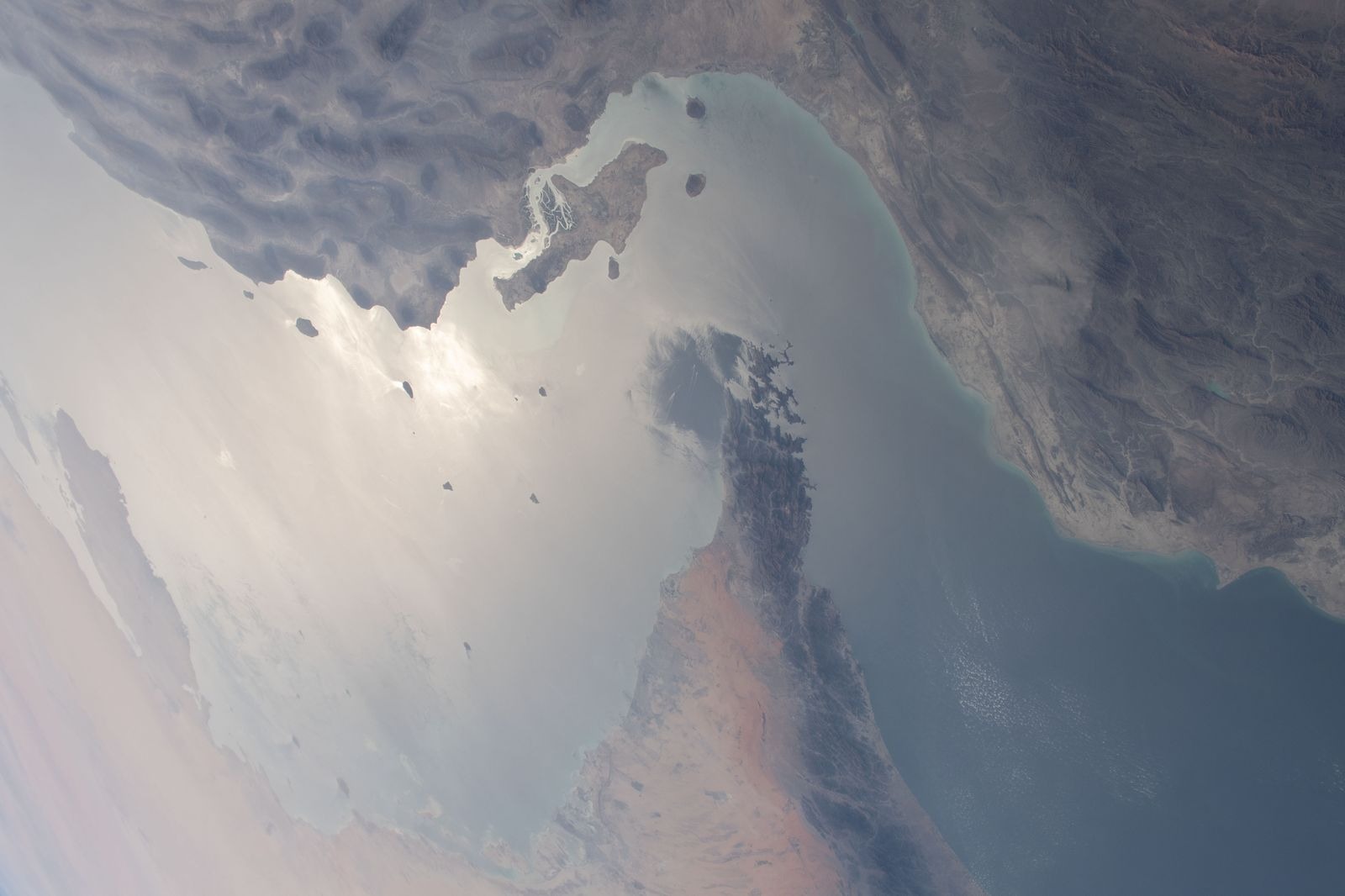
The Strait of Hormuz is the hinge of the global energy system. In peacetime, one-fifth of the world’s oil and gas passed through a channel barely 33 kilometres wide at its narrowest, and every week of disruption reprices energy for importers from Tokyo to Rotterdam. The war has already pushed global energy prices higher and spread to countries across the region. The open question for importers is whether global oil reserves are sufficient to withstand a prolonged closure of the strait.
The drone claim matters because it is a test of who controls the sky above that hinge. If Iran can reliably shoot down American reconnaissance aircraft, the US loses the eyes it uses to police the strait; and the blockade it enforces from the sea becomes harder to sustain. If it cannot, the claim is theatre, and the theatre itself is the point: a reminder to shipping, insurers and oil buyers that the strait is contested.
It matters domestically in Washington too. The war has already cost Republicans both chambers of Congress in the midterm elections earlier this month, according to Vice President JD Vance’s own framing, and Democratic representatives are now moving to cut off funding for offensive operations.
Two wars in one: the shooting war and the money war
There are two wars running over Hormuz, and Saturday showed both of them. The first is the shooting war: drones, air defences, tankers and mines. The second is the money war, and it may decide the outcome sooner. The Treasury’s sanctions on Friday targeted four Iranians it calls “oil trustees”; men it says collect the proceeds of illicit oil sales abroad and, in many cases, keep the money for themselves. The message is aimed as much at Tehran’s insiders as at its enemies: the regime, the Treasury says, is trying to recoup billions of dollars from its own trustees, and the trustees are not paying. The IRGC, meanwhile, has spent the war building underground sites to shield its arsenal from American strikes.
Secretary Scott Bessent’s framing is blunt. Under Operation Economic Outcast, launched on 24 August, the Treasury says there is “no oil on the water outside of the US military blockade” and none has been loaded since the operation began.
That is the context for Araghchi’s seven conditions. Ending the war, lifting sanctions and lifting the naval blockade are not three separate demands; they are one demand, stated three ways: let the oil flow again. Tehran’s leverage is the strait. Washington’s leverage is the blockade.
The attrition ledger is now a political weapon
The MQ-9 has become an accounting unit in this war, and both sides keep the books in public. Washington counts dollars: more than $1.3 billion in Reapers lost by August, a quarter of the fleet. Tehran counts airframes: 55, 56, 58; a running tally announced with each claim. The ledger is the message. Every drone claimed is a signal to Washington that the air war is not free, and every billion counted is a signal to Tehran that the losses are absorbable.
The second-order effects reach beyond the Gulf. Insurers price the strait as a war zone, and that premium lands on every barrel that moves through it; paid, in the end, by consumers far from the fighting. And in Washington, the war’s cost is migrating from the Pentagon’s budget into the domestic political argument: Representatives Yassamin Ansari and Ro Khanna are urging Congress to use the funding bill due by 11 December to end spending on offensive operations against Iran, with a government shutdown as the stakes.
The risk is that the ledger becomes the strategy; that each side keeps score because neither has a plan to stop scoring.
What happens next in the war over Hormuz?
Three dates now frame the war. The first is 11 December, when the US government funding bill falls due. If Congress attaches a ban on offensive spending against Iran, the war’s political foundation shifts overnight; if it does not, the funding fight simply moves to the next deadline.
The second is the negotiation itself, which has no date. Araghchi said Iran was prepared to negotiate how its seven conditions should be implemented, conditional on American confidence-building measures. Trump said he wants “a real deal, not a fake deal”. Between those two sentences there is a negotiation; if either side is willing to make the first move.
The third is the next IRGC announcement. The claims have come almost weekly, and each one tests whether the strait is still contested. The question is whether Washington confirms it; and whether the oil starts moving again.
What we agree on, and what remains open
Established
- On the facts. Iran’s Revolutionary Guard said on Saturday, 21 November, that its Aerospace Force shot down a US MQ-9 drone over the Strait of Hormuz with a newly deployed air defence system, the 58th it counts.
- Foreign Minister Abbas Araghchi set out seven conditions on Friday for reopening the strait.
- The US Treasury sanctioned four Iranians it calls “oil trustees” on Friday.
- President Donald Trump said at the White House that Tehran wants a deal, but not one acceptable to him.
Contested
- On what the downing proves. Tehran reads the interception as proof its air defences can deny the strait to American aircraft. Washington’s allies read an unverified claim in a war of attrition, and note that a downed drone does not reopen a waterway or lift a blockade. The two sides also disagree on the price of peace: Iran demands the war’s end and the blockade’s lifting first, while the US demands concessions first.
Still open
- Whether this MQ-9 was actually destroyed, since no US confirmation, wreckage or imagery had been published.
- Which air defence system was used.
- Whether Araghchi’s seven conditions are negotiable in substance or only in timetable.
- Whether the US Congress will cut funding for offensive operations against Iran.
- Or when, if ever, the strait fully reopens.
What to watch
Questions, answered
Iran’s Revolutionary Guard says its Aerospace Force intercepted and destroyed a US MQ-9 drone over the Strait of Hormuz in the early hours of Saturday, 21 November, using a newly deployed advanced air defence system. It says the interception marked the 58th MQ-9 brought down by Iranian forces since the war began. The announcement was carried by state broadcaster IRIB.
No. Washington had issued no public confirmation of the loss by the time of publication, and no wreckage or imagery of the interception had been shown. The claim rests on the IRGC statement carried by Iranian state media. That does not make it false, the US lost 45 MQ-9s by August, according to The Washington Post, but it means the loss is unverified.
Foreign Minister Abbas Araghchi said on Friday that seven conditions delivered to the US in September “must be implemented for the Strait of Hormuz to reopen”, including ending the war and lifting sanctions and the naval blockade on Iran’s southern ports. He called the timetable “flexible” and said Iran would negotiate how the conditions are implemented, but ruled out transferring its 60 percent enriched uranium stockpile abroad.
The Treasury sanctioned four Iranians it calls “oil trustees”: Mohammad Javad Bavand, a former IRGC intelligence officer; Majid Taj, brother of the Iranian Football Federation’s president; Mohammadhossein Servati, son of an IRGC brigadier general; and Mojtaba Arabnejad, son of the Mahan Air chief executive. All four were placed on the Specially Designated Nationals list.
Three dates frame what comes next: 11 December, when the US government funding bill falls due and Congress may vote on cutting offensive war spending; the negotiation itself, which has no date but which Araghchi says depends on American confidence-building measures; and the next IRGC announcement, which will test again whether the strait is still contested and whether Washington confirms the claim.