Rain floods 70,000 tents in Gaza as the first winter storm hits the camps
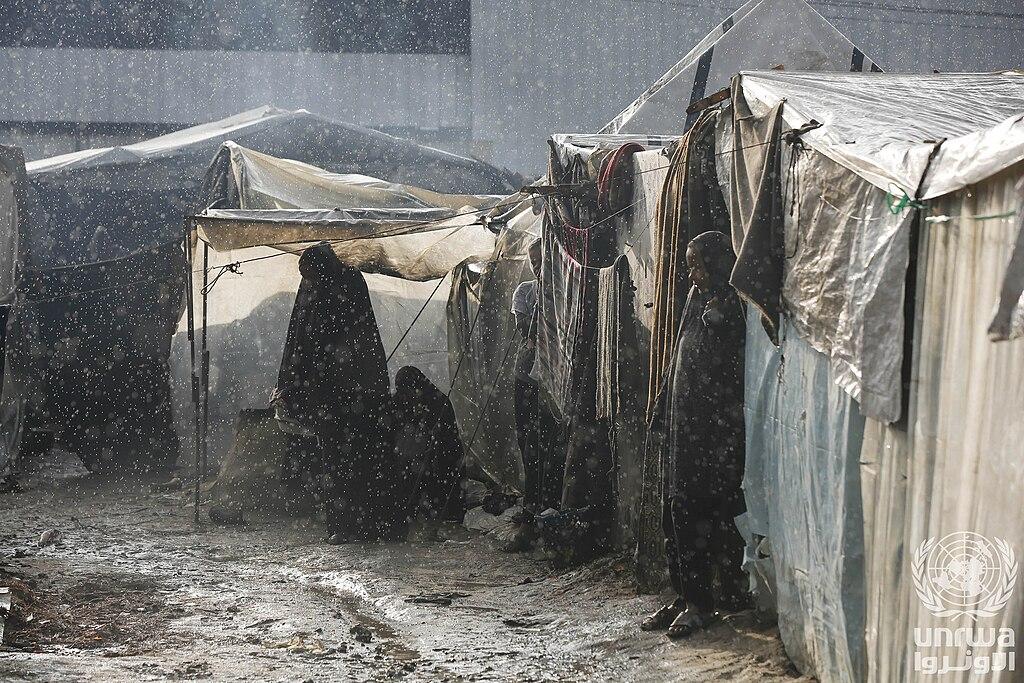
Within twelve hours, the season's first storm flooded about 70,000 tents sheltering displaced Palestinians across Gaza, according to the territory's Government Media Office, while civil defence crews answered 1,500 distress calls and hospitals braced for a wave of illness.
Published 7 November 2026 · 14:10 GMT
The summary
Saturday 7 November 2026: the first winter storm of the season floods about 70,000 tents sheltering displaced Palestinians across Gaza within twelve hours. 1,500 distress calls: Gaza's civil defence receives about 1,500 calls in ten hours, with water rising 30 to 40 cm in several shelter sites.
The three lenses
- WestWestern reporting led with the numbers and the dispute over who is responsible for them.
- EastThe view from the region's own outlets filled in the details the wires passed over.
- Global SouthThe reporting closest to the camps was also the most concrete.
Key facts
- Saturday 7 November 2026: the first winter storm of the season floods about 70,000 tents sheltering displaced Palestinians across Gaza within twelve hours. Al Jazeera
- 1,500 distress calls: Gaza's civil defence receives about 1,500 calls in ten hours, with water rising 30 to 40 cm in several shelter sites. Reuters
- About $3m in initial losses: the estimate given by Gaza's Government Media Office in its statement on Saturday. Al Jazeera
- Two people injured: a wall collapses in northern Gaza, and a building partially collapses in Nuseirat, where residents are evacuated. WAFA
- 200,000 tents needed: Gaza's emergency committee says more than one million displaced people face a harsh winter and urgently need tents and heating supplies. Al Jazeera
- Al-Shifa hospital floods: the emergency department in Gaza City is out of service for about four hours after the storm. Al Jazeera
How did one night of rain undo 70,000 shelters?
The rain began on Friday night and did not let up. In al-Mawasi, the coastal strip of southern Gaza sheltering more than 900,000 displaced people, it had been falling since 10pm, and by Saturday morning the water was inside the tents. Across Gaza City, Khan Younis and Deir el-Balah, families woke to find their shelters flooded, their mattresses soaked and their blankets floating in water mixed with mud and sewage. Footage from the camps showed children standing barefoot in pools of filthy water while their parents bailed out tents with cooking pots.
Within twelve hours of the first winter storm of the season, about 70,000 tents sheltering displaced Palestinians had been flooded, according to Gaza's Government Media Office. The territory's civil defence agency said its crews received about 1,500 distress calls in just ten hours, with water levels in several shelter sites rising by 30 to 40 centimetres. Dozens of walls collapsed, and two people were injured when a wall fell in northern Gaza.
What do the counts from Saturday actually say?
The figures all come from the authorities in Gaza, reported independently by more than one outlet. The Government Media Office put the number of flooded tents at about 70,000 and the initial losses at about $3 million. The civil defence agency counted roughly 1,500 distress calls in ten hours after the rain began early on Saturday, Its spokesman, Mahmoud Basal, told Al Jazeera: “What we feared has actually happened,” adding that premature babies, the elderly and the sick were most at risk.
The storm also brought down buildings already weakened by bombardment: rescuers evacuated a building in the central Nuseirat area that partially collapsed in the wind and rain, and a wall fell in northern Gaza, injuring two people, according to the Palestinian news agency WAFA. At al-Shifa Medical Complex in Gaza City, the emergency department flooded and was out of service for about four hours, its director, Mohammed Abu Salmiya, told Al Jazeera.
United Nations figures put nearly 950,000 displaced Palestinians in areas of moderate or high flood risk, and more than 400,000 in places vulnerable to flooding or close to the seashore. Al Mayadeen cited field surveys finding more than 162,000 of roughly 270,000 displacement tents already severely damaged or unusable before the storm.
What is still uncounted while the water stands?
The full toll is still being counted, and the early numbers describe only the first twelve hours. Nobody has yet said how many of the 70,000 flooded tents are destroyed outright and how many can be dried out and used again, and that distinction will decide how many families spend tonight without any shelter at all. The casualty count is also incomplete: Reuters reported injuries but no fatalities, and the two people hurt in the northern wall collapse were the only injuries confirmed in detail.
Nor is it clear what the next days will bring. The Palestinian news agency WAFA reported that a low-pressure system accompanied by cold air continued to affect the territory, which raises the prospect of more rain on camps that are already soaked. And the question that will shape everything else is whether shelter materials will be allowed in: the emergency committee says the territory urgently needs about 200,000 tents and heating supplies, while the crossing rules remain unchanged.
Why does a storm count as a test of the ceasefire?
It matters because winter has only just begun, and the shelter that was supposed to protect more than a million displaced people has already failed at the first storm. Gaza's emergency committee says more than one million displaced people face a harsh winter, and the United Nations relief agency UNRWA reported on Friday that around 1.98 million people, or 94 percent of Gaza's population, need urgent assistance.
Many tents were put up in the first year of displacement and are now in their fourth, patched and re-stitched by their owners, and officials had warned since August that most were already unusable. Under the ceasefire's humanitarian protocol, the tents were supposed to be replaced with caravans, which Israel has not allowed in. The storm therefore tests more than drainage: it tests whether the truce, in force since 10 October 2025, can deliver the protection it promised to people who have already survived two years of war. The United Nations had already warned that nearly a million people in Gaza face flood risks as winter closes in, and the camps are also where life stubbornly goes on: this same week, 250 Palestinian couples married in a mass wedding in Gaza, three years into the war.
What does the flooding reveal about a shelter system that was already broken?
The most important fact about Saturday is that the disaster was forecast in detail and still arrived unprepared for. The civil defence agency warned on Thursday that heavy rain and strong winds threatened people in tents, temporary shelters and damaged buildings, and the United Nations had already warned of the flood risk. When the rain came, the response ran into the same shortages as the rest of the territory: officials told Reuters they could not cope for lack of fuel and damaged equipment, and the civil defence director, Raed al-Dahshan, told Al Jazeera that his crews had nothing to give the families they reached. “Civil defence does not have a single tarpaulin or a single tent,” he said. “We deal only with saving lives, and that is not enough.”
That shortage sits at the centre of the dispute over blame. The Government Media Office held Israel “fully responsible” for what it called a disaster caused by the continued closure of crossings and the blocking of shelter and reconstruction materials Israel says it restricts the entry of equipment that could be used as weapons and has accused Hamas of looting humanitarian aid, while COGAT did not immediately comment on the accusations. Four more vacuum trucks entered Gaza this week through the Red Cross, joining eight others from the past month, but twelve trucks cannot pump out a territory.
What breaks next if the rain keeps coming?
The second wave will be measured in hospital wards rather than in tents. The director of al-Shifa warned of a rise in gastrointestinal, respiratory and skin infections as sewage mixed with rainwater inside the tents, and he warned that deaths among newborns who need warmth could reach the dozens or even the hundreds. That warning turns a night of flooding into a public-health emergency unfolding over weeks, on a health system whose emergency department was itself underwater for four hours on Saturday.
The buildings are the second risk. Dozens of walls have already collapsed, and every further storm will test structures cracked by bombardment and soaked through. The coastal camps face a third danger: thousands of families have pitched tents along the shoreline at Gaza City port, where strong winds and rising tides threaten from the sea as well as the sky. “These tents will flood first from the rain, and second from seawater,” an Al Jazeera reporter at the port said. If the next storm arrives before replacement tents do, the count will not be a record of one night but the start of a winter-long pattern, in a territory where families have already been turning discarded cooking pots into seawalls to hold back the water.
What should readers watch for in the days ahead?
Watch the sky first: the low-pressure system behind Saturday's rain was still over the territory, and a second storm would hit camps that have not yet dried out. Watch the crossings next, because the emergency committee's appeal for about 200,000 tents and heating supplies can only be answered if shelter materials are allowed in, and the caravans promised under the ceasefire protocol are still waiting. Watch the hospitals, where the infection counts over the coming days will show whether the storm's real toll was measured in tents or in lives. And watch the aid agencies, whose appeals for equipment and fuel will show whether the response can grow beyond twelve vacuum trucks to match a million people facing winter in tents.
The three lenses
West Lens:
Western reporting led with the numbers and the dispute over who is responsible for them. Reuters, reporting from Gaza and Cairo, put the flooded tents at 70,000 in twelve hours, the distress calls at 1,500, and the injuries without fatalities, then set beside them the fuel shortages, the damaged equipment and the silence from COGAT.
East Lens:
The view from the region's own outlets filled in the details the wires passed over. The Siasat newspaper in India, drawing on the Anadolu agency and the WAFA news agency, named the places: the Gaza City port, the west of Deir al-Balah, the north of the Nuseirat camp, Jabaliya and Beit Lahia, and it reported the two people injured when a weakened wall collapsed.
South Lens:
The reporting closest to the camps was also the most concrete. Al Jazeera reported from Gaza City, Khan Younis and Deir el-Balah as the water rose, and it put names and numbers to the night: more than 28,000 widows facing the winter alone with their children, 125,000 coastal families at particular risk of being swept away by the sea, and a civil defence with no tarpaulins to hand out.
The consensus
- What we agree on
- What we agree on: heavy rain from the first winter storm of the season flooded about 70,000 tents sheltering displaced Palestinians in Gaza within twelve hours on Saturday 7 November 2026; the civil defence received about 1,500 distress calls in ten hours; water rose 30 to 40 centimetres in several shelter sites; and the initial losses were estimated at about $3 million.
- What we don't agree on
- What we disagree on: who bears responsibility for the scale of the disaster, with Gaza's Government Media Office holding Israel fully responsible for blocking shelter materials while Israel says it restricts equipment that could be used as weapons; and whether the crossings will open for tents and caravans before the next storm.
- What we know
- What we know: the numbers, 70,000 tents, 1,500 distress calls, about $3 million in initial losses; the places, Gaza City, Khan Younis, Deir el-Balah, al-Mawasi and the northern camps; the names, Mahmoud Basal, Raed al-Dahshan, Mohammed Abu Salmiya; and the needs, about 200,000 tents and heating supplies for more than a million people facing winter.
- What we don't know yet
- What we don't know: how many of the 70,000 flooded tents are destroyed rather than merely soaked; how many people will fall ill as sewage mixes with rainwater; whether more rain will follow the low-pressure system still over the territory; and whether shelter materials will be allowed in before the next storm.
- What we expect
- What we expect: hospitals to report rising gastrointestinal, respiratory and skin infections in the coming days; the emergency committee's appeal for 200,000 tents to dominate the aid debate; and the ceasefire's humanitarian protocol to face its sharpest test yet as winter sets in.
Questions, answered
How many tents were flooded in Gaza?
About 70,000 tents sheltering displaced Palestinians were flooded within twelve hours of the first winter storm of the season, according to Gaza's Government Media Office. The figure covers camps across the territory, from Gaza City in the north to al-Mawasi in the south, and the office put the initial losses at about $3 million.
Why are the tents so vulnerable to rain?
Most of the tents were put up in the first year of displacement and are now in their fourth, patched and re-stitched by their owners. Field surveys found more than 162,000 of roughly 270,000 tents were already severely damaged or unusable before the storm, and officials had warned since August that the shelters could not withstand winter weather.
What aid is reaching the camps?
Four additional vacuum trucks entered Gaza this week through the International Committee of the Red Cross, joining eight others brought in over the past month to pump sewage and repair water infrastructure. Civil defence crews are still answering distress calls, but officials say fuel shortages and damaged equipment are hampering the response.
What happens next as winter sets in?
Gaza's emergency committee says more than one million displaced people face a harsh winter and the territory urgently needs about 200,000 tents and heating supplies. Hospitals expect a rise in infections as sewage mixes with rainwater, and much depends on whether shelter materials and the caravans promised under the ceasefire protocol are allowed in.
Sources
- Al Jazeera
- Reuters
- WAFA