Tom Barrack’s podcast warning detonated across oil markets and Gulf capitals on Friday — hours before the president publicly disowned it. The split reveals how Washington is really thinking about the next round.
Published 23 October 2026 · 23:42 GMT
Tom Barrack’s podcast warning detonated across oil markets and Gulf capitals on Friday — hours before the president publicly disowned it. The split reveals how Washington is really thinking about the next round. On Friday, October 23, 2026, U.S. ambassador to Turkey Tom Barrack told podcast host Mario Nawfal that the United States could strike Iran as early as this weekend: “Could there be a strike this weekend? Hours later in Florida, President Donald Trump downplayed the warning: “That was my ambassador?
On Friday, October 23, 2026, U.S. envoy Tom Barrack said on the Mario Nawfal podcast that the United States could strike Iran as early as this weekend, describing President Trump as open to a deal while ruling out regime change as an American objective.
Whether any strike is actually planned — Trump says he knows nothing about it — and what Washington’s goal would be: Netanyahu vows to topple Iran’s clerical state while Barrack says the consequence “won’t be regime change.”
Whether an operation has been ordered, what targets and scope it would involve, whether Israel is coordinating, and whether Barrack’s remark was authorized signaling, a negotiating tactic, or freelance commentary.
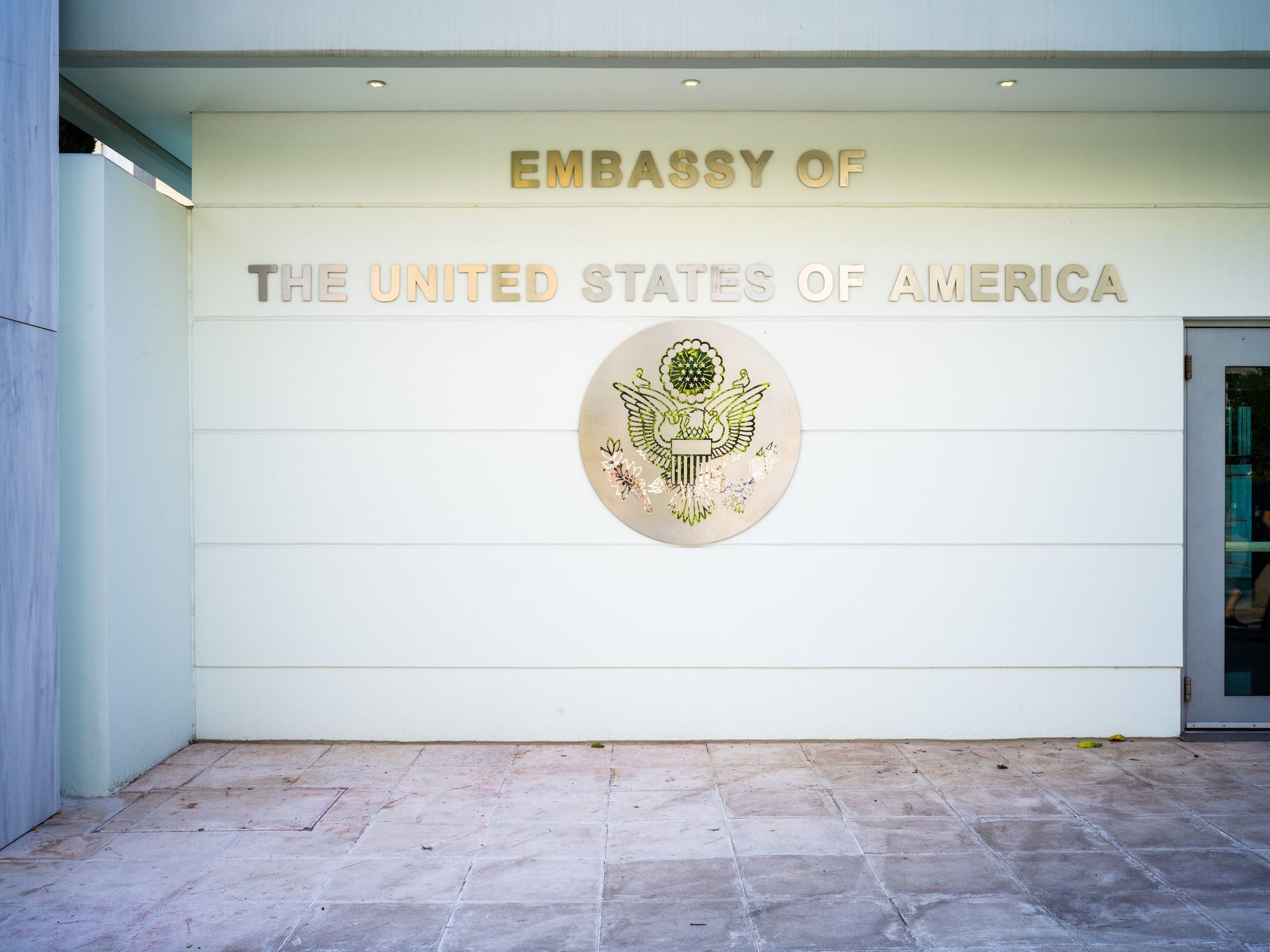
It landed on a podcast, not at a podium. On Friday, October 23, 2026, Tom Barrack — the United States ambassador to Turkey and Washington’s special envoy to Syria — told online host Mario Nawfal that American strikes on Iran could come within days. Asked whether a strike was possible this weekend, Barrack answered without hesitation: “Could there be a strike this weekend? Absolutely.”
The interview took place as Barrack was visiting the Gulf; a snippet aired on Israeli army radio before the full exchange circulated. Barrack, a longtime friend and business partner of President Donald Trump, has no direct role on the Iran portfolio — a caveat every newsroom carrying his words repeated. Yet the quote crossed the wires within the hour: Agence France-Presse moved it from Jerusalem; outlets from New Delhi to Seoul carried it by nightfall.
Barrack paired the threat with an open door. Trump, he said, “is very clear. He’s open and available and accessible to a deal and we’ve been at the table for months and months and months.” But the goal, he insisted, would not be toppling Iran’s government — a direct contradiction of the Israeli prime minister’s stated war aims.
Hours after the podcast clip spread, the president appeared to pour cold water on his own envoy’s warning. Asked by reporters in Florida to confirm a weekend strike, Trump replied: “That was my ambassador? He’s a pretty powerful man, I guess. If that’s the case, I don’t know anything about it.”
It was not the president’s first word on the subject this week. On Friday morning at the White House, Trump told reporters: “We could end it very quickly, but… the question is, do we want to finish it off or do we want to let it wither.” Earlier the same day he said the United States could launch “another little Epic Fury” — a reference to the joint Israeli-American operation that ignited the war with Iran at the end of February.
Eight months on, the conflict has settled into a grim rhythm of threats and lulls. Trump has recently signaled openness to resuming strikes after a long diplomatic deadlock, even though he earlier said no attack would come before the November 3 congressional elections. Barrack’s weekend timeline lands inside that changed calculus — or ahead of it, if the denial is taken at face value. Eight months after the February strikes, the war’s shape is shifting again.
The most important question has no answer on the record: has the president actually ordered or authorized a strike? Trump’s Florida denial suggests not — or suggests the denial is part of the choreography. Envoys of Barrack’s rank do not usually freelance on matters of war and peace; whether his remark was a deliberate trial balloon, a negotiating signal, or an unscripted overstep is something Washington is not saying.
Nor do we know the scope. Barrack spoke of “a strike” without targets, duration, or objectives — a limited punitive raid, a longer air campaign, or a coordinated American-Israeli operation? The Israeli dimension is the loudest silence: Prime Minister Benjamin Netanyahu, who faces elections on Tuesday, October 27, has repeatedly vowed to topple the clerical state in Iran, a goal Barrack explicitly ruled out for Washington. Whether Jerusalem was briefed, consulted, or warned is unknown.
The trigger is equally undefined. Barrack’s condition — “If you keep threatening the world, our allies, the Gulf, there will be a consequence” — is broad enough to cover almost any Iranian move. What exactly Tehran must do, or stop doing, to defuse the weekend deadline is not specified.
Markets did not wait for Monday. On Friday, Brent crude — the international benchmark — climbed to about $117.30 a barrel, its highest in more than four years, rising roughly four percent in a single session on renewed fears that the American-Israeli war on Iran is about to resume. The U.S. benchmark, West Texas Intermediate, hit $103 a barrel, its highest in five weeks. Houthi attacks on Saudi Arabia added to the upward pressure.
Energy is only the first transmission channel. Iran has detailed plans to strike undersea communications cables in the Gulf if war resumes, officials have told reporters — a threat that would sever data flows for the region’s financial centers. Shipping through the Strait of Hormuz is already strained: India has raised formal concerns over the safety of its seafarers and tankers amid attacks on commercial vessels, even as New Delhi keeps flying life-saving medicines into Iran through disrupted corridors.
The February war taught traders that Gulf escalation reprices oil in hours, not days. A weekend strike — however limited — would force insurers, airlines, and shipping lines to rewrite risk assumptions on Monday morning. Are global reserves enough to survive a renewed war? Analysts are divided, and Friday’s price action showed which way the fear is leaning.
Read closely, the interview contains two messages — and the second may matter more than the weekend deadline. Barrack drew an explicit, public line between Washington’s aims and Jerusalem’s. Netanyahu, campaigning ahead of Tuesday’s vote, has vowed to topple Iran’s clerical state after two major bombing campaigns since last year. Barrack answered: “The consequence won’t be regime change. The United States — the president of the United States — has said he’s not interested in regime change. The problem with regime change always is, what’s the day-two scenario?”
That is a doctrine, not a throwaway line. Barrack reframed American military action as “rebalancing” — “so that there’s no hostages, no threats, and the world can calm down” — rather than as the opening move of Iran’s transformation. The distinction speaks to several audiences at once: Tehran, which must judge whether the threat is existential or punitive; the Gulf states, which fear a collapsed Iran more than a defiant one; and Netanyahu, whose electoral interests run toward maximalism.
Then there is the messenger. Barrack is no career diplomat — he is Trump’s friend and business partner, dispatched to Ankara and Damascus, not the Iran file. When such a figure speaks of war on a podcast, the ambiguity is the message: deniable enough for the president to disown in Florida, specific enough — “Absolutely” — to rattle Tehran and the markets. Coercive diplomacy in its purest televised form.
The first casualties of a renewed bombing campaign would not be in Iran — they would be in the spreadsheets of every institution that prices Gulf risk. Beyond oil, the undersea-cable threat looms largest: the Gulf’s data arteries carry the region’s banking traffic, and Iranian officials now openly discuss them as targets. One severed cable would force the world’s financial plumbing to reroute around a war zone.
The human geography is already shifting. India — flying life-saving medicines into Iran despite grounded commercial routes — is simultaneously warning about its seafarers in the Strait of Hormuz. National Security Adviser Ajit Doval raised the issue with Iran’s security chief Mohsen Rezaei on October 12, and Defence Minister Rajnath Singh met Iran’s first vice president at the Shanghai Cooperation Organisation summit in Dushanbe this week. New Delhi is preparing for the worst while negotiating for the best.
Regionally the tripwires multiply: Houthi strikes on Saudi targets, Hezbollah’s posture in Lebanon, U.S. bases across the Gulf threatened by Iran’s Revolutionary Guard, and the West Bank — under Israeli lockdown since Friday. Qatar and France have already demanded Hormuz reopen and a real Gaza ceasefire hold, a sign Paris and Doha see the theaters as one crisis. A weekend strike on Iran would not stay in Iran.
The clock Barrack set expires on Sunday night. Three markers will tell the story before markets open Monday: the weekend’s military posture — carrier movements, airbase activity, Gulf airspace closures, all tracked in near-real time by open-source analysts; the full podcast, of which only a snippet has aired; and Washington’s Monday briefing cycle — if the Pentagon and the White House say nothing, the denial stands.
Beyond the weekend, two dates dominate. Tuesday, October 27, is Israel’s election: Netanyahu’s maximalist rhetoric may soften or harden with the result. November 3 is the U.S. congressional election — Trump’s earlier red line against pre-election strikes. Barrack’s timeline, if real, crosses that line; if the weekend passes quietly, the red line may quietly return.
The diplomatic track keeps moving underneath the noise. Eight foreign ministers — European and Middle Eastern — urged Washington this week to choose diplomacy over new strikes, calling further escalation a losers’ game. Their appeal now reads like a direct reply to Barrack. Whether Tehran answers the threat with a concession or a counter-threat will decide which script the region follows.
The Western lens: the contradiction at the heart of the story Western coverage has fixated on the split-screen: an envoy warning of war while his president claims ignorance. The Times of Israel framed it head-on — “US envoy: We could strike Iran this weekend; Trump: I don’t know anything about that” — and read Barrack’s no-regime-change line as a direct rebuttal of Netanyahu’s campaign vow to topple the clerical state. France 24 led instead with Trump’s own escalation language: the “another little Epic Fury” remark that named the February operation.
The Eastern lens: the calendar first Eastern outlets read the calendar. The Korea Times stressed the two major bombing campaigns since last year and, crucially, the November 3 U.S. congressional elections — the date Trump himself once set as the earliest window. The emphasis is on process and timing: not whether Washington can strike, but when domestic politics allow it.
The Global South lens: consequences first The Global South read the consequences. Al Jazeera paired the Barrack quote with the oil-price surge — Brent at a four-year high — Houthi strikes on Saudi Arabia, and Israel’s West Bank lockdown: one interlocking crisis. Gulf and Arab News centered the Gulf’s exposure — seafarer safety, Hormuz shipping, India’s medicine corridor to Iran — while The Hindu’s Indian readers got both the AFP dispatch and the parallel warning that Gulf undersea cables are now explicit Iranian targets.
Tom Barrack is the United States ambassador to Turkey and Washington’s special envoy to Syria. He is a longtime friend and business partner of President Donald Trump — which is why his unscripted-sounding remark on Mario Nawfal’s podcast travelled so fast. The caveat: he holds no direct role on the Iran portfolio, and Trump publicly distanced himself from the warning within hours.
No — he did the opposite. Asked in Florida on Friday whether a strike could come this weekend, Trump said: “That was my ambassador? He’s a pretty powerful man, I guess. If that’s the case, I don’t know anything about it.” Earlier the same day, however, he told reporters the U.S. “could end it very quickly” and floated “another little Epic Fury” — leaving the door wide open.
The name given to the joint Israeli-American military operation at the end of February 2026 that ignited the current war with Iran. When Trump said Friday that Washington could launch “another little Epic Fury,” he was explicitly invoking that February campaign — a signal his audience in Tehran and Jerusalem understood instantly, and one the region’s traders heard as a price alert.
Barrack says yes — and Netanyahu’s camp hears no. On the podcast, the envoy insisted: “The consequence won’t be regime change. The president of the United States has said he’s not interested in regime change.” Netanyahu, facing elections on October 27, has repeatedly vowed to topple Iran’s clerical state. That split between Washington’s “rebalancing” and Jerusalem’s maximalism is the story’s deepest fault line.
Brent crude jumped about four percent on Friday to roughly $117.30 a barrel — a four-year high — while U.S. benchmark WTI hit $103, its highest in five weeks. Traders priced in a resumption of the American-Israeli war on Iran; Houthi attacks on Saudi Arabia added pressure. Insurers and shipping lines serving the Gulf began repricing risk ahead of Monday’s open.
Iranian officials have warned that Gulf undersea communications cables could become targets if war resumes — a threat to the region’s financial data flows. Tehran has also attacked commercial shipping in the Strait of Hormuz, prompting India to raise formal concerns for its seafarers and tankers, and the Revolutionary Guard has threatened U.S. bases across the Gulf.
