
No people on earth has been itself for longer. For five thousand years the Chinese have written in the same script, farmed the same river plains, and revived the same empire every time it fell — and they did it while inventing paper, printing, gunpowder, and the civil service examination.
The people in images
Origins
The story begins with a river the color of the earth it carries. The Yellow River — the Huang He — flows thick with loess silt, and on its banks farming villages rose some seven thousand years ago, growing millet in the north while rice paddies spread along the Yangtze to the south. Tradition dates the first dynasty, the Xia, to c. 2100 BCE; whether the Xia were history or legend, what followed is carved in bone. The Shang (c. 1600–1046 BCE) left oracle bones — tortoise shells and ox scapulae inscribed with the earliest known Chinese writing, questions put to ancestors about harvests, wars, and the king’s toothache.
The Zhou (1046–256 BCE) gave China its most durable political idea: the Mandate of Heaven, the doctrine that rulers hold power only while they rule well — and that rebellion against a failed dynasty is not treason but cosmic housekeeping. It was under the Zhou’s long unraveling that Confucius (551–479 BCE) taught his answer: order the family, and the state will follow; cultivate virtue, and ritual will hold the world together. Then came the Warring States, two and a half centuries of brilliant, blood-soaked competition — and in 221 BCE the king of Qin ended it. Qin Shi Huang, the First Emperor, unified the warring states into a single empire, standardized the script, the currency, and the weights and measures, began joining the northern walls into what would become the Great Wall, and was buried with an army of terracotta soldiers. The Qin endured only 15 years (221–206 BCE) — and set the template for everything after.
Golden ages
The Han took the Qin’s machinery and made it humane. For 400 years (206 BCE–220 CE) the Han ruled an empire stretching from Korea to Central Asia, opened the Silk Road after the envoy Zhang Qian’s epic journey west, and gave their name to the Chinese people themselves — the Han. Paper was invented in the imperial workshops around 105 CE; the bureaucracy began recruiting by merit rather than blood. When the Han fell, China split into the romance-haunted Three Kingdoms — and then reunited, as it always does.
The Tang lasted 289 years (618–907) and were China’s most cosmopolitan age: the capital Chang’an — today’s Xi’an — held perhaps a million people, the largest city on earth, its markets crowded with Persian merchants, Indian monks, and Central Asian musicians. The poets Li Bai and Du Fu wrote verses schoolchildren still memorize. Buddhism, arrived centuries earlier along the Silk Road, flowered into schools of philosophy; Confucianism and Daoism argued, borrowed, and intermarried. The Song governed for 319 years (960–1279) and turned invention into an industry: the compass, gunpowder, movable-type printing, and the world’s first paper money. Then the steppe struck: the Mongols completed their conquest in 1279, and for the first time all of China answered to foreigners.
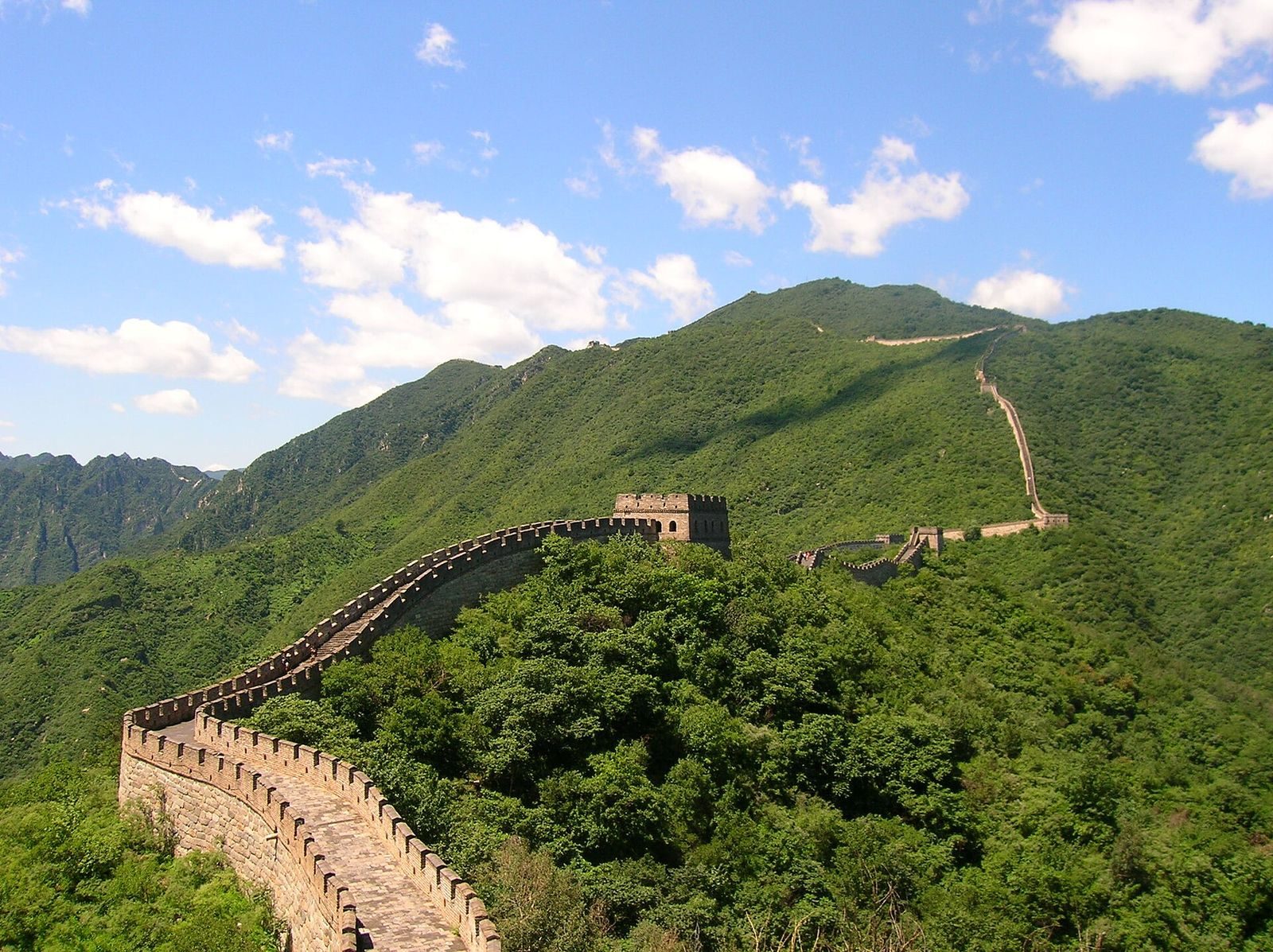
China absorbed them, as it absorbs everyone. The Ming rose in 1368 and endured 276 years: they built the Forbidden City in Beijing, sent the admiral Zheng He on treasure voyages as far as East Africa between 1405 and 1433, and rebuilt the Great Wall in the brick-and-stone form tourists climb today. From Nanjing to Guangzhou, from Luoyang to Shanghai, the ports and kilns of Ming China made it the workshop of the pre-modern world.
Trials
In 1644 Manchu horsemen from the northeast took Beijing, and the Qing ruled for 268 years (1644–1912) — China’s last dynasty, and in territory its largest. The eighteenth century was prosperous; the nineteenth was catastrophe. Britain’s appetite for tea, paid in silver, flipped into an appetite for opium paid in addiction, and the First Opium War of 1839–1842 ended with the Treaty of Nanking: Hong Kong ceded, ports forced open, the beginning of the “century of humiliation.” The Taiping Rebellion (1850–1864), a peasant uprising with a Christian veneer, killed tens of millions; the Boxers rose in 1900 and were crushed by eight foreign armies.
The Xinhai Revolution of 1911 toppled the boy emperor; the Republic was proclaimed in 1912. What followed was warlords, then invasion: Japan seized Manchuria in 1931 and launched full-scale war in 1937, committing the Nanjing massacre that December. Eight years of resistance bled into civil war between Chiang Kai-shek’s Nationalists and Mao Zedong’s Communists. In 1949 Mao proclaimed the People’s Republic from Tiananmen. The Great Leap Forward (1958–1962) brought famine that killed tens of millions; the Cultural Revolution (1966–1976) turned the country on itself. Then, in 1978, Deng Xiaoping opened the door.
Today
What walked through it astonished the world. Reform and opening turned fishing villages into megacities; entry into the WTO in 2001 made China the workshop of the planet a second time. The World Bank credits the boom with lifting more than 800 million people out of extreme poverty — the fastest mass enrichment in human history. China built the longest high-speed rail network on earth, landed rovers on the far side of the Moon, and staffed its own space station.
Over 1.4 billion people, tens of millions more of the diaspora from Singapore to San Francisco, one script binding a hundred spoken tongues. Confucian respect for learning still drives the world’s most ferocious examination culture; the Mandate of Heaven still whispers that rulers must deliver. Five thousand years in, the Chinese remain what they have always been: the world’s longest continuous civilization — and its most patient.