US evacuates aircraft from a second British base after an Iran threat
Tankers left RAF Mildenhall for Germany on Monday and the security level was raised at two American bases in England, weeks after bombers were pulled out of RAF Fairford over a suspected Iran-linked plot.
Published 10 November 2026 · 09:27 GMT
The summary
Two KC-135 refuelling tankers diverted from RAF Mildenhall to Germany on Monday 9 November 2026, and several more tankers were moved to Germany and other locations later in the day. Flight-tracking data showed nine KC-135 tankers and three CV-22 Osprey aircraft left Mildenhall on Monday; most tankers headed for Germany and Spain, one for RAF Prestwick, and the Ospreys for RAF Lakenheath.
The three lenses
- WestThe West reads a credible threat and a forced retreat American and British coverage has treated the move as a response to a genuine warning.
- EastAsia and the Middle East stress what Washington will not say Coverage across Asia and the Middle East has carried the same facts with a different emphasis: the silence.
- Global SouthThe South counts the bases and asks what comes next Reporting from the Global South has put the pattern first.
Key facts
- Two KC-135 refuelling tankers diverted from RAF Mildenhall to Germany on Monday 9 November 2026, and several more tankers were moved to Germany and other locations later in the day. The Wall Street Journal
- Flight-tracking data showed nine KC-135 tankers and three CV-22 Osprey aircraft left Mildenhall on Monday; most tankers headed for Germany and Spain, one for RAF Prestwick, and the Ospreys for RAF Lakenheath. Sky News
- The United States raised the security posture at RAF Mildenhall and RAF Lakenheath to FPCON Charlie, the second-highest defensive threat level in the Pentagon's system. The Wall Street Journal
- B-1 bombers were withdrawn from RAF Fairford in October 2026 over a suspected Iran-backed plot to kill American pilots and target the aircraft with drones. The Wall Street Journal
- Seven people were arrested in connection with the Fairford incident; five outside the base in September, and two more later on suspicion of assisting Iranian intelligence. Reuters
- Iran's Revolutionary Guards said in July 2026 that RAF Fairford, and any base used to launch attacks on Iran, were legitimate targets. Reuters
Nine tankers and three Ospreys left Mildenhall in a single day
The United States moved military aircraft out of RAF Mildenhall in Suffolk on Monday 9 November after a threat from Iran, The Wall Street Journal reported, citing people familiar with the matter. Two KC-135 refuelling tankers that were using the base diverted to Germany earlier in the morning, and several other tankers were moved to Germany and other locations later in the day, according to flight-tracking data and an official familiar with the matter.
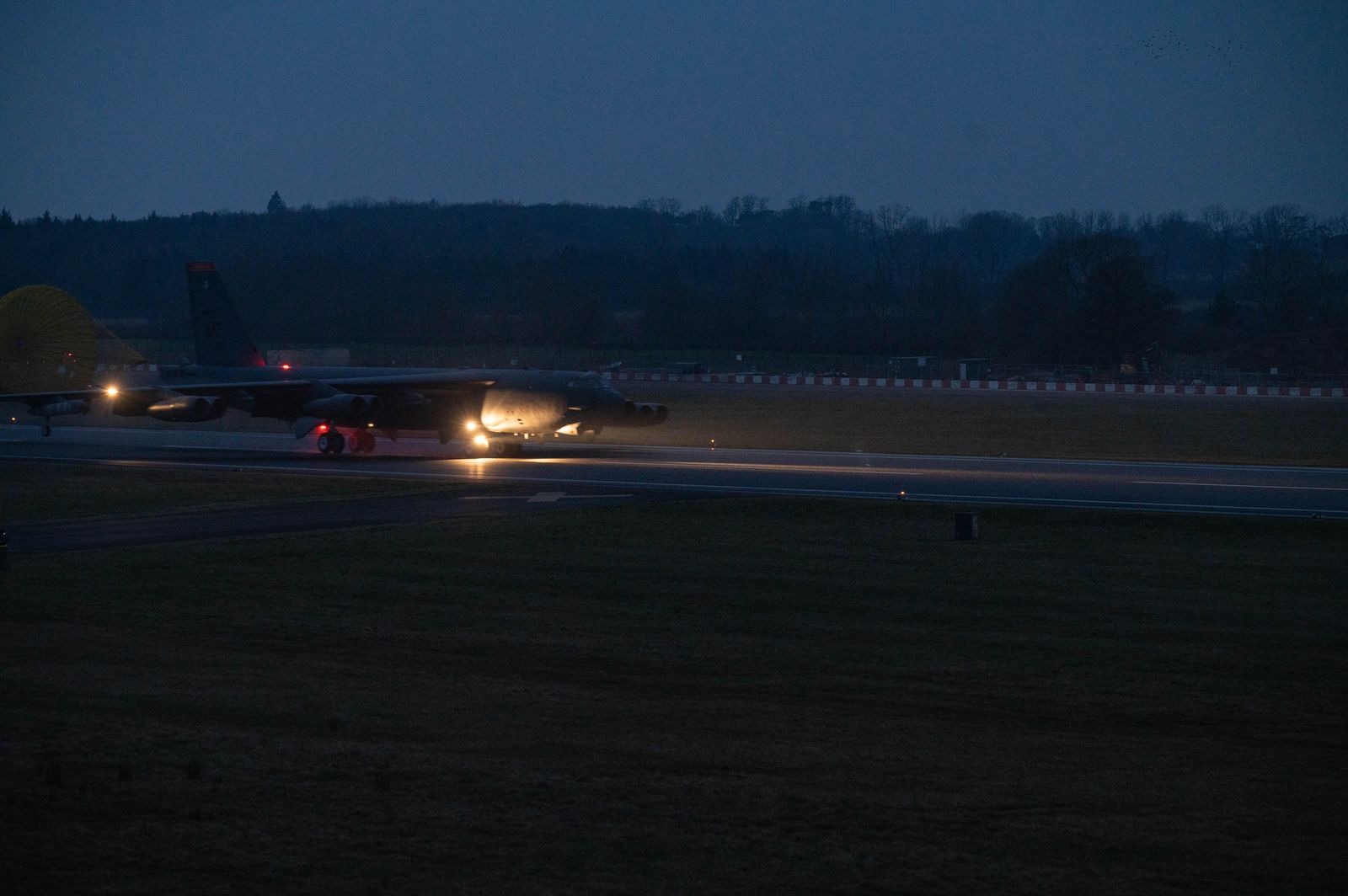
Flight-tracking data counted nine KC-135 Stratotankers and three CV-22 Osprey aircraft leaving Mildenhall late on Monday afternoon and into the evening, Sky News reported. Most headed for airbases in Germany and Spain, one landed at RAF Prestwick in Scotland, and the three Ospreys moved the short distance to RAF Lakenheath. The United States also raised the security posture at Mildenhall and Lakenheath to Force Protection Condition Charlie, the second-highest defensive threat level in the Pentagon's system, which applies when intelligence indicates that a terrorist action is likely.
The Fairford withdrawal, the arrests and the warnings that came before
The move at Mildenhall is the second of its kind in a matter of weeks. Last month the Pentagon sent B-1 bombers back to the United States from RAF Fairford in Gloucestershire, after officials grew concerned about a complex Iran-backed plot to kill American pilots and target the aircraft using drones, the Journal has reported. Fairford had been used by US bombers to carry out strikes on Iran.
The Fairford incident began with arrests. Five men were arrested outside the base in September, and two others were arrested later on suspicion of assisting Iranian intelligence. The circumstances remain largely unexplained. Prime Minister Andy Burnham said last month that the activity at Fairford was likely to have been coordinated in Iran. Tehran's ambassador to Britain has denied any Iranian involvement, while Iran's Revolutionary Guards said in July that Fairford, and any base used to launch attacks on Iran, were legitimate targets.
The warning signs had been building for weeks. The director of national intelligence, Jay Clayton, said in October that Iran was in the advanced stages of planning to target US personnel in the Middle East, a warning he gave as the reason for a sudden evacuation of diplomats from regional posts. The War Zone, a military news site, first reported the enhanced force-protection measures at Mildenhall and Lakenheath on Monday, after aviation spotters tracked the unusual movements; a US official confirmed to the site that the measures were in effect at both installations. Secretary of State Marco Rubio said the threat was being addressed by moving people away from it, and cabinet minister Lucy Powell told Sky News the security of military bases in Britain was kept under review.
Neither the US Air Force nor the Ministry of Defence has confirmed that the aircraft movements were an evacuation prompted by Iran. An Air Force spokesperson declined to give details of the movements, saying American aircraft rotate between installations and operating locations for a variety of reasons. A Ministry of Defence spokesperson said Britain does not routinely comment on the activity of other nations, and that aircraft and other assets move regularly according to operational requirements.
What exactly was the threat to Mildenhall?
The precise nature of the threat to Mildenhall remains under discussion among US officials, according to the Journal, and it is not clear whether it was imminent or general, or whether it was a specific plan against the base or a broader warning about American facilities in Britain. No official has said what intelligence triggered the move, or who issued it.
It is also unconfirmed whether the Mildenhall threat is connected to the Fairford investigation, how long the FPCON Charlie posture will stay in place, and when, or whether, the tankers will return to Suffolk. The Pentagon, the White House and US European Command did not immediately respond to requests for comment.
A second base in a month turns a single incident into a pattern
One withdrawal can be read as caution; two, within weeks, reads as a campaign. The United States is now treating its British bases as places its aircraft may have to leave at short notice, and that changes the value of the bases themselves. Mildenhall is the hub of American air refuelling in Europe, home to the 100th Air Refueling Wing and its KC-135 Stratotankers, and the tankers that left on Monday keep fighter and bomber missions in the air. Lakenheath, some fifteen miles away, hosts F-15E Strike Eagles and F-35A Lightning IIs.
The stakes reach beyond the two airfields. Fairford's bombers flew strikes on Iran, and Tehran has said its retaliation for any American attack would extend beyond the Middle East; a warning that now covers British soil. For London, the question is how far hosting the American war effort exposes Britain itself; for Washington, whether deterrence still works when the other side can force its aircraft to scatter. President Donald Trump has said further US strikes on Iran are highly unlikely, but the dispersal at Mildenhall shows the threat picture has not eased with the rhetoric.
Dispersal is cheap insurance; and a signal Tehran will read
Geopolitically, the move exposes the bargain at the heart of the American presence in Britain. The bases exist to project power into the Middle East, and the strikes flown from Fairford made that bargain visible. Tehran's July warning named the price, and the two withdrawals since are that price being paid in public. The United States can move its aircraft; it cannot move the runways, and every dispersal advertises that the launchpads for its war are targets too.
Economically, the cost is measured in readiness rather than money. Tankers are the bottleneck of American air power: without them, fighters and bombers cannot stay over their targets. Scattering nine KC-135s across Germany, Spain and Scotland keeps them safe and flying, but breaks the rhythm of a wing that trains, maintains and flies as one unit. The longer the dispersal lasts, the more it costs in maintenance, crew hours and mission planning.
Demographically, the pressure falls on the communities around the bases. Mildenhall and Lakenheath are not remote outposts; they are towns with American families, schools and housing, and a heightened threat level reaches into daily life. Lakenheath asked the public to report suspicious drone activity on the same day the aircraft moved, a reminder that the threat is felt first by the people who live beside the fence.
Historically, the sequence matters more than any single day. Fairford in October, Mildenhall in November: escalation by repetition, each incident borrowing credibility from the one before. The September arrests gave the Fairford withdrawal its weight; the Fairford withdrawal now gives the Mildenhall move its weight. Technologically, the episode played out in the open: spotters tracked the tankers as they left, and flight-tracking data confirmed what officials would not. In a war of signals, the aircraft were visible to everyone except the people paid to describe them.
If dispersal becomes routine, the map of American air power in Europe changes
The first consequence is operational: if tankers must be ready to scatter, the United States will harden its dispersal plans across Europe, pre-positioning fuel, crews and maintenance at more bases. The second is political. In Britain, the question of what hosting American bombers costs the host will move to the centre of the debate, and ministers will be pressed on what they were told before the aircraft left. The third is Iranian: Tehran has learned that a threat, described or not, can clear a runway. That lesson will shape the next warning, and the one after. The fourth is about the war itself. With the president saying further strikes are highly unlikely and Iran's forces described as stronger than at the war's start, the dispersal reads as the military preparing for a threat the politics claims is over.
When will the tankers return to Mildenhall?
The markers to watch are simple. Whether the Pentagon confirms the Iran link or lets the Journal's reporting stand. Whether FPCON Charlie stays, rises or falls, and whether the tankers return to Mildenhall or settle into dispersal. Whether the Fairford arrests lead to charges, and what those charges say about who was behind the plot. And whether Tehran answers the move at all; with a denial, a warning, or silence.
The three lenses
West Lens:
The West reads a credible threat and a forced retreat American and British coverage has treated the move as a response to a genuine warning. The Journal's reporting, the FPCON upgrade and the Fairford plot to kill pilots are presented as a single sequence: a threat was received, the aircraft moved, and the posture rose. The Times and Sky News stress the same order of events, and the official non-denials are read as confirmation that something real was at stake.
East Lens:
Asia and the Middle East stress what Washington will not say Coverage across Asia and the Middle East has carried the same facts with a different emphasis: the silence. TRT World and Turkish and Indian outlets report the diversion to Germany and the raised posture while noting that no official has described the threat, confirmed the Iran link, or said when the aircraft will return. Press TV, Iran's English-language state channel, goes further, calling the threat alleged and describing the bases as involved in the war on Iran; treating the evacuation as a consequence of American action rather than a precaution against Iranian action.
South Lens:
The South counts the bases and asks what comes next Reporting from the Global South has put the pattern first. The Reuters report carried by the Daily Maverick and the coverage in The National in Abu Dhabi both lead with the same fact: this is the second British base in a matter of weeks. Their emphasis falls on the Fairford arrests, the B-1 withdrawal, the July warning from the Revolutionary Guards and the unanswered questions; how long the posture lasts, whether the two incidents are linked, and what a third base would mean.
The consensus
- What we agree on
- What we agree on: American aircraft left RAF Mildenhall on Monday 9 November after a threat from Iran; two refuelling tankers diverted to Germany in the morning and several more tankers were moved later in the day; the security posture at Mildenhall and Lakenheath was raised to FPCON Charlie; and B-1 bombers were withdrawn from RAF Fairford in October after a suspected Iran-linked security incident.
- What we don't agree on
- What we disagree on: whether the threat to Mildenhall was imminent or precautionary; whether the Mildenhall move is connected to the Fairford investigation; and whether moving the aircraft reduces the risk to American personnel or signals that the bases themselves have become a vulnerability.
- What we know
- What we know: the movements themselves, confirmed by flight-tracking data; the FPCON Charlie upgrade at two bases; the Fairford timeline of arrests, the B-1 withdrawal and the July warning from Iran's Revolutionary Guards; and the fact that neither Washington nor London has publicly described the threat.
- What we don't know yet
- What we do not know: the precise nature of the threat to Mildenhall, who issued it and how it was delivered; whether it was a specific plan against the base or a general warning; how long the heightened posture will last; and when, or whether, the tankers will return to Suffolk.
- What we expect
- What we expect: the aircraft to stay dispersed while FPCON Charlie holds; continued official silence on the intelligence behind the move; closer scrutiny of other American bases in Europe; and a denial or deflection from Tehran rather than a claim of responsibility.
Questions, answered
What happened at RAF Mildenhall on Monday?
American aircraft left RAF Mildenhall in Suffolk on Monday 9 November after a threat from Iran. Two KC-135 refuelling tankers diverted to Germany in the morning, and flight-tracking data later showed nine tankers and three CV-22 Ospreys leaving the base, most of them for Germany and Spain.
Why did the United States move the aircraft?
The Wall Street Journal reported that the move followed a threat from Iran, citing people familiar with the matter. The precise nature of the threat is still under discussion among US officials, and neither the Pentagon nor the US Air Force has publicly confirmed that the evacuation was prompted by Iran.
What is FPCON Charlie?
Force Protection Condition Charlie is the second-highest defensive threat level in the US Department of Defense system. It applies when intelligence indicates that a terrorist action is likely, and it was raised at both RAF Mildenhall and RAF Lakenheath on Monday.
What happened at RAF Fairford?
In October the Pentagon withdrew B-1 bombers from RAF Fairford after concern about a suspected Iran-backed plot to kill American pilots and target the aircraft with drones. Five men were arrested outside the base in September, and two more were arrested later on suspicion of assisting Iranian intelligence.
Sources
- The Wall Street Journal (10 Nov 2026); the primary report: the Mildenhall evacuation, the tankers diverted to Germany, the FPCON Charlie upgrade and the Fairford plot
- Sky News (10 Nov 2026); the flight-tracking count: nine KC-135 tankers and three Ospreys left Mildenhall, and the minister's response
- Reuters