South Africans vote in municipal elections that could end the ANC's era of dominance
A record 29.2 million voters cast ballots on November 4 in South Africa's local elections; a verdict on the ANC's stewardship of cities buckling under water failures, power cuts and crime, with Johannesburg the biggest prize and more than a hundred councils likely headed for coalition rule.
Published 4 November 2026 · 22:10 GMT
The summary
November 4, 2026: South Africans voted in the sixth local government elections since 1994; polls were open 7am–9pm (0500–1900 GMT) and results are expected on Sunday. Record registration: 29.2 million registered voters across 23,696 voting stations; 546 political parties and nearly 137,000 candidates contested 10,526 council seats in 4,488 wards.
The three lenses
- WestThe verdict on the liberation party Western coverage, Reuters, the Associated Press, the Guardian, France 24, Deutsche Welle, reads the election as a verdict, and the verdict is on the ANC.
- EastThe machinery of the vote Eastern coverage, Xinhua's reporting on the government's turnout drive, the IANS wire carried across Indian outlets, reads the election as an institutional event rather than a morality play.
- Global SouthThe queues and what they mean The most on-the-ground reporting comes from the South: Daily Maverick's reporters at the stations, the barcode scanners, the two-and-a-half-hour waits, the nurse who jumped the queue in her scrubs before a hospital shift, and Al Jazeera's Haru Mutasa reporting from Johannesburg, with Ramaphosa's own admission that municipal failures have eroded trust.
Key facts
- November 4, 2026: South Africans voted in the sixth local government elections since 1994; polls were open 7am–9pm (0500–1900 GMT) and results are expected on Sunday. Reuters / Al Jazeera, 2026-11-04
- Record registration: 29.2 million registered voters across 23,696 voting stations; 546 political parties and nearly 137,000 candidates contested 10,526 council seats in 4,488 wards. IANS / IEC, 2026-11-04
- Early turnout: 3,523,691 votes by 10am; 12 million by 5pm; 40 percent of registered voters by 4pm, against 44 percent overall in 2021. Daily Maverick / IEC, 2026-11-04
- IEC 'war on queues': handheld barcode scanners, vote-only-at-registered-station rule; fewer than 1 percent of stations opened late, mostly due to storms. Daily Maverick, 2026-11-04
- The ANC trajectory: 45.6 percent in 2021, 40.2 percent in the 2024 national vote; polls suggest the party could fall below 40 percent this time. The Guardian / Reuters, 2026-11-04
- Johannesburg the prize: DA candidate Helen Zille polling at 36 percent; projected most votes but short of a majority; the city has had five mayors in four years. News24 via Al Jazeera / AP, 2026-11-04
- MK's first local test: Jacob Zuma's party, third-largest in Parliament since 2024, is polling above 40 percent in eThekwini (Durban), where the ANC is near 10 percent. The Guardian / Daily Maverick, 2026-11-04
What did 29 million South Africans decide on November 4?
From sunrise on Wednesday, November 4, 2026, queues formed outside polling stations across South Africa, in the Lawley informal settlement south of Johannesburg, in Alexandra township, in the suburbs of Cape Town and the port city of Durban, as voters cast ballots in the country's sixth local government elections since the end of apartheid. A record 29.2 million people were registered to vote at 23,696 polling stations, choosing the councils that will run the country's eight metropolitan municipalities, 44 district councils and 205 local councils for the next five years, and those councils will in turn choose the mayors. More than 1.4 million special votes had already been cast on Monday and Tuesday, after the Electoral Commission approved 2.65 million special-vote applications.
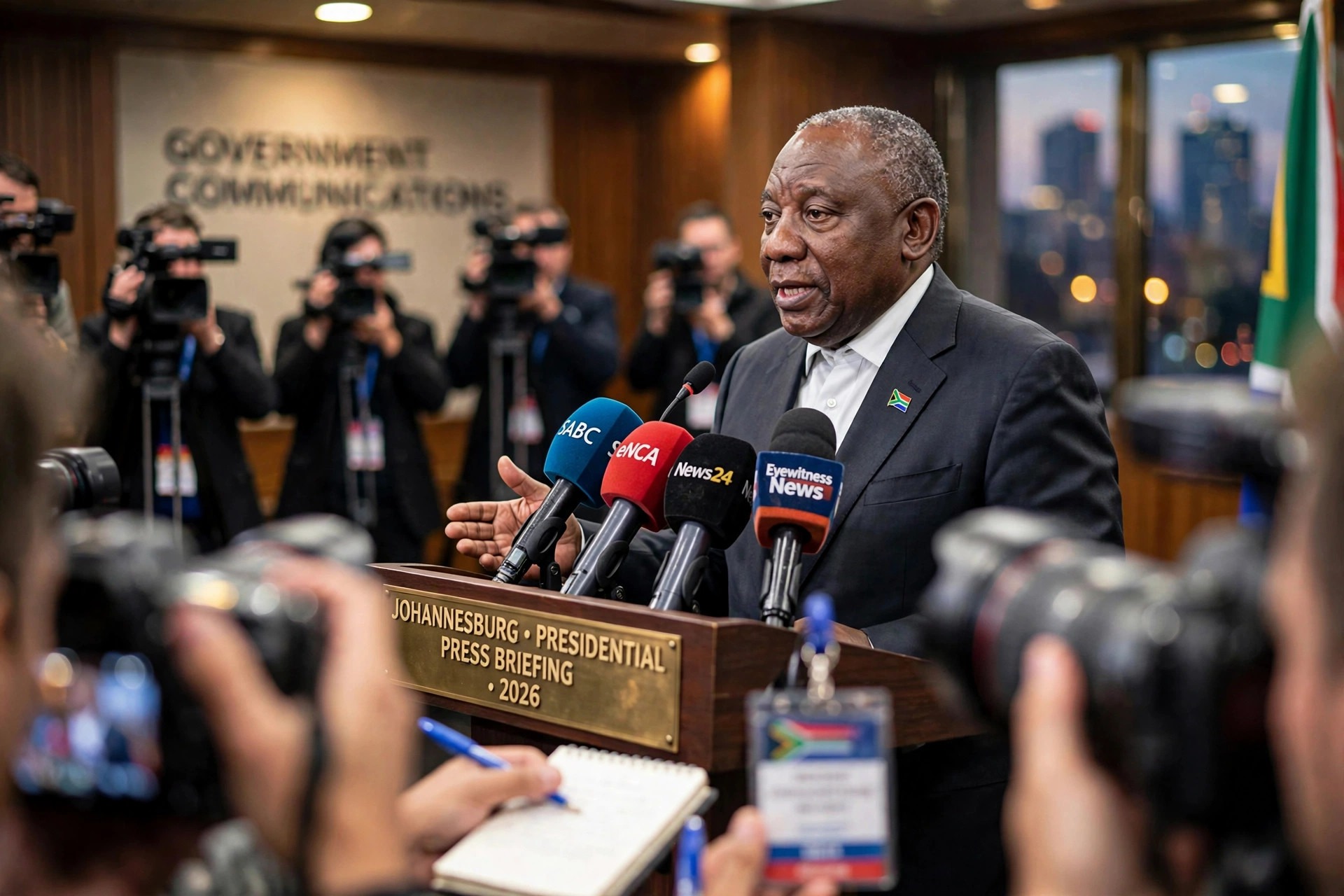
President Cyril Ramaphosa voted at Hyde Park High School in Johannesburg, praised the turnout, telling reporters he had rarely seen a local election with so many parties contesting; 546 of them, fielding nearly 137,000 candidates for 10,526 council seats across 4,488 wards, according to the Electoral Commission. The scale of the contest is itself a statement about how fragmented the country's politics have become, because no single party is expected to win outright majorities in the main cities, and attention is already shifting to the coalition negotiations that will follow the count.
What do the early turnout numbers tell us?
The Independent Electoral Commission declared a "war on queues" for this election, and the early numbers suggest the new machinery worked. Armed with handheld barcode scanners, sequence numbers and better-trained staff, and under a stricter rule that voters may cast their ballot only at the station where they are registered, 3,523,691 votes had been cast by 10am, Gauteng leading the provinces. By 4pm, 40 percent of registered voters had voted, compared with 44 percent overall in the 2021 local elections, and by 5pm the commission put the figure at 12 million votes cast, with Gauteng at three million and KwaZulu-Natal at 2.5 million.
Fewer than one percent of voting stations opened late, mostly because of stormy weather, and the commission said the process was largely smooth, though some voters faced long distances and waits of up to two and a half hours. The commission is also investigating more than 700 complaints of disinformation, and in KwaZulu-Natal, where 165 voting stations were classified as high risk, police recorded 21 election-related cases since Sunday. The final turnout figure will only be clear once counting is complete, but the early pace pointed to participation at least on par with, and possibly above, the depressed 46 percent of 2021.
Which questions stay open until Sunday's results?
No results had been announced by the time polls closed at 9pm, and the Electoral Commission is expected to announce the final outcome on Sunday, with up to a week allowed for the formal declaration, so every projection below remains a projection until then. The central unknown is the size of the ANC's decline: polls cited by international outlets suggest the party could fall below 40 percent of the vote, down from 45.6 percent in 2021 and 40.2 percent in the 2024 national election, with one polling firm putting the possible figure as low as 30 percent, but polls have missed before, and the ANC's ground machine is built for exactly this kind of election.
The second unknown is Johannesburg, where the Democratic Alliance's Helen Zille is projected to win the most votes but fall short of a majority, with a News24 poll putting her at 36 percent, leaving open who she would need, and who would accept, as coalition partners, including possibly the ANC itself. The third is the scale of the coalition scramble: projections cited by South African media put the number of hung councils at around 110, but the real arithmetic will only emerge council by council, and the identity of the kingmakers, ActionSA, the Patriotic Alliance, the Economic Freedom Fighters; will decide who actually governs the cities.
Why is this the most consequential vote since 1994?
This election is a referendum on the party that led South Africa out of white minority rule, and its trajectory reads like a slow unravelling: below 50 percent for the first time in 2021, the loss of its 30-year parliamentary majority in 2024, a national coalition with the Democratic Alliance that was unthinkable a decade ago, and now a municipal vote that could confirm the ANC as a party in structural decline rather than a party in a bad cycle. Because municipalities are where the state actually touches people's lives, the water that comes out of the tap, the lights that stay on, the refuse that gets collected; this is the level of government where the ANC's failures are most visible and least abstract, and where voters punish with the least hesitation.
The stakes run well beyond the next five years of city budgets. The outcome will shape the political landscape ahead of the 2029 national election and, more immediately, the succession battle inside the ANC as Ramaphosa approaches the end of his term as party leader at the party's conference in December 2027. A bruising result would embolden the party's regional blocs and weaken the centre's authority over coalition negotiations; a better-than-feared result would be claimed as vindication of the president's reformist line. Either way, the night will be read in Pretoria as a preview of who leads the ANC next; and Ramaphosa's own standing is inseparable from the party's.
How did the liberation party reach this point?
The honest answer, and one the president himself has now given, is that the ANC stopped delivering the basics. In his weekly "From the Desk of the President" newsletter, Ramaphosa wrote that "municipal failures have contributed to declining public trust and confidence in democratic governance"; an admission from the top that the crisis is not one of communication but of pipes, wires and trucks. Water monitoring group WaterCAN has said almost 70 percent of the country's wastewater treatment works are in a critical state, residents of communities like Tembisa have complained of sewage in the streets and unreliable electricity, and unreliable water and power supplies, unemployment, crime and a lack of affordable housing ranked among voters' biggest concerns ahead of the election.
The fragmentation is both cause and consequence. Unstable coalitions are already a feature of many of South Africa's 257 municipalities, 74 were run by coalitions or minority administrations earlier this year, and analysts point to their high turnover as a major reason services keep failing, which in turn drives voters away from the big parties and toward smaller ones, which makes the next round of coalitions even more fragile. Into that vacuum has stepped Jacob Zuma's uMkhonto weSizwe party, contesting its first local election after becoming the third-largest party in Parliament in 2024: the 84-year-old former president, expelled from the ANC in 2024, is polling above 40 percent in the eThekwini metro around Durban, where the ANC itself is polling around 10 percent against the 42 percent it won there in 2021. That is not a protest vote; it is a transfer of the ANC's own base, and the campaign in Durban has also carried a prominent thread of anti-migrant sentiment, a sign of how the contest for the townships is being fought.
What will the count leave behind?
Whatever the final numbers, the morning after will belong to the negotiators. With projections of around 110 hung councils, both the ANC and the DA are reportedly centralising coalition talks at head office rather than leaving them to provincial structures; because a deal struck in one council can be traded for positions in another, and because the parties want their electoral promises embedded in written coalition agreements. For the ANC, centralisation will be a fight in itself: regional blocs have already asserted themselves during candidate selection, with Johannesburg's regional bloc notably sidelining the reformist wing's mayoral choice. The likely ANC team, David Makhura, secretary-general Fikile Mbalula, general manager Febé Potgieter and elections head Mdumiseni Ntuli, will be negotiating from weakness if the party's vote share slides as polls suggest.
The DA, by contrast, arrives with the wind at its back and an explicit target: federal leader Ashor Sarupen has said the party aims to be the largest party in 60 councils, which would give leader Geordin Hill-Lewis a strong hand in the Gauteng metros alongside Solly Msimanga; while Helen Zille, even without a top party office, remains one of its most formidable deal-makers. The kingmakers will be courted by everyone: Julius Malema, who cast his vote in Seshego and is described as a master negotiator with close ties to Mbalula, speaks for the EFF alongside Marshall Dlamini and Leigh-Ann Matthys; Herman Mashaba's ActionSA negotiates through Michael Beaumont; and the Patriotic Alliance's three founders, Gayton McKenzie, Charles Cilliers and Kenny Kunene, will be weighing offers in councils across the country. Parties will have two weeks from the results announcement to form councils and elect mayors, and the horse-trading will be where the election is actually won. For the broader arc of these municipal contests, our earlier coverage of the local-elections cycle and its economic backdrop is worth revisiting.
When will South Africa know who runs its cities?
The Electoral Commission is expected to announce the final results on Sunday, November 8, and the week after will be the real election: the coalition talks and mayoral horse-trading that decide whether Johannesburg, Tshwane, Ekurhuleni and eThekwini are governed or merely occupied. Watch the three Gauteng metros first, where the DA is leading the polls but short of the majorities it wants; watch eThekwini, where the MK party's challenge could redraw KwaZulu-Natal's politics overnight; and watch whether the ANC's national leadership can impose discipline on its regions or whether the regions impose their terms on the centre.
Beyond the councils, the results will feed directly into the ANC's December 2027 succession conference, and the jockeying has already begun in everything but name. South Africa's country profile in our Factbook tracks the longer arc; the economy and the institutional strain against which this election will be judged. The count goes on, and the country that emerges from it will look less like the South Africa of 1994 and more like the South Africa of whatever comes next.
The three lenses
West Lens:
The verdict on the liberation party Western coverage, Reuters, the Associated Press, the Guardian, France 24, Deutsche Welle, reads the election as a verdict, and the verdict is on the ANC. The frame is institutional and historical: the party of Nelson Mandela, below 50 percent for the first time in 2021, stripped of its parliamentary majority in 2024, now facing polls that put it under 40 percent. The Western lens is most animated by the Johannesburg subplot, Helen Zille's energetic campaign for mayor of the commercial hub, projected to win the most votes but not the majority, and by the service-delivery ledger: corruption, crime, water, power.
East Lens:
The machinery of the vote Eastern coverage, Xinhua's reporting on the government's turnout drive, the IANS wire carried across Indian outlets, reads the election as an institutional event rather than a morality play. The emphasis is procedural and numerical: 29.2 million registered voters called to the polls by the cooperative governance minister Velenkosini Hlabisa, 2.65 million approved special votes, the sixth local government election since the 1994 transition, 546 parties and nearly 137,000 candidates contesting 10,526 council seats across 4,488 wards. Where the West sees a verdict, the East sees a system functioning; the largest democratic exercise in the country's municipal history, administered, scheduled, and delivered on time.
South Lens:
The queues and what they mean The most on-the-ground reporting comes from the South: Daily Maverick's reporters at the stations, the barcode scanners, the two-and-a-half-hour waits, the nurse who jumped the queue in her scrubs before a hospital shift, and Al Jazeera's Haru Mutasa reporting from Johannesburg, with Ramaphosa's own admission that municipal failures have eroded trust. In the Southern lens this is a lived story before it is a political one: the water that doesn't run, the lights that go out, the sewage in the street in Tembisa, the anti-migrant anger on the campaign trail in Durban. The South reads the election the way it reads the country; not as the decline of a party, but as the daily negotiation between citizens and a state that keeps promising to work.
The consensus
- What we agree on
- What we agree on: on November 4, 2026, South Africans voted in local government elections choosing councils for 8 metropolitan municipalities, 44 district councils and 205 local councils; a record 29.2 million people were registered at 23,696 voting stations, polls ran 7am to 9pm, more than 1.4 million special votes were cast on November 2–3, and final results are expected on Sunday.
- What we don't agree on
- What we don't agree on: whether the ANC will actually fall below 40 percent of the vote, as several polls suggest, or whether its ground machine will outperform the surveys as it has in past cycles; and whether the DA's momentum in the Gauteng metros represents a durable realignment or a protest vote that fades by 2029.
- What we know
- What we know: the ANC fell below 50 percent for the first time in 2021 with 45.6 percent, lost its parliamentary majority in 2024 with 40.2 percent, and Ramaphosa himself has admitted that municipal failures eroded public trust; the DA is targeting Johannesburg, Tshwane, Ekurhuleni and Nelson Mandela Bay, with Helen Zille polling at 36 percent in Johannesburg; and Zuma's MK party is polling above 40 percent in eThekwini in its first local contest.
- What we don't know yet
- What we don't know yet: the final results and turnout figures; who will govern Johannesburg and the other hung metros; how many of the projected 110 hung councils materialise; and which smaller parties, ActionSA, the Patriotic Alliance, the EFF, end up holding the balance of power in the coalition talks.
- What we expect
- What we expect: a week of coalition negotiations after Sunday's results, with the ANC and DA both centralising talks at head office; mayors elected within two weeks of the announcement; and the outcome feeding directly into the ANC's December 2027 leadership succession race and the positioning for the 2029 national election.
Questions, answered
Why are these elections such a test for the ANC?
Because municipalities are where the state touches daily life, water, power, refuse, roads, and the ANC’s record there is its weakest. From 45.6 percent in 2021 to 40.2 percent nationally in 2024, polls suggest the party could drop below 40 percent in this election. Ramaphosa has admitted that municipal failures eroded public trust, so the vote is widely read as a verdict on three decades of ANC local rule.
Who are the main contenders in Johannesburg?
The Democratic Alliance’s Helen Zille, 75, a former party leader, is projected to win the most votes, a News24 poll put her at 36 percent, but to fall short of a majority, which means she would need coalition partners, possibly including the ANC. The city, South Africa’s commercial hub, has had five mayors in four years under a fragile ANC-led coalition, and control of it is the biggest prize in the election.
What is Jacob Zuma’s MK party, and why does it matter?
uMkhonto weSizwe (MK), led by 84-year-old former president Jacob Zuma, who resigned in 2018 amid corruption allegations and was expelled from the ANC in 2024, became the third-largest party in Parliament in the 2024 national election. This is its first local contest, and it is polling above 40 percent in the eThekwini metro around Durban, where the ANC has collapsed to around 10 percent from 42 percent in 2021.
How does voting work in South African local elections?
Voters do not elect mayors directly. They cast ballots for ward councillors and for parties, choosing the councils that run the eight metropolitan municipalities, 44 district councils and 205 local councils; and those councils then elect the mayors. With no party expected to win outright majorities in the main cities, the councils will be formed through coalition negotiations, for which parties have two weeks after the results are announced.
When will the results be known?
The Electoral Commission is expected to announce the final results on Sunday, November 8, though it formally has up to a week. Counting began after polls closed at 9pm on November 4. The week after the announcement belongs to coalition talks: the ANC and DA are both centralising negotiations at head office, and the horse-trading in hung councils will decide who actually governs South Africa’s cities for the next five years.
Sources
- Reuters / Al Jazeera, 2026-11-04
- IANS / IEC, 2026-11-04
- Daily Maverick / IEC, 2026-11-04
- Daily Maverick, 2026-11-04
- The Guardian / Reuters, 2026-11-04
- News24 via Al Jazeera / AP, 2026-11-04
- The Guardian / Daily Maverick, 2026-11-04