 MAGNA BUREAU
The Wire
US jets strike Iranian missile site on Qeshm as Gulf states go on alert
Kuwait’s air defences countered hostile drones and Bahrain intercepted Iranian attacks hours after American jets hit a Revolutionary Guard missile site on Qeshm Island; with three US carrier groups now in the region and a three-way summit days away.
Key points
- US fighter jets struck an Islamic Revolutionary Guard Corps missile launch site on Qeshm Island on Tuesday 17 November, using precision munitions, in what Washington described as self-defence. <span class=”src”><a href=”https://www.cnn.com/2026/11/17/politics/us-iran-self-defense-strikes” target=”_blank” rel=”noopener”>CNN</a> (17 Nov 2026)</span>
- Hours earlier, the Revolutionary Guards said they had launched drones at a US-operated radar system at Bahrain’s Sheikh Isa Air Base; Bahrain said its air defences intercepted the attack, with no casualties or damage reported. <span class=”src”><a href=”https://www.aljazeera.com/amp/news/liveblog/2026/11/18/iran-war-live-kuwait-says-intercepting-hostile-drone-attacks” target=”_blank” rel=”noopener”>Al Jazeera</a> (18 Nov 2026)</span>
- Kuwait’s military said on Wednesday 18 November that its air defences were countering hostile drone attacks, and urged the public to follow safety instructions; Kuwait has not named the origin of the drones. <span class=”src”><a href=”https://www.channelnewsasia.com/world/us-strikes-iran-qeshm-island-gulf-alert-6560721” target=”_blank” rel=”noopener”>CNA</a> (18 Nov 2026)</span>
- Iran’s official IRNA news agency, citing the deputy governor of Hormozgan province, said the strikes on Qeshm caused no damage to residential, commercial or infrastructural areas, after five to six explosions were heard on the island. <span class=”src”><a href=”https://www.channelnewsasia.com/world/us-strikes-iran-qeshm-island-gulf-alert-6560721” target=”_blank” rel=”noopener”>CNA</a> (18 Nov 2026)</span>
- The USS Theodore Roosevelt has moved into the region, bringing the number of American carrier strike groups there to three, alongside the George H W Bush and the George Washington and more than a dozen destroyers. <span class=”src”><a href=”https://www.channelnewsasia.com/world/us-strikes-iran-qeshm-island-gulf-alert-6560721” target=”_blank” rel=”noopener”>CNA</a> (18 Nov 2026)</span>
ONE EVENT. THREE READINGS.
The story is told as a defensive operation.
CNN’s account leads with the American military official’s framing: precision munitions, a missile launch site, self-defence, a response to aggression against American personnel and assets.
What this reading highlights: The Western lens lingers on the deterrent signal, US Central Command’s statement that it remains highly vigilant and fully postured, and on the dirty-bomb report, which Trump amplified on Tuesday with a warning that Iran would pay a price the likes of which no other country has ever paid.
Sources: CNN (1)
The story reads as a regional alert with the shipping lanes at its centre.
CNA, reporting from Singapore, gives equal weight to the strike, the Kuwait and Bahrain alerts, and the strait itself, the conduit for global energy shipments, and notes the Roosevelt’s arrival as the third carrier group in the region.
What this reading highlights: The Korea Herald, carrying AFP, frames the same events around the waterway and the summit to come.
Sources: CNA (1), The Korea Herald (1)
The story is told from inside the alert.
Al Jazeera’s live coverage follows the sirens, the danger alerts and the all-clears as they happen in Manama and Kuwait City, and Gulf News carries the same night from Dubai; the GCC’s condemnation, the Bahraini Defence Force’s statements, the residents told to stay calm and seek safe locations.
What this reading highlights: The Southern lens centres the people caught between the two militaries: Gulf citizens who host American bases, hear the explosions, and have no say in the exchange.
Sources: Al Jazeera (1), Gulf News (1), Dunya News (1)
Sources by lens: 1 West, 2 East, 3 Global South. See every source
THE POINT OF CONVERGENCE
On the core sequence; Revolutionary Guard drones targeted a US radar at Bahrain’s Sheikh Isa Air Base on Tuesday morning; US fighter jets struck a Guard missile launch site on Qeshm Island on Tuesday evening; Bahrain said it intercepted the attack; Kuwait said its air defences were countering hostile drones on Wednesday; Iran said the Qeshm strikes caused no damage to residential, commercial or infrastructural areas; and three American carrier strike groups are now in the region.
WHAT REMAINS CONTESTED
On what the exchange means. Washington calls the Qeshm strike self-defence against aggression targeting its personnel and assets; Tehran calls it aggression and says its own drone operation answered repeated violations of Iranian airspace by US drones. The two sides also differ on the mine incidents in the strait, with Iranian armed forces reporting three tankers struck and other reports putting the number of ships hit at five.
The story
Tuesday night’s exchange, hour by hour
The exchange began on Tuesday morning in Bahrain. The Islamic Revolutionary Guard Corps said its combat drones had carried out a precision operation against a radar system operated by US forces at the Sheikh Isa Air Base, in response to what it called repeated violations of Iranian airspace by US military drones. Bahrain’s armed forces said they confronted, intercepted and destroyed a number of the incoming attacks before they could achieve their objectives, and reported no casualties or damage.
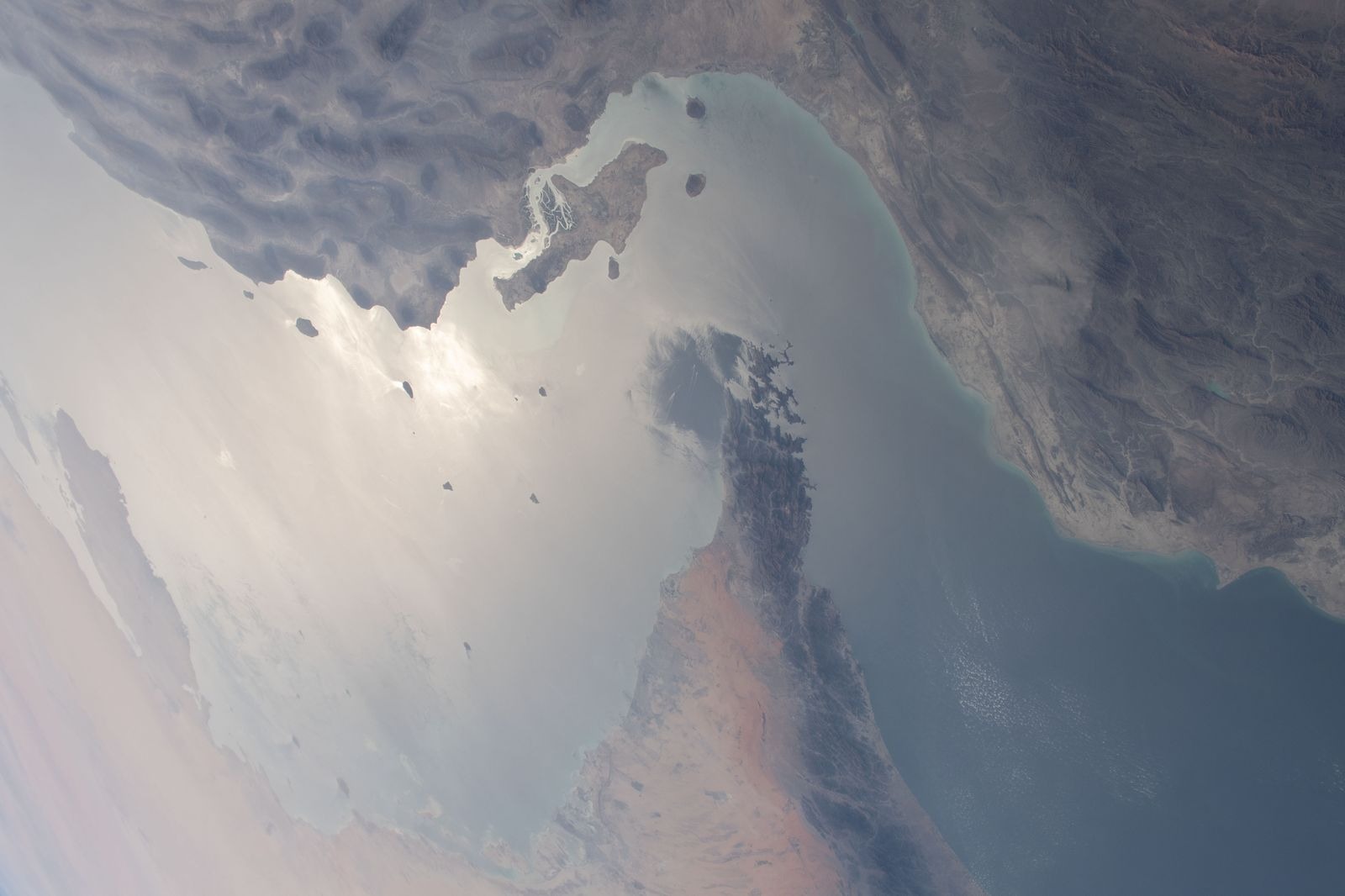
Hours later, on Tuesday evening, American fighter jets struck back. A US military official, speaking on condition of anonymity, said the jets used precision munitions to hit a Revolutionary Guard missile launch site on Qeshm Island, in the Strait of Hormuz. The strike, the official said, was in response to Guard aggression targeting US personnel and assets, and US Central Command said it remains highly vigilant and fully postured to protect Americans across the region.
On Qeshm itself, residents heard five to six explosions on Tuesday evening, according to Iran’s official IRNA news agency. Ahmad Nafisi, the deputy governor of Hormozgan province, told IRNA that the American attack caused no damage to residential, commercial or infrastructural areas, that the situation on the island was under control, and that all relief, service and executive bodies were on full alert.
By early Wednesday, the alert had spread. Kuwait’s military said its air defences were responding to hostile drone threats and urged the public to follow security and safety advice, explaining that explosion sounds heard in the country were the result of interception systems at work. Kuwait did not name the origin of the drones. In Bahrain, the Interior Ministry issued danger alerts telling residents to remain calm and seek a safe location, then issued an all-clear; before the Bahrain Defence Force said on Wednesday that its air defences had intercepted a new wave of Iranian aerial attacks.
What the strike, the interceptions and the alerts confirm
The sequence itself is confirmed by several independent reporting chains. CNN reported the Qeshm strike from an American military official; Al Jazeera’s live coverage tracked the Kuwait and Bahrain alerts through the night; CNA, drawing on Reuters and AFP, carried the same sequence from Singapore; and Gulf News followed it through the Gulf’s own morning.
The military build-up around the exchange is also confirmed. The USS Theodore Roosevelt has moved into the region, bringing the number of American carrier strike groups there to three, alongside the George H W Bush and the George Washington. A third American carrier reached the Gulf as Iran warned it would not wait, and the Roosevelt’s arrival underlines how heavily the United States is now invested in keeping the waterway open.
The context is a war that began in late February 2026, when US and Israeli strikes hit Iran and Tehran effectively closed the Strait of Hormuz, the conduit for global energy shipments. The conflict has spilled over to the Gulf states that host US military facilities, Bahrain hosts the headquarters of the US Navy’s Fifth Fleet, and Kuwait hosts US forces, turning hosts into targets.
Two further facts frame the week. On Tuesday, US President Donald Trump said he was taking very seriously reports that Iran was developing plans to use a so-called dirty bomb in Washington. CNN cited seven American officials as saying Iran was plotting how to target senior administration figures with a bomb laced with chemical or radioactive material, though they stopped short of saying Iran planned to carry out such an attack. Iran’s Foreign Minister Abbas Araghchi dismissed the report as Iraq War-style propaganda.
What is still unconfirmed in the Gulf tonight
The first open question is the simplest: who sent the drones over Kuwait? Kuwait’s military said its air defences were countering hostile drone attacks, but it gave no details about their origin, their targets, or any casualties or damage, and it did not say the drones were Iranian. There has been no Iranian claim of responsibility for the Kuwait incident, and the origin remains unattributed in every public statement so far.
The second is the Revolutionary Guards’ claim that they shot down a US MQ-1 Predator drone in the southern waters of Iran, near Qeshm Island, on Tuesday. The claim has been reported, but no independent evidence has been published to confirm it, and the United States has not confirmed the loss of an aircraft. Until wreckage, imagery or an official American acknowledgement appears, it stands as a claim, not a verified fact.
The third concerns the mines. Iran’s armed forces said three oil tankers struck naval mines while trying to cross the strait on Tuesday. Other reports put the number of ships hit at five. The discrepancy matters: three tankers is a serious incident, five ships is a wider mining campaign. Neither figure has been independently verified by a shipping authority or an insurer in public, and the true toll is unresolved.
The fourth is the dirty-bomb report itself. Seven American officials spoke to CNN about an alleged Iranian plot, but no evidence has been shown in public, and the officials stopped short of saying Iran planned to carry out an attack. Iran denies the report entirely. Whether it reflects a real plan, a contingency discussion inside Tehran, or an intelligence assessment inflated in the telling cannot be established from what is public.
Why a missile site on Qeshm moves oil, shipping and the summit
Qeshm sits in the Strait of Hormuz, and the strait is the reason this exchange matters beyond the Gulf. Roughly a fifth of the world’s traded oil passes through the narrow waterway, and every strike on its shores, every mine reported in its shipping lanes, and every threat to close it reprices energy for everyone. A missile site on Qeshm is not a remote military target; it is a weapon pointed at the artery of the global oil trade.
The second reason is the spillover. When the war began in late February, the fighting was between the United States, Israel and Iran. Now Bahrain and Kuwait, states that host American forces rather than fight their own wars, are issuing public danger alerts, sounding sirens over their capitals and telling residents to seek safe locations. The war is no longer something Gulf residents watch; it is something they shelter from.
The third is the scale of the American response. Three carrier strike groups in one region is a major concentration of naval power, and it signals that Washington expects the confrontation to continue rather than fade.
The fourth is timing. The exchange comes two days before the first-ever three-way meeting of Trump, Xi and Putin in Shenzhen, a summit China has framed around world peace. Trump has said he will raise the Iran war there. An escalation in the Gulf in the 48 hours before the meeting changes what that meeting is about; and what it can deliver.
How a defensive strike became the week’s test of restraint
Both sides describe their own moves as responses, and that is the pattern to watch. The Revolutionary Guards say the drone operation against Sheikh Isa answered repeated violations of Iranian airspace by US military drones. The United States says the Qeshm strike answered Guard aggression against its personnel and assets. Each strike is presented as the second move, never the first
The targets themselves tell the same story of calibration. A missile launch site on Qeshm, a radar system at Sheikh Isa: military assets, struck at night, with no casualties or damage reported on either side. Neither side has, so far, hit a city, a port or an oil terminal. The exchange is designed to be visible, explosions over Qeshm, sirens over Manama, and survivable, a demonstration of reach rather than an attempt at destruction.
But calibration is not control. The lull that held for weeks in Bahrain broke with attacks on Friday and Sunday, and Tuesday made it three in five days. The risk is not that either side wants a wider war; it is that the cycle of responses, each framed as defence, runs faster than the diplomacy meant to stop it. Talks with mediators Oman and Qatar were under way even as the two sides exchanged fire on Tuesday; a reminder that the diplomacy and the shooting are now happening at the same time.
What happens if the strait closes again?
If the mining reports harden into a pattern, the first consequence falls on shipping. Insurers raise war-risk premiums for the strait, owners reroute or delay, and the cost of moving oil through the Gulf climbs within days. Tehran has already shown it can close the waterway in practice, if not in law, and a second closure would hit Asian buyers first; China, India, Japan and South Korea take the largest share of Gulf crude through Hormuz.
The second consequence falls on the Gulf states themselves. Bahrain and Kuwait have now issued public danger alerts twice in a week, and repeated alerts carry their own cost: disrupted flights, nervous expatriate workers, businesses pricing in the risk of the next siren.
The third consequence is military. Three carrier strike groups, more than a dozen destroyers, and Iranian drones operating over the Gulf put large numbers of armed forces in close proximity, at night, under alert conditions. The more crowded the Gulf becomes, the smaller the margin for error.
Can the Shenzhen summit stop the spiral?
Thursday 19 November is the day that decides the week. Trump, Xi Jinping and Vladimir Putin meet in Shenzhen for the first time as a trio, and Trump has said he plans to discuss the Iran war. China confirms the first Xi–Trump–Putin summit in Shenzhen on Thursday, and the UN is ready to back any denuclearisation deal that emerges from it
Before Thursday, watch the alerts. If Kuwait and Bahrain go quiet, the exchange may have run its course for now; if the sirens sound again, the cycle is still turning. Watch the strait: whether more ships report mines, and whether insurers move. And watch Tehran: whether the Revolutionary Guards answer the Qeshm strike, or hold their fire until after the summit. The week that began with a missile site on Qeshm ends, one way or another, in Shenzhen.
What we agree on, and what remains open
Established
- On the core sequence; Revolutionary Guard drones targeted a US radar at Bahrain’s Sheikh Isa Air Base on Tuesday morning.
- US fighter jets struck a Guard missile launch site on Qeshm Island on Tuesday evening.
- Bahrain said it intercepted the attack.
- Kuwait said its air defences were countering hostile drones on Wednesday.
- Iran said the Qeshm strikes caused no damage to residential, commercial or infrastructural areas.
- Three American carrier strike groups are now in the region.
Contested
- On what the exchange means. Washington calls the Qeshm strike self-defence against aggression targeting its personnel and assets.
- Tehran calls it aggression and says its own drone operation answered repeated violations of Iranian airspace by US drones. The two sides also differ on the mine incidents in the strait, with Iranian armed forces reporting three tankers struck and other reports putting the number of ships hit at five.
Still open
- Who sent the drones over Kuwait.
- Whether the Revolutionary Guards actually shot down a US MQ-1 Predator drone near Qeshm, as they claim.
- How many ships were really hit by mines in the strait.
- Whether the reports of an Iranian dirty-bomb plot in Washington reflect a real plan.
- Or what damage, if any, the Qeshm strikes caused beyond the official Iranian account.
Questions, answered
US fighter jets struck a Revolutionary Guard missile launch site on Qeshm Island, in the Strait of Hormuz, on Tuesday evening, using precision munitions. A US military official said the strike was self-defence, in response to Guard aggression against American personnel and assets. Iran’s IRNA news agency reported five to six explosions and said no residential, commercial or infrastructural areas were damaged.
Bahrain’s air defences intercepted Iranian drone attacks on a US radar at Sheikh Isa Air Base on Tuesday, the third such attack in five days, and intercepted a new wave on Wednesday. Kuwait’s military said its air defences were countering hostile drone attacks on Wednesday, without naming their origin. Both countries host US forces and have issued public safety alerts.
Donald Trump, Xi Jinping and Vladimir Putin meet in Shenzhen on Thursday 19 November, the first three-way meeting of its kind. China says the leaders will discuss world peace, and Trump has said he plans to raise the Iran war. The Gulf exchange, two days before the summit, puts Iran at the top of the agenda and tests whether the meeting can produce anything beyond ceremony.
No. The strait remains open, but it is contested: Iran’s armed forces said three oil tankers struck naval mines there on Tuesday, while other reports put the number of ships hit at five. Shipping continues through the waterway, but insurers and owners are watching the mine reports closely, and the United States has reinforced its naval presence with a third carrier strike group.