An overnight airstrike destroyed a Gaza City apartment, killing five — including a Christian mother and daughter. On Saturday, Muslims and Christians gathered at Saint Porphyrius Church to bury them.
Published 3 October 2026 · 23:43 GMT
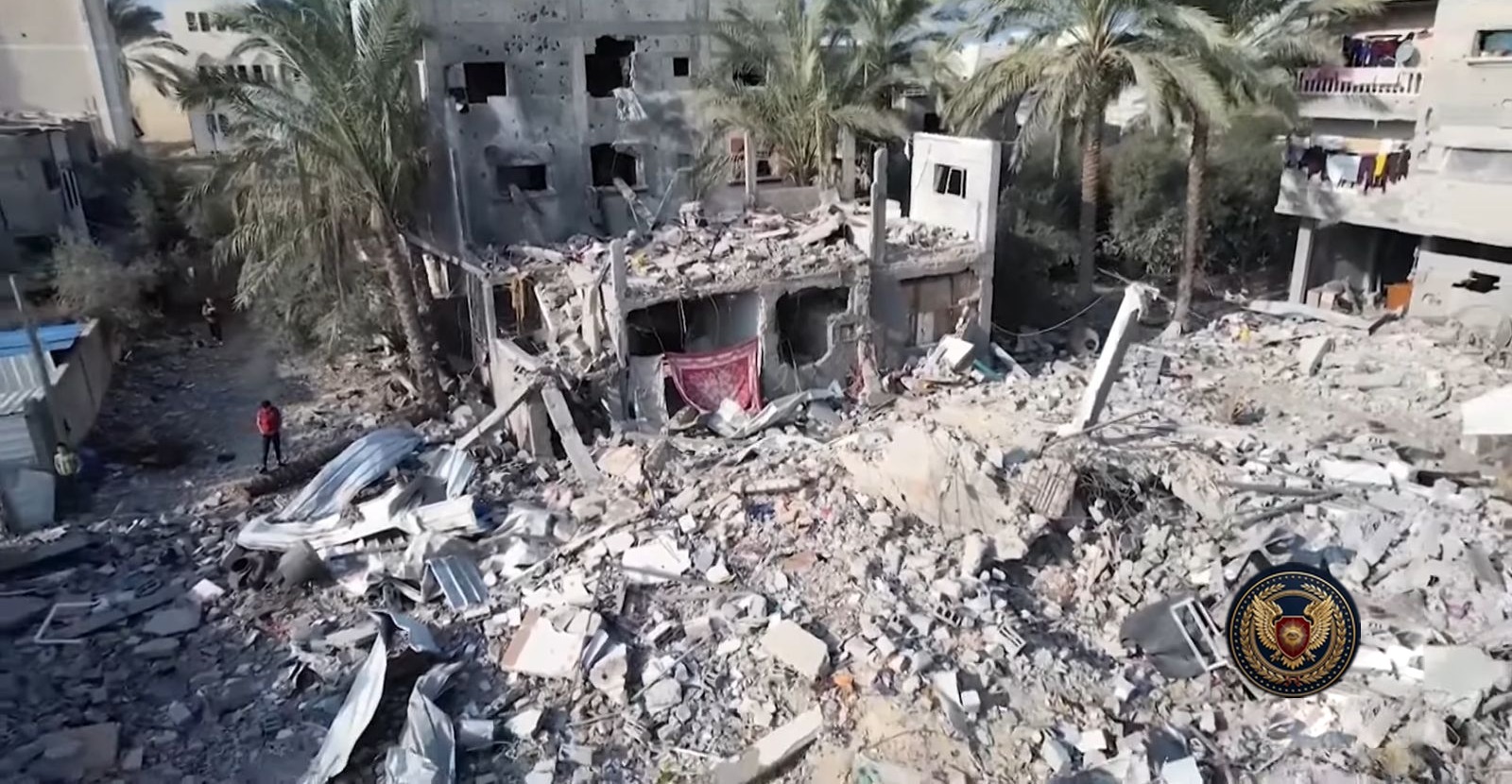
The coffins entered the Church of Saint Porphyrius on Saturday carried on the shoulders of relatives, and the old stone walls of Gaza City's Greek Orthodox parish filled with hymns in Arabic. Inside lay Maysaa Abu Daoud, 56, and her daughter Mary Najjar, 36 — a Christian mother and daughter killed hours earlier when an Israeli airstrike destroyed their apartment building.
Funeral prayers were said over the two women as relatives wept, and the congregation that gathered was not only Christian. Muslims stood among the mourners, neighbors of the dead women who had spent the night pulling bodies from the rubble. “We are Muslims and these are our Christian brethren, who are not involved in anything, they are peaceful people, and everybody loves them, and now we pulled out their bodies, a mother and her daughter,” witness Ahmed Al-Dahdouh told Reuters.
The strike came at about 1:30 in the morning, according to the family. Gaza's civil defence spokesman Mahmoud Bassal said two missiles hit the apartment directly, setting it ablaze and damaging the building. Neighbors described waking to continuous explosions. “We were asleep and suddenly heard continuous strikes and heavy explosions. The children woke up startled and started running and screaming,” Al-Dahdouh said. “We ran out and found that our neighbour's house was struck and there were dismembered martyrs, women, men and children, we started to pull them out, they were scattered under the rubble.”
Five people were killed in the strike, including four women, according to Gaza's health and civil defence officials. There was no immediate comment from the Israeli military.
For the boy who lost the most, the day had no politics in it. Fouad al-Najjar, 14, the son of Mary and grandson of Maysaa, told reporters at the church: “Today is essentially the worst day of my life. I lost my mother and my grandmother today.”
The dead have names, and in Gaza's small Christian community every name is known to everyone. The mother was Maysaa Khader Ibrahim Abu Daoud, known as Umm Michel, 56. Her daughter was Mary Hafez Michel Najjar, known as Umm Fouad, 36. Both were Palestinian Christians from Gaza City, members of a community that numbered about 1,017 before the war and, by recent estimates, has fallen to roughly 600 — a decline of about 41 percent.
The three other people killed in the strike were identified as the academic Yasmin al-Boubou, her mother Halloum al-Boubou, and a man. An official at Al-Shifa hospital told AFP the facility received at dawn the bodies of five people — two women and their daughters, as well as a man — plus a number of injured, following an airstrike in the Rimal neighbourhood of Gaza City. Two of the five victims were Christians, the hospital director said.
What the two women were known for, beyond their family, was service. According to Palestine's Higher Presidential Committee for Church Affairs, Maysaa and Mary devoted their time to helping parishioners and displaced people sheltering at the Holy Family Church. The committee's chairman, Ramzi Khoury, described their deaths as a “painful loss” for their families, the church and its parishioners.
The mourning crossed the lines that usually divide Gaza's churches. The Greek Orthodox Patriarchate of Jerusalem issued a statement mourning Maysaa and Mary and extending condolences to their family. Cardinal Pierbattista Pizzaballa, the Latin Patriarch of Jerusalem, offered his own condolences to the relatives and to Gaza's Christian community. The funeral itself took place at Saint Porphyrius in Gaza City's Old City, with prayers, hymns and religious readings — and, according to those present, friends of both faiths.
Fouad al-Najjar spoke to the Turkish news agency Anadolu about the night the strike came. “My grandmother and my mother died. May God have mercy on them,” he said. He appealed for an end to the war, saying people were losing loved ones every day. “We are exhausted by this war and have endured so much,” he said. “For almost three years, we have been living through the same destruction, the same grief and the same war.” He added that Israeli attacks had killed Muslims and Christians alike: “The occupation does not distinguish between a Muslim and a Christian. I have personally lost many Muslims and Christians who were dear to me.”
A relative, Ihab Ayad, said the women had been “minding their own business” at home when the strike came. “We didn't hurl stones or fire rockets,” he said. “If any child among us carries a stone, they call him a terrorist, a murderer. But they possess the most powerful arsenal and destroy everything.”
Saint Porphyrius is among the oldest churches in Gaza, its roots reaching back to the fifth century and the bishop for whom it is named. It has been a place of mourning before. On October 19, 2023, a strike on the church compound killed at least 18 people. Two months later, the Latin Patriarchate of Jerusalem said an Israeli sniper shot dead a woman and her daughter inside the Holy Family parish compound. By one count, 25 Christians have been killed in Gaza since 2023.
The Israeli military has said nothing about this strike — no confirmation, no denial, no explanation of what was targeted or why. That silence is the largest fact in the file, because everything else about the operation's purpose is inference.
One inference is circulating in Israeli media, relayed by Catholic outlets: that the strike was a precision operation aimed at a senior Hamas figure, Ali al-Amoudi, described as a key political official overseeing civil administrative transition plans in Gaza. According to those reports, his fate is unconfirmed — military sources have not confirmed his status, and he was not listed among the hospital casualties. Nothing in the official record establishes that the apartment was his location, or that he was harmed.
We do not know what munitions were used beyond the civil defence account of two missiles, whether any warning was given to the building's residents, or how many people were injured. We do not know whether the five dead were near the intended point of impact or collateral to it — because no authority has said what the intended point of impact was.
What remains genuinely unclear, a year into a ceasefire, is the procedure by which a strike like this is ordered, reviewed and disclosed. Strikes continue; explanations do not.
This funeral took place a year into a ceasefire that was supposed to end the killing. Last year's US-brokered Gaza ceasefire called for an eventual reconstruction of the territory and laid out terms — Hamas to disarm, Israel to withdraw its troops — that were meant to close the war. Little progress has been made toward implementing any of it, and the killing never stopped.
Israel says Hamas has been rearming and launching attacks in violation of the ceasefire, and has stepped up strikes on the group in recent weeks. Hamas denies trying to carry out attacks or rebuilding its arsenal, and accuses Israel of undermining the Gaza peace deal. In July, Hamas agreed to a US plan for the group to give up its weapons — an arrangement President Donald Trump hailed as a breakthrough and Israeli Prime Minister Benjamin Netanyahu dismissed as insincere. The diplomacy stalled; the airstrikes did not.
The numbers since the ceasefire was announced are stark and asymmetric. Gaza's health officials estimate that at least 1,400 Palestinians have been killed by Israeli fire since last October's ceasefire — one count puts the figure above 1,440. Over the same period, Israel says four of its soldiers have been killed by militants in Gaza, plus one civilian contractor. The full war's tolls are larger by orders of magnitude: more than 74,200 Palestinians killed according to Gaza's health ministry, against 1,221 people killed in the Hamas-led October 7 attack, per an AFP tally of official Israeli figures.
Within those numbers, the Christian dead carry a particular weight. Christians make up barely one percent of Gaza's more than two million people. A community of about a thousand has lost roughly two-fifths of its number to death and emigration since 2023. When a mother and daughter who spent their days serving displaced families are killed in their home, the question asked in Gaza's churches is not only who fired the missiles but whether the community itself survives the war.
And then there is the image the funeral produced: Muslims carrying the coffins of Christians, in a church, in a city under bombardment. Gaza keeps staging this scene — at Saint Porphyrius, at the Holy Family compound — and each time it is both a genuine expression of a shared civic life and a rebuke to every narrative that divides the territory's dead into categories.
Strip away the competing frames and the strike reveals the machinery of a ceasefire with no adjudicator. Both sides claim the other is violating the truce; there is no referee both accept; so each side enforces its own reading with force, and the enforcement itself becomes the next violation. This is the loop Gaza has been in for a year, and the funeral at Saint Porphyrius is what the loop looks like from the inside.
If the Israeli-media reporting is accurate — and it is unconfirmed — the strike's logic was decapitation: removing Ali al-Amoudi, a figure associated with the civil administrative transition, would be an attack not on Hamas's rockets but on its governance. That would make the operation part of a discernible campaign: preventing any Hamas-administered post-war order from taking shape, even as no alternative administration has been stood up and reconstruction has not begun. The policy, in that reading, is to keep Gaza ungoverned and call it security.
The July disarmament episode is the counterfactual that haunts this story. Hamas agreed to a US plan to give up its weapons; Trump called it a breakthrough; Netanyahu called it insincere; nothing followed. Whether the plan was real or theater, its burial removed the one off-ramp that could have converted the ceasefire from a pause into an exit. Every strike since has been, among other things, a monument to that failure.
Then there is the matter of the Christians. A community of a thousand people cannot absorb losses the way a community of millions does. Twenty-five dead and hundreds emigrated is not a statistic for Gaza's Christians; it is an existential threat. The churches of Gaza — Saint Porphyrius, the Holy Family — have served as shelters, morgues, and now recurring crime scenes. Their survival is the survival of the idea that Gaza was ever a plural place, and that idea is running out of people.
Finally, the funeral itself deserves to be read as a political act, whether or not anyone intended it as one. Muslims carrying Christian coffins, in a church, under bombardment, is Gaza's recurring answer to every attempt to sort its dead into deserving and undeserving. It does not change the military calculus. It changes, slightly, what the rest of the world is allowed to pretend the war is about.
The most immediate second-order effect is demographic. Gaza's Christian community was already emigrating before the war; the war has turned a drift into a hemorrhage. Each funeral like Saturday's is both a tragedy and an advertisement to the young that there is no future here. If the current rate continues, Gaza's two-millennia Christian presence could become a memory within a generation — a loss that no ceasefire can reverse.
The second effect is institutional. The churches that shelter the displaced — the Holy Family compound took in hundreds — are themselves targets or collateral, and their capacity to serve as Gaza's last neutral spaces is eroding. When the sanctuaries are struck, the displaced have nowhere left that is even notionally protected.
The third is diplomatic. The Patriarchates of Jerusalem — Greek Orthodox and Latin — are among the few institutions that speak to all sides and are heard in Western capitals. Each Christian death in Gaza activates that channel: statements, condolences, quiet pressure. It has not stopped the strikes, but it is one of the few forms of leverage that still moves, and both churches know it.
The fourth is the ceasefire's own credibility. A truce under which 1,400 people are killed by one side's fire is a truce in name only, and every named victim — Maysaa, Mary, Yasmin, Halloum — makes the abstraction harder to sustain. Mediators in Cairo, Doha and Washington are trying to revive a deal whose central promise, the end of killing, is visibly unkept. Funerals are the evidence the negotiators cannot file away.
The Israeli military may yet comment on the strike, as it sometimes does days later when operational details are cleared — or it may not, as it often does not. If the al-Amoudi reporting firms up, expect a debate over whether targeting a civil-administration figure constitutes counterterrorism or political assassination, and whether the distinction matters to the families in the rubble.
Watch the tempo. Israel has stepped up strikes in recent weeks; the question is whether Saturday's operation was routine enforcement or the start of a new phase. Watch, too, for any Hamas response — the group's denials of rearmament sit uneasily beside Israel's claims, and the space between them is where the next escalation lives.
Watch the churches. The Patriarchates' statements were measured; if strikes continue to kill Christians, that measured tone has limits, and the Vatican's voice carries in capitals where Gaza's voice does not. And watch the community itself — whether the funerals accelerate the emigration that is quietly ending two thousand years of Christian life in Gaza.
The boy at the center of this story asked for only one thing: an end to the war. “We are exhausted,” Fouad al-Najjar said. Exhaustion, in Gaza, is not a mood. It is a casualty count.
Western coverage of the strike has split along a familiar fault line. Some outlets lead with the civilian ledger — five dead, four of them women, a Christian mother and daughter buried on Saturday — and frame the story as the latest evidence that the year-old ceasefire is a fiction. Others lead with the unconfirmed Israeli-media reporting that the operation targeted a Hamas political figure, Ali al-Amoudi, and frame it as counterterrorism inside a truce that Hamas is accused of violating.
The Israeli position, insofar as it can be read from the silence, is consistent with a standing practice: strikes are presented as enforcement against Hamas rearmament, and operational details are withheld pending internal review. Israel's stated numbers — four soldiers and one contractor killed by militants since the ceasefire — are offered as proof that the threat is real and the truce is one-sided.
Quiet Western church diplomacy is the third Western thread. The Latin Patriarchate's condolences and the Vatican's attention to Gaza's Christians give Western audiences a frame that is neither military nor partisan: a two-thousand-year-old Christian presence, down to its last few hundred souls, being ground down between armies. For that audience, the funeral is not only a news event but a question about what, exactly, is being preserved.
Eastern and Arab coverage has centered the victims and the funeral, not the alleged target. Al Jazeera's reporting, Turkish outlets and Arab media lead with the names — Maysaa, Mary — the interfaith mourning, and the 14-year-old boy's testimony. The frame is straightforward: an airstrike on a home, a family destroyed, a community burying its own.
Anadolu's interview with Fouad al-Najjar is the emotional core of this coverage: a child describing the 1:30 am strike, the loss of his mother and grandmother, and three years of “the same destruction, the same grief and the same war.” The quote travels because it compresses the entire war into one household.
The analytical thread in this coverage is the accusation Hamas itself makes: that Israel is undermining the Gaza peace deal, and that each strike is a data point in a pattern of ceasefire erosion. The figure that recurs — 25 Christians killed since 2023, a community down 41 percent — is presented as evidence that the war's attrition is not only military but demographic.
In Gaza and across the Global South, the story is read as arithmetic. Two missiles on an apartment at night; five dead; no explanation. The ledger of the ceasefire year — more than 1,400 Palestinians killed by Israeli fire against a handful of Israeli military deaths — is quoted not as an accusation but as a description of what a “ceasefire” has meant in practice.
Palestinian institutional voices give this reading its vocabulary. Ramzi Khoury's “painful loss” speaks for a church-affairs establishment watching its flock shrink. Fouad al-Najjar's line — “The occupation does not distinguish between a Muslim and a Christian” — is the southern summary of the strike: the bombs do not check identity cards. Ihab Ayad's bitterness about stones and arsenals is the southern summary of the discourse around it.
There is also a weary familiarity in this coverage. Saint Porphyrius has been bombed before; the Holy Family compound has been shot at before; funerals of Christians have been held before. The South's perspective is that Gaza's Christians are a community the world notices mainly when it buries them — and that the attention fades long before the next funeral.
