For the first time in its history, the Rassemblement National will hold a parliamentary group in the Senate — 15 seats won Sunday, seven months before a presidential election in which Marine Le Pen leads the polls.
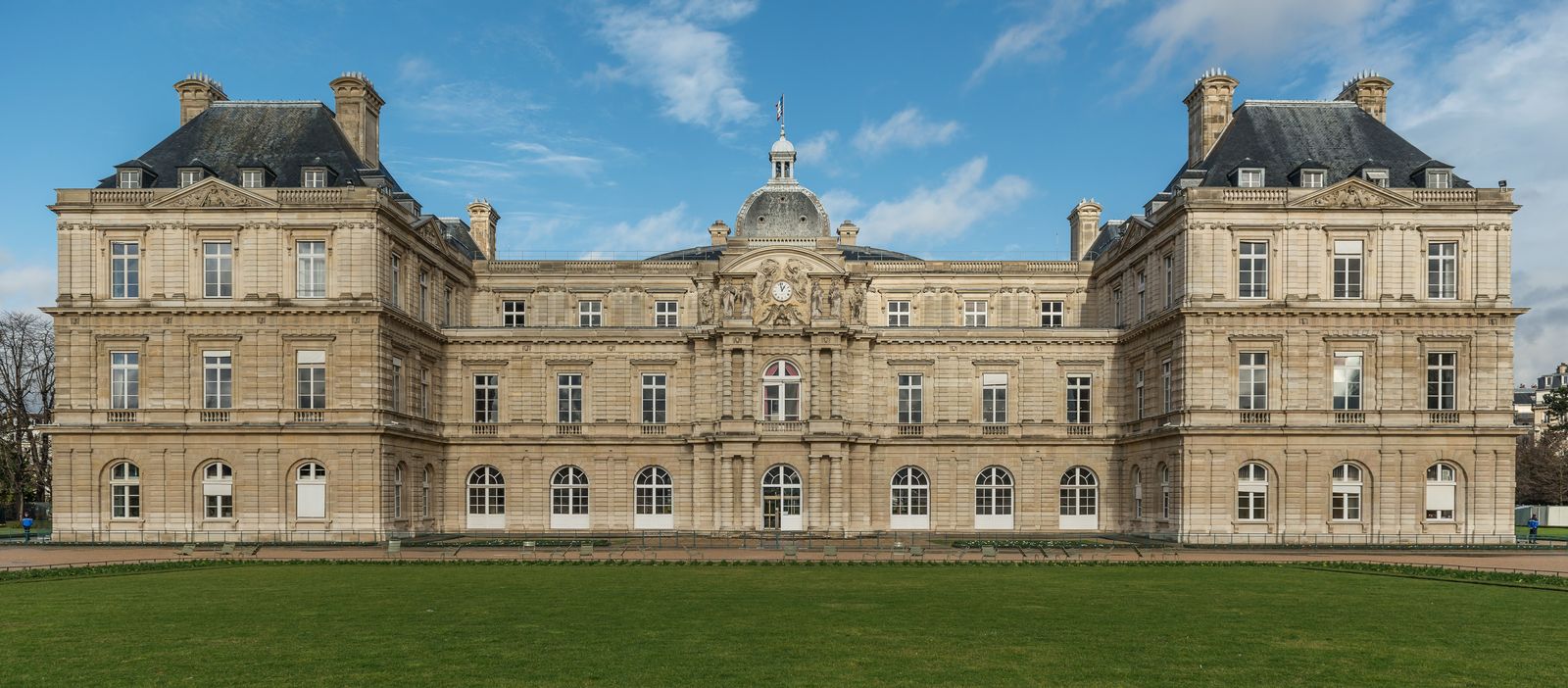
There is one fortress the French far right had never taken: the Senate, the conservative upper house that has been the right's stronghold since the 1970s. On Sunday, the Rassemblement National took it — or at least, took enough of it to plant its flag. For the first time, the party of Marine Le Pen will sit as a parliamentary group in the Luxembourg Palace.
The numbers tell the story of a breakthrough. Half the Senate — 178 of 348 seats — was renewed Sunday by some 94,000 local elected officials, mostly mayors. The RN went in with three senators. It came out with at least twelve of its own, plus two to three from Éric Ciotti's UDR allies, for a group of fifteen — comfortably above the ten needed, larger than the ecologist and radical-left groups, and the high end of what the party dared hope.
What a group buys is not power but presence. Until now the RN's senators sat among the non-registered, in the attic of the Luxembourg Palace, as Le Monde puts it. A group means speaking time in the hemicycle, money for staff, seats on the standing committees, and — the prize — a place at the Conference of Presidents, the body that sets the Senate's agenda. It is the difference between shouting from the gallery and sitting at the table.
This is not a protest vote. It is an implantation.
The geography of the win matters more than the arithmetic. The gains came in the Var, Vaucluse, Gard, Gironde and Alpes-Maritimes — the Mediterranean rim where the March municipal elections had already turned town halls. Senators are elected by mayors; the municipal breakthrough of March mechanically produced the senatorial breakthrough of September. This is not a protest vote. It is an implantation.
The timing is the message. Seven months before the spring 2027 presidential election, with Marine Le Pen leading first-round polling by a wide margin, the Senate result feeds the narrative her camp has been building for a decade: the 'march to power' is not a slogan but a schedule. 'An accelerator for this presidential campaign,' as vice-president Sébastien Chenu put it.
There was a second first on Sunday, easily missed in the RN's shadow: La France insoumise won its first-ever Senate seat. The indirect ballot, which rewards local roots, has long kept the radical left out of the upper house. Its arrival, however solitary, completes the picture of a political system being remade from the municipalities upward.
The balance of the chamber has not fundamentally shifted. The Republicans and their centrist allies have held the Senate since the 1970s, barring a 2011–2014 socialist interlude, and they hold it still — slightly diminished, but in command. The RN will be the smallest group, a subaltern force with new microphones.
But symbols have their own arithmetic. A party that holds the largest French delegation in the European Parliament, the largest opposition group in the National Assembly, and now a group in the Senate can no longer be described as an outsider. The question for the next seven months is not whether the RN belongs to the system, but whether the system can still contain it.
Western coverage — Le Monde, Reuters, AFP — treats the result as the normalization milestone it is. The narrative is institutional: each chamber conquered makes the RN harder to describe as anti-system, and the 'march to power' framing, once the party's own propaganda, is now the press's working hypothesis. Le Monde's analysis is unsparing about what the municipal-to-senatorial pipeline means.
The Western lens also notes the dog that didn't bark: the mainstream right held the chamber. The story, in this telling, is not a takeover but a credentialing — the RN collecting the institutional furniture of a governing party, seven months before asking for the keys.
Eastern coverage — TASS, Russian state media — reads the result as the latest proof that Europe's liberal order is hollowing from within. The argument: the same establishment that lectures the world on democracy keeps losing to the parties it calls extremist. Moscow's commentary frames Le Pen's rise as the bill coming due for decades of elite failure.
The Eastern lens dwells on the presidential calendar with open interest. A Le Pen presidency would scramble every assumption underpinning EU sanctions policy, NATO posture and the Ukraine file. In this reading, the Senate group is a footnote; the Élysée is the story.
The Global South lens — Romanian, Argentine and African press — reads the story through the migration prism. The RN's breakthrough is, for much of the South, the European electorate voting on the one issue that touches it directly: who gets to come, and on what terms. The Senate group is Paris politics; the signal is continental.
What resonates, in the South's telling, is the municipal pipeline. A party built town hall by town hall, mayor by mayor, is a party that understood something the old left forgot: power grows from the ground. Developing-world political operatives are taking notes.
