On the truce's first anniversary, monitors say it exists 'in name only': one Palestinian killed or wounded every 90 minutes, no stabilisation force, aid at a third of the agreed rate — while settler violence disrupts the West Bank olive harvest.
Published 13 October 2026 · 09:20 GMT
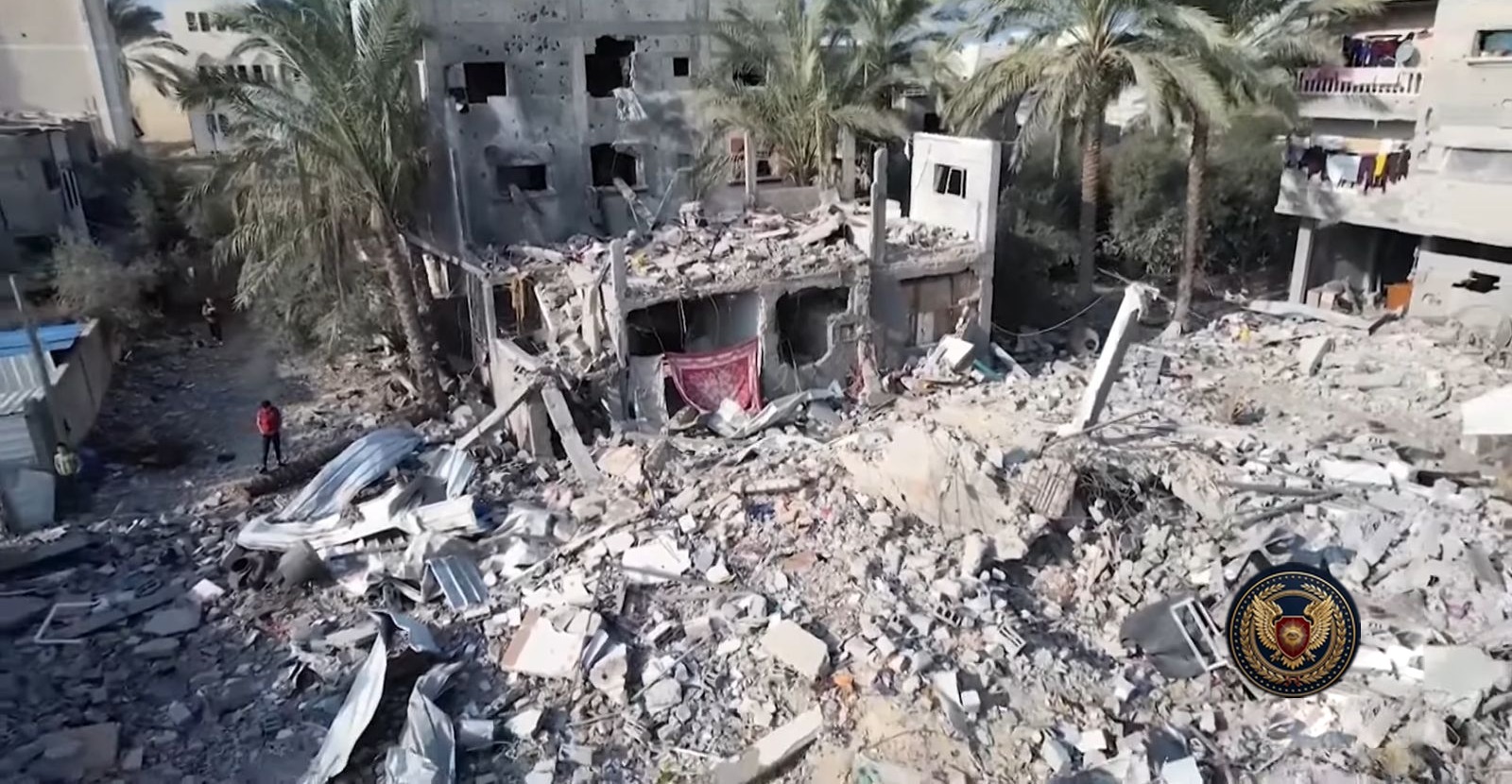
On October 10, 2026, the Gaza "ceasefire" marked its first anniversary — and the verdict from the organisations that track the Strip's humanitarian reality was unsparing. More than 100 humanitarian and human rights organisations declared that the truce exists "in name only."
The arithmetic behind that verdict is stark. Islamic Relief calculated that Israeli forces have killed or wounded a Palestinian in Gaza on average every 90 minutes since the ceasefire took effect. Gaza's Health Ministry put the toll since the truce at 1,493 killed and 5,299 wounded, up from 1,460 killed a week earlier. The cumulative death toll since October 2023 stood at 74,382.
Israeli forces also spent the past week pushing the so-called Yellow Line — the demarcation of Israeli control — further into residential Gaza City neighbourhoods, triggering fresh displacement a full year into what was supposed to be a truce.
The past week offered a concentrated picture of what the "ceasefire" means in practice. Among the Palestinians killed in Gaza over the week, according to field reporting carried by Al Jazeera and the Palestinian news agency Wafa:
In statements describing the attacks, Israel's military claimed several of those killed this week were Palestinian fighters. It said two men killed near the Jordanian Field Hospital were Islamic Jihad operatives; Wafa identified one of them as a recently released former prisoner. The military separately said a civil defence worker killed near Kamal Adwan Hospital in northern Gaza had been a Hamas sniper — a claim Hamas rejected and which has not been independently verified.
One year in, the institutions created to turn the ceasefire into something real have mostly failed to materialise — and their future is the great unknown of this story. The Board of Peace, Gaza's transitional oversight body, has failed to meet most of its central commitments: no international stabilisation force has deployed, aid trucks are entering at roughly a third of the agreed rate, and Israel now controls nearly two thirds of the Strip — above the roughly 50 percent it was supposed to retain before withdrawal and a future handover of control to Palestinians.
It is not known whether the stabilisation force will ever deploy, what would trigger it, or whether the aid-entry rate will recover to the agreed level. Independent verification of the Israeli military's "fighter" designations for this week's dead is unavailable, and the Health Ministry's count does not distinguish combatants from civilians. And it remains unclear what, if anything, the Board of Peace's next review will conclude about a ceasefire whose own monitors describe it as existing in name only.
Because the label shapes everything that follows: the volume of aid, the urgency of diplomacy, the willingness of third parties to deploy forces, and the public's attention. A ceasefire that kills one person every 90 minutes delivers the casualty rate of a war while drawing the scrutiny of a peace — the worst of both states. That is the precise meaning of the "in name only" verdict.
Gaza's health system has continued its collapse through the truce. The Ministry of Health says 44 percent of essential medicines are completely out of stock. A Physicians for Human Rights Israel report found that a year into the ceasefire, not one of Gaza's 36 hospitals is operating at full capacity. More than 18,500 patients need medical evacuation, and more than 1,000 have died waiting, according to the joint NGO statement. This week, the ministry said no patient had been permitted to leave through the Rafah crossing. The slow death of the health system under truce conditions is documented in detail in our earlier coverage of Gaza's healthcare a year after the ceasefire.
The Palestinian olive harvest — traditionally a time of family and celebration — gathered pace this month as Israeli settlers and soldiers intensified efforts to disrupt it. Harvesters were killed, attacked and blocked, while isolated families faced days-long settler sieges. The shape of the assaults is the story: on October 7, Ali Hassan Yasser al-Bazzari, 44, was shot dead when settlers and soldiers opened fire on olive pickers on farmland between Burqa and Ramin, northwest of Nablus; at least 16 others were wounded. The Palestine Red Crescent Society said Israeli forces assaulted ambulance crews trying to reach the wounded and briefly detained three paramedics; soldiers later raided the nearby village and made arrests, while the settlers who carried out the attack marched past unimpeded.
The Commission recorded 19 settler attacks on Friday alone, another 12 on Saturday and 18 more on Sunday; Yesh Din had already documented 109 harvest-related incidents across 75 Palestinian communities between September 27 and October 6. The commission says settlers and soldiers have destroyed roughly 50,000 trees this year. The pattern repeats village by village: in Qusra, settlers stole a farmer's olives before bulldozing more than 50 of his trees; in Birin, settlers from the Adorim outpost set a dog on a 79-year-old woman harvesting nearby, hospitalising her, and repeatedly cut power to roughly 20 homes; at Deir Abu Mash'al, an attack on a solidarity harvest left eight wounded, including a photojournalist shot in the thigh. Israeli forces also blocked the harvest, driving farmers out of Wadi Abwein with drone-mounted loudspeakers.
The harvest matters politically because it is legible everywhere. Unlike the Gaza casualty ledger — contested, technical, buried under competing designations of "fighter" — a 79-year-old woman mauled while picking olives needs no interpreter.
Two political clocks are ticking alongside the truce. In Israel, parliamentary elections are scheduled for October 27, and Joint List leader Yousef Jabareen said his alliance — of mostly Palestinian citizens of Israel — was prepared to support a coalition against Prime Minister Benjamin Netanyahu from outside government, in exchange for policy commitments including a pathway to Palestinian statehood; polls suggest neither bloc can reach a majority without Arab party support. The election calendar rewards governments that look strong, not governments that make concessions — a poor backdrop for ceasefire revival.
On the Palestinian side, President Mahmoud Abbas once again postponed legislative elections — this time to September — citing Israeli restrictions on election materials and observers entering Gaza and East Jerusalem, and ongoing settler violence. Mustafa Barghouti of the Palestinian National Initiative said the decision reflects that "everything is concentrated in the hands of the executive authority," with no parliament or independent judiciary to check it. Meanwhile, Israeli authorities began demolishing homes this week in al-Dahiya, an unrecognised Bedouin village in the Naqab, after a district court rejected a request to freeze the orders; roughly 60 homes face demolition — a reminder that the machinery of displacement operates under truce and war alike.
The monitors' verdict implies a checklist, and every item on it is currently failing. A truce that deserved the name would need the international stabilisation force the Board of Peace promised but never deployed; aid entering at the agreed rate rather than a third of it; Israeli control receding toward the agreed 50 percent instead of expanding toward two thirds; the Yellow Line frozen rather than pushed into residential Gaza City; and Rafah open for the more than 18,500 patients waiting for evacuation, rather than closed for a seventh straight week.
None of those items moves without political cost in an Israeli election fortnight — which is the honest reason to expect the "in name only" verdict to survive the anniversary rather than a reset. The wire will keep tracking the Board of Peace's next review, the aid-entry figures, and the harvest season's remaining weeks: the three metrics that will tell whether the second year of the ceasefire differs from the first.
The Western reading centres on international humanitarian law and the credibility of monitoring. More than 100 organisations — Western and international NGOs among them — have effectively declared the truce a fiction, a rare convergence of watchdog verdicts that puts the burden of proof on those who still call it a ceasefire. The downgrade of the United Kingdom's consulate in occupied East Jerusalem to a reduced "mission" after Israel's closure deadline passed was read in Western diplomatic circles as a quiet admission that the post-ceasefire architecture is not functioning.
The Eastern and regional reading is organised around the Board of Peace and the question of who governs Gaza next. For Arab states and regional powers, the ceasefire was meant to be a corridor to a managed transition: withdrawal in stages, a stabilisation force, and an eventual handover of control to Palestinians. A year in, that corridor is blocked at every door — no force, a third of the aid, Israeli control expanding instead of receding toward the agreed 50 percent. Al Jazeera's field reporting, which documented both the Gaza killings and the West Bank harvest assaults in granular detail, functions in the region as the evidentiary record of a truce hollowed out. The regional question is no longer whether the ceasefire holds, but whether the Board of Peace has any authority left to lose.
The Global South reading treats the anniversary as a test case for the credibility of ceasefire diplomacy itself. Across Africa, Asia and Latin America, the "in name only" verdict lands as confirmation of a familiar pattern: truces whose terms are written in one capital and violated in another, with the victims' own counts — 74,382 dead since October 2023, Gaza's ministry says — discounted against official military claims. The harvest violence, documented village by village, reads in this frame as the structural companion to the Gaza truce: three years of devastation tracked daily, each season renewing a cycle of dispossession the ceasefire was never designed to address.
The truce turned one on October 10, 2026. More than 100 humanitarian and human rights organisations say it exists "in name only": Gaza's Health Ministry counts 1,493 killed and 5,299 wounded since the ceasefire began, and 74,382 dead since October 2023. Aid enters at a third of the agreed rate, no stabilisation force has deployed, and Israel controls nearly two thirds of the Strip.
The Board of Peace is Gaza's transitional oversight body, created to manage the ceasefire's next phases. A year in, it has failed most of its central commitments: no international stabilisation force has deployed, aid trucks enter at roughly a third of the agreed rate, and Israeli control has expanded to nearly two thirds of the Strip instead of receding toward the agreed 50 percent before a handover to Palestinians.
The harvest season has been met with a coordinated wave of settler assaults. Ali Hassan Yasser al-Bazzari, 44, was shot dead on October 7 between Burqa and Ramin. Officials recorded 19 settler attacks on Friday, 12 on Saturday and 18 on Sunday; Yesh Din documented 109 harvest-related incidents across 75 communities from September 27 to October 6, and about 50,000 trees have been destroyed this year.
It is still collapsing. The Health Ministry says 44 percent of essential medicines are completely out of stock. A Physicians for Human Rights Israel report found that not one of Gaza's 36 hospitals is operating at full capacity. More than 18,500 patients need medical evacuation, over 1,000 have died waiting, and no patient was permitted to leave through Rafah in the past week.
