South Africa's anti-foreigner movement squares up to the state, two days before the polls
With the 4 November local elections two days away, a court ban, a troop deployment and a spy-agency scandal have fused into one confrontation: March and March versus the South African state; and the digital conversation shows the movement is winning the week.
Published 2 November 2026 · 10:10 GMT
The summary
On Friday, October 30, the Durban High Court barred March and March from protesting over the election period, after Acting Police Minister Firoz Cachalia and KZN police commissioner Nhlanhla Mkhwanazi sought an interdict covering the Durban CBD and the Home Affairs refugee centre. President Cyril Ramaphosa authorised 510 SANDF members to support police in KwaZulu-Natal under Operation Prosper, from October 9 to November 30, 2026, at a projected cost of R34,082,720; about $2.05 million.
The three lenses
- WestThe Western lens frames the week as a stress test for democratic norms: soldiers and court orders deployed against protesters weeks before an election, set against a movement whose grievances, high unemployment, strained services, are real even when its remedies are not.
- EastThe Eastern lens , via the Singapore Straits Times' Reuters account, is cooler and more procedural: 510 soldiers, R34.1 million, 9 October to 30 November, elections on 4 November.
- Global SouthThe Global South lens is the richest, because the story is South African.
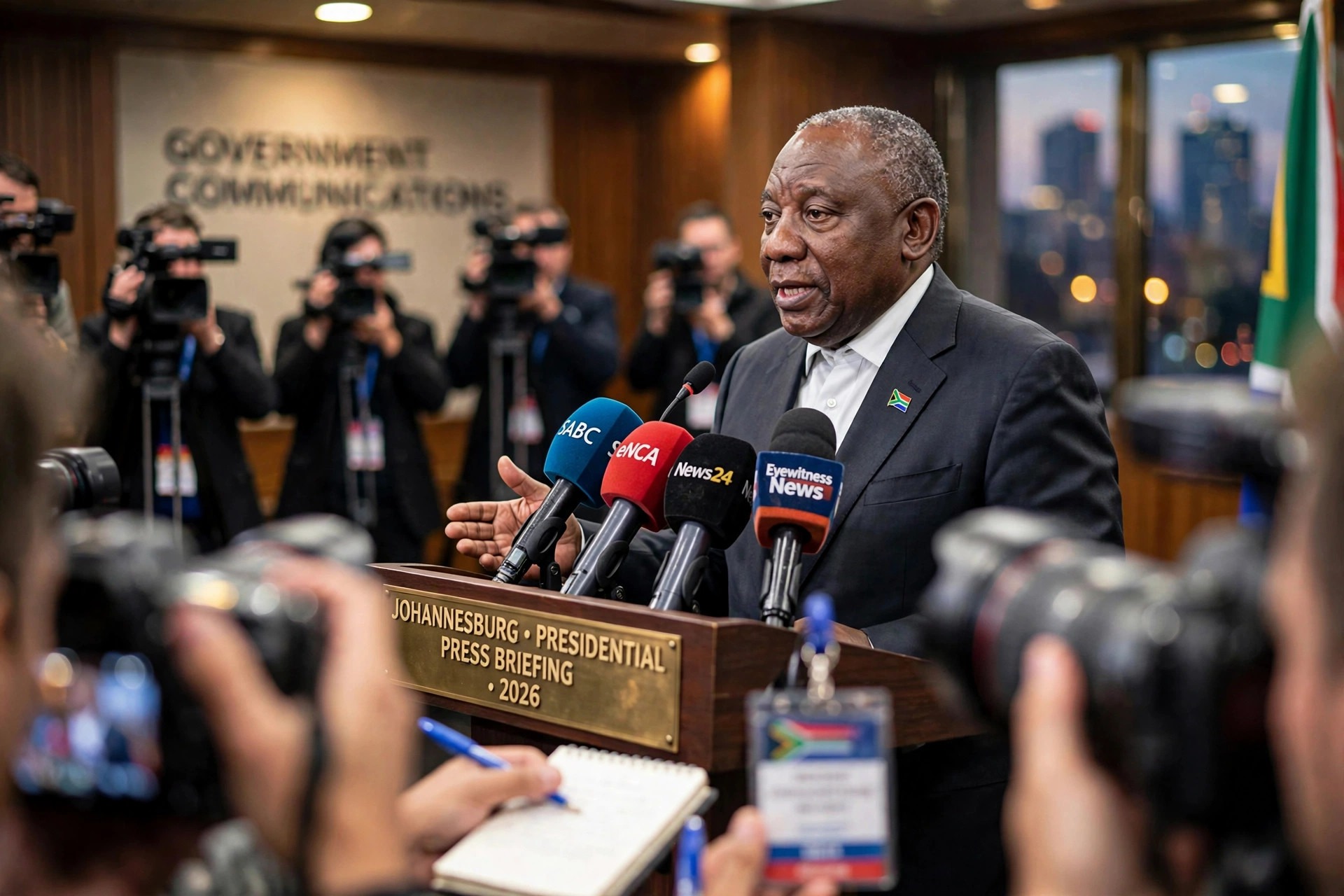
Key facts
- On Friday, October 30, the Durban High Court barred March and March from protesting over the election period, after Acting Police Minister Firoz Cachalia and KZN police commissioner Nhlanhla Mkhwanazi sought an interdict covering the Durban CBD and the Home Affairs refugee centre. IOL (Nov 2, 2026)
- President Cyril Ramaphosa authorised 510 SANDF members to support police in KwaZulu-Natal under Operation Prosper, from October 9 to November 30, 2026, at a projected cost of R34,082,720; about $2.05 million. The Straits Times (Oct 27, 2026)
- NATJOINTS warned that no marches of any kind will be allowed on election day, Wednesday November 4, and that protests must end by midnight on Tuesday. IOL (Nov 2, 2026)
- Two anti-foreigner communities produced 43% of all political posts on X between October 23 and 29, from 25% of accounts; up from 31% the week before, per Murmur Intelligence tracking. Daily Maverick (Nov 2, 2026)
- The Gauteng High Court granted the EFF partial access to the trial record in the R12-million fraud case against two former SSA officials, amid testimony linking Project Mayibuye to the infiltration of the EFF. EWN (Oct 29, 2026)
Two days out, the fight turns toward the state itself
Two days before South Africa's local government elections on 4 November 2026, the country's anti-foreigner movement has turned its fire away from foreign nationals and toward the state itself. The acting police minister went to court to stop March and March from protesting in Durban, the President put 510 soldiers into KwaZulu-Natal, and the movement's most visible figure, Jacinta Ngobese-Zuma, cast both moves as a government at war with its own citizens.
The collision is the subject of this week's Digital Politics column in the Daily Maverick, drawing on a week of tracking by Murmur Intelligence across X, public Facebook pages and online news between 23 and 29 October. Its headline finding: two anti-foreigner communities produced 43% of all political posts on X from just 25% of accounts, up from 31% the week before; the rebound that put the movement back on top of the national conversation, days before voters go to the polls.
Friday brought the sharpest turn. The Durban High Court barred March and March from protesting over the election period, after Acting Police Minister Firoz Cachalia and KwaZulu-Natal police commissioner Nhlanhla Mkhwanazi sought an interdict covering the Durban city centre and the Home Affairs refugee centre on Che Guevara Road. The National Joint Operational and Intelligence Structure separately warned that no marches of any kind will be allowed on election day itself.
How did the courts rule on March and March?
The Durban High Court's Friday ruling converts an urgent interim interdict, granted days earlier after police cited intelligence of a plot to burn the refugee centre, into a ban on March and March demonstrations through the election period. When protests resume, they may only run between 10am and 3pm along designated routes; protesters may not carry sticks, knobkerries or other weapons, may not cover their faces, and may not intimidate or obstruct. The order also bars demonstrations within 100 metres of voting stations while voting, counting and results announcements take place.
The application was brought jointly by Cachalia and Mkhwanazi, who told the court that unannounced marches were forcing police to divert officers at short notice from election security. March and March's attorney, Xolani Zuma, told supporters the movement would resume protesting after 6 November and urged compliance to avoid further legal action.
On the military side the record is exact: President Cyril Ramaphosa authorised 510 South African National Defence Force members to support police in KwaZulu-Natal under Operation Prosper, from 9 October to 30 November 2026, at a projected cost of R34,082,720; about $2.05 million. The decision, taken under section 201(2)(a) of the Constitution, was communicated to Parliament's presiding officers in a letter dated 21 October and announced publicly on 27 October. The presidency's stated reason: violence linked to misinformation about a July Constitutional Court ruling on asylum seekers.
The week's other verified strand concerns the Economic Freedom Fighters. Following a News24 report, the Gauteng High Court granted the EFF partial access to the trial record in the fraud case against two former State Security Agency officials. Testimony has linked a R12-million project, code-named Project Mayibuye, to efforts to infiltrate the EFF during Jacob Zuma's presidency. Julius Malema told a Soweto rally on Saturday that he knows the names of the alleged infiltrators and has locked the list in a safe.
The gaps the court orders and the dashboards cannot fill
Murmur Intelligence flags its own sharpest limit: the movement's online surge shows "focused amplification", small clusters of accounts repeatedly reposting the same influencers, but the data cannot say whether that reflects fan enthusiasm, activist discipline or inauthentically coordinated behaviour. The same caveat covers 164 accounts repeatedly reposting EFF material, and 36 accounts that posted about 250 near-identical "Vote ANC" messages between 23 and 27 October, none marked as advertising.
On the military deployment, the authorisation records what Parliament was told, 510 members, the dates, the cost, but not how many soldiers are physically on the streets at any moment, nor their precise operational rules. One wire-service account put the permitted protest window at 9am rather than 10am; the South African outlets that covered the hearing report 10am to 3pm, and the discrepancy stands unresolved.
On the spy-agency scandal, the EFF has partial access to the trial transcript, but the defence is preparing a discharge application arguing the state has failed to make its case; so the full evidentiary picture may never reach the public. And the central electoral unknown remains: whether the week's confrontation helps or hurts the movement's sympathisers at the ballot box on Wednesday.
Why a digital-first movement now sets the campaign's tempo
The column's numbers describe a structural shift, not a blip. A movement with no parliamentary seats produced nearly half of the week's political conversation on South Africa's most politically engaged platform, from a quarter of the accounts. When a non-party actor sets the agenda that aggressively in a campaign's final week, the established parties end up campaigning on its terrain. The ANC's own most-shared moment of the week, tellingly, came from abroad: Ramaphosa's congratulations to Brazil's newly re-elected president, Lula da Silva; carried largely by Brazilian accounts.
The state has answered with two instruments it rarely deploys together before an election: the courts and the army. An interdict dictating where, when and how citizens may march, backed by soldiers authorised to support police through the end of November, makes this an election held under extraordinary security pressure; in a province still carrying the memory of the July 2021 unrest. The precedent will outlast Wednesday: future governments will cite this week when the next protest movement tests the limits.
There is also a trust ledger at stake. The same week the state asked citizens to trust its policing of the campaign, a court heard how the state's own spy agency allegedly spent R12 million infiltrating an opposition party; a Zuma-era legacy the current government says it has buried. That contradiction is the week's real fuel: it lets the movement argue, plausibly to its audience, that the state polices its critics harder than its own abuses.
Reading the standoff through the 5D lens
Geopolitically, this is a governing party managing a legitimacy squeeze: the ANC lost its parliamentary majority in 2024 and now governs through an unwieldy coalition, so a security-heavy response to protest carries both reassurance and risk. Economically, the fuel is measurable: persistently high unemployment and strained municipal services make the claim that "foreigners take state money" politically potent, even when the numbers collapse under scrutiny; the R1.3-billion grants figure promoted by the ATM's Vuyo Zungula is roughly 0.004% of the roughly R300-billion social assistance budget.
Demographically, the movement's engine is young, urban and digital: its communities dominate X while established parties like ActionSA barely register, and its narratives travel through influencers whose posting more than doubled in a week. Historically, xenophobic mobilisation has flared before South African elections; but the state's response has escalated: from policing marches to interdicting them, from interdicting them to deploying the army. Technologically, the week is a case study in platform dynamics: coordinated-looking amplification and pseudo-news accounts anchoring a community for years can now out-shout every party's communications machinery combined.
The shockwaves beyond election day
The human cost is already regional. The Associated Press reported that Ghana and Nigeria have repatriated citizens following weeks of violence, and an AFP tally cited in August put total departures at around 176,000; mostly Malawians, Mozambicans and Zimbabweans. A movement that began as street protest is now a migration driver, redrawing remittance flows across southern Africa.
Domestically, two institutional precedents are being written. First, the interdict model: future police ministers now have a tested template for fencing protest around sensitive sites and election windows. Second, the intelligence model: the EFF's court victory on the trial record keeps the Zuma-era politicisation of the security services in the headlines; a reminder that surveillance powers, once turned inward, become a permanent campaign issue for whoever inherits them. Meanwhile, deportation debates are raging on other continents too, giving the movement's sympathisers a global vocabulary and its critics a global comparison set.
What happens after 4 November?
The immediate calendar is set. NATJOINTS has drawn its line: marches must end by midnight on Tuesday, and nothing marches on Wednesday while South Africa votes. The interdict keeps March and March off Durban's streets through the election period; its lawyer says protests resume after 6 November; the first post-election test of the movement's discipline, and of the state's willingness to keep the courts in the loop once ballots are counted.
The soldiers stay longer than the campaign: the SANDF authorisation runs to 30 November, so new municipal councils take office with the army still formally on standby in KwaZulu-Natal. And the spy-agency trial continues regardless of Wednesday's winner; the defence's discharge application and the EFF's newly granted record access guarantee the week's second scandal outlives the first. Polls have misled voters before; but court records, unlike polls, will still be there on Thursday.
The three lenses
West Lens:
The Western lens frames the week as a stress test for democratic norms: soldiers and court orders deployed against protesters weeks before an election, set against a movement whose grievances, high unemployment, strained services, are real even when its remedies are not. The Associated Press account stresses the human ledger: citizens of Ghana and Nigeria repatriated, foreign nationals killed, shops looted; with illegal immigration the campaign's defining fault line.
East Lens:
The Eastern lens , via the Singapore Straits Times' Reuters account, is cooler and more procedural: 510 soldiers, R34.1 million, 9 October to 30 November, elections on 4 November. The emphasis falls on the presidency's stated rationale, violence linked to misinformation about the Constitutional Court's asylum ruling, and on months of anti-migrant marches drawing international criticism. The deployment reads less as drama than as administration.
South Lens:
The Global South lens is the richest, because the story is South African. The Daily Maverick's column supplies the week's real data: who is talking, how much, and with what amplification. IOL and eNCA track the election-security machinery; the Mail & Guardian and EWN keep the SSA infiltration scandal, a Zuma-era wound, in frame.
The consensus
- What we agree on
- We agree: the verified core is not in dispute; on Friday, October 30, 2026, the Durban High Court barred March and March from protesting over the election period; 510 SANDF members are authorised to support police in KwaZulu-Natal through November 30 at a projected cost of R34,082,720; and South Africa's local government elections take place on Wednesday, November 4.
- What we don't agree on
- We disagree on what the state's response means: the movement and its sympathisers read the interdict and the troop deployment as a government silencing its citizens and protecting foreigners; the government and police read them as the minimum required to guarantee a free, fair and safe election after weeks of violent protest.
- What we know
- What we know: the interdict's terms (10am–3pm, set routes, no weapons or face coverings, 100m exclusion around voting stations), the deployment's figures (510 troops, October 9–November 30, section 201(2)(a)), the tracking numbers (43% of X political conversation from 25% of accounts, October 23–29), and the trial facts (R12-million Project Mayibuye, the EFF's partial record access).
- What we don't know yet
- What we don't know: whether the movement's online amplification is fan enthusiasm, activist discipline or inauthentic coordination; how many soldiers are physically deployed at any moment; whether the full SSA trial record will ever reach the public; and whether the week's confrontation helps or hurts the movement's sympathisers at the ballot box.
- What we expect
- What we expect: no marches on election day under the NATJOINTS order; a first post-election test when March and March says it will resume protesting after November 6; the SANDF presence continuing through November 30; and the Project Mayibuye trial, and its discharge application, keeping the spy-agency scandal in the headlines regardless of Wednesday's results.
Questions, answered
Why were March and March banned from protesting?
The Durban High Court barred the movement from demonstrating over the election period after Acting Police Minister Firoz Cachalia and KZN police commissioner Nhlanhla Mkhwanazi applied for an interdict. Police cited intelligence of a plot to burn the Home Affairs refugee reception centre on Che Guevara Road, weeks of unrest that saw vehicles torched and shops looted, and the need to keep officers free for election security. When protests resume, they are limited to 10am–3pm on set routes.
Why are soldiers deployed in KwaZulu-Natal?
President Cyril Ramaphosa authorised 510 SANDF members to support police in the province under Operation Prosper, from October 9 to November 30, 2026, at a projected cost of R34,082,720. The presidency says the deployment responds to violence linked to misinformation about a July Constitutional Court ruling on asylum seekers. It was authorised under section 201(2)(a) of the Constitution and notified to Parliament's presiding officers.
What did the News24 report say about the spy agency and the EFF?
News24 reported that the State Security Agency spent R12 million on a project code-named Project Mayibuye to infiltrate the Economic Freedom Fighters during Jacob Zuma's presidency. Two former SSA officials, Patrick Mshothola and Thulani Dlomo, face fraud, theft and forgery charges in the Gauteng High Court in Pretoria. The EFF has been granted partial access to the trial record; the defence is preparing a discharge application.
When are the elections, and what is at stake?
South Africa's local government elections take place on Wednesday, November 4, 2026; the first local polls since the ANC lost its parliamentary majority in 2024 and entered coalition government. Municipal control of the country's metros is on the ballot. NATJOINTS has banned all marches on election day, and demonstrations within 100 metres of voting stations are prohibited during voting, counting and results announcements.
What does the week's online tracking actually show?
Murmur Intelligence tracked about 760,000 X posts related to South African politics between October 23 and 29, up from about 610,000 the week before. Two anti-foreigner communities produced 43% of those posts from 25% of accounts. The tracking also found signs of focused amplification, small clusters repeatedly reposting the same influencers, but states explicitly that it cannot determine whether that behaviour is fan enthusiasm, activism or inauthentic coordination.
Sources
- IOL (Nov 2, 2026)
- The Straits Times (Oct 27, 2026)
- Daily Maverick (Nov 2, 2026)
- EWN (Oct 29, 2026)