Five days after a driver allegedly rammed her outside her Wangaratta electorate office, the independent MP's condition has improved from critical — the first encouraging news in a case that has forced Australia to reckon with rising threats against its elected officials.
Published 24 October 2026 · 06:04 GMT
Five days after a driver allegedly rammed her outside her Wangaratta electorate office, the independent MP's condition has improved from critical — the first encouraging news in a case that has forced Australia to reckon with rising threats against its elected officials. The Alfred hospital in Melbourne said on Saturday morning that Helen Haines was in "serious but stable" condition, improved from critical — the first improvement since the October 19 attack.
On Saturday morning, October 24, 2026, The Alfred hospital in Melbourne said Helen Haines's condition had improved from critical to serious but stable — the first improvement since she was airlifted there five days earlier. Haines, 65, the independent federal MP for Indi, had both legs amputated after the alleged car attack outside her Wangaratta electorate office on Monday, October 19.
How to read an attack police call "targeted" while no motive has been established — a personal-crisis reading (the family connection, the lawyer's "mental health concerns", the drug-or-medication line of inquiry) versus a political-violence reading (a federal MP attacked at her office amid a quadrupling of threats against MPs since 2020). The verified evidence does not yet settle it.
The motive; whether drug use or medication played a part; whether further charges, including attempted murder, will be laid; what the February court hearing will establish; and how the national debate over MP security and the tone of political discourse will resolve.
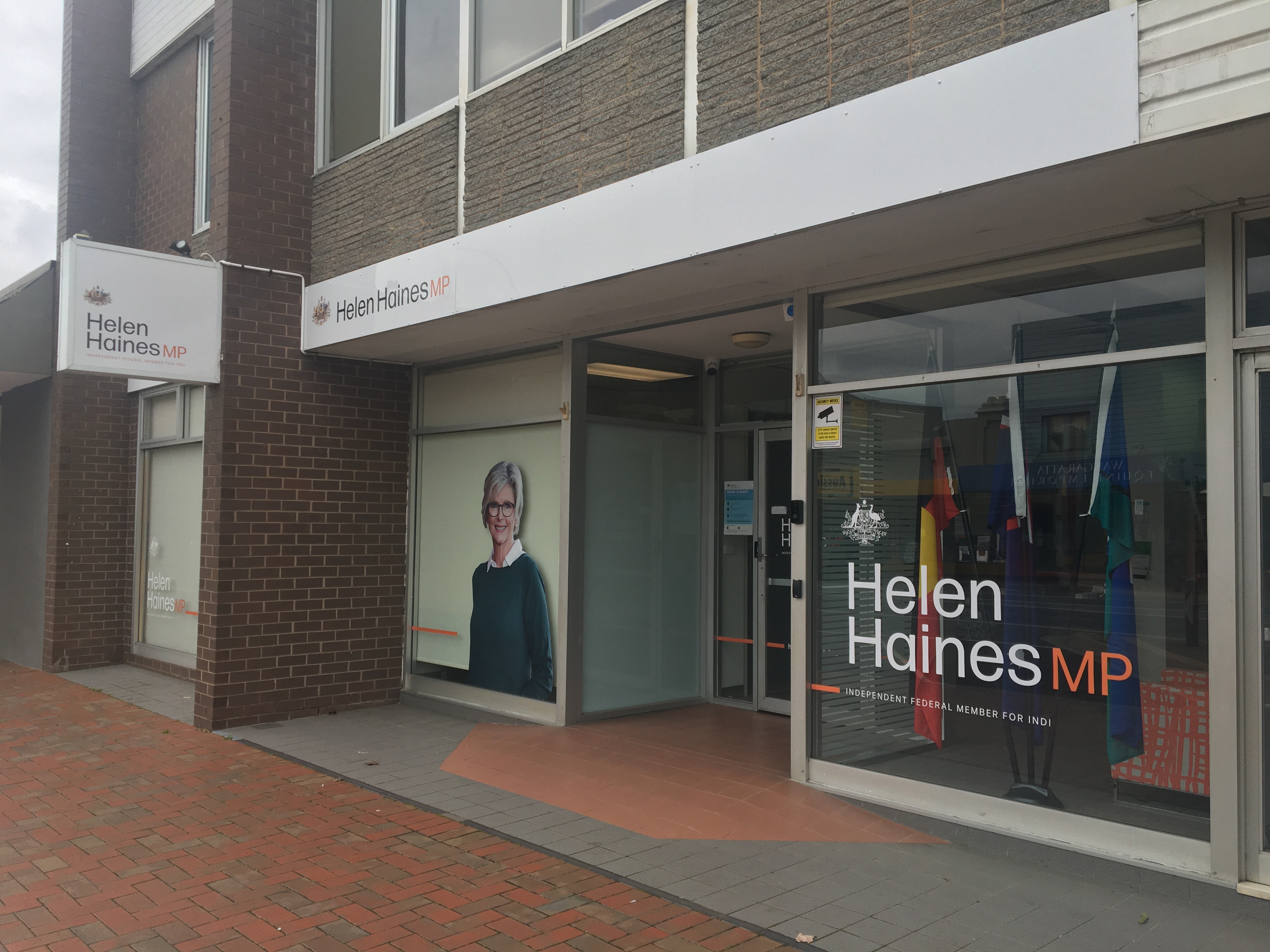
The Alfred hospital in Melbourne said on Saturday morning, October 24, 2026, that Helen Haines was in a "serious but stable" condition — the first improvement since the independent Australian MP was airlifted to the major trauma centre five days ago. The upgrade, from critical, is the first encouraging medical news in a case that has held Australia's attention all week.
Haines, 65, the independent federal member for Indi, was struck by a car on Monday afternoon outside her electorate office on Murphy Street in Wangaratta, in north-east Victoria, more than 200 kilometres north-east of Melbourne. Australian media reports put the time at about 3:35pm. She had been at the rear of her parked car when a white Toyota LandCruiser allegedly drove past, made a sharp U-turn, and rammed her into her own vehicle before reversing and striking her again.
According to CNA, a local barber, Ricky Jefferies, pulled the driver from the car and held him until police arrived. Haines was airlifted to Melbourne for emergency surgery. Her left leg was amputated on Monday; surgeons worked for days to save her right leg before amputating it too on Wednesday, her husband Phil Haines told reporters. For a full account of Monday's attack, see our earlier reporting on the incident.
The man charged is Brendan Nugent, 43, of Tarrawingee, a rural town inside Haines's own electorate. He was arrested at the scene on Monday. On Wednesday, October 21, he appeared at the Wangaratta Magistrates' Court facing three charges: dangerous driving causing serious injury, intentionally causing serious injury, and causing harm to a Commonwealth public official — a federal offence that carries a maximum penalty of ten years in prison. Court documents also list further charges of cultivating and possessing cannabis.
Nugent did not apply for bail and was remanded in custody; a further hearing is set for February. His lawyer told the court his client had "mental health concerns" but gave no further detail. Police say more charges may be laid, including attempted murder.
Victoria Police, with support from the Australian Federal Police, says its investigation remains ongoing and that a motive has not been established. Investigators are examining whether drug use or medication played a part in the incident. Police have described the attack as targeted, and Australian media report investigators consider it an isolated incident. The prime minister's response and the political fallout were covered in our earlier report.
About the victim: Haines entered federal parliament in 2019 as the independent member for Indi after a career as a nurse and midwife, and was re-elected in 2022 and 2025, according to Australian media. She is widely praised for her advocacy of climate action, regional housing and political transparency. She is married to Phil Haines; the couple have been together for nearly forty years and have three children and two grandchildren.
The central unanswered question is motive. Five days on, police have established no reason why Nugent allegedly drove at the MP, and the BBC reports investigators are still working through whether drug use or medication played a role. Whether the Crown will add charges — attempted murder has been raised as a possibility — will depend on where that investigation leads.
One line of inquiry attracting Australian media attention is the personal connection: Nugent's family has said they were long-time friends with Haines, and tabloid reports, citing The Australian, say his parents were friends with her for decades and described the alleged attack as "devastating and unfathomable", with investigators reportedly examining whether a family rift played any role. That remains unconfirmed speculation, not a finding, and no court has made any determination of guilt.
Also unresolved: whether the February court date will produce new facts about the moments before the alleged U-turn; how the MP-security debate now under way in Canberra resolves; and what Haines's own recovery timeline looks like beyond the family's account that she faces a long, difficult road.
Political violence is rare in Australia — and that rarity is precisely why this case matters. The Times reports that threatening and harassing behaviour directed at federal MPs has quadrupled since 2020. Australia's home affairs minister, Tony Burke, said police recorded more than 1,000 threats against politicians in the 2025-26 financial year, and reports indicate threats against parliamentarians have doubled over three years. Mike Burgess, the director-general of the Australian Security Intelligence Organisation, warned last year that the risk of politically motivated violence was "already flashing red" and was expected to remain elevated until 2030.
Unlike Britain, where Brexit intensified hostility towards politicians, Australia has no single defining political controversy driving the increase. The Times notes that analysts instead point to declining trust in government, conspiracy theories, and the spread of misinformation and extremist rhetoric through social media. Prime Minister Anthony Albanese, who said there had been a "rise in temperature" and "too much shouting, not enough discourse" in the country, called the attack a "test of our character". That framing — a deliberate attack on a regional independent MP with no party machine behind her — is what has turned a criminal case into a national reckoning.
There is a tension at the heart of the official account: police call the attack "targeted", yet no motive has been established. Three readings are circulating, and they are not mutually exclusive.
The first is the personal-crisis reading. Nugent's family were long-time friends of Haines; his lawyer raised "mental health concerns"; investigators are looking at drug use or medication. On this reading, the target was a person the accused knew, and the office doorstep was incidental.
The second is the political reading. A sitting federal MP was allegedly run down outside her own electorate office — the most public symbol of her mandate. Albanese's "rise in temperature" language, and the statistics on threats against MPs, place the case inside a pattern of escalating hostility towards elected officials. Al Jazeera's explainer on the case frames it exactly this way: as one more data point in the global surge of threats against legislators.
The third is the structural reading, and it is the one the numbers support most firmly. Whatever drove one man on Murphy Street, the environment in which he acted is documented: threats quadrupled since 2020, more than a thousand recorded in a single financial year, the intelligence chief warning of a risk "already flashing red". The verified facts do not yet settle which reading explains this attack. What they establish is that Australia's political class now operates inside a threat picture it had, until recently, considered a foreign problem.
The aftershocks are already visible beyond Victoria. Two days after the attack, Western Australia police charged a 56-year-old man who allegedly entered the Perth electorate office of the state's local government minister, Hannah Beazley, carrying nunchucks and making verbal threats to staff. No connection to the Haines case has been established, but the two incidents have intensified the national conversation about the safety of elected officials.
In Wangaratta itself, the response has been communal. Floral tributes have piled up outside Haines's office; a community vigil was held in Wodonga on Wednesday evening, where her predecessor as the member for Indi, Cathy McGowan, said the community was dealing with mixed emotions. More than 730,000 Australian dollars have been raised for Save the Children in Haines's honour after her husband directed well-wishers to the appeal.
At the institutional level, Governor-General Sam Mostyn said she was keeping King Charles III updated on developments — a measure of how far the case has travelled. A statement shared on Haines's social media accounts said her staff were working towards reopening her electorate offices on Thursday, October 29, while acknowledging that Monday's events had deeply affected the family and staff. For the earlier chapter of this story, see our report on the double amputation.
Medically, the family expects a long and difficult recovery. Phil Haines told reporters this week that while the injuries were "horrendous", his wife's "heart and her mind" were "in good shape" — and Saturday's upgrade to serious but stable is the first clinical confirmation that the trajectory is moving in the right direction.
Legally, Nugent remains in custody ahead of a further hearing in February. Police have signalled that more charges could follow, including attempted murder, and the motive investigation continues with federal police support. The February date is the next window in which new facts may enter the public record.
Politically, the debate Albanese opened — about the temperature of public discourse and the physical security of MPs — will not close with this cycle. Whether it produces concrete changes to electorate-office security, or remains a week of sombre rhetoric, is the question Canberra now has to answer.
The Western lens: procedure, protection, and the tone debate Western coverage — the BBC, CNN, The Times — is procedural and institutional. The BBC anchors on the hospital bulletin and the court process; CNN follows the human narrative through the husband's press conferences and the Governor-General's updates to the King; The Times widens to the threat statistics and the Beazley follow-on incident. The shared Western frame is accountability: what the police do next, what the courts decide, and whether the prime minister's "test of our character" language turns into security policy.
The Eastern lens: the facts, carried straight Eastern coverage — Singapore's CNA and India's WION — carries the same verified facts with a straighter newsroom tone and a human lead. CNA, working from AFP material and Australian outlets, is meticulous on the court procedural: the three charges, the cannabis filings, the February date, the remand. WION leads with the husband's account — "her heart and her mind are in good shape" — the family story before the politics.
The Southern lens: a pattern, not an incident Southern coverage reads the attack as one more data point in a global pattern. Al Jazeera's explainer — "how threats against legislators have soared" — places Haines inside the worldwide surge of political violence rather than treating Australia as a special case. Pakistan's Dawn, carrying the AFP wire, frames it as national "soul-searching" in a country where political violence is rare but where the threat curve is bending the same way as everywhere else.
On Saturday morning, October 24, 2026, The Alfred hospital in Melbourne said Haines was in a "serious but stable" condition — an improvement from critical, and the first encouraging medical news since she was airlifted there five days earlier. Her family has said she faces a long and difficult recovery.
Brendan Nugent, 43, of Tarrawingee in north-east Victoria, was arrested at the scene on Monday, October 19. He faces three charges — dangerous driving causing serious injury, intentionally causing serious injury, and causing harm to a Commonwealth public official — plus cannabis cultivation and possession charges listed in court filings. He was remanded in custody.
No. Victoria Police, supported by the Australian Federal Police, says the investigation remains ongoing and no motive has been established. Investigators are examining whether drug use or medication played a part. Police have described the attack as targeted and say it appeared to be an isolated incident.
Political violence is rare in Australia, but threats against federal MPs have quadrupled since 2020 and police recorded more than 1,000 threats in the 2025-26 financial year. The attack on a sitting MP outside her own office has become a national reckoning over the tone of political discourse and the physical security of elected officials.
