
The Ottoman Empire lasted from about 1299 to 1922, more than six hundred years, and at its height it ruled lands on three continents: southeastern Europe, the Middle East and North Africa. It began as a small Turkish principality on the frontier between the Byzantine Empire and the Muslim world, and it grew into a world power whose armies reached Vienna, whose fleets sailed the Mediterranean, the Red Sea and the Indian Ocean, and whose sultans claimed the title of caliph, leader of the world's Muslims. Its capital, Constantinople, taken in 1453 and renamed Istanbul, was one of the great cities of the world. Its decline took two centuries, and its end, in the wreckage of the First World War, redrew the map of the modern Middle East. The Ottoman story is the story of how an empire is built, how it endures, and how it falls.
The Ottoman Empire in dates
The Ottoman state takes its name from Osman I, a Turkish tribal leader in northwestern Anatolia, whose small principality, or beylik, is conventionally dated to about 1299. Anatolia at the time was a borderland: the Byzantine Empire, heir of Rome, held the west, the Mongols had shattered the Seljuk Turks in the east, and a patchwork of Turkish beyliks fought for land, plunder and prestige. Osman's principality sat on the Byzantine frontier, and that position was an advantage: it gave his warriors, the ghazis, a cause, holy war against the Christians, and a direction of expansion, westward into Byzantine territory. Osman's son Orhan took Bursa in 1326, making it the first Ottoman capital, and Orhan's son Murad I crossed into Europe in the 1350s, taking Adrianople, modern Edirne, and making it the new capital. Within two generations a border tribe had become a Balkan power.
The early Ottomans were pragmatic as well as warlike. They offered conquered Christians and Jews a place in the empire in return for taxes and loyalty, they recruited talented outsiders into their administration, and they built a military system that mixed Turkish cavalry with an infantry of enslaved boys, the Janissaries, taken from Christian families, converted to Islam and trained as the sultan's elite troops. The devshirme, the levy of Christian boys, is one of the most debated institutions in Ottoman history: it tore children from their families, and it also gave those children, as Janissaries or as administrators, a path to the highest offices of the empire. Grand viziers of Christian birth ran the empire for sultans who trusted merit over blood.
By the end of the fourteenth century the Ottomans had defeated the Serbs at Kosovo in 1389, taken most of the Balkans, and reduced the Byzantine Empire to Constantinople and a few scraps of land. Then came disaster: in 1402 the Central Asian conqueror Timur crushed Sultan Bayezid I at the Battle of Ankara, captured him, and threw the empire into an eleven-year interregnum of civil war among Bayezid's sons. The Ottoman state nearly ended there. It survived because its institutions, its provincial governors, its tax system and its army, held together, and because Mehmed I, who won the civil war by 1413, rebuilt the empire with patience. The recovery from Ankara became a founding lesson: the empire could be broken and remade, and its strength lay in its institutions as much as in its armies.
On 29 May 1453, after a fifty-three-day siege, the Ottoman army of Sultan Mehmed II, then twenty-one years old, broke through the walls of Constantinople, the capital of the Byzantine Empire and the greatest city of the Christian East. The Byzantine emperor Constantine XI died fighting on the walls. The city that had stood for eleven centuries, that had resisted Arab, Bulgar and Russian sieges, fell to cannon, and the event echoed across Europe as a catastrophe. Mehmed, who would be called the Conqueror, entered the city, prayed in the Hagia Sophia, and made it his capital. The Byzantine Empire was over, and the Ottoman Empire had a capital worthy of its ambitions.
The conquest mattered for three reasons. First, it gave the Ottomans control of the straits between the Black Sea and the Mediterranean, and with it the trade routes that connected Europe to Asia. Second, it gave Mehmed a claim to universal empire: he styled himself Caesar of the Romans, heir to the Roman emperors, and he kept the Greek Orthodox Patriarch in place, making himself the protector of Orthodox Christians. Third, it gave the empire a centre. Mehmed rebuilt Constantinople, repopulating it with Greeks, Armenians, Jews and Turks, endowing mosques, markets and schools, and turning it into a city of perhaps half a million people, the largest in Europe. The Topkapi Palace, the Grand Bazaar and the great mosques of the city date from this rebuilding.
Mehmed's reign also set the pattern of Ottoman law and administration. He issued a law book, the Kanunname, that regulated taxation, criminal justice and the sultan's own household, including the grim rule that a new sultan might kill his brothers to prevent civil war. He conquered Serbia, Greece, Bosnia and the Black Sea coast, and his armies reached Italy, landing at Otranto in 1480. He died in 1481, planning a campaign against Italy or Egypt. The empire he left was the dominant power of the eastern Mediterranean, and his successors, Bayezid II and Selim I, extended it further: Selim's conquest of Egypt and Syria in 1516 and 1517 made the sultan the guardian of Mecca and Medina, and brought with it the title of caliph, the claim to lead the world's Muslims, a claim that would shape Ottoman politics for four centuries.
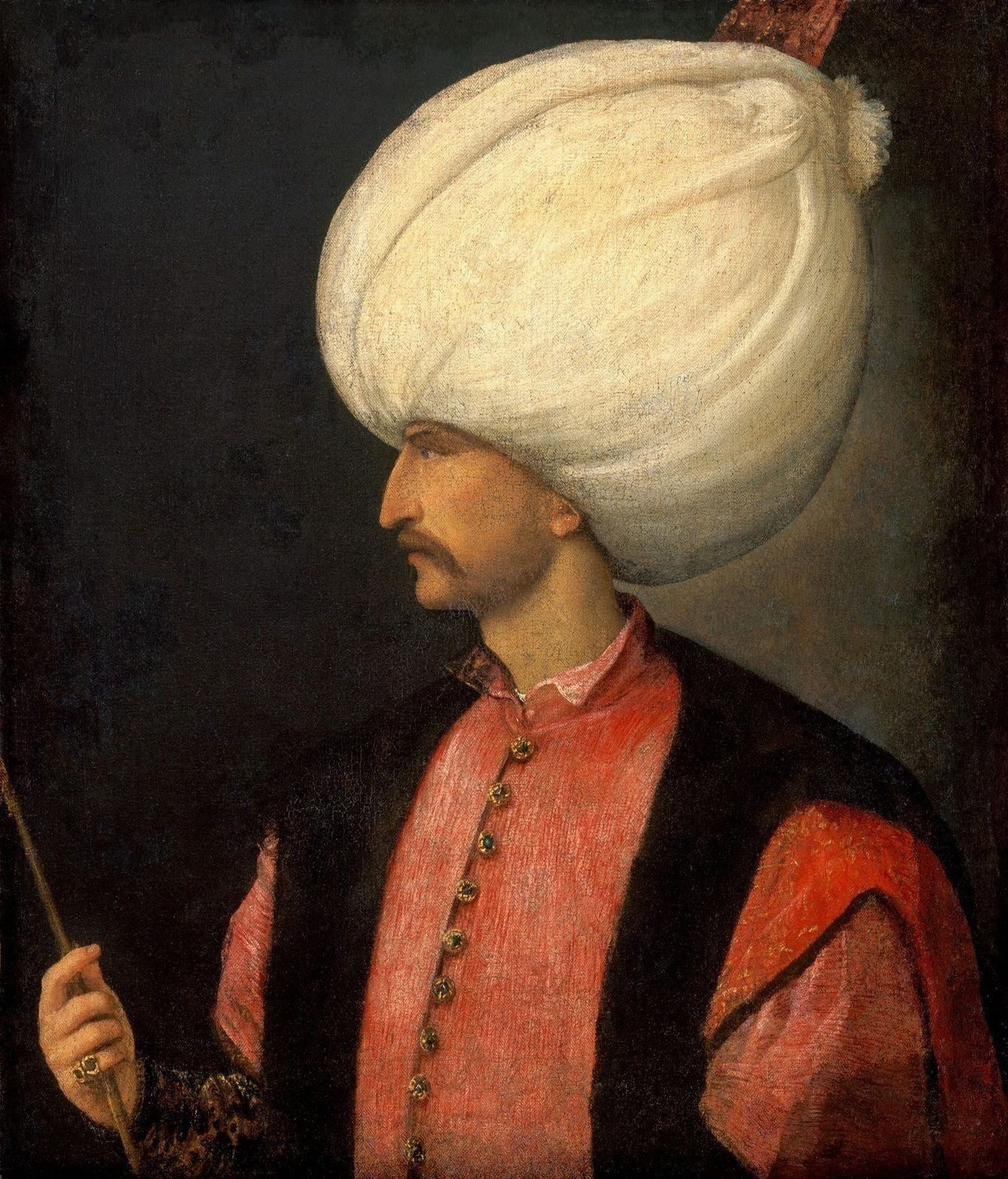
Suleiman I, called the Magnificent in the West and the Lawgiver in the East, reigned from 1520 to 1566, the longest reign in Ottoman history and the one that marks the empire's peak. In his first decade he took Belgrade in 1521, crushed Hungary at Mohacs in 1526, and besieged Vienna in 1529, the first Ottoman attempt on the Habsburg capital. He conquered Baghdad, Tabriz and the coasts of North Africa, and his admirals, above all Hayreddin Barbarossa, swept the Mediterranean, raiding as far as Spain and Italy. By the 1540s the Ottoman Empire stretched from Hungary to Yemen and from Algeria to Persia, and its fleet dominated the Mediterranean. No European power could face it alone.
Suleiman's golden age was not only military. His court at Constantinople was a centre of art, architecture and law. The architect Sinan built the Suleymaniye Mosque, the empire's greatest, and hundreds of mosques, bridges and schools across the empire. The calligraphers, potters of Iznik, carpet weavers and manuscript illuminators of his reign set standards that are still admired. Suleiman reformed taxation, land tenure and criminal law, earning his Turkish title, Kanuni, the Lawgiver, and his administration ran from Budapest to Basra through a bureaucracy that European visitors described with a mixture of admiration and fear. His wife, Hurrem Sultan, a former slave from Ruthenia who rose to become his legal wife and political partner, built mosques and hospitals and corresponded with queens, breaking the conventions of the harem and becoming one of the most powerful women of the century.
The golden age had a price. The siege of Vienna in 1529 failed, and the Ottoman advance into central Europe stalled. The war with Safavid Persia, fought over the frontier and over the Sunni-Shia divide, drained resources for decades. The death of Suleiman's talented son and heir Mustafa, strangled in 1553 after court intrigues in which Hurrem's faction played a part, left the succession to the weaker Selim II, and the empire's later historians would see in that murder the beginning of decline. Suleiman died in 1566, of natural causes, while besieging the fortress of Szigetvar in Hungary. His reign remains the standard by which Ottoman greatness is measured, and his mosque still dominates the skyline of Istanbul.
The century after Suleiman is often told as a story of decline, and in territorial terms it is true that the empire stopped growing. The naval defeat at Lepanto in 1571, when a coalition of Spanish, Venetian and papal fleets destroyed the Ottoman navy off Greece, ended Ottoman naval dominance in the western Mediterranean, though the empire rebuilt its fleet within a year. The long wars with Austria, Persia and Russia ground on, and in 1683 the second Ottoman siege of Vienna failed, this time decisively: a coalition of Austrian, German and Polish forces under Jan Sobieski broke the siege, and the war that followed cost the Ottomans Hungary, Transylvania and much of the Balkans in the Treaty of Karlowitz of 1699. For the first time the empire signed a peace that gave up large territories, and the age of expansion was over.
The causes of decline have been debated for centuries. Older histories blamed corrupt sultans, harem intrigues and the decay of the Janissaries, who had become a hereditary caste more interested in trade than in fighting. Newer histories point to deeper forces: the discovery of the sea route to India reduced the value of the overland trade the Ottomans taxed, American silver inflated prices, the empire's population grew faster than its revenues, and the European powers, with their new military technology, their joint-stock companies and their industrializing economies, pulled ahead. The Ottoman state adapted slowly: it reformed its tax farming, it hired European advisers, it built new armies, but it never matched the pace of its rivals, and each war ended with more territory lost.
Decline was not collapse. The empire remained a great power through the eighteenth century, its cities flourished, its trade networks stretched from India to the Balkans, and its culture, its coffee houses, its poetry, its calligraphy, its music, remained vibrant. The Ottoman state also showed a remarkable capacity for reform from within: the Tulip Era of the 1720s brought printing, fire brigades and diplomatic missions to Europe, and the reign of Selim III in the 1790s began the Nizam-i Cedid, the New Order, an attempt to build a European-style army. The French Revolution and Napoleon changed the terms of the problem. When Napoleon invaded Egypt in 1798, the Ottomans faced a new kind of enemy: a European power with a national army, a revolutionary ideology and a fleet, and the old ways of meeting it no longer worked.
The nineteenth century was the empire's long crisis, and its rulers responded with the most ambitious reforms in Ottoman history. The Tanzimat, the Reorganization, proclaimed in the Gulhane Edict of 1839 and pursued until 1876, promised equality before the law for all subjects regardless of religion, modern courts, a conscript army, secular schools, a census, a modern bureaucracy and a modern budget. The reforms were real: the empire built railways, telegraphs, a modern army and a modern university, and it produced a generation of reformist statesmen, above all Midhat Pasha, who pushed for a constitution. In 1876 the empire proclaimed a constitution and a parliament, the first in the Muslim world, though Sultan Abdul Hamid II suspended it within two years and ruled as an autocrat for thirty more.
Reform could not stop nationalism. The Greeks won independence in 1830, after a war that drew in Britain, France and Russia. Serbia, Romania, Bulgaria and Montenegro followed, each war peeling away European territory. The Armenian population of eastern Anatolia, caught between Ottoman rule, Russian pressure and nationalist agitation, suffered massacres in the 1890s under Abdul Hamid and, catastrophically, deportations and mass killings in 1915 under the Young Turk government during the First World War, events that scholars and many governments describe as genocide, a term the Turkish state rejects. The Arab provinces, Egypt under Muhammad Ali, and the North African provinces slipped from Istanbul's control, Egypt under British occupation from 1882 and Algeria under French rule from 1830. By 1900 the empire was called the Sick Man of Europe, and the European powers debated how to divide it.
The Young Turk Revolution of 1908, led by the Committee of Union and Progress, restored the constitution, deposed Abdul Hamid in 1909, and promised a modern, multi-ethnic, constitutional empire. The promise failed. The Balkan Wars of 1912 and 1913 stripped the empire of almost all its remaining European territory, and the Unionists, increasingly dominated by Turkish nationalists, turned to repression. The empire that entered the First World War in 1914 was a shadow of Suleiman's state: it held Anatolia, the Arab provinces, and little else in Europe, and it was in debt to European banks. Its leaders hoped that war, and an alliance with Germany, would restore its fortunes. The war destroyed it instead.
The Ottoman Empire entered the First World War in November 1914 on the side of Germany and Austria-Hungary, after its war minister Enver Pasha, who had seized power with the Unionists, gambled that a German victory would restore the empire's lost territories. The gamble failed on every front. The Ottoman armies fought bravely and well in places: at Gallipoli in 1915, where the British and French landings were repelled with heavy losses on both sides, and in Mesopotamia, where a British army was forced to surrender at Kut in 1916. But the empire was outmatched in men, money and machines, and the Arab Revolt of 1916, encouraged by Britain, broke its hold on the Arab provinces. By 1918 British forces under Allenby had taken Jerusalem, Damascus and Baghdad, and the empire signed the Armistice of Mudros in October 1918. The war had killed perhaps three million Ottoman subjects, soldiers and civilians alike, and the victors moved to partition the empire.
The partition, imposed by the Treaty of Sevres in 1920, would have left the Turkish state a small rump in central Anatolia, with Greece, France, Britain, Italy and Armenia dividing the rest. It was never implemented. Mustafa Kemal, later Ataturk, a general who had distinguished himself at Gallipoli, organized a national resistance from Ankara, fought the Greek army to a standstill, and forced the Allies to renegotiate. The Treaty of Lausanne of 1923 recognized a new, sovereign Turkish state in Anatolia and eastern Thrace, and provided for a vast exchange of populations between Greece and Turkey. The sultanate was abolished in November 1922, the last sultan, Mehmed VI, left Istanbul on a British warship, and the caliphate was abolished in March 1924. On 29 October 1923 the Republic of Turkey was proclaimed, with Ataturk as its first president. The Ottoman Empire, six hundred and twenty-three years old, was over.
The end was not only a political event but a human catastrophe. The wars of 1912 to 1923, the Balkan Wars, the First World War and the Turkish War of Independence, killed millions, displaced millions more, and ended communities that had lived in Anatolia and the Balkans for centuries. The Armenian killings of 1915, the Greek and Turkish population exchange of 1923, and the expulsions and massacres of the war years remain among the most painful subjects in modern history, and they shape the politics of Turkey, Armenia, Greece and the Middle East to this day. The Ottoman story ends, as it began, in violence and in the remaking of a map.
The Ottoman legacy is visible in the map of the modern world. The borders of the Middle East, drawn by Britain and France from Ottoman provinces after the First World War, are still the borders of Iraq, Syria, Lebanon, Jordan, Israel and Palestine, and much of the region's instability traces back to that partition. The Turkish Republic inherited the empire's Anatolian core, its bureaucracy, its army and its capital, and Ataturk's reforms, secularism, the Latin alphabet, the abolition of the caliphate, women's suffrage, were a deliberate break with the Ottoman past. Yet the Ottoman past survived in the language, the cuisine, the music, the architecture and the family memories of the region, from the Balkans to Yemen.
The empire's cultural legacy is equally rich. The mosques of Sinan still dominate Istanbul and Edirne, the tiles of Iznik are among the world's great ceramics, and the Ottoman court produced a literature, a music and a cuisine that blended Turkish, Arab, Persian, Greek, Armenian and Slavic traditions. The millet system, by which religious communities governed their own family law and worship, was an early form of religious pluralism, though it was also a hierarchy, with Muslims on top. The Ottoman archives, millions of documents in Istanbul, are among the world's great historical resources, and historians are still rewriting the empire's story from them, replacing the old tale of unbroken decline with a subtler picture of adaptation, resilience and, in the end, defeat by forces larger than any empire could withstand.
Above all, the Ottoman Empire is a reminder that empires are not permanent, and that the forces that build them, military power, administrative skill, tolerance and trade, are also the forces that must be renewed in every generation. The Ottomans built a state that lasted six centuries, that ruled three continents, and that produced some of the world's great art and architecture. They lost it in a decade of war. Their story is studied today not only by historians but by everyone who wants to understand the Middle East, the Balkans and the relationship between Islam and the West, because the Ottoman Empire was, for six hundred years, the place where those worlds met.
Osman I (about 1258-1326)
Founder of the Ottoman dynasty and of the principality that bears his name, who began the westward expansion into Byzantine territory.
Orhan (about 1281-1362)
Osman's son, who took Bursa in 1326, crossed into Europe, and built the first Ottoman administration.
Mehmed II, the Conqueror (1432-1481)
Sultan who took Constantinople in 1453 at twenty-one, made it his capital, and claimed the inheritance of Rome.
Selim I, the Grim (1470-1520)
Sultan who conquered Egypt and Syria in 1516-1517, bringing Mecca and Medina under Ottoman rule and claiming the caliphate.
Suleiman the Magnificent (1494-1566)
Sultan of the golden age, who reigned forty-six years, conquered Hungary and Baghdad, reformed the law, and built the Suleymaniye Mosque.
Hurrem Sultan (about 1502-1558)
Suleiman's wife, born a slave, who rose to become his legal wife, political partner and builder of mosques and hospitals.
Sinan (about 1490-1588)
The empire's greatest architect, who designed the Suleymaniye and Selimiye mosques and hundreds of buildings across the empire.
Hayreddin Barbarossa (about 1478-1546)
Ottoman admiral who swept the Mediterranean, made North Africa an Ottoman province, and terrified the coasts of Spain and Italy.
Abdul Hamid II (1842-1918)
Sultan who suspended the constitution in 1878 and ruled as an autocrat for thirty years, modernizing the empire while resisting reform.
Enver Pasha (1881-1922)
Young Turk leader and war minister who brought the empire into the First World War on Germany's side and fled after its defeat.
Mustafa Kemal Ataturk (1881-1938)
General of Gallipoli, leader of the national resistance, founder and first president of the Republic of Turkey.
Midhat Pasha (1822-1884)
Reformist statesman and architect of the 1876 constitution, later exiled and murdered under Abdul Hamid.
- 1299 – Conventional founding date of Osman's principality in northwestern Anatolia.
- 1326 – Orhan takes Bursa, the first Ottoman capital.
- 1389 – Ottoman victory over the Serbs at Kosovo; the Balkans fall under Ottoman rule.
- 1402 – Timur crushes Sultan Bayezid I at Ankara; an eleven-year interregnum follows.
- 1413 – Mehmed I wins the civil war and rebuilds the empire.
- 1453 – Mehmed II takes Constantinople on 29 May after a fifty-three-day siege.
- 1517 – Selim I conquers Egypt and Syria; the sultan becomes guardian of Mecca and Medina.
- 1526 – Suleiman crushes Hungary at Mohacs.
- 1529 – First Ottoman siege of Vienna fails; the advance into central Europe stalls.
- 1571 – The Holy League destroys the Ottoman fleet at Lepanto.
- 1683 – Second siege of Vienna fails; the Treaty of Karlowitz (1699) costs the Ottomans Hungary.
- 1839 – The Gulhane Edict proclaims the Tanzimat reforms: equality before the law and modern administration.
- 1876 – First Ottoman constitution proclaimed; suspended by Abdul Hamid II within two years.
- 1908 – The Young Turk Revolution restores the constitution; Abdul Hamid is deposed in 1909.
- 1914 – The empire enters the First World War on Germany's side.
- 1915 – Gallipoli: the Allied landings are repelled. Armenian deportations and mass killings begin.
- 1918 – Armistice of Mudros ends Ottoman fighting in the First World War.
- 1920 – Treaty of Sevres proposes the partition of the empire; the Turkish national resistance rejects it.
- 1922 – The sultanate is abolished in November; the last sultan leaves Istanbul.
- 1923 – Treaty of Lausanne recognizes the Turkish state; the Republic of Turkey is proclaimed on 29 October.
The Ottoman legacy is written on the map of the modern Middle East. The borders drawn from Ottoman provinces by Britain and France after the First World War are still the borders of Iraq, Syria, Lebanon, Jordan, Israel and Palestine, and much of the region's instability traces to that partition. The Turkish Republic inherited the empire's Anatolian core and its institutions, and Ataturk's reforms were a deliberate break with the Ottoman past.
The empire's cultural legacy endures in the mosques of Sinan, the tiles of Iznik, the cuisine and music of the region, and the archives of Istanbul, one of the world's great historical resources. The Ottoman story, six centuries of building, endurance and fall, remains the essential background to understanding the Middle East, the Balkans and the meeting of Islam and the West.
- Caroline Finkel, Osman's Dream: The History of the Ottoman Empire (John Murray, 2005), the standard modern narrative history in English.
- Suraiya Faroqhi, The Ottoman Empire: A Short History (Markus Wiener, 2009), a concise scholarly survey.
- Halil Inalcik, The Ottoman Empire: The Classical Age, 1300-1600 (Weidenfeld, 1973), the classic study of the empire's institutions and economy.
- Donald Quataert, The Ottoman Empire, 1700-1922 (Cambridge University Press, 2000), on the later empire and the reforms.
- Jason Goodwin, Lords of the Horizons: A History of the Ottoman Empire (Henry Holt, 1998), a readable narrative of the empire's rise and fall.
- Stanford J. Shaw and Ezel Kural Shaw, History of the Ottoman Empire and Modern Turkey, two volumes (Cambridge University Press, 1976-1977), the detailed political history.
- Erik Jan Zurcher, Turkey: A Modern History (I. B. Tauris, 1993; revised 2004), on the end of the empire and the Turkish Republic.
- The Topkapi Palace Museum and the Ottoman archives in Istanbul, the primary documentary record of the empire.