Twelve bombers gone in a weekend: Washington emptied its forward English airbase after a foiled terror plot that London says carries strong indications of an Iranian hand.
Published 5 October 2026 · 06:00 GMT
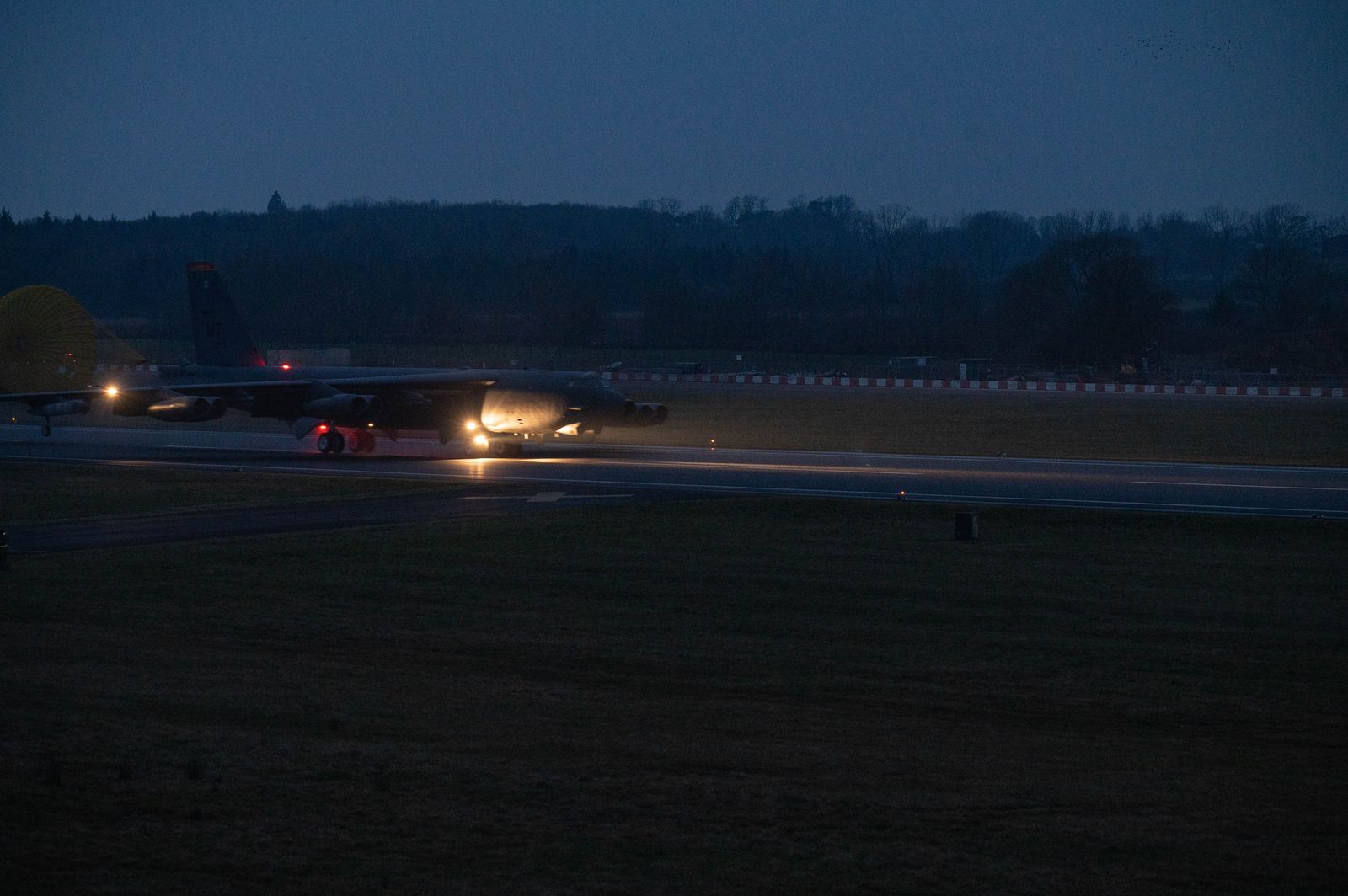
FAIRFORD, England — The bombers left in daylight, one after another. Over the weekend, the United States Air Force scrambled to pull every one of its 12 B-1 Lancers out of RAF Fairford, the Gloucestershire airfield that has served as America’s forward launchpad for strikes on Iran since the war began in February. By Sunday, the flight line was empty. A Pentagon official, speaking on condition of anonymity, confirmed what planespotters had already photographed: “While operational security precluded us from confirming the movement of our assets and forces in real-time, we can acknowledge now that all U.S. bombers that were deployed to RAF Fairford have redeployed to their home stations in the United States.” The urgency was not logistical. It was fear — fear that the base itself had become the target, days after British counterterrorism police foiled what Prime Minister Andy Burnham says carries “strong indications” of an Iranian hand. When Washington moves a dozen strategic bombers across an ocean on a weekend, it is saying something it will not say out loud: that the war with Tehran has arrived on English soil.
The departure was witnessed. Photographs published Sunday show B-1B Lancers lifting off runway 27 at Fairford bound for home, the images credited to Getty photographer David Bown and taken on October 4. Aircraft watchers had tracked the movements through the weekend, and by Sunday evening the Pentagon made it official in an email statement. The Wall Street Journal first reported that the aircraft were being removed amid security concerns over suspected terror plots against the facility. Then came confirmation from the top: The New York Times reported, citing two U.S. officials, that commanders withdrew all 12 B-1s “after commanders received new threats about an Iran-backed plot against the installation.” A senior U.S. official alleged to the Journal that the plotters had been recruited by Iran’s Islamic Revolutionary Guard Corps — an assertion the Pentagon pointedly does not confirm.
When Washington moves a dozen strategic bombers across an ocean on a weekend, it is saying something it will not say out loud: the war with Tehran has arrived on English soil.
It began shortly after midnight on September 27, when residents of the village of Whelford, near Gloucestershire, noticed suspicious vans and masked men wearing balaclavas on a country lane. They called the police. What followed was a major counterterrorism operation: five British men, all in their mid-20s, were arrested at gunpoint near the base on suspicion of explosives offences and preparing an act of terrorism. Eighty-five homes were evacuated and a 440-yard cordon thrown around the scene while military ordnance disposal specialists examined three white vans. The vans contained a quantity of petrol — but no explosives. Within a day, all five men were released on bail, still under investigation. Police stressed that release was not exoneration: the inquiry continued, with seized devices under analysis and investigators weighing whether a foreign power had recruited or directed the men.
Days later, the case grew a sixth name. On October 1, counterterrorism officers arrested a 25-year-old dual British-Iranian national in London on suspicion of preparing terrorist acts under the Terrorism Act. Two properties were searched. On Saturday, October 3, he too was released on bail. Counter Terrorism Policing said simply: “The investigation into the circumstances surrounding events in Gloucestershire is continuing.” No one has been charged. A 26-year-old British national was separately questioned under caution but not arrested. Six men, zero charges, and an investigation that British police insist remains live — the profile of a case built around intent rather than an explosive device.
The political fallout has moved faster than the forensics. On September 30, Prime Minister Andy Burnham said there were “strong indications that Iran played a part” in the incident — a remarkable public attribution while investigators were still officially weighing foreign-state involvement. Two days earlier, from the White House, President Donald Trump had openly criticised Britain’s decision to release the five men on bail: “I’m surprised that they released them,” he said. “I wouldn’t have done that.” The president later told reporters the plotters had planned “big damage,” while Secretary of State Marco Rubio pointed to the “hands of a foreign actor.”
Tehran’s response has been flat denial wrapped in diplomatic muscle. Iranian officials called the accusations “fabricated speculations” and baseless — and summoned the British ambassador in Tehran over the affair. Iran has previously declared that any base used to strike its territory would be considered a legitimate target, and Fairford, as the launchpad for strikes on Iranian missile sites, sits squarely in that category. For London, the calibration is excruciating: accuse and risk rupture, stay quiet and look weak. Burnham chose accusation. Trump chose volume. And the bombers, the actual prize in this contest, are gone.
The strategic logic of the withdrawal is written into the base’s recent history. Fairford has been used extensively by the U.S. Air Force to strike Iran since the start of the war in February, and Britain had allowed the Americans to use bombers based there to hit Iranian missile sites threatening ships in the Strait of Hormuz — permission granted under former prime minister Keir Starmer. The base’s value is arithmetic: the shorter flight distance from England to Iran reduces transit time and refueling cost relative to missions flown from the continental United States. The Pentagon stresses strike capability is undiminished — but the trade is convenience and tempo for safety. Every sortie that once left Gloucestershire will now need longer legs, more tankers, and more planning.
There is also a message inside the message. The withdrawal is a vote of no confidence — not in British counterterrorism, which Washington publicly praised, but in the idea that a high-value asset can sit safely beside an unresolved threat. The Telegraph reported that Iran was considered the most likely source of the plot, and American officials believe investigators are examining whether an Iran-linked element of the Revolutionary Guard recruited British nationals to carry it out. If that theory holds, the September 27 operation was not a lone-wolf improvisation but a state-directed attempt to decapitate America’s European bomber force on the ground. That is the kind of attack that does not end a war. It widens one.
Geopolitics. This is the first time since the war began that Iranian retaliation has been plausibly aimed at American hardware on European soil — and Britain, the ally that lent the runway, is now caught between its American partner and its diplomatic channel to Tehran. Burnham’s “strong indications” attribution puts London on record in a way that will be hard to walk back. If the evidence hardens, Britain faces a choice it has avoided all year: sanction Tehran further, expel diplomats, or accept that its soil is now part of the battlespace.
Macroeconomics. The withdrawal is a cost shock disguised as a security decision. Every strike mission that must now originate in the United States instead of Gloucestershire burns more fuel, more tanker hours, more crew time — and every hour of delay is an hour in which Iranian missile crews reposition. The Strait of Hormuz, the chokepoint through which the world’s tankers pass, is the reason Fairford’s bombers were there in the first place: Iranian missile sites targeting ships. Longer warning times for Tehran mean a longer war, and a longer war means the oil price keeps its risk premium
Demographics. Look at who the suspects are: five British men in their mid-20s, a 25-year-old dual national, a 26-year-old questioned under caution. If the Revolutionary Guard did recruit them, the pattern matches a documented Iranian playbook — young diaspora nationals, recruited at arm’s length, deniable to the last. The security services’ problem is arithmetic: there are hundreds of thousands of dual nationals in Britain, and a counterterrorism posture built for this threat starts to look like suspicion of a community.
Historical patterns. History has a file on this tactic. Iran’s response to American forward-basing has always been to make the bases themselves the argument: proxies and pressure against the hosts until the hosts recalculate. What is new is the geography. Previous Iranian operations against Western targets have clustered in the Middle East, South Asia and Latin America. A plot — even an unexecuted one — against a strategic bomber base in the English countryside is an escalation in range, and it mirrors the logic of the war itself: if American bombers can reach Iran from England, Iranian planners can reach England from the diaspora.
Structural and technological. The deeper signal is structural: the age of the sanctuary is over. Forward bases once traded proximity for vulnerability and won the trade; now the vulnerability is asymmetric and cheap — vans, petrol, masked men on a country lane — while the proximity is priced in tankers and hours. The Pentagon’s answer, for now, is distance: pull the bombers home and fly longer. But distance has its own tax, and the structural question the withdrawal raises is whether any forward base hosting American strike assets is still defensible against a state willing to recruit in the host country’s own cities. Fairford was the test case. It failed the test.
The investigation is the hinge on which everything turns. British counterterrorism police continue to analyse seized electronic devices and to pursue the question of foreign-state direction — the difference between five men with vans and petrol, and a Revolutionary Guard operation. Charges, if they come, will land in a political environment already superheated: a prime minister on record blaming Iran, an American president who says he would never have released the suspects, and a Tehran that has summoned London’s ambassador and called the whole affair fabrication.
The bombers, for their part, are home — and home is further from the fight. Washington insists long-range strike capability is undiminished, but undiminished is not the same as undelayed. If the threat picture over Gloucestershire clears, the B-1s could rotate back; if it does not, Fairford’s role as the European tip of the spear against Iran may be over for the duration of the war. The war did not come to Britain by accident. It was invited — by the runway, by the mission, and by the logic of retaliation. The vans on the country lane were only the messenger.
The Western press reads the withdrawal as the moment the Iran war came home to Europe: a forward bomber base in the English countryside, emptied on a weekend because the perimeter could no longer be trusted. Coverage centres on the intelligence question — did the Revolutionary Guard recruit British nationals? — and on the unusual public friction between allies, with Trump openly criticising British bail decisions.
Editorial lines split between resolve and unease: hawks see a prudent force-protection move that denies Tehran a cheap propaganda victory; sceptics ask what it says about Western security that vans and petrol in Gloucestershire can dislodge a strategic bomber force. Burnham’s “strong indications” attribution is treated as a gamble — statesmanlike if the evidence lands, reckless if it does not.
From Moscow and Tehran’s vantage, the withdrawal is proof of concept: American power projection has a soft underbelly, and it sits in the suburbs and villages of its allies. Iranian commentary frames the empty flight line as the direct consequence of Tehran’s declared doctrine — bases that strike Iran are legitimate targets — while flatly denying the specific plot as a Western fabrication.
Russian-linked analysis reads the episode as alliance friction made visible: an American president publicly second-guessing British justice, a British prime minister pinning blame on Iran before the forensics are done. The strategic takeaway in the East is patience — the longer the war stretches supply lines, the more the tempo-tax compounds, and every mile the bombers fly from home is a mile of warning for the other side.
Across the Global South, the Fairford episode reads as a parable of entanglement: a European village becomes a front line because an ally lent a runway, and the bill for someone else’s war arrives in the form of masked men on a country lane. The sympathy is real but detached — this is a NATO-adjacent drama, not a Southern one.
The economic reading dominates: if longer bomber transits mean a longer war over the Strait of Hormuz, the oil risk premium stays, and fuel-importing nations from Manila to Dakar keep paying the tax. For the South, the question is not who recruited whom in Gloucestershire, but how many more weekends of escalation the world’s energy prices can absorb.
Commanders withdrew all 12 B-1s over the October 3–4 weekend after receiving what The New York Times described as new threats of an Iran-backed plot against the base — days after British police foiled a suspected terror plot near the airfield on September 27. The Pentagon framed it as a force-protection move; the bombers returned to their home stations in the United States.
Five British men in their mid-20s were arrested at gunpoint near the base in the early hours of September 27 after residents reported suspicious white vans and masked men; police found petrol but no explosives, evacuated 85 homes and set a 440-yard cordon. A sixth suspect, a 25-year-old dual British-Iranian national, was arrested in London on October 1. All six were released on bail; no one has been charged and the investigation continues.
On September 30, Prime Minister Andy Burnham said there were “strong indications that Iran played a part” in the plot. On September 28, President Trump criticised the bail releases from the White House: “I’m surprised that they released them. I wouldn’t have done that.” Trump later said the plotters had planned “big damage,” and Secretary of State Marco Rubio pointed to the “hands of a foreign actor.”
Iranian officials have flatly denied involvement, calling the accusations “fabricated speculations” and baseless, and summoned the British ambassador in Tehran. Iran has previously said any base used to strike its territory would be considered a legitimate target in any future confrontation.
The Gloucestershire base has been used extensively by the U.S. Air Force to strike Iranian missile sites threatening ships in the Strait of Hormuz since the war began in February — with British permission granted under former prime minister Keir Starmer. Its shorter flight distance to Iran cuts transit time and refueling cost versus missions from the continental United States.
The Pentagon says no — the U.S. retains the ability to conduct long-range strikes from American territory. But every mission must now fly further, with more tanker support and longer planning cycles, giving Iranian targets more warning time. The bombers could rotate back if the threat picture clears.
