Thai defences steer floodwater away from Bangkok into riverside villages, where families on stilts flood for a sixth straight year. The capital stays dry. The villages pay.
Published 14 October 2026 · 06:00 GMT
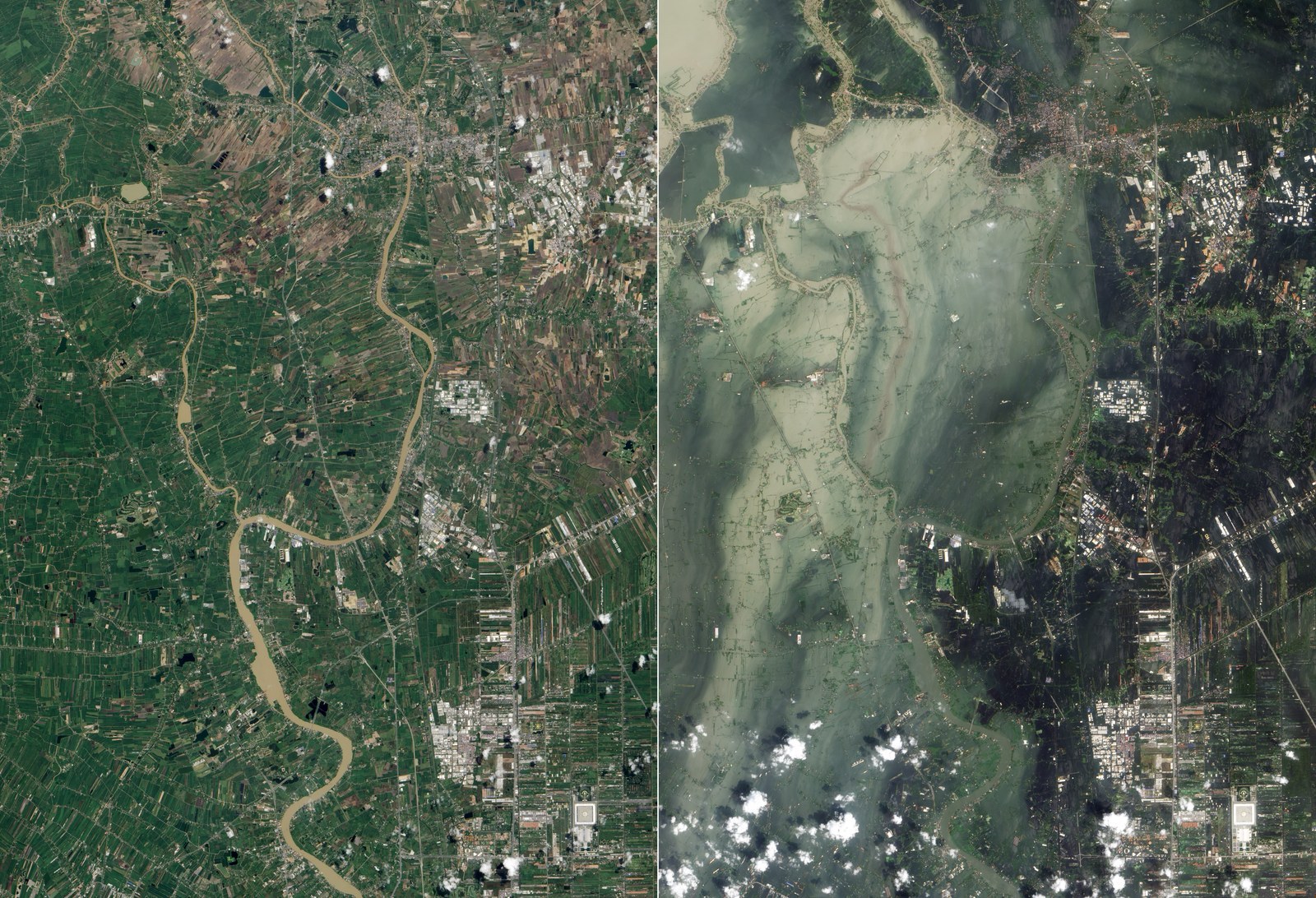
The water inside Kamonchanok Sathaphonamonwut’s stilt house in Ayutthaya has risen past the floor, past the furniture, and into the rooms where her family sleeps on platforms above it. Her village floods by design, so that Bangkok does not: water steered away from the capital, toward her.
The water inside Kamonchanok Sathaphonamonwut’s house in Ayutthaya province has nowhere left to go, and neither does she. Her home stands more than three metres above the ground on stilts, high enough, in most years, to stay dry. This year the flood rose past the stilts, past the floor, and into the rooms where her family of three now sleeps on makeshift platforms above the water, unable to use a waterlogged toilet. Her village has flooded six years in a row. Some neighbours have moved away. Others have raised their houses higher, and are running out of height.
“Our area simply cannot cope with this much water anymore,” the 34-year-old office worker told Agence France-Presse, wading through her soaked home. She commutes by boat now, and hoists the household appliances above the waterline each time the river rises. “All we can do is deal with the consequences,” she said. “There’s only so much we can do to adapt.” Her village is not flooded by accident. It is flooded, in part, by design: the water that swamps her home is water that was steered away from somewhere else.
Our area simply cannot cope with this much water anymore.
Thailand floods every year during the monsoon, and this year has been severe. Since September 16, flooding has touched 51 provinces, according to the Department of Disaster Prevention and Mitigation. By October 12, water still covered 20 provinces and parts of Bangkok, with 908,595 households and 2,458,895 people affected, and 71 people dead. Earlier in October the active totals were higher still, above 1.14 million households and 3.18 million people, before waters receded in several regions. The numbers move with the rivers, and the rivers are still moving.
The answer is a choice made years ago and renewed every rainy season: protect the capital first. After the catastrophic floods of 2011, the government expanded embankments, water gates, and other infrastructure to direct water away from Bangkok, the historic city of Ayutthaya, and the industrial zones along the Chao Phraya River, which flows through the capital to the Gulf of Thailand. The defences have largely kept commercial centres safe. Residents of the areas that receive the diverted water say they have been left to fend for themselves.
The machinery of that choice is visible across the central plain. Embankments hold the river back from the city, gates shunt water into canals and fields, and dam operators upstream adjust releases to manage the flow. The Royal Irrigation Department has been trimming discharges as upstream flows eased: the Chao Phraya Dam cut its release from 2,300 cubic metres per second to 2,100, the Pasak Chonlasit Dam from 500 to 450, and the Phra Ram VI Dam from 735 to 713. Each adjustment is a judgement about who gets wet, and how much.
Around 20 kilometres from Ayutthaya’s centuries-old temple ruins, a UNESCO World Heritage site, residents say floods that once reached their knees now rise above their heads in some areas and can take several months to recede. The stilt houses that defined the region’s architecture, raised to live with the river, are no longer high enough. The system was built to spare the places where the economy concentrates. The places where the water goes instead are the ones that pay.
The 2011 floods remain the benchmark, and the warning. Triggered by tropical storms and months of heavy rain, they killed more than 800 people, with 815 deaths recorded and three people missing, affected 13.6 million people, and saw 65 of Thailand’s then 76 provinces declared flood disaster zones. The World Bank estimated economic damage and losses at 1.425 trillion baht, about 46.5 billion dollars at the time, making it one of the costliest disasters on record. Seven major industrial estates were inundated in water as much as three metres deep, disrupting car production and causing a global shortage of hard disk drives that lasted into the following year.
The political lesson was as sharp as the economic one. Many people blamed the government for mishandling the crisis, above all for failing to release enough water from northern reservoirs early in the rainy season. Afterward, Thailand pledged more than 12 billion dollars in flood mitigation, and built the embankments and gates that now shape each monsoon. The engineering worked, in the sense that commercial centres have largely stayed dry. The bargain underneath it, that some communities would absorb the water so others would not, was never fully settled with the communities themselves.
That bargain is now the argument. Villagers in the path of the diverted water describe a yearly ritual of loss: crops drowned, appliances ruined, floors and walls soaked, months of cleanup. Officials describe a duty to protect the capital, where millions live and where the country’s government, finance, and logistics concentrate. Both accounts are true, and neither cancels the other. A flood plan that saves a city of millions by flooding villages of thousands is a plan that needs to be defended in the open, with the people who live with it.
Compensation has arrived, but it is modest against the losses. Under the government’s 2026 relief scheme, households receive 5,000 to 9,000 baht depending on the damage and the length of flooding, while families of those killed receive 2 million baht. By October 12, the Bangkok Metropolitan Administration had approved more than 649.4 million baht for 88,198 households, including 9,000 baht for 52,107 households and 5,000 baht for 36,091. The Department of Disaster Prevention and Mitigation and the Government Savings Bank had transferred 221.8 million baht to 30,492 families by October 11.
A newer promise may matter more than the one-off payments. On October 1, a government-funded disaster insurance programme took effect, covering an estimated 30 million homes against flooding, windstorms, and earthquakes, with payouts capped at 100,000 baht per household per disaster based on verified damage to the structure. The Cabinet approved 15.5 billion baht for the programme. The catch, for villagers whose furniture, appliances, and stock are under water, is that contents and moveable property are excluded. A house can be insured while everything inside it is not.
Behind the numbers sits a warming climate. Scientists say human-made climate change has made heavy rain and floods more frequent and severe, and Thailand’s monsoon is no exception. Bangkok recorded 487 millimetres of rain from September 1 to 25, against an average of nearly 269 millimetres for the period, and the city’s drainage pipes, some able to handle only about 60 millimetres of rainfall, were overwhelmed. The capital’s governor has said the canals are full. When the rain falls harder than the drains can carry, someone’s street becomes a river, and the choice is only whose.
Bangkok itself is not dry. The Bangkok Metropolitan Administration has issued flood alerts for communities along three canals in the Sai Mai and Khlong Sam Wa districts, advising residents to move belongings to higher places. Flooding has been reported at 74 highway locations in 13 provinces, nine of them still impassable. By October 13, waters were falling or stable in most affected areas, but still rising in Phetchaburi and Phitsanulok. Rescue boats and relief packages are reaching residents who cannot leave their homes, and anyone needing emergency help can call the disaster agency’s hotline on 1784.
What happens next depends on the rain and the rivers. The Meteorological Department has warned of flash floods and landslides through October 13 in parts of 15 provinces, mostly in the south. If the monsoon eases, the slow work of pumping, cleaning, and assessing damage will follow, and the new insurance scheme will face its first real test: whether claims reach households quickly, and whether a cap of 100,000 baht means anything to a family that has flooded six years in a row. The deeper question, the one the embankments cannot answer, is whether Thailand will keep asking the same villages to absorb the water, year after year, or finally pay for a system in which they do not have to. Readers can follow the monsoon’s wider toll in our coverage of the season’s floods and the Thailand country profile, alongside the politics and economy of the kingdom and the stakes at the climate summit.
From a Western vantage, the floods read as a climate-adaptation story with a ledger. Thailand built hard defences after 2011, and they work for the assets they were built to protect: the capital, the factories, the supply chains that feed global markets. The question is whether a wealthy country’s adaptation can keep passing the cost to its poorest riverside communities without a political reckoning.
The same lens watches the insurance scheme as a test of state capacity. A capped, state-funded programme that pays quickly would be a model for other middle-income countries. One that pays slowly, or leaves contents uncovered, will confirm the suspicion that adaptation is still designed for buildings, not for the people inside them.
From an Eastern vantage, the floods are a water-management story with regional echoes. The Chao Phraya basin concentrates a large share of Thailand’s people and output, and every dam release is a decision about the basin as a whole. Neighbours across Southeast Asia watch the same pattern each monsoon: upstream rain, downstream cities, and rural areas caught between the two.
The same lens notes the industrial stakes. The 2011 floods shut factories that supplied the world, and the defences built since were meant to make sure that never happened again. Protecting the industrial belt is, in this reading, not favouritism but survival, and the task is to bring the villages inside the protection rather than to weaken it.
From a Global South vantage, the story is about who adaptation is for. Across the South, flood plans routinely protect capitals, ports, and industrial zones first, because that is where the money and the cameras are. The villages that absorb the water are rarely consulted, and their losses, crops, tools, school years, are rarely counted at full value.
The same lens hears the villagers’ complaint as a demand for standing, not charity. Compensation that arrives late and covers only the structure does not restore a livelihood. A fair system, in this reading, would give riverside communities a seat at the table where the gates are opened and closed, and a share of the protection, not only of the water.
After the 2011 floods, Thailand built embankments, gates, and diversions to steer water away from Bangkok, Ayutthaya city, and industrial zones along the Chao Phraya River. The system keeps commercial centres dry by sending water into canals, fields, and riverside communities. Villagers say they absorb the flood so the capital does not have to.
Since September 16, flooding has touched 51 provinces and killed 71 people, according to disaster officials. By October 12, water still covered 20 provinces and parts of Bangkok, affecting 908,595 households and 2,458,895 people. Earlier in October, the active totals were higher, above 1.14 million households, before waters receded in several regions.
Under the 2026 relief scheme, households receive 5,000 to 9,000 baht depending on damage and flooding duration, while families of those killed receive 2 million baht. A new disaster insurance programme, in force since October 1, caps payouts at 100,000 baht per household per disaster for verified structural damage, but excludes contents and moveable property.
By October 13, waters were falling or stable in most affected areas, but still rising in Phetchaburi and Phitsanulok. The Meteorological Department warned of flash floods and landslides through October 13 in parts of 15 provinces, mostly in the south. Officials continue pumping and monitoring, but a second peak cannot be ruled out while the monsoon continues.
