Washington cut roughly a fifth of the pipeline gas Mexico imports, citing a critical situation. Mexico absorbed the shock without blackouts, but in a full cutoff, reserves would last three days.
Published 8 October 2026 · 06:00 GMT
On Wednesday, October 7, the head of Mexico's national gas control center told the country something no government enjoys admitting: the United States had notified Mexico about a week earlier that it would stop sending roughly one-fifth of the pipeline natural gas Mexico imports. The cut was absorbed without blackouts. But in the same breath, the official said that in a full cutoff, Mexico's gas would last about three days. A week of quiet diplomacy ended with a national reckoning on energy dependence.
On Wednesday morning, October 7, Claudia Sheinbaum's daily press conference took an unusual turn. Instead of the usual political rhythm, the morning belonged to the engineers. Cuitláhuac García Jiménez, director general of the National Center for Natural Gas Control, Cenagas, stepped to the microphone and said the United States had notified Mexico approximately a week earlier, around October 1, that it would stop sending roughly one-fifth of the imported natural gas Mexico receives through its national pipelines. García described the notice as a critical situation and, in the phrase every front page in Mexico would quote, a serious blow. Then he delivered the number that turned a supply adjustment into a national question: in the event of a total cutoff of imports, Mexico could keep the gas flowing for about three days.
That is why we are expanding renewables: to replace gas. (Claudia Sheinbaum)
The facts, as presented by the Mexican government, are precise on volume and vague on motive. The reduction concerns about one-fifth of the natural gas Mexico imports through pipelines, the great majority of it crossing from the United States. The U.S. notification was attributed to a critical situation on the American side; Mexican coverage associated it with maintenance-related restrictions, with one analysis estimating the affected volume at between 950 million and 1.35 billion cubic feet per day. How long the reduction will last was not specified. What matters is what happened next: nothing. The lights stayed on. García said the shortfall was absorbed without problems through coordinated action by Pemex, the Federal Electricity Commission (CFE), the National Energy Control Center (Cenace) and the Energy Ministry, drawing on gas packed into the pipeline network and adjusting the operation of power plants. It was, in other words, a controlled event, not a rupture. Mexican outlets stressed the distinction: this was a reported partial reduction, not an announced suspension, and nothing in the record establishes it as deliberate political pressure on Mexico.
García's admission was stark because the physics behind it are stark. Mexico can hold out for roughly three days only if it draws on the gas sitting inside its pipelines, which is why the country's roughly 21,000 kilometers of gas ducts function as its accidental reserve. The real reserve does not exist: Cenagas's own Institutional Program for 2026-2030 recognizes that the National Integrated Natural Gas Transport and Storage System, Sistrangas, has no operational or strategic storage capacity. Five private liquefied natural gas terminals exist in the country, but they are not integrated into Sistrangas, so they cannot serve as a national backstop. The distinction is the entire story. Having fuel inside the transport network is not the same as having a strategic inventory designed for a prolonged emergency, and Mexico, five and a half years after the Texas freeze that first exposed this fragility, still does not have one. Three days is not a policy. It is a grace period.
The reason a fifth of imports can be called a serious blow is that imports are nearly the whole system. Mexico imports roughly 75 percent of the natural gas it consumes, almost exclusively from the United States. Last April, Sheinbaum put the previous year's figure even higher: four-fifths of the imported gas from Texas alone, the rest from California. Her phrasing at the time was plain: any winter storm in the north or any geopolitical conflict, she said, puts Mexico in a position of extreme vulnerability. Gas is not a marginal fuel in Mexico. It fires a large share of the country's power plants, and a large share of the country's industrial economy runs on electricity those plants produce. A prolonged interruption, officials acknowledged this week, would force extraordinary measures to ration the available fuel and protect priority sectors. The more than 35 percent of the country that is not even connected to the gas network, and the households of which only 8.6 percent use piped gas against 76 percent on bottled gas, are a different problem. But the factories and power stations are one integrated machine, and its fuel arrives from north of the border.
This has happened before, and worse. In February 2021, a deep freeze knocked out power to more than four million people in Texas and halted nearly all oil and natural gas production in the west of the state. U.S. pipeline exports of natural gas to Mexico fell to about 4.3 billion cubic feet per day from a 30-day average of 5.7, and Texas's governor directed gas providers to keep their supply inside the state. Mexico's government called Washington pressing for guarantees, and millions of Mexicans lost power. The lesson was supposed to be storage and diversification. Five and a half years later, the storage still does not exist, and the diversification is a plan. The country remembered the cold, but it did not build the warehouse. That is why García's three days landed with such weight: it is not a new vulnerability. It is an old one, measured again.
The October 7 press conference was not only a damage report. It was the unveiling of the government's answer: a historic investment of 1.16 trillion pesos in electricity and natural gas over the six-year term. The pipeline piece alone is split between the CFE, with 53 billion pesos, and Cenagas, with 87 billion, to expand the gas network. On the generation side, the government says it has inaugurated six combined-cycle plants in its first two years, with four more about to enter operation and five under construction, and that about 9,000 additional megawatts will be assigned before the end of the year across 55 energy-transition projects. The stated direction is away from gas, not toward more of it: renewables are to rise from 24 percent of generation to 38 percent by 2030, with about 15,000 new megawatts of solar, wind and geothermal, repowered hydroelectric plants, and a target for the CFE to reach 60 to 61 percent of national generation, all while capping oil production at 1.8 million barrels a day for environmental and sovereignty reasons. Sheinbaum's line on why was direct: that is why, she said, the country is expanding renewables, to replace gas. Her longer argument, made last April, is the one the government now leans on: sovereignty, because nobody has to ask anyone for sun or wind. The program also reaches households directly: electricity coverage from near 97 percent to 99.9 percent by 2030, rooftop solar for summer peaks, and efficient wood stoves for rural kitchens.
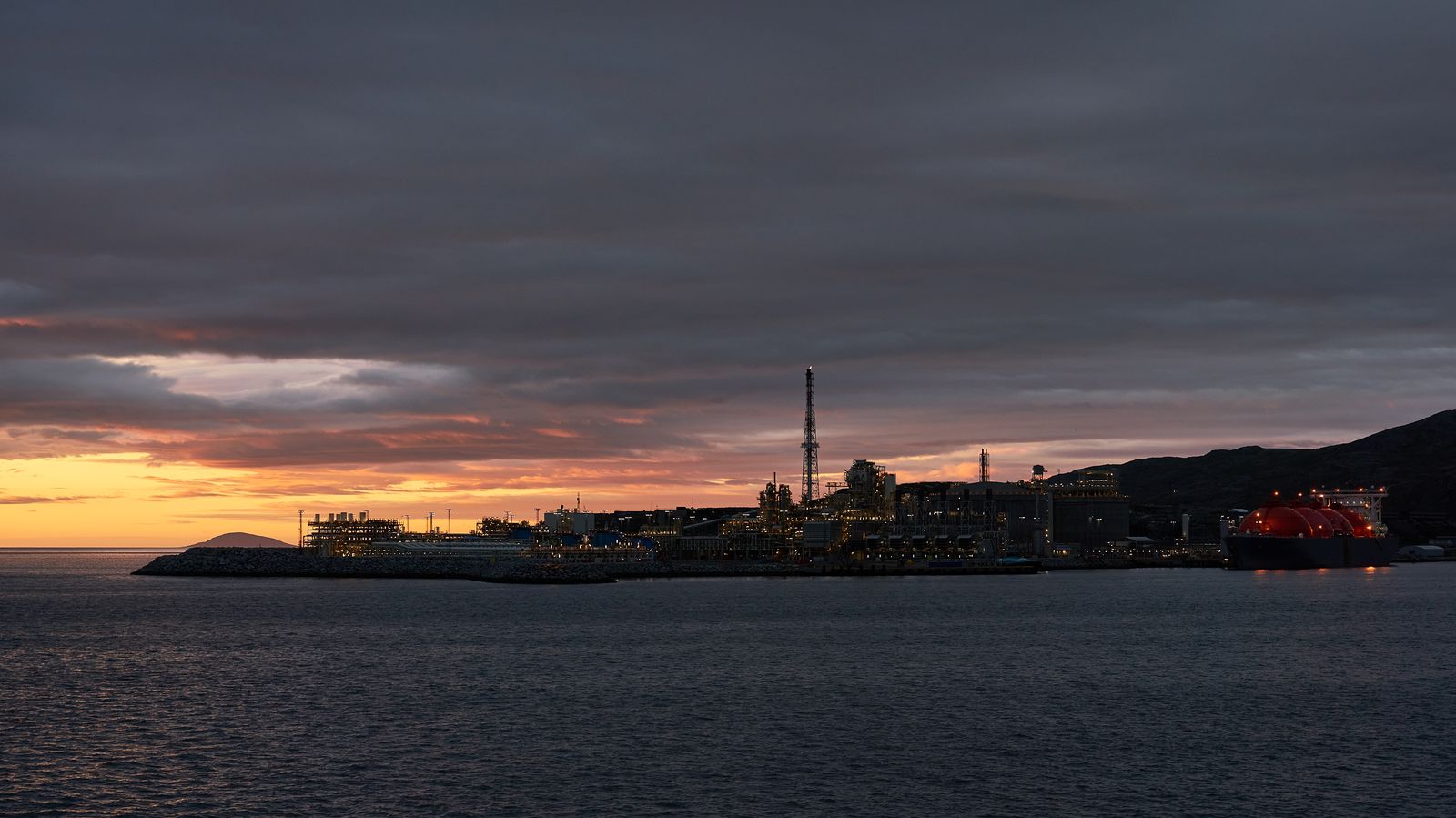
There is an irony the government did not dwell on this week. In July 2026, according to the U.S. Department of Energy, Energía Costa Azul LNG Phase 1, Mexico's second liquefied natural gas export terminal, shipped its first-ever cargo of U.S.-sourced gas, bound for South Korea. Mexico, which imports three-quarters of the gas it burns, has become a re-export bridge carrying American gas to Asia. Critics argue that this export architecture deepens the very dependence the government pledges to erase, turning the country into a toll road for someone else's energy trade. The official position is that domestic supply comes first and that the LNG terminals are someone else's commercial project. But the image is hard to shake: a nation with three days of buffer, loading tankers for Seoul.
Geopolitically, the episode quietly rewrites the USMCA review. The agreement's annual review now runs alongside a trade relationship in which one party is the other's sole meaningful energy supplier. Energy has not formally been the centerpiece of the review, whose agenda runs from steel and aluminum tariffs to autos, transshipment and digital regulation, but every Mexican negotiator now knows the supplier sits across the table with an unspoken second file. Economically, the arithmetic of nearshoring is at stake. Mexico's pitch to the world, the factories, the trucking corridors, the buy-American pledges, assumes abundant, reliable power. A country that can guarantee three days of gas cannot fully guarantee the lights. On industry and labor, the workers most exposed are not in the press room but in the plants and packing houses whose electricity depends on a pipeline from Texas. Historically, the story is the maturation of a vulnerability first measured in February 2021: the system did not get safer, it got better coordinated. Environmentally, the answer on offer is the cleanest part of the story, solar, wind, geothermal, hydro, but also the most contested: whether domestic gas, including shale, belongs in the sovereignty strategy remains an open political fight, with expert committees, consultations and pilot projects stretching into 2028 before any serious volumes could arrive.
First, the clock on this cut: Washington never said how long the reduction lasts, and a temporary maintenance restriction and a structural shift look identical until one of them ends. Second, the calendar: the Atlantic season has produced its first hurricane of 2026, and the same week Mexican officials spoke of a critical situation on the U.S. side, Gulf operators were adjusting staffing and shutting in production ahead of a developing storm. Third, the storage question: the 87 billion pesos earmarked for Cenagas will be judged not by announcements but by whether Sistrangas finally gets a real inventory. Fourth, the shale debate: the government wants more domestic gas by 2030, and the pilots, consultations and environmental reviews will decide whether that date is real. Fifth, the USMCA table: the fourth round is expected this month, and the Mexican delegation arrives with a new exhibit, a country that negotiates its trade future annually but keeps its lights on someone else's schedule.
In the end, the week will be remembered less for the gas that was missing than for the honesty about the gas that is missing. A government that admits it has three days of buffer is a government that has stopped pretending dependence is a strategy. What replaces it, storage, sun, wind, domestic wells, will take longer than three days to build. Mexico has begun counting.
From the American side of the pipelines, the episode reads as an accident of arithmetic, not of strategy. The United States sells Mexico more than 7 billion cubic feet of gas a day, and its Department of Energy celebrates the flow as a pillar of the trade relationship. A maintenance-driven cut of one-fifth was absorbed without incident, which from this angle proves the system's resilience rather than its fragility.
The uncomfortable footnote is the calendar. The fourth USMCA round is expected this month, and Washington's negotiators arrive with Section 232 tariffs, transshipment grievances and rules of origin on the table. Mexico arriving with a public three-day energy buffer hands them a quiet second deck of cards they did not ask for, but will certainly play.
Seen from Beijing, the story is a demonstration of how energy dependence quietly converts into diplomatic weight. China has spent a decade building its own gas storage and import-route diversity precisely to avoid a morning like Mexico's. The episode will be read as confirmation that a supply relationship with a single dominant provider is a vulnerability with a trade calendar attached.
There is a commercial read as well. Mexico has become a re-export bridge for American gas to Asia, with the first Energía Costa Azul cargo of U.S.-sourced LNG reaching South Korea in July 2026. For Asian buyers, the lesson is that North American gas arrives through chokepoints of infrastructure and politics alike, and that Mexican terminals are only as reliable as the pipelines behind them.
For the Global South, the story is a cautionary tale written in a familiar hand. Developing economies everywhere have learned that cheap imported energy is the fastest route to industrialization and the most brittle foundation for sovereignty. Mexico's three days are the number every energy minister from Dakar to Jakarta now does in her head about her own country, and the answer is rarely more comforting.
The second southern lesson is in the response. Mexico did not panic; it coordinated, then announced a trillion-peso answer built on sun, wind, pipelines and public ownership. Whether that answer arrives before the next cut is the question the whole South is watching, because the supplier's quiet leverage is never only Mexico's problem.
Mexico's gas control center, Cenagas, said the U.S. had notified Mexico about a week earlier, around October 1, that it would stop sending roughly one-fifth of the natural gas Mexico imports through its national pipelines, citing a critical situation on the American side. Mexican coverage associated the cut with maintenance-related restrictions, and one analysis estimated the affected volume at 950 million to 1.35 billion cubic feet per day. No duration was given.
Because it has no strategic storage. Cenagas's own Institutional Program 2026-2030 recognizes that the national gas system, Sistrangas, has no operational or strategic storage capacity. The country can hold out for roughly three days only by drawing on the gas packed inside its roughly 21,000 kilometers of pipelines. Five private LNG terminals exist but are not integrated into Sistrangas.
A 1.16 trillion peso investment in electricity and natural gas over the six-year term. The CFE will put 53 billion pesos and Cenagas 87 billion into gas pipeline expansion. Six combined-cycle plants have been inaugurated in two years, four more are about to enter operation and five are under construction; about 9,000 additional megawatts are to be assigned before year end. Renewables are to rise from 24 percent of generation to 38 percent by 2030.
The review now runs annually, and energy dependence has quietly joined the agenda: Mexico's negotiating partner is also its sole meaningful gas supplier. For nearshoring, the math is blunt. Factories, data centers and supply corridors assume abundant reliable power; a country that can guarantee about three days of gas cannot fully guarantee the lights.
A deep freeze knocked out power for more than four million Texans and halted nearly all gas production in west Texas. U.S. pipeline exports to Mexico fell to about 4.3 billion cubic feet per day from a 30-day average of 5.7, Texas ordered gas kept in-state, and millions of Mexicans lost power. Mexico pressed Washington for guarantees then; five and a half years later, strategic storage still does not exist.
