A Kenyan who had lived in the DRC for seven years flew from Entebbe to Nairobi visibly ill, died of Bundibugyo Ebola on October 5, and has put 55 people under contact tracing — while officials insist there is no outbreak in Kenya.
Published 10 October 2026 · 18:00 GMT
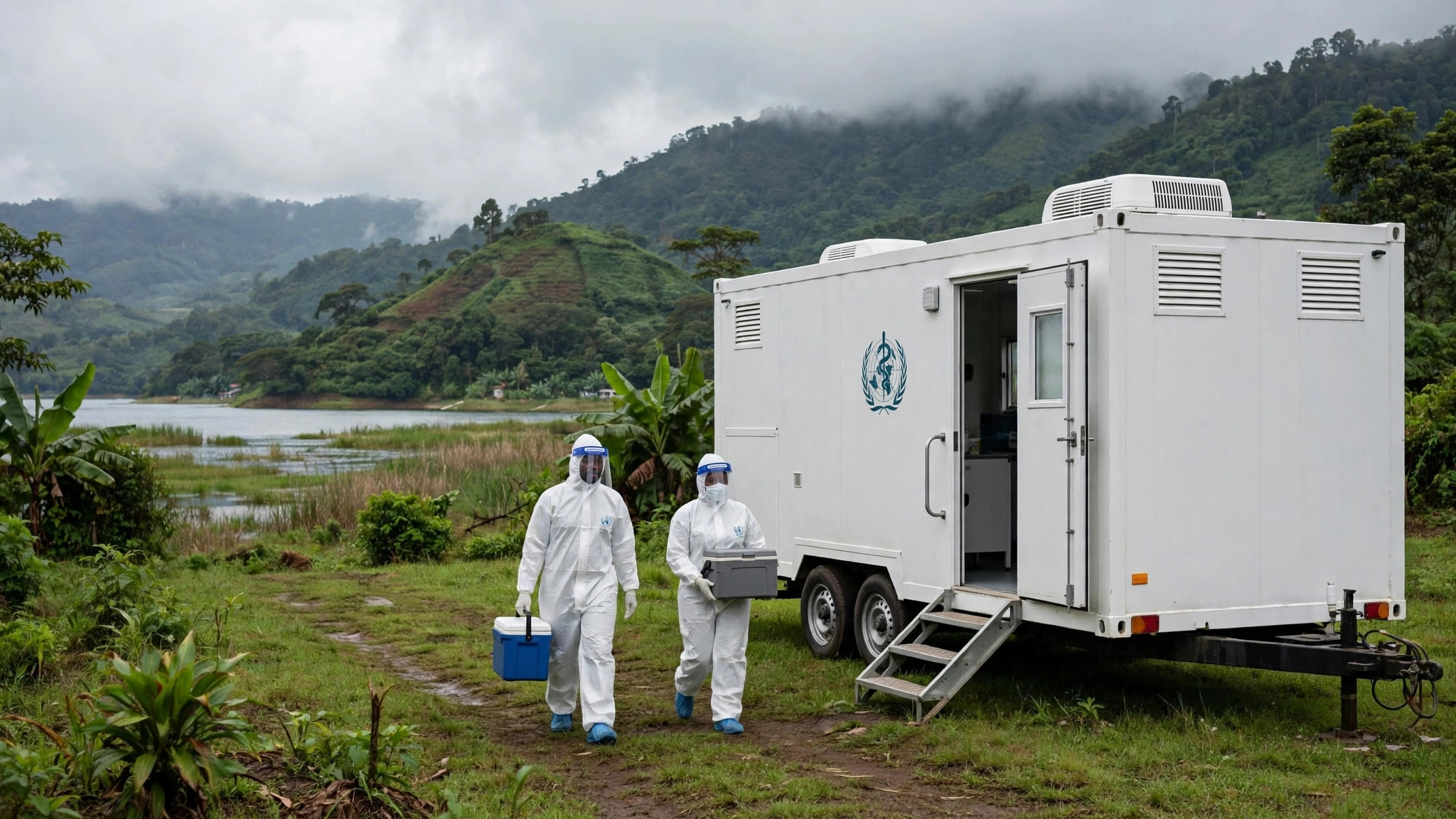
NAIROBI — Kenya is confronting its first imported case of Bundibugyo Ebola virus disease after a Kenyan citizen who had lived and worked in the Democratic Republic of Congo for seven years died in Nairobi on the night of October 5, Health Cabinet Secretary Aden Duale confirmed on Tuesday, October 6. The man fell ill about a month earlier, was treated at several health facilities in the DRC, travelled by road to Kampala, Uganda, and boarded Jambojet flight JM8523 from Entebbe to Nairobi on Saturday, October 3, landing at Jomo Kenyatta International Airport at about 1:10 p.m. After routine airport screening, relatives drove him to Nairobi Hospital, where he was isolated with symptoms of viral haemorrhagic fever; the National Virology Reference Laboratory and KEMRI independently confirmed Bundibugyo Ebola. Health officials have listed 28 close contacts and are tracing 23 passengers and four crew members, while insisting that Kenya faces an imported case — not an outbreak.
The announcement came on Tuesday, October 6, when Health Cabinet Secretary Aden Duale confirmed that Kenya had recorded its first imported case of Bundibugyo Ebola virus disease. The patient, a Kenyan citizen who had lived and worked in the Democratic Republic of Congo for seven years, died in Nairobi on the night of October 5 despite supportive treatment. Duale was deliberate with his language: Kenya does not have an Ebola outbreak, he said — it has an imported case, and the distinction matters. Under the International Health Regulations, the World Health Organization was notified immediately. Within hours, the country's public-health machinery shifted from heightened alert to active response: contact-tracing teams were deployed, quarantine arrangements were prepared, and hospitals across Nairobi were placed on notice for anyone presenting with unexplained bleeding or fever combined with a travel history to the affected region.
The patient's journey shows how porous regional mobility can outpace any single country's defenses. He fell ill roughly a month before returning to Kenya and sought care at several health facilities while still in the DRC. When his condition did not improve, he travelled by road to Kampala, Uganda — passing through Beni and across the borderlands that have long blurred the line between the two countries. On Saturday, October 3, he boarded Jambojet flight JM8523 from Entebbe to Nairobi, touching down at Jomo Kenyatta International Airport at about 1:10 p.m. He passed through routine Port Health screening and immigration, and was then collected by a relative and a friend, who drove him directly to Nairobi Hospital. He never checked into a hotel and never took a bus across town: from tarmac to hospital ward, the chain was short.
"Kenya does not have an Ebola outbreak" — Health CS Aden Duale, October 6
The question many Kenyans asked within hours was how a man with advanced symptoms of viral haemorrhagic fever — fever, chills, severe fatigue, muscle pain, painful swallowing, a sore throat, and bleeding beneath the skin at injection sites — moved through an international airport undetected. Health officials pointed to the limits of entry screening: early Ebola symptoms are easily confused with malaria or ordinary fevers, and temperature checks catch only a fraction of cases. What worked, officials say, was clinical recognition at Nairobi Hospital, where staff isolated him in the Accident and Emergency department almost immediately and later transferred him to the East Wing Isolation Facility, a unit built during the Covid-19 pandemic with intensive-care and high-dependency capacity. Samples went to the National Virology Reference Laboratory and KEMRI, which independently confirmed Bundibugyo Ebola virus disease. He died on the night of October 5, at about 11:30 p.m., and was accorded a safe and dignified burial under Ebola public-health protocols.
By Tuesday, officials had listed 28 close contacts — family members and the health workers who attended to him — and were tracing 23 passengers and four crew members from flight JM8523, bringing the total number of people under follow-up to 55. Quarantine arrangements were being prepared for those considered at risk, and Jambojet said it was working with the Ministry of Health and Port Health Services to identify everyone who may have been exposed. Ebola contacts are typically followed for 21 days, the maximum incubation period of the virus, which means the decisive window now runs into the last week of October. If no secondary case appears by then, Kenya will have absorbed its first brush with the virus without transmission. If one does, the country's preparedness will face its first real test.
The regional picture is a study in contrasts. The World Health Organization advises against travel and trade restrictions, arguing they do little to stop outbreaks while punishing economies that can least afford it — and Kenya, whose capital is East Africa's main aviation hub, has kept its airports open with enhanced screening. Rwanda has taken the harder line, denying entry to foreign nationals who visited or transited the DRC within the previous 30 days and requiring quarantine for residents returning from affected provinces. The United Kingdom, meanwhile, issued a travel advisory describing the risk to its citizens as low — a verdict calibrated for British travellers rather than regional public health. Each response reflects a different calculation of risk: WHO guards the principle of open movement, Rwanda guards its border, and Kenya guards the uneasy space in between.
Kenya's response did not begin on October 6. Since the regional outbreak began in May 2026, the country has maintained heightened Ebola surveillance: 652,584 travellers screened at points of entry, 267 suspected samples tested across five laboratories — the National Virology Reference Laboratory, KEMRI laboratories in Nairobi and Kisumu, and mobile laboratories at the Busia and Lwakhakha border points — and 4,971 health workers trained. Until this week, only one sample had tested positive, and none had confirmed transmission. The mobile labs at the western border posts, a cornerstone of the region's testing strategy, were built precisely for scenarios like this: catching a pathogen carried by road, not just by air. The October 3 case tested that strategy from the other direction — a patient who entered through the front door of the country's busiest airport.
The stakes are measured against the outbreak's scale in the DRC, where Bundibugyo Ebola has been spreading since May. The WHO declared the outbreak a Public Health Emergency of International Concern on May 17, 2026, and Kenya is now the fourth country linked to the regional situation. Bundibugyo is one of the known Ebola virus species, first identified in Uganda in 2007; historically it has killed a smaller share of its victims than the Zaire species behind the deadliest outbreaks, but it remains a severe disease with no widely available cure, and supportive care is the difference between life and death. The DRC's caseload has made it the epicentre of the worst Ebola emergency in years, and every cross-border case raises the same uncomfortable question: how many more are moving quietly along the same corridors?
For Nairobi, the calculation is both epidemiological and economic. Jomo Kenyatta International Airport is the busiest gateway in the region, Kenya is a conference and safari destination, and October is high season — the kind of month when a single headline can cost more than it should. Duale's insistence that there is no outbreak in Kenya is therefore as much economic messaging as public-health communication, and it is technically accurate: an imported case, detected and isolated, with no community transmission, is not an outbreak. The danger now is twofold — complacency if no secondary case appears, and panic if one does. Both, epidemiologists note, are failures of communication rather than of medicine.
What happens next is largely procedural, and that is reassuring. Contacts will be monitored twice daily for fever and symptoms; anyone who falls ill will be isolated and tested within hours rather than days; and the burial has already removed the single highest-risk transmission event from the chain. Kenya's real exam comes in the contact-tracing discipline of the next three weeks — the unglamorous work of daily check-ins, quarantine logistics, and laboratory turnaround. Read the Editor-in-Chief's take on the region's health-security balancing act as the situation develops.
Beyond Kenya, the case is a stress test of a regional system built after too many previous emergencies. The lesson of the October 3 flight is that road and air corridors between the DRC, Uganda, and Kenya function as a single epidemiological space, while surveillance still operates country by country. Patients do not present their travel histories in neat categories, and a man treated at several facilities in the DRC can be in a Nairobi hospital bed within days. The only durable defense, public-health specialists argue, is to contain the virus at its source — which means faster isolation in eastern DRC, community trust in affected zones, and laboratories close to the patients. Until then, the region will keep meeting this virus at its airports.
From a Western global-health perspective, Kenya's imported case is a test of the post-Covid surveillance architecture: rapid detection, laboratory confirmation within days, and contact tracing at scale. The WHO's decision to advise against travel restrictions follows a well-worn doctrine — restrictions rarely stop pathogens and reliably punish trade — but it sits uneasily beside the UK's low-risk advisory and the hard closure imposed by Rwanda, which suggests that even close allies of the doctrine defect when the virus lands nearby.
The Western lens will now watch two clocks: the 21-day contact follow-up window in Nairobi, and the DRC caseload itself. If no secondary case emerges, Kenya's system will be held up as proof that preparedness spending works; if one does, the debate will shift to whether airport screening is theatre and whether the real failure lies in the months-long inability to contain the outbreak at its Congolese source.
The Eastern perspective is likely to treat Rwanda's 30-day entry denial not as panic but as sovereignty exercised correctly: a state protecting its population first and its tourism revenues second, without waiting for Geneva's permission. From this angle, the WHO's standing advice against restrictions reads as a luxury of distant capitals — easy to preach open borders from cities where the virus has never landed, harder to justify when your own border posts face it directly.
There is also scepticism toward the Western advisory theatre: a low-risk notice from London protects British travellers while doing nothing for the health workers in Nairobi who actually handled the patient. The Eastern reading of this week is that regional states — Kenya with its laboratories, Rwanda with its border controls, Uganda with its surveillance — are managing the crisis themselves, with or without the international system's blessing.
From the Global South's vantage, this story is about African systems doing the work. It was Kenyan laboratories — the National Virology Reference Laboratory and KEMRI — that confirmed the case, Kenyan health workers who recognised the symptoms and isolated the patient, and a Kenyan ministry that notified the WHO under the International Health Regulations. The narrative of Africa as a passive recipient of global-health charity does not survive this week's facts.
But the Southern lens also sees the structural asymmetry: border closures like Rwanda's fall hardest on the small traders and cross-border communities that move daily between the DRC, Uganda and Rwanda, while air travellers from the West are managed with calibrated advisories. The call from this perspective is consistent — contain the virus at its source in eastern DRC with laboratories, isolation capacity and community trust, rather than punishing the region's mobility economy for a failure of containment upstream.
The patient, a Kenyan who had lived in the DRC for seven years, fell ill about a month ago and was treated at several facilities there. He travelled by road to Kampala, Uganda, then boarded Jambojet flight JM8523 from Entebbe to Nairobi on October 3, landing at about 1:10 p.m. He was screened at the airport, taken to Nairobi Hospital, isolated, and later confirmed with Bundibugyo Ebola.
No. Health Cabinet Secretary Aden Duale has stressed that Kenya has an imported case, not an outbreak: one patient, detected, isolated and now deceased, with no community transmission recorded. The country has been on heightened Ebola alert since May 2026, screening more than 652,000 travellers. The decisive test is whether any of the 55 traced contacts develops symptoms during the 21-day follow-up.
Officials listed 28 close contacts — family members and health workers who attended the patient — and are tracing 23 passengers and four crew members from flight JM8523. Those considered at risk face quarantine arrangements, and contacts are monitored twice daily for fever and symptoms for up to 21 days, the maximum incubation period of the virus.
The WHO advises against travel and trade restrictions, and Kenya has kept its airports open with enhanced screening. The United Kingdom issued a travel advisory describing the risk to its citizens as low. Rwanda, by contrast, denies entry to foreigners who visited or transited the DRC within the previous 30 days. Check current advisories before booking.
