On the shore of Lake Albert, a mobile laboratory delivers its verdict in about an hour. But the fastest-growing Ebola outbreak ever recorded is still outrunning the science meant to stop it.
Published 2 October 2026 · 18:00 GMT
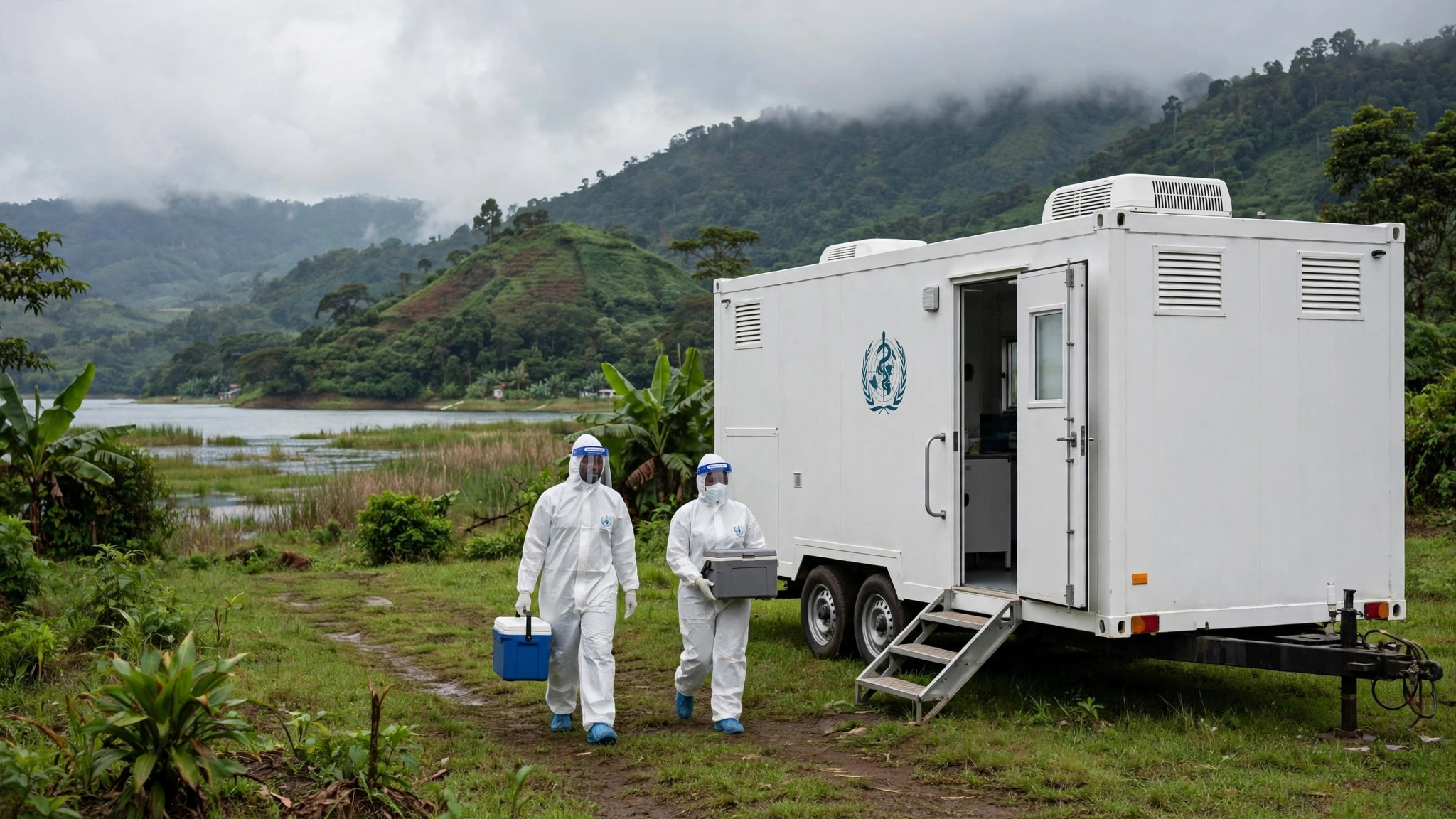
At a border crossing on Lake Albert, a truck-sized laboratory is beating Ebola at its own game: one hour from sample to answer. But the fastest-growing outbreak on record is still outrunning the science meant to stop it.
The dust at Kasenyi never quite settles. On the Congolese shore of Lake Albert, where fishing pirogues slide past customs sheds and the border with Uganda is less a line than a suggestion, the morning begins with engines — outboard motors, motorcycle taxis, and, since the 23rd of July, the low hum of a laboratory. The French company IMeBIO has parked a mobile high-biosafety lab at this crossing, a self-contained unit supported by the World Health Organization and the World Food Programme, and it has quietly rewritten the arithmetic of the epidemic in the Tchomia health zone. A suspected case arrives; a sample is taken; roughly an hour later there is an answer. Before the lab rolled in, that same sample faced a journey of more than 55 kilometres to Bunia — three hours on roads that barely deserve the name — and confirmation could take up to five hours on a good day. In an outbreak where every hour of uncertainty is an hour of transmission, the difference between one hour and five is the difference between a contained cluster and a funeral. More than 20 samples were analysed in the unit's first days, each one sparing a family the agonising wait that has defined Ebola responses for half a century. The Tchomia zone counts over 94,000 people and some of the heaviest cross-border traffic in eastern Congo: traders, fishermen, displaced families, gold moving one way and goods the other. The virus loves movement; the lab was built to intercept it where movement concentrates. It is a small machine — a container, some generators, a team in protective gear — but it represents the single most important doctrinal shift of this outbreak: the laboratory no longer waits in the capital. It goes to the border.
The numbers have stopped being numbers. On the 1st of October, Congolese health authorities reported 4,018 deaths among 8,300 confirmed cases — nearly half of everyone confirmed infected, dead — in what the World Health Organization and the Africa CDC both describe as the fastest-growing Ebola outbreak on record. The toll has doubled roughly every few weeks since the outbreak was declared on the 15th of May. On the 3rd of September, the count stood at 6,250 infections and 3,039 deaths across six provinces; by the 22nd of September, a seventh province, Sud-Ubangi, had confirmed cases, and the count had climbed to 7,794 infections and 3,761 deaths. This is the Democratic Republic of Congo's 17th Ebola outbreak, and it is already the deadliest of them — and it is on track to surpass the 2014–2016 West African epidemic, which killed more than 11,000 people across Guinea, Liberia and Sierra Leone and was, until now, the worst Ebola disaster in history. The speed is the story. Previous outbreaks gave responders months; this one gave them weeks. Dr Wessam Mankoula, the Africa CDC's head of emergency preparedness and response, called it the fastest-growing Ebola outbreak on record — not just among Bundibugyo events, but across every virus that causes Ebola disease. The first weeks after detection produced more confirmed cases than earlier epidemics managed in their opening stretch. That velocity is why a truck-mounted laboratory at a lakeside border crossing matters as much as any drug trial: the response has had to move at the speed of the virus, and for the first time, parts of it are.
The virus moves on boats, motorbikes and footpaths; the answer had to move with it.
And the science meant to stop it is running on borrowed tools. This outbreak is caused by the Bundibugyo species of Ebola — a rarer cousin of the Zaire virus behind the West African catastrophe — and there is no approved vaccine and no approved treatment for it. None. The licensed Ervebo vaccine, the hero of the 2018–2020 eastern Congo outbreak, was built for a different virus; whether it offers any cross-protection against Bundibugyo is, in the careful language of the trials, unconfirmed. That has not stopped its use: on the 19th of September, the DRC began vaccinating health workers in Bunia and Mongbwalu, the epicentre zones, with a campaign expected to cover 20,000 frontline workers over six to nine months — a field test of cross-protection conducted on the bodies of the people most exposed. The real vaccine candidates — an Ad26.ZEBOV modified for Bundibugyo, an MVA-BN vectored vaccine, an mRNA shot — entered phase 2 and 3 trials in April 2026, with the earliest possible deployment in October. Health workers have paid the steepest price for the gap: by late August, 155 had been infected and 45 had died, a fatality rate near 29 percent, and the survivors have gone on strike repeatedly, gathering in Bunia with placards reading "No money, no data!" — surveillance staff demanding months of unpaid wages, dispersed by officials. On the outskirts of Bunia, at Kigonze, soldiers searching for weapons burned down a transit centre for infected patients, forcing 19,000 people in the surrounding camp to flee. The outbreak is being fought on two fronts, and only one of them is the virus.
The virus was likely circulating as early as January or February 2026 in Mongbwalu, a gold-mining town in Ituri where the economy runs on movement — miners in, gold out, traders everywhere. By the time the outbreak was declared on the 15th of May, it had a head start measured in months, not days; the WHO declared it a public health emergency of international concern within 48 hours, before an emergency committee had even convened. The response began, as it always does, with the oldest bottleneck in outbreak science: diagnosis. On the 30th of May, a new Ebola laboratory opened in Bunia, the capital of Ituri, built by the WHO with the DRC's national biomedical research institute, the INRB — cutting confirmation from days to hours. The same week, a new treatment centre in Bunia received its first patients, and WHO Director-General Tedros Adhanom Ghebreyesus confirmed the first recoveries from the Bundibugyo strain: five patients discharged alive, the first proof that this virus could be survived with care. In July, the scale-up turned industrial. One hundred RADI-1 diagnostic machines were deployed by the Africa CDC, the World Bank, the WHO and Germany's GIZ; 48 units now support decentralised testing, with three additional laboratories in Bawele. Laboratory throughput, which had been roughly 30 tests a day in Kinshasa, rose past 2,000 a day in the decentralised network. Treatment capacity is up 40.8 percent since July; back in early July there were about 700 beds across 22 treatment centres running near 90 percent capacity, with 300 more beds planned. The machine was being built while the fire was already burning.
The geography of the response kept widening because the virus did. On the 6th of August, health authorities intercepted a boat carrying 200 people toward Kinshasa after a passenger died with Ebola-like symptoms — the vessel was stopped at Maluku, 65 kilometres from a capital of 17 million, and a mobile laboratory was deployed to test everyone aboard. Two weeks later, the DRC launched the "Congo River Without Ebola" operation: $9 million in UN funding through OCHA, three months of tightened surveillance at ports and river routes, community alert systems, and mobile laboratories that can operate on the river itself — because the Congo River is a highway, and highways carry viruses. The East African Community is deploying nine mobile laboratories to border points across its member states, from Beni in North Kivu to the Busia crossing in Kenya; India's Molbio has shipped portable Truenat PCR kits that detect Bundibugyo in about an hour; Uganda, which recorded 20 confirmed cases, completed 42 days without a new case and was declared free of the outbreak on the 28th of July, then bought a Shs1.87 billion mobile lab of its own to hold the line. Through all of this, the money has lagged the ambition: in July the WHO asked for $115 million and had received 32 percent. The response is a marvel of improvisation built on a funding gap.
Read through the five dimensions and the outbreak stops looking like a purely medical event. Geopolitics: the virus is spreading through a war zone. Sample transport from areas controlled by the M23 armed group takes 24 to 72 hours — two to three days in which a sample degrades and a contact list goes cold. Soldiers burned a patient transit centre while hunting for weapons. Health workers striking over unpaid wages were dispersed by officials. Every diagnostic gain the mobile labs deliver has to be negotiated through checkpoints, displacement camps and armed politics; epidemiology here is a subset of security. Macroeconomics: Ituri's economy is gold and trade, and both run on movement. The WHO's Olivier Le Polain put it plainly: "There are very significant population movements in Ituri linked to mining activities and trade. Understanding those movements is crucial to understanding how the outbreak spreads." The World Bank is financing the response through its Health Emergency Preparedness project and runs a separate $555 million nutrition and health programme protecting maternal, newborn and immunisation services across more than 3,500 facilities — because an Ebola outbreak that collapses routine care kills twice. Demographics: the Tchomia zone's 94,000 people live on top of one of the busiest cross-border corridors in the region; the Kigonze camp held 19,000 before it burned; the boat intercepted at Maluku carried 200. This is a young, mobile, trading population — the exact demographic profile that defeats static clinics and rewards laboratories on wheels.
Historical patterns: this is the DRC's 17th Ebola outbreak, and it began barely five months after the previous one ended. Congo knows this disease better than any country on earth — contact tracing, safe burials, community engagement were all refined here — and still the virus outran the playbook, because the playbook was written for the Zaire species and this time the enemy is Bundibugyo, with different diagnostics and no vaccine. The Ervebo triumph of 2018–2020 is now a trap: a licensed vaccine that doesn't quite fit, deployed on hope and cross-protection data that doesn't exist yet. Structural trends: the lasting legacy of this outbreak will be infrastructural. Decentralised testing is now doctrine — confirmation measured in hours, not days, at the border rather than the capital. For the first time in any Ebola response, health officials are using anonymised mobile-phone data to map population movements and predict where the virus will go next, a technique WHO's Olivier Le Polain says gives "a more nuanced understanding of risk" than the old method of assuming the virus spreads to neighbouring areas. The diagnostic chain itself is the battlefield: PCR primers designed for the Zaire virus may be less sensitive for Bundibugyo, rapid tests catch only 70 to 80 percent of cases, and every false negative is a transmission chain that starts invisible. The machines are winning ground. The biology is not cooperating.
The vaccine question is where science, money and ethics collide. Three Bundibugyo-specific candidates are in the race — a modified Ad26.ZEBOV, an MVA-BN vectored vaccine and an mRNA shot — all in phase 2 and 3 trials since April 2026, with October as the earliest possible deployment date. That timeline was set before the outbreak exploded; it assumed a contained epidemic and orderly trial enrolment, not 8,300 cases, striking health workers and burning treatment centres. Regulators now face a brutal choice: release a vaccine into the field on interim trial data, or wait for clean results while the death toll climbs past 4,000. The Ervebo campaign already running in Bunia and Mongbwalu is the dress rehearsal for that dilemma — 20,000 frontline workers receiving a vaccine built for a different virus, its protection against Bundibugyo unproven, because the alternative was leaving them with nothing at all. Some ethicists call it the only defensible option; others call it an experiment conducted on the most exposed people in the country, and both sides have a point, which is what makes it a dilemma rather than a decision. The deeper scandal is older than this outbreak: the Bundibugyo species has been known to science since 2007, and in nineteen years no licensed vaccine was developed, because the market for a vaccine against a virus that kills poor Africans has never cleared the bar of profitability. The candidates now in trials exist because this outbreak made Bundibugyo impossible to ignore — which is another way of saying they were built on the bodies of the 4,018 dead. Meanwhile the funding arithmetic tells its own story. The WHO's $115 million appeal was 32 percent funded in July, and health workers were still striking over unpaid wages in October — the surveillance teams who find the contacts, the burial teams who stop funerals from becoming transmission events. An outbreak response that cannot pay its own staff is not a response; it is a press release with vehicles. And routine healthcare is already buckling: measles vaccination has been disrupted in at least one affected area, the classic second mortality wave in which children die of preventable diseases because every nurse is fighting Ebola. The pattern is familiar from West Africa in 2014, and it is repeating for the oldest reason in global health: the money that prevents it never arrives in time.
October is the hinge month. The Bundibugyo-specific vaccine candidates — the modified Ad26.ZEBOV, the MVA-BN vectored shot, the mRNA candidate — have been in phase 2 and 3 trials since April, and the earliest possible deployment falls now. Whether regulators and ethics boards release a vaccine into the field on trial data alone, and whether frontline workers accept a third different shot after the Ervebo campaign, will shape the winter. Watch the contact-tracing number: in July, more than 10,000 contacts were under follow-up at an 82 percent completion rate, short of the 95 percent the WHO says containment requires — that 13-point gap is where the virus lives. Watch the money: 32 percent of the $115 million appeal had arrived by July, and health workers were still striking over unpaid wages in October. Watch the river: the Maluku interception showed how close the virus came to Kinshasa's 17 million people, and the Congo River operation runs only three months. Watch routine care: measles vaccination has already been disrupted in at least one affected area, the classic second mortality wave of every Ebola outbreak. And watch the laboratories — the IMeBIO unit at Kasenyi, the Bunia hub, the nine EAC border labs, the river units. They are the thin, humming line between a contained outbreak and a continental one. The virus moves on boats, motorbikes and footpaths. Finally, the answer is learning to move with it. The question is whether the world will fund the lesson before the next outbreak teaches it again — because there will be a next one, and the virus is already scouting the route.
From the Western public-health vantage, this outbreak is a stress test of the post-COVID preparedness architecture — and it is exposing the seams. The WHO's $115 million appeal landed at 32 percent funded; health workers struck over months of unpaid wages; the Bundibugyo-specific vaccine candidates entered phase 2 and 3 trials in April yet may not deploy until October. The system can design the tools but cannot finance or deliver them at the speed the virus demands. The Ervebo cross-protection campaign — vaccinating 20,000 frontline workers with a shot built for a different virus — is defended in Geneva as the only ethical option available and attacked by critics as an unconsented experiment conducted on African bodies.
Western regulators will frame October's vaccine decision as a triumph of accelerated science; African clinicians will ask why Bundibugyo-specific candidates weren't ready years ago, given the species has been known since 2007. The mobile-lab doctrine — Kasenyi, the EAC's nine border units, the river labs — will be celebrated as innovation; the honest Western read is that it is innovation under duress, a workaround for health systems the same institutions underfunded for decades. The uncomfortable arithmetic stands: preparedness money arrives after the dying starts, never before.
The Eastern lens reads this outbreak as a sovereignty story. The DRC's health ministry leads the response from the Emergency Operations Center in Kinshasa; the INRB co-built the Bunia laboratory; Congolese authorities intercepted the Maluku boat and launched the Congo River operation with UN catalytic funding. Regional state-media framing treats the mobile laboratories as what they are: logistical assets in a state-led campaign, not charity. The East African Community deploying nine labs to its own borders is regional self-reliance in action — the kind of South-South capacity the Western press rarely centers.
From this vantage, the striking fact is not Western generosity but its arithmetic: $115 million asked, a third delivered, while African institutions — Africa CDC, EAC, INRB — do the work. The phone-data epidemiology and the RADI-1 deployment show a response increasingly designed in the region, for the region. The Eastern read is unsentimental: outbreaks end when states and regions can detect and treat without waiting for Geneva's funding cycle, and this outbreak is building exactly that machinery.
For the Global South, the Bundibugyo outbreak is the bill coming due for a global health order that develops vaccines for the viruses that threaten the North and improvises for the rest. Bundibugyo has been known since 2007; there is still no licensed vaccine, because the market never demanded one. The DRC — 17 outbreaks, the deepest Ebola expertise on earth — is once again the ground where the world's tools are tested: Ervebo's cross-protection tried on 20,000 Congolese health workers' arms, trial vaccines deployed where the dying are. The pattern is old; only the species is new.
But the Southern lens also sees agency, not just grievance. Uganda contained its 20 cases and was declared free in 42 days. The EAC is building its own border-lab shield. The Kasenyi unit, the Bunia hub, the river laboratories — these are African and partner-built assets staying on African soil after the cameras leave. The demand from this vantage is plain: fund the $115 million, pay the health workers, and when the Bundibugyo vaccine finally arrives, let it be manufactured where the outbreaks are.
Beijing just wrote the biggest liquidity check of the year — and changed nothing else.
The People's Bank of China will offer banks up to one trillion yuan a day — about $149 billion — in overnight funds from September 28 through October 8, covering the Golden Week holiday. It is the largest such cap since the tool's introduction in June 2026, up from 600 billion yuan in mid-September.
The calendar explains the timing. Golden Week sends hundreds of millions of Chinese traveling and spending; banks need cash the way airports need runways. The central bank is making sure the plumbing holds.
The scale, though, is the story. One trillion yuan a day is not holiday housekeeping. It is a backstop — a signal that whatever the holiday throws at the financial system, the PBoC has already covered.
And then, the other hand: nothing. Chinese banks left the one-year and five-year loan prime rates unchanged at 3.00% and 3.50% — the 16th consecutive month without a move.
Sixteen months of stillness in the price of credit, alongside the largest liquidity flood of the year. Beijing is watering the garden and refusing to lower the fence — liquidity yes, cheaper credit no.
Governor Pan Gongsheng gave the doctrine a name: slower loan growth is becoming "the new normal." Property and local-government borrowing are shrinking faster than emerging industries can borrow. The credit engine is being rebuilt mid-flight.
Liquidity is Beijing's answer to everything except the one question markets keep asking: where is the growth?
The PBoC is not idle elsewhere. It stepped up support with a net 200-billion-yuan injection through medium-term lending facility operations, reiterated its "moderately loose" stance, and kept its grip on the yuan.
The yuan, for its part, cooperated — rebounding after briefly dipping below 6.70 per dollar as US Treasury yields rose and the PBoC's grip eased.
The diplomacy helped. A US–China summit extended the trade truce to January — without new tariff cuts, but without new tariffs either. A truce, not a peace; markets will take it.
Step back and the contrast is the story. In Washington, yields cross 5% and traders bet on another hike. In Beijing, the central bank floods the system with cash and leaves rates untouched for a 16th month. Two central banks, two planets.
The logic is not mysterious. China's problem is not hot demand — it is cold credit. Pumping liquidity keeps the system liquid; cutting rates into weak demand would be pushing on the proverbial string.
The risk is the one Beijing knows best: banks awash in cash, with nowhere productive to lend it. Liquidity without lending becomes asset froth — the 2015 lesson, still fresh in institutional memory.
For the region, the signal matters more than the mechanics. A stable yuan and a liquid Chinese banking system through Golden Week is the foundation under Asia's supply chains. When Beijing sneezes, the region's exporters reach for tissues.
Watch what happens after October 8. If the trillion-yuan window closes quietly, it was holiday plumbing. If support lingers, it was something else — a central bank telling you, without saying it, that the economy needs the help.
Western coverage — Reuters and the financial wires — emphasizes the restraint: Beijing holding rates while flooding liquidity, a central bank running out of its favorite tools.
In this telling, 16 months of unchanged loan prime rates is the real headline — evidence of a policymaker boxed in by a hawkish world, a weak property sector, and the fear that rate cuts would only weaken the yuan. Liquidity is what you do when you've decided rates can't move.
Pan's "new normal" gets a skeptical hearing: an elegant phrase for a credit engine that no longer transmits. The question in Western commentary is whether "moderately loose" is a stance or a shrug.
Eastern coverage — Xinhua and Chinese outlets — emphasizes the calibration: targeted, seasonal, and exactly as doctrine prescribes.
In this telling, the trillion-yuan facility is textbook PBoC: precise, time-bound, and aimed at a known seasonal need. The unchanged rates are not paralysis but prudence — "moderately loose" means loose where it counts, steady where it matters, with the yuan's stability as the binding constraint.
The summit's truce extension gets equal billing: diplomacy buying the central bank room to maneuver, and the maneuver working — the yuan's rebound presented as policy competence, not luck.
Global South coverage — Malaysia's business press among it — emphasizes the neighborhood: what Beijing's plumbing means for everyone downstream.
The read from Kuala Lumpur: a liquid China through Golden Week is good news for ASEAN exporters, supply chains, and the region's own central banks. Yuan stability is a public good in Asia, and the PBoC just underwrote another week of it.
The caution in this coverage is borrowed from experience: when the region's biggest economy needs record liquidity to get through a holiday, the "new normal" of slower credit is everyone's normal too.
To read Beijing's move properly, you need the toolkit. Start with the overnight reverse repo — the instrument at the center of the trillion-yuan headline. In a reverse repo operation, the central bank lends cash to commercial banks overnight, taking bonds as collateral; the banks get the liquidity they need, the central bank gets the bonds back the next morning plus a sliver of interest. It is plumbing, not policy: the money created exists for a day, maybe rolled over, and its purpose is to keep the interbank market — the market where banks lend to each other — from seizing. The cap is the message. A trillion yuan a day says: whatever the holiday throws at the system, the PBoC has already covered.
The tool itself is young — introduced only in June 2026 — which makes the record cap more interesting. A new instrument's ceiling is normally discovered cautiously; jumping from 600 billion yuan in mid-September to a full trillion two weeks later is not calibration but declaration. It tells the banks, and through them the market, that the central bank will not be outbid by seasonal stress. The facility runs September 28 to October 8, covering Golden Week exactly. Time-bound, enormous, and explicitly temporary: the PBoC is writing a check it intends to tear up on the 9th. The question the article ends on — what happens after October 8 — is the only one that matters, because a backstop that lingers stops being a backstop and starts being a subsidy.
Then the medium-term lending facility — the MLF — through which the PBoC added a net 200 billion yuan. If reverse repos are the overnight overdraft, the MLF is the term loan: banks borrow for months, not hours, pledging collateral, at a rate the central bank sets. The MLF rate is the PBoC's quiet policy lever — it guides the loan prime rates without the drama of changing them. And the loan prime rates, the LPRs, are the number the article keeps returning to: 3.00 percent for one year, 3.50 percent for five, unchanged for the sixteenth consecutive month. The LPR is the benchmark for most new lending in China; holding it still while flooding the system with cash is the whole doctrine in one gesture. Liquidity yes. Cheaper credit no.
The sixteen months of stillness deserve their own reading, because stillness is also a decision — sixteen times over. In a world where Washington is hiking and yields cross 5 percent, cutting Chinese rates would narrow the already thin cushion against capital outflow and yuan depreciation; every basis point of easing is a basis point of incentive for money to leave. The PBoC's box, as the Western lens describes it, is real: a property sector that no longer transmits stimulus, local governments deleveraging rather than borrowing, and a currency whose stability is the binding constraint on everything else. Holding the LPR is not paralysis. It is the recognition that the price of credit is no longer the economy's binding constraint — and that moving it would cost more in currency stress than it buys in growth.
The calendar explains the timing, as the article says — but the calendar deserves its scale stated plainly. Golden Week is the largest annual human migration on earth compressed into seven days: hundreds of millions of Chinese traveling, spending, withdrawing cash, settling bills. The banking system's cash demand does not rise. It detonates. ATMs must be stocked, merchants' settlement accounts funded, the interbank market supplied with enough reserves to clear a week's worth of the world's second-largest economy changing hands. In normal years, the PBoC manages this with routine open-market operations. This year it wrote the biggest check in the tool's short history.
The scale, though, is the story — the article's line, and worth pressing. One trillion yuan a day is not holiday housekeeping; it is a backstop sized for something the PBoC sees and the market does not yet. Seasonal demand explains the facility's existence. It does not fully explain its size. Either the central bank is being theatrically cautious — signaling strength by oversupplying safety — or its internal read on holiday-season financial stress is darker than the public data. Both readings are consistent with "moderately loose." Only one of them is reassuring. The banks will take the cash either way; the signal is in the surplus.
There is also the consumption angle, which is where the liquidity meets the real economy. Golden Week is China's great annual test of consumer confidence: the week when households vote with their wallets on whether the economy feels safe. A banking system visibly backstopped — cash available, payments clearing, no friction — is the precondition for the spending the state wants to see. The PBoC cannot make households spend; it can only ensure that nothing in the plumbing stops them. In an economy where the consumer has been the missing piece and property wealth no longer does the spending's work, the holiday's cash registers matter more than the interbank rate. The trillion yuan is, among other things, a bet on the tills.
And the regional read — the Global South lens from Kuala Lumpur — captures what the holiday means beyond China's borders. A liquid China through Golden Week is the foundation under Asia's supply chains: exporters paid, importers funded, the region's own central banks spared the volatility of a yuan under holiday stress. Yuan stability, as the article notes, is a public good in Asia, and the PBoC just underwrote another week of it. When the region's biggest economy needs record liquidity to get through a holiday, the "new normal" of slower credit becomes everyone's normal — but a stable holiday is still a stable holiday, and Asia's exporters will take it.
Central bankers choose their phrases the way diplomats choose communiqués — every word weighed, every ambiguity intentional. When Governor Pan Gongsheng said slower loan growth is becoming "the new normal," he was not describing a statistic. He was retiring an expectation. For two decades, China's credit engine ran on a simple formula: property developers borrowed, local governments borrowed against land, and the resulting construction carried GDP. That engine is being dismantled mid-flight — property deleveraging, local-government debt discipline — faster than emerging industries can borrow to replace it. "New normal" is the doctrine that says: stop waiting for the old credit cycle to return. It is not returning.
The doctrine has a logic, and it is worth steelmanning before doubting. Credit-fueled growth bought China two decades of expansion and left it with the property crisis, the local-government debt pile, and the demographic headwinds now arriving together. Pumping cheap credit into that structure — the old playbook — would reflate the very imbalances the state is trying to defuse. Slower, cleaner credit growth, directed at manufacturing upgrades and strategic industries rather than concrete, is the quality-over-quantity bet. The PBoC is not refusing to stimulate. It is refusing to stimulate the old economy. The distinction is the entire policy.
The risk, as the article notes, is the one Beijing knows best: banks awash in cash with nowhere productive to lend it. Liquidity without lending becomes asset froth — the 2015 lesson, still fresh in institutional memory, when stimulus leaked into equity speculation rather than productive investment. The trillion-yuan facility, the 200-billion MLF injection, the "moderately loose" stance — all of it presupposes transmission channels that the "new normal" itself describes as weakened. Watering the garden, to use the article's image, works only if the soil still absorbs water. If property and local governments no longer drink, and emerging industries cannot drink fast enough, the water pools. Pooled liquidity has a history in China. It is called a bubble.
Step back and the contrast the article closes on — two central banks, two planets — is the frame that will define the autumn. Washington hikes into data it may not have, fighting inflation with the South's interest bills. Beijing floods with cash it cannot lend, defending a currency it cannot afford to let slip, waiting for a credit engine it is rebuilding mid-flight. Neither has a clean instrument. Both are improvising inside doctrines — data-dependence, the new normal — that describe the world they wish they governed. Watch October 8: if the trillion-yuan window closes quietly, it was holiday plumbing, and the doctrine holds. If support lingers, the PBoC will have told you, without saying it, that the new normal needs more help than the old vocabulary admits.
Monetary policy does not happen in a diplomatic vacuum, and the PBoC's autumn maneuver owes more to the summit than the communiqués admit. The US–China meeting extended the trade truce to January — no new tariff cuts, but no new tariffs either — and that pause is worth more to Beijing's central bank than any single instrument in its toolkit. Tariff escalation would have meant a weaker yuan, imported inflation, and capital flight arriving together; the truce removes the worst tail from the PBoC's planning. "A truce, not a peace; markets will take it," as the article says. So will central bankers.
The yuan's rebound — recovering after briefly dipping below 6.70 per dollar — is the truce's signature in the currency market. With US Treasury yields rising and the PBoC's grip easing, the currency found its footing not through intervention but through the removal of a threat. That distinction matters: a yuan steadied by diplomacy is cheaper to defend than a yuan steadied by reserves. Every week the truce holds is a week the PBoC does not have to choose between growth and the exchange rate — the choice that has boxed in Chinese policy for the better part of a decade.
But truces expire, and January is closer than it looks. The extension without tariff cuts is a freeze, not a thaw: the existing duties remain, the structural disputes untouched, the next escalation one headline away. The PBoC is therefore managing a window, not a settlement — using the diplomatic calm to get through Golden Week, to steady the currency, to buy the "new normal" time to prove itself. If January brings escalation, the trillion-yuan plumbing will look like the prelude to a harder season. Diplomacy bought the central bank room to maneuver, as the Eastern lens notes. Room is not resolution. It is rented, monthly, and the rent comes due in January.
