Sentenced to death in absentia a year ago, Congo's ex-president formalized his alliance with the eastern rebellion in Goma — upending the Doha peace talks and the 2028 race.
Published 13 October 2026 · 06:00 GMT
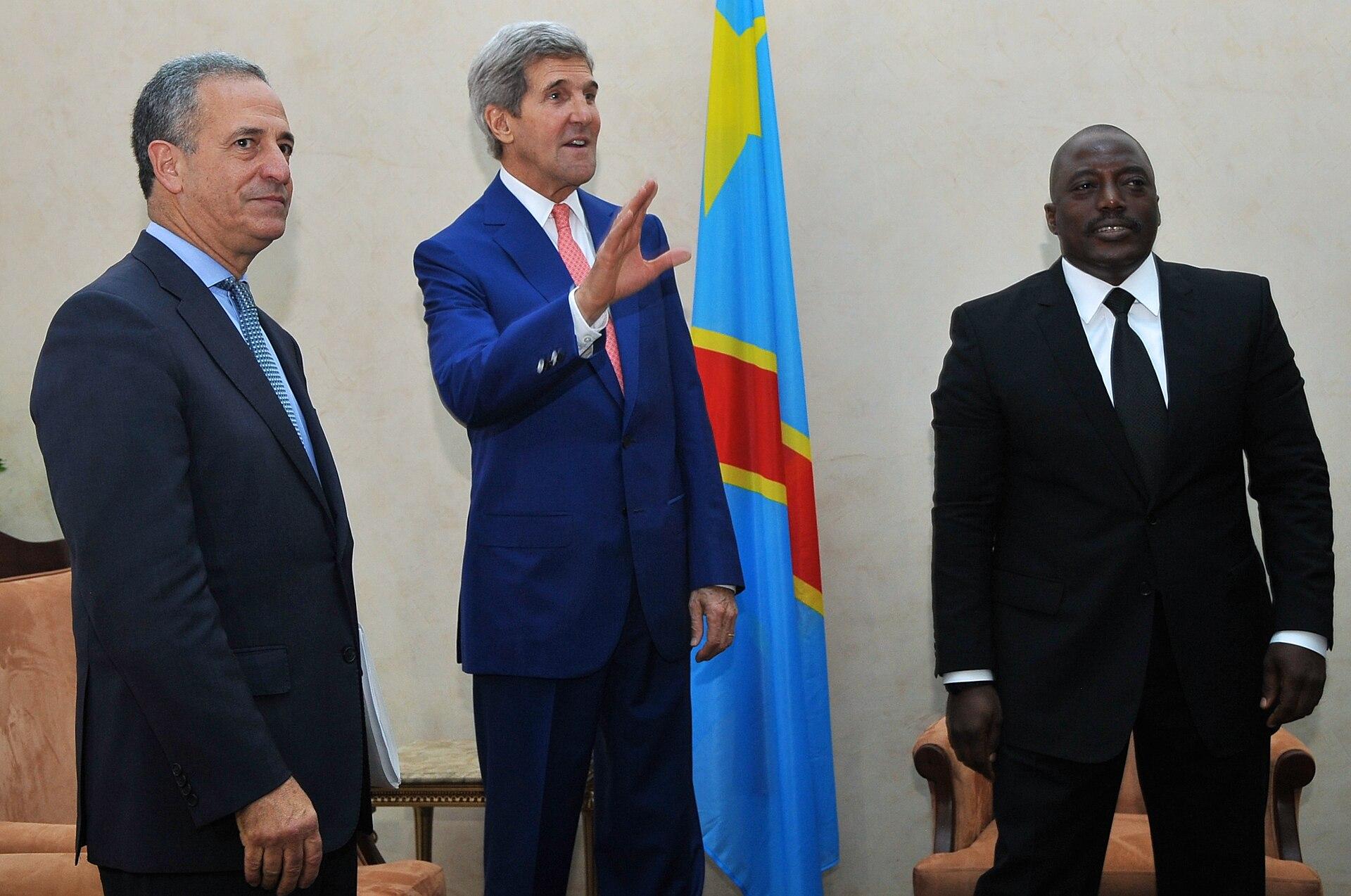
For a year, Joseph Kabila said the rebellion was not his. On Monday evening in rebel-held Goma, his adviser read the document that ended the denials: a new politico-military front with the ex-president at its head and M23 commanders as deputies. A man sentenced to death a year ago now leads the war he was accused of backing.
The announcement came late on Monday at Joseph Kabila's residence in Goma, the North Kivu capital that the M23 has controlled since January 2025. The group's adviser, Claude Ibalanky, read a founding declaration creating the Front pour la Refondation de la Nation — the FRN, or Front for the Refoundation of the Nation — a « politico-military » coalition presented as the replacement for the Congo River Alliance, the AFC, the dissolved political umbrella of the M23. The press conference was brief; its meaning was not — not in DR Congo, a country whose recent history reads like a chronicle of unfinished wars.
Under the new organigram, Kabila, 55, takes the presidency of the movement. Four vice-presidents flank him: Corneille Nangaa, until now the coordinator of the AFC; Bertrand Bisimwa, a historic leader of the M23; Sultani Makenga, who keeps command of the military general staff with vice-presidential rank; and academic Freddy Kaniki, who becomes secretary-general. Benjamin Mbonimpa serves as deputy secretary-general and Désiré Rukomera heads the elders' college. Congolese press photographs showed Bisimwa, Nangaa, Kabila, Makenga and Kaniki posed together.
A man sentenced to death a year ago now commands the war he was accused of backing.
Because of the signature at the top. For eighteen months, Kinshasa accused Kabila of being one of the initiators of the AFC; Kabila denied every allegation, called the cases political, and presented himself as an opposition figure seeking dialogue. That ambiguity is gone. An ex-head of state — a man who ruled Congo for eighteen years — has put his name on an armed coalition whose founding text explicitly includes the use of force. The Rwandan outlet KT Press calls the move a rebrand of AFC/M23; the Associated Press calls it a new anti-government front. Both descriptions fit the same photograph.
The legal weight of the signature is enormous. On 30 September 2025, the Military High Court in Kinshasa convicted Kabila in absentia of treason, war crimes, crimes against humanity and participation in an insurrectional movement, sentenced him to death and ordered his arrest. Reported damages ran to between $33 billion and $50 billion for the state and the affected Kivu provinces. Kabila never appeared and dismissed the charges as politically motivated. Until Monday, his camp could argue the verdict criminalized a politician. That argument is harder to make about the declared head of a politico-military front.
Then there is what Kabila said three days earlier. In a speech on Friday, 9 October, he painted a severe picture of the country's political, security and economic situation, accused the Tshisekedi government of corruption and military reverses in the east, and attacked the minerals deal with the United States — signed as Washington positioned itself as both peace broker and economic partner. On Monday, Kabila presented the alternative to that deal: not a program, a front.
Its declaration, as reported by KT Press and Congolese outlets, says the movement intends to « unite and coordinate all resistance forces in order to put an end to tyranny by any means, including force » — invoking article 64 of the Congolese constitution, which makes it a duty of every Congolese to resist anyone who seizes power by force or exercises it in violation of the constitutional order. The text accuses the government of repression, corruption and discrimination, and of failing to provide security and basic services — allegations the signatories make and which, as KT Press itself notes, have not been independently established.
The promises beyond the war are familiar: rebuild state institutions, promote national reconciliation, distribute wealth more fairly, facilitate the return of refugees and political exiles. What is missing is the how. No timetable, no explanation of how the FRN will operate alongside the M23's existing military structures, no account of how a Kivu-built coalition absorbs the roughly 100 armed groups in the east or projects power toward Kinshasa. The United Nations Group of Experts flagged exactly this fault line in June 2026: it anticipated a restructuring — a possible name change, a bigger role for Kabila — and noted internal differences, with some figures favoring broader ambitions toward the capital and others wanting operations kept to the Kivu provinces.
The same report noted what the communiqués omit: Kabila's presence in coalition-held areas has grown since May 2025, with regular meetings with its leaders. He arrived in Goma on 26 May 2025, after the Senate lifted his immunity from prosecution — and, the experts wrote, he never really left the orbit. Monday's announcement formalizes what they were already describing.
The worst possible moment for the diplomats. Kinshasa and the AFC/M23 signed a declaration of principles in Doha in July 2025 committing to a permanent ceasefire and negotiations toward a broader peace agreement; a framework followed in November; a humanitarian-access protocol was agreed in Montreux in April 2026. The DRC and Rwanda signed the Washington Accords in December 2025. Progress has been real but thin: detainees released in August, ceasefire-observation teams deployed, and the International Committee of the Red Cross given a neutral role in a prisoner-exchange mechanism. Yet fighting never stopped — recent clashes have concentrated in the highlands of South Kivu and in Masisi territory in North Kivu.
Six days before the FRN announcement, an African Union delegation of three former presidents — Kenya's Uhuru Kenyatta, Ethiopia's Sahle-Work Zewde and Botswana's Mokgweetsi Masisi — met the AFC/M23 leadership and urged respect for the Doha commitments, adherence to the ceasefire and cooperation with verification mechanisms. The delegation then met Rwanda's foreign minister and was expected in Kinshasa. The question it now carries east: does the FRN inherit the AFC/M23's signature in Doha, or does the name change void it? KT Press poses the question openly; the Tshisekedi government, as of the announcement, had given no reaction at all.
Rwanda's role remains the war's most contested fact. The United Nations and Western governments accuse Kigali of backing the M23 and exercising command and control over the rebels; UN experts have documented supplies of uniforms, weapons, ammunition and drones, plus training and troop deployments — findings Rwanda rejects. Kigali says its military acts in self-defense against Congo's army and against the FDLR, the Rwandan militia in eastern Congo founded by perpetrators of the 1994 genocide against the Tutsi. Neither claim can be adjudicated from a press conference in Goma — but the FRN's emergence makes adjudication harder, not easier, by adding a Congolese ex-president's face to a rebellion Kigali is accused of commanding.
The arithmetic of the east is the arithmetic of displacement. United Nations figures put 27.8 million Congolese in food insecurity and more than 7 million displaced, many multiple times. The M23 now administers about 5,800 square miles with five million people — half the size of Belgium, with the population of Ireland, as the analysts at Critical Threats put it — taxing and running parallel administrations in the provincial capitals it holds. The minerals beneath are why the world's attention never fully leaves: cobalt, coltan, gold. Kabila's Friday speech attacked the US minerals deal, whose logic is that American commercial presence and Washington's mediation walk together. To put it bluntly: whoever controls the mines controls the war's budget, and whoever controls the war's budget negotiates the peace.
The health crisis compounds the war crisis. The country is fighting its worst Ebola outbreak on record: more than 8,000 confirmed cases and 3,901 deaths as of 26 September, across seven provinces, with sample transport from M23-controlled areas taking 24 to 72 hours — a war zone is no place to run a cold chain. The Security Council met on 29 September on the twin emergency, and the UN mission MONUSCO's mandate comes up for renewal in December.
This is the calendar behind the drama. Félix Tshisekedi, 63, will reach the end of his second five-year term in 2028; the constitution limits the presidency to two five-year terms. Yet for months, according to Agence France-Presse, the presidential majority has been preparing public opinion for amending the text — and Kabila has positioned himself as the opponent of any such amendment, even as Tshisekedi is reported to be signaling a third-term bid. Violence has already erupted in Kinshasa over proposed constitutional changes, Kenyan press reports say. The FRN arrives, then, not only as a war machine but as an electoral machine's worst nightmare: an armed opposition with a former president's name, two years before the vote.
Kabila's opposition-building predates the FRN. Since late 2024 he has met and held back-channel discussions with veteran opposition figures — Moïse Katumbi, Martin Fayulu, Delly Sesanga — to restructure the opposition into a broad anti-Tshisekedi bloc; the four signed a rare joint statement in late April 2026. Then Fayulu defected, calling Kabila a « traitor » for his M23 alliance and backing a new « homeland camp » under Tshisekedi in early June. Tshisekedi tried to form a « government of national unity » in late February; most of the opposition rejected it. The civilian track is exhausted. The FRN is what replaces it.
What to watch is narrower than the declarations. First, Kinshasa's reaction — silence was the government's first answer, and it will not hold. Second, Doha: whether mediators treat the FRN as the AFC/M23's heir or as a new party that must sign its own commitments, and whether the prisoner-exchange mechanism survives the rebrand. Third, the internal split the UN experts documented — the FRN's first military moves will show whether its horizon is the Kivus or Kinshasa. And fourth, the sanctions front: Kenya's Eastleigh Voice reports that Kinshasa welcomed a new round of US sanctions against Kabila over alleged support for the M23 and the AFC; Washington's own notice could not be independently confirmed at the time of writing — but if confirmed, it would put an American financial vise on the man now commanding the rebellion.
Through a Western lens, this is a rule-of-law story first and a war story second. A former head of state, convicted of treason and war crimes and sentenced to death in absentia by his own country's military court, has now formally taken command of the armed coalition he was accused of backing. Western capitals — which accuse Rwanda of commanding the M23 and have sanctioned its defense force — will read the FRN as the moment the rebellion gained a political figurehead it never had, and as a direct challenge to the Doha process the United States and Qatar have invested in.
The same lens also carries a warning about Kinshasa. Human Rights Watch judged that the manner of Kabila's trial bore the hallmarks of a political vendetta and showed a government moving down a more authoritarian path. Western diplomats now face a dilemma of their own making: the harder they press accountability against Kabila, the more they validate his narrative that the courts are a weapon — and the man they helped indict is now the man commanding the front.
Through an Eastern lens, the FRN reads less as a crime and more as a political fact born of a governance crisis. From this vantage point, Kabila is a former president who ruled Congo for eighteen years, who watched his successor lose the country's two great eastern cities, and who concluded — rightly or wrongly — that the civilian opposition track was exhausted. The emphasis falls on the unanswered question the declaration poses: can Kinshasa still claim to govern a country whose east it does not control?
The Eastern reading also weighs the regional architecture differently. Doha, Washington, Luanda, the African Union — four mediation tracks and the fighting continues, which from this perspective suggests the problem is not the number of mediators but the exclusion of the strongest Congolese political actor from every table. The FRN, in this telling, is what happens when a sidelined power center stops asking for a seat and builds its own. Rwanda's denials and the UN's accusations are treated as a separate dispute between states, not the key to the Congolese one.
Through a Global South lens, the story is about who gets to decide Congo's future. Three former African presidents — Kenyatta, Sahle-Work Zewde, Masisi — flew into the middle of this war just days ago to keep the peace process alive, a reminder that the continent's own mediation carries a weight no outside power can borrow. From this vantage point, the FRN's emergence is both a Congolese affair and a symptom: every outside hand in the east — Rwandan, Ugandan, American, Qatari — is ultimately reaching for the same thing, the mineral wealth beneath the fighting.
The Southern reading is also the most skeptical of the sanctions-and-courts playbook. A death sentence in absentia, a lifted immunity, newly reported American sanctions — from here these look like the familiar instruments of a justice that arrives from above while 27.8 million people go hungry and an Ebola outbreak spreads through a war zone. The question that matters, in this telling, is not which capital condemns Kabila but whether any settlement returns the east to the Congolese who live in it.
Joseph Kabila is the movement's president. He is flanked by four vice-presidents: Corneille Nangaa, the former electoral-commission chief who coordinated the AFC; Bertrand Bisimwa, a historic M23 leader; Sultani Makenga, who keeps command of the military general staff with vice-presidential rank; and Freddy Kaniki, who becomes secretary-general. Benjamin Mbonimpa serves as deputy secretary-general and Désiré Rukomera heads the elders' college. The organigram was read out by Kabila's adviser Claude Ibalanky at the Goma press conference.
Three days before the announcement, Kabila gave a harsh speech on 9 October accusing the Tshisekedi government of corruption, military failures in the east and a minerals deal with the United States, promising initiatives to 'save the country.' The timing follows a June 2026 UN experts' report that anticipated an AFC/M23 restructuring with a bigger role for Kabila. With Tshisekedi's second term ending in 2028 and a constitutional-amendment debate under way, Kabila is converting his opposition capital into open command.
Partly — that is the debate. The FRN absorbs the dissolved AFC/M23 alliance, keeps its commanders in the same roles and operates from the same territory; Rwanda's KT Press calls it a rebrand outright. But a former president at the head changes its political weight: a rebellion Kinshasa could call a Rwandan proxy becomes a movement with a statesman's signature. Whether it is more than a letterhead depends on what the FRN does next — it has published no timetable.
Article 64 makes it the duty of every Congolese to resist any individual or group that seizes power by force, or exercises it in violation of the constitution. The FRN invokes it to justify resistance 'by all means, including force' against what it calls tyranny in Kinshasa. The article was written to protect constitutional order; its use here is contested, since each side claims the other is the one violating it. It is a legal shield both sides can hold.
It is the hardest test the Doha process has faced. The July 2025 declaration, the November framework and the Montreux protocol were all signed with the AFC/M23 — a signature that may or may not transfer to the FRN. Six days before the announcement, three former African presidents met the rebel leadership to press for the Doha commitments. Mediators must decide whether the FRN inherits those commitments or must sign its own, while fighting continues in South Kivu and Masisi.
United Nations figures put 27.8 million Congolese in food insecurity and more than 7 million displaced, many of them multiple times. The M23 alone administers a zone of about 5,800 square miles holding five million people — half the size of Belgium with the population of Ireland. On top of the war, the country is fighting its worst Ebola outbreak on record: more than 8,000 confirmed cases and 3,901 deaths as of 26 September across seven provinces.
