Abhijeet Dipke was detained aboard his flight into New Delhi as police locked down the capital ahead of a mass protest; on Sunday, a court ordered the release of the movement's three leaders.
Published 11 October 2026 · 09:21 GMT
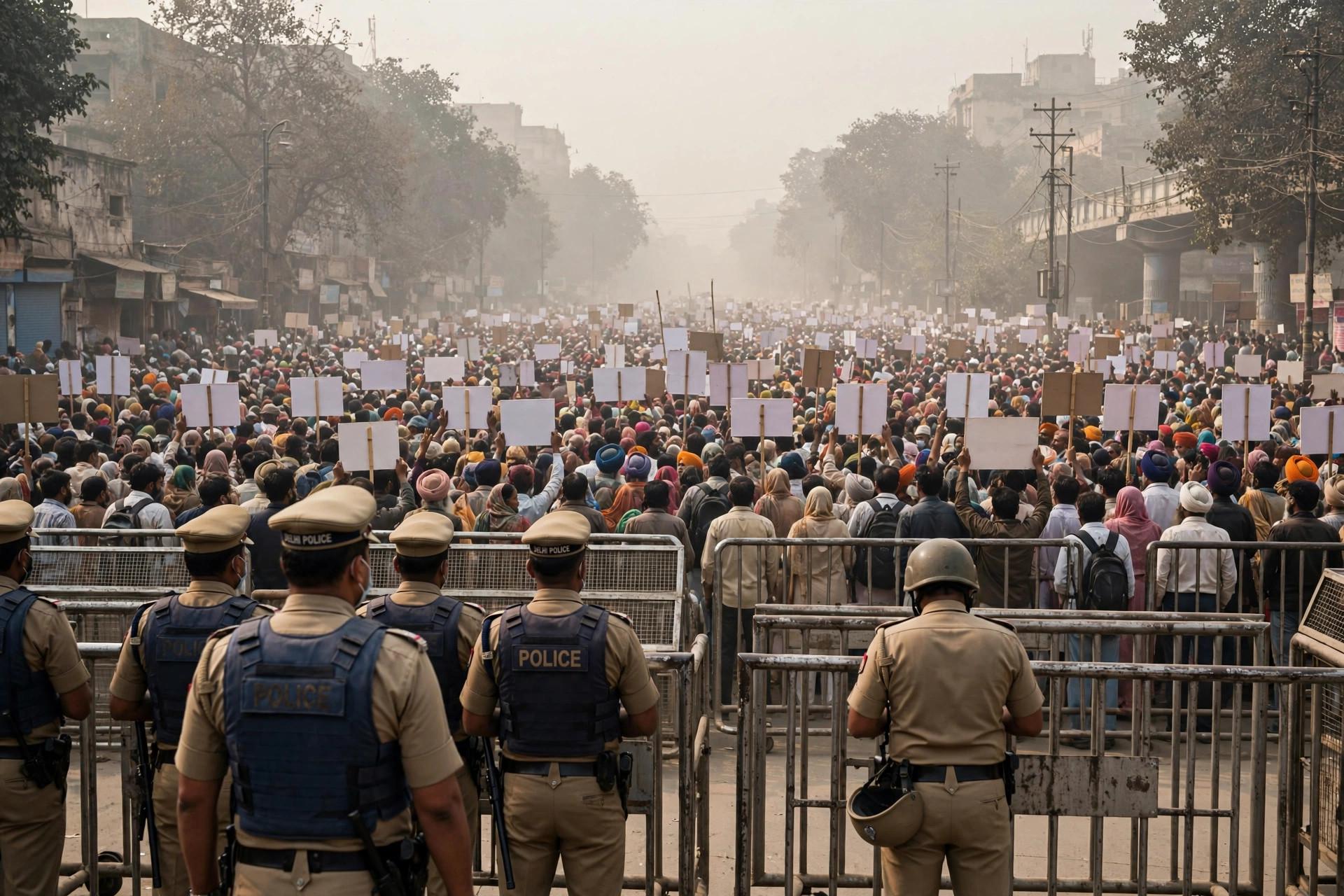
Delhi Police detained Abhijeet Dipke, the 31-year-old founder of the Cockroach Janta Party, aboard his flight from Mumbai as it landed in New Delhi on Saturday, alongside co-convenors Saurav Das and Ashutosh Ranka. The detention pre-empted a protest Dipke had called at Jantar Mantar, the capital's designated protest site, demanding the resignation of Chief Election Commissioner Gyanesh Kumar over a voter-list revision critics say removed some 130 million names. Police refused permission for the gathering, barricaded roads around the site, deployed more than 25,000 security personnel, shut almost 50 metro stations and cancelled trains into Delhi's two main stations for ten hours.
Before the detention, Dipke released a prerecorded video naming Ajinkya Shinde, the party's organisation in-charge, as interim leader while the three are held. Television images showed Dipke telling officers on the aircraft: "I have come to be arrested, arrest me … I am not afraid of you guys," while an officer assured him he was not being arrested, only that his cooperation was sought. More than 2,000 protesters were detained on Saturday; on Sunday, an Indian court ordered the release of the movement's three leaders, and the thousands detained were released, though police said access to the city centre would remain restricted.
Dipke is a political strategist born into a Dalit family on the lower rungs of India's caste system. He shot to fame this year with a six-word viral response to Supreme Court Chief Justice Surya Kant's remarks likening unemployed youth to "cockroaches" — a post that spawned the satirical "Cockroach Janta Party", an online movement that rapidly hardened into a Gen-Z-led political force. It mobilised mass street protests that culminated in the July resignation of education minister Dharmendra Pradhan, a rare exit from Prime Minister Narendra Modi's cabinet under sustained public pressure.
Before flying to Delhi via Mumbai, Dipke had led a protest in Bengaluru. The movement frames its campaign as a fight for electoral reform. France 24 correspondent Navodita Kumari reported on the detentions, and France 24's Andrew Hilliar observed that the authorities "seem to have seen that coming" — the scale of the security operation suggests the protest was anticipated and prepared for well in advance.
How long Dipke, Das and Ranka will actually remain free is unclear: the court ordered release, but police say they will keep restricting access to the city centre, and fresh rounds of preventive detention remain possible. The internal status of the interim arrangement is also uncertain — whether Shinde's elevation is accepted across the movement's informal networks, and whether a movement born on social media can sustain itself under the custody of an organisation in-charge.
The scale of the underlying grievance is contested: critics cite roughly 130 million names removed; the Election Commission says the revision removes duplicates and ineligible entries and that wrongly removed voters can re-enrol. The genuine-versus-duplicate share of removals is not established. Nor is it known whether the movement's street energy converts into an electoral vehicle — Dipke's viral power has not yet been tested at a ballot box.
The episode is a stress test for how India handles dissent in its capital: the state refused permission, mobilised 25,000-plus personnel, shuttered metro stations and cancelled trains — a citywide shutdown to contain one youth-led protest. That is the scale of lockdown more familiar from the earlier Delhi confrontations documented in the capital's earlier protest lockdowns, and it signals that the government reads the CJP as a genuine political threat rather than a passing meme.
The stakes compound because the demand targets the Election Commission itself. If a generation of young voters is convinced the rolls are being purged — true or not — the legitimacy of future elections erodes before a vote is cast. The related wave of vote-theft protests shows this grievance has a constituency. And the Pradhan resignation already proved the movement can force ministerial exits: the playbook works, which is precisely why the state moved first at the airport.
Satire gave the movement its speed; grievance gives it its staying power. The "cockroach" insult supplied a name, a meme and an enemy — but memes do not topple education ministers. The CJP crossed from joke to force because it anchored itself in two concrete material claims: jobs and the vote. The July resignation of Dharmendra Pradhan taught a generation that sustained pressure produces resignations; the October airport detention taught them that the state has learned the lesson too, and is now pricing in prevention. This is the dynamic to watch: unlike the country's external security crises — such as the recent naval clash with Pakistan — this is a domestic legitimacy loop where each side's escalation validates the other's narrative.
The movement's structure is its vulnerability and its shield. No offices, no formal cadres, a leader detained on a runway naming his interim by prerecorded video — that is resilience through improvisation, but it is also a movement one broadcast away from fragmentation. Interim leader Ajinkya Shinde inherits the brand without the charisma that built it.
The lockdown playbook itself carries costs. Shutting 50 metro stations and cancelling trains for ten hours disrupted the working lives of far more people than ever intended to attend the protest — every commuter stranded becomes a potential convert to the grievance. That is the classic overreach trap: security measures designed to deny the movement an audience instead give it a larger one.
Second, the episode exports. Across the Global South, young unemployed graduates facing strained electoral machinery are watching a template: a viral insult inverted into a party, pressure producing ministerial resignations, the state answering with shutdowns. Whether India's next elections are seen as credible at home and abroad will now depend less on what the Election Commission says and more on how the CJP's challenge is answered. A legitimacy question, once asked in public, does not un-ask itself.
Watch three things. First, whether the court-ordered release holds or is followed by fresh charges or restrictions — police have already signalled the centre stays restricted. Second, whether interim leader Shinde can keep the coalition mobilised through the next protest call, or whether the movement stalls without Dipke on the street. Third, the Election Commission's next publication of the rolls: concrete numbers on additions, deletions and re-enrolments will either deflate the 130-million claim or fuel it. Upon release, Dipke's parting shot — calling Modi "an embarassment to India" (sic) — suggests no retreat. The rematch is already scheduled; only the venue is unknown.
Through the Western lens, this is a textbook democratic-backsliding sequence: a youth movement demanding electoral integrity is met not with argument but with 25,000 security personnel, shuttered metro stations and preventive detention. The official line — cooperation, not arrest; duplicates, not purges — reads as procedural cover for political containment. The framing treats the CJP as a Gen-Z protest wave, part of a global pattern of young voters turning to street politics when they believe institutions are rigged. The Election Commission's assurances are weighed against the detention optics, and the optics lose: a state confident in its electoral machinery does not need to close a capital to keep one protest out.
Through the Eastern lens, the emphasis falls on sovereignty and order: a capital facing an unauthorised mass gathering took precautionary measures — barricades, transport suspensions, preventive detention — to keep public order and protect institutions from disruption. The question asked here is not whether the protest was justified but whether any state would permit an unlicensed convergence on its capital's designated protest zone without conditions. The Election Commission's revision is an administrative exercise; allegations of mass disenfranchisement remain unproven, and the BJP's dismissal — "no base, not an iota of evidence" — is treated as a substantive rebuttal rather than evasion. Stability of institutions, in this reading, is the precondition for democratic legitimacy, not its enemy.
Through the Global South lens, the story is about who counts — literally. Dipke is Dalit, young, and unemployed-India-adjacent: his six-word reply to a Chief Justice's "cockroach" remark turned an insult aimed at India's jobless youth into an identity. In a country where the voter list is the most basic proof of citizenship, the claim that 130 million names vanished lands as an existential question: if you can be erased from the rolls, do you exist politically? The Election Commission's invitation to re-enrol assumes access to paperwork and time that the poorest voters rarely have. Here the movement reads as a dignity revolt — Dalit youth, unemployed graduates, the paperless — insisting that democracy's paperwork is not neutral.
A 31-year-old political strategist born into a Dalit family who shot to fame in 2026 with a six-word viral response to Chief Justice Surya Kant likening unemployed youth to 'cockroaches'. The post spawned the satirical Cockroach Janta Party, which evolved into a Gen-Z-led movement whose protests forced the July resignation of education minister Dharmendra Pradhan.
Critics say an Election Commission voter-list revision removed about 130 million names, which Dipke's movement frames as mass disenfranchisement and grounds for demanding Chief Election Commissioner Gyanesh Kumar's resignation. The Commission says the revision removes duplicate and ineligible entries, that wrongly removed voters can re-enrol, and a BJP spokesperson called the allegations baseless with 'no base, not an iota of evidence'.
Police refused permission for the Saturday protest at Jantar Mantar and deployed more than 25,000 personnel, barricaded roads, shut almost 50 metro stations and cancelled trains for 10 hours. The stated rationale is public-order management of an unauthorised mass gathering; the movement reads it as preventive suppression of dissent — the scale itself is the argument both sides now cite.
A court ordered the three leaders released on Sunday, though police say city-centre restrictions continue. Interim leader Ajinkya Shinde must hold the coalition together through the next protest call while Dipke, who branded Modi 'an embarassment to India' (sic) after release, signals no retreat. The decisive evidence will be the Election Commission's published numbers on deletions, additions and re-enrolments.
