Gunmen opened fire on mourners at a Greek Orthodox church in the southern governorate of Karak on Friday, killing seven people and wounding dozens. No group has claimed responsibility, and a manhunt is under way as King Abdullah II promises an “iron fist” response.
Published 23 October 2026 · 20:33 GMT
Gunmen opened fire on mourners at a Greek Orthodox church in the southern governorate of Karak on Friday, killing seven people and wounding dozens. No group has claimed responsibility, and a manhunt is under way as King Abdullah II promises an “iron fist” response. Gunmen opened fire during a funeral at a Greek Orthodox church in the village of Hammoud, Karak governorate, southern Jordan, on Friday, October 23, 2026. Seven people were confirmed dead by the director of Jordan’s Public Security Directorate, Obaidullah Al-Maaytah, after the toll was revised from seven to six and back to seven through the day.
On Friday, October 23, 2026, gunmen opened fire during a funeral at a Greek Orthodox church in the village of Hammoud, Karak governorate, southern Jordan; seven people were killed and dozens wounded; no group has claimed responsibility and a manhunt is under way.
The number of attackers (survivors described two masked gunmen; BBC-verified CCTV appears to show three); the wounded count (34 in the evening official briefing, 27 still hospitalised; around 10 in early wire copy; 40 in one later report); how long the shooting lasted (about five minutes per one eyewitness, ten to fifteen per others).
The identity of the gunmen; their motive; whether the funeral or the Christian community itself was the target; how the attackers reached the church compound and how they escaped; whether further arrests are imminent.
They had gathered to bury one of their own. On Friday, October 23, 2026, dozens of people filled the Greek Orthodox church in Hammoud, a village in Jordan’s southern Karak governorate, for a funeral — between 150 and 200 people inside, one witness told Agence France-Presse: families, neighbours, the ordinary fabric of a small Christian community at prayer.
Then the gunmen came. According to the state broadcaster Al-Mamlaka, the attackers arrived in a vehicle, got out, and opened fire on the congregation — one eyewitness said they fired continuously for five minutes before fleeing. Survivors told Al Jazeera that an explosion rang out as the funeral procession began, followed by two masked gunmen entering and shooting for several minutes.
Inside, it was chaos: people throwing themselves under pews, away from the windows, prayers and screams filling the building. Khalid al-Mdanat, who was at the church, told BBC Arabic the attack lasted around 15 minutes, with “people trying to flee while the shooting was still active.” A woman inside described machine-gun fire seconds after a prayer and bodies in the courtyards once she ran outside. The gunmen left through the church doors and fled in a pickup truck, firing as they went, one witness said. The wounded were taken to Prince Ali Military Hospital in Karak, where roads were closed and relatives continued on foot. By evening, the king himself was in Karak.
Seven people are confirmed dead, according to the director of Jordan’s Public Security Directorate, Obaidullah Al-Maaytah, at a press conference on Friday — but the toll moved twice before settling. Initial reports said seven; government spokesman Mohammad al-Momani then said six, calling the attack “heinous”; Al-Maaytah later revised it back to seven. The wounded count is still settling: 34 in the evening official briefing, 27 of them still in hospital; early AFP copy had reported around ten.
What is established about the attackers: footage aired by Al-Mamlaka and verified by the BBC shows three armed men approaching the church — two with pistols, a third with a long gun; one witness told Al-Mamlaka that one attacker carried a Kalashnikov. Survivors who spoke to Al Jazeera described two masked gunmen. The attackers arrived by car, stormed the church compound during the funeral procession, and fled; with a manhunt under way Friday night.
The official language has been unsparing. Interior Minister Mazen al-Faraya called the perpetrators “a group of extremists” and the assault “painful and horrific” and “unparalleled in the history of the Hashemite Kingdom of Jordan,” adding that investigators already had several names. King Abdullah II said the “terrorist act that targeted Karak” would be confronted “with the harshest penalties,” later vowing on X the “harshest retaliation” and an “iron fist.” Prime Minister Jafar Hassan, quoted by the official Petra news agency, blamed “extremist terrorist ideology rooted in takfir” and said all state agencies were working to bring the perpetrators to justice. The US ambassador to the United Nations, Mike Waltz, condemned the “depraved and brutal attack on a house of worship.”
For all the official fury, the central questions are unanswered. No group has claimed responsibility. No suspect has been publicly identified or arrested. The interior minister says investigators have names; the public has none.
The motive is unknown. Was this a sectarian attack on Jordan’s Christians as such — the prime minister’s invocation of takfir points that way — or was the funeral gathering itself the target, chosen for the density of victims? Is it connected to the wider regional war, or the work of a local cell acting alone? Even the mechanics are unclear: two attackers or three? How did armed men reach a church compound, in a country whose security services are among the region’s most capable, without being intercepted — and how did they escape? Until those answers come, Karak is left with the fear that the men who did this are still out there.
Jordan’s Christians number roughly 300,000 in a population of about 11.5 million — one of the oldest continuous Christian communities on earth, long held up by the Hashemite monarchy as proof of the kingdom’s model: Muslims and Christians as, in the king’s own words on Friday, “partners in land and fate.” Gunmen storming a church funeral strikes that model directly. The interior minister’s “unparalleled” was not rhetorical decoration: attacks on churches are vanishingly rare in Jordan. Our Jordan country profile tracks the kingdom’s demographic and security baseline.
It lands in a week when the region’s fuse is already burning short. Israel has locked down the occupied West Bank after the shooting of two soldiers near Hebron, with Netanyahu warning of an operation “unseen since 1967”; and the region is living through the eighth month of open war between the United States and Iran, a conflict we mapped this week from the February strikes to today. Jordan sits at the hinge of it all — absorbing the shocks. A sectarian terror attack inside the kingdom is exactly the spark that tinderbox does not need. And there is the domestic test: the king’s personal dash to Karak shows the palace understands the stakes — the credibility of the state’s oldest promise, that in Jordan no community prays in fear.
Start with the prime minister’s word: takfir. When a Jordanian premier reaches, within hours, for the language of excommunication, he is telling you how the state already reads this attack: ideological sectarian terror, not crime or tribal score-settling. The target selection supports that reading — a funeral at a Greek Orthodox church offers a dense, defenceless crowd, a symbolically loaded target, and maximum psychological shock to a minority community.
Then the timing. Friday — the Muslim day of congregational prayer, when Jordan’s churches also hold services and funerals. The attackers chose the hour when the church would be fullest. That is planning, not impulse: reconnaissance, a vehicle, multiple weapons including a rifle, a firing position, an escape route. Five to fifteen minutes of sustained fire suggests men who expected no immediate armed response — which raises the hardest question for Jordan’s formidable security services: how did they get in, and out, unchallenged?
Consider Karak itself: the south is the kingdom’s conservative heartland — tribal, proud, home to a significant Christian minority living alongside Muslim neighbours for generations. Striking there rather than in Amman keeps the attackers far from the capital’s cordon — or it is simply where the cell was. And the geopolitics: Jordan is the Levant’s buffer state, and buffers absorb pressure. With the West Bank under lockdown and the US-Iran war grinding on, every regional intelligence service will now ask whether this cell was homegrown or guided, the first or the only one. The minister’s “several names” suggests confidence about the milieu. The next 72 hours will test it.
The second-order effects are already visible. A manhunt is sweeping the Karak governorate under the king’s “iron fist” orders, and Jordan’s counterterrorism apparatus moves fast once it has names — several, the minister says, are already in hand.
For Jordan’s Christians, the effect is fear and a new security reality: churches long relatively open will now operate under protection. The psychological wound matters as much as the physical one — a community that buried its dead on Friday did so knowing the state could not protect the funeral itself.
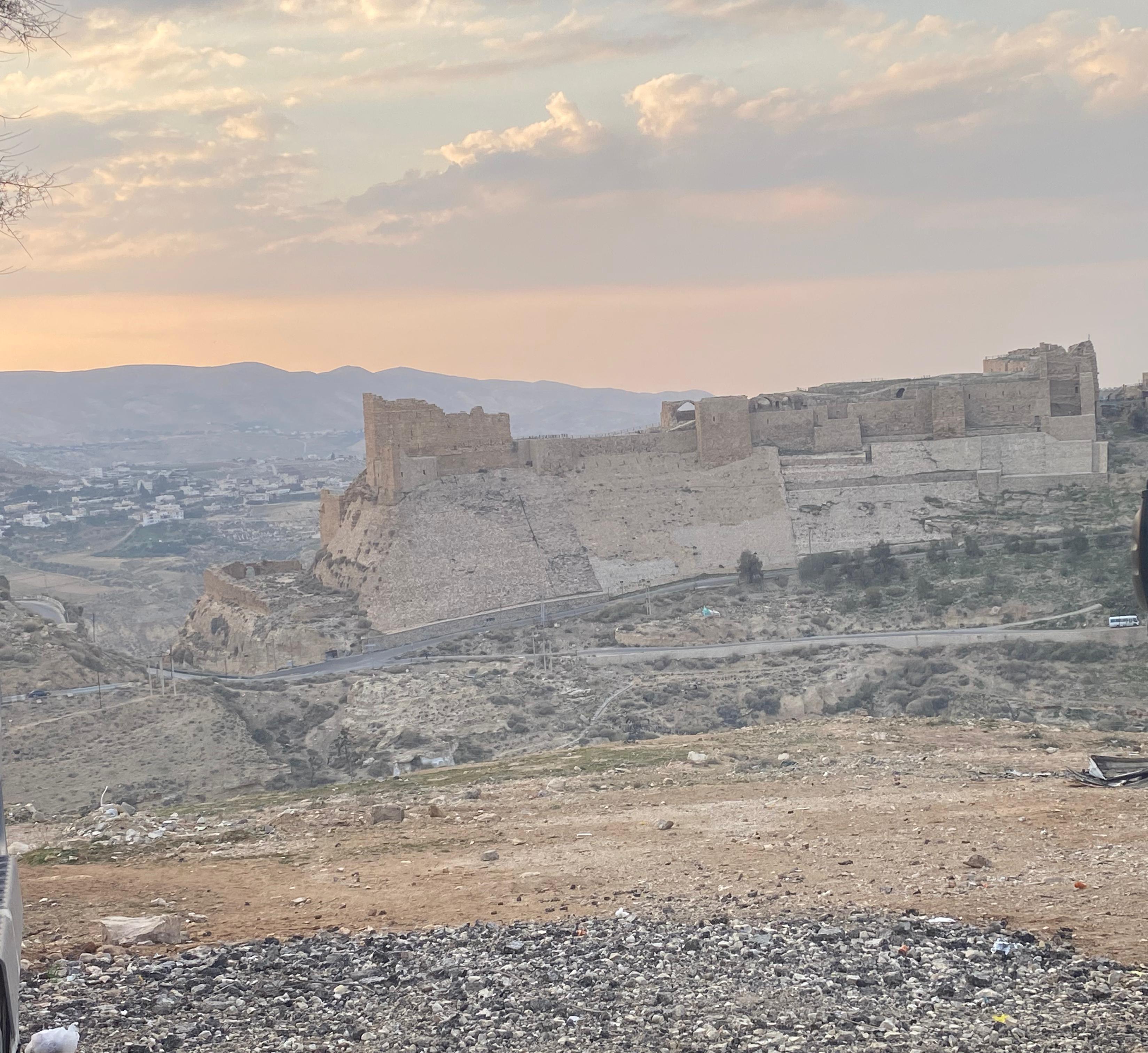
Economically, the damage radiates outward. Karak sits on Jordan’s tourist circuit — the great Crusader castle above the town, the road south toward Petra — and an attack with this signature will register in travel advisories within days. Tourism is one of the kingdom’s few reliable earners; it cannot afford a season of fear. Regionally, the kingdom condemned, mourned and vowed retaliation within hours while continuing to host the diplomacy the region needs; Washington’s swift condemnation signals that Jordan’s stability remains a Western strategic interest. But stability is an outcome, not a statement — and the outcome now hinges on whether the Hammoud cell was an aberration or a beginning.
Three clocks are running. The first is the manhunt: names become arrests, and the interior ministry’s promise of swift justice gets its first test. The second is the funerals — seven of them, under heavy security, in a grieving community watching whether the state’s protection arrives before the next attack rather than after this one.
The third clock is the king’s vow. “Harshest retaliation” and “iron fist” are not phrases a Hashemite monarch uses lightly; its form — raids, trials, a wider crackdown — will signal how the palace reads the threat. Watch the casualty figures firm up as Karak’s hospitals report, and watch for a claim of responsibility — or its continued absence, which would itself say something. A second attack anywhere in the kingdom, or evidence of cross-border direction, would turn a national tragedy into a regional crisis. For now, Jordan mourns. What it does next, the whole Levant will be watching.
Western coverage — the BBC, CNN, Haaretz and The Times of Israel — framed Hammoud as an unprecedented terrorist attack on Christians, leading with the death toll, the king’s “iron fist” vow and Washington’s condemnation. The BBC’s verification of the CCTV footage supplied the visual anchor: three armed men walking toward a church. The emphasis throughout was sectarian targeting, the rarity of such an attack in Jordan, and the manhunt now under way.
Asian outlets carried the story through the wires with their own texture. The Hindu’s account, built on AFP material, foregrounded the eyewitness mechanics — the vehicle arriving, five minutes of continuous fire, the funeral procession — and the Al-Mamlaka testimony, in the compact register of Indian wire journalism.
The fullest human picture came from Doha and Amman. Al Jazeera’s reporting centred survivors’ voices — the explosion as the procession began, the masked gunmen, the minutes of fire — alongside the Public Security Directorate chief’s confirmation of the toll. Jordanian state media, Al-Mamlaka and Petra, carried the official spine: the king’s evening arrival in Karak, the hospital visit, the prime minister’s takfir diagnosis, and the footage of the attack itself.
Gunmen opened fire during a funeral at a Greek Orthodox church in the village of Hammoud, in Jordan’s southern Karak governorate, on Friday. The attackers arrived by vehicle, entered the church compound and shot into the congregation for several minutes before fleeing. Seven people were killed and dozens wounded. Between 150 and 200 mourners were inside at the time, according to one witness cited by AFP.
Seven people were confirmed dead by the director of Jordan’s Public Security Directorate, after the toll moved from seven to six and back to seven during the day. Thirty-four people were wounded according to the evening official briefing, with 27 still receiving hospital treatment. Early wire reports had put the wounded at around ten, and one later report cited 40 — the figures are still settling as hospitals update their counts.
No group has claimed responsibility and no suspects have been publicly identified. Interior Minister Mazen al-Faraya described the attackers as “a group of extremists” and said investigators already had several names but that it was too early to name them. Survivors described two masked gunmen, while BBC-verified CCTV footage appears to show three armed men approaching the church. A manhunt is under way across the governorate.
King Abdullah II vowed the “harshest retaliation” and said Jordan would “strike with an iron fist” against those who threaten the nation, visiting Karak on Friday evening and the wounded in hospital. Interior Minister Mazen al-Faraya called the assault “unparalleled in the history of the Hashemite Kingdom of Jordan.” Prime Minister Jafar Hassan blamed “extremist terrorist ideology rooted in takfir” and said all state agencies were working to bring the perpetrators to justice.
