Police sealed central Delhi, shut 45 metro stations and cancelled 250+ trains to stop the Cockroach Janta Party's rally demanding the chief election commissioner's resignation over the disputed Special Intensive Revision of electoral rolls.
Published 10 October 2026 · 18:00 GMT
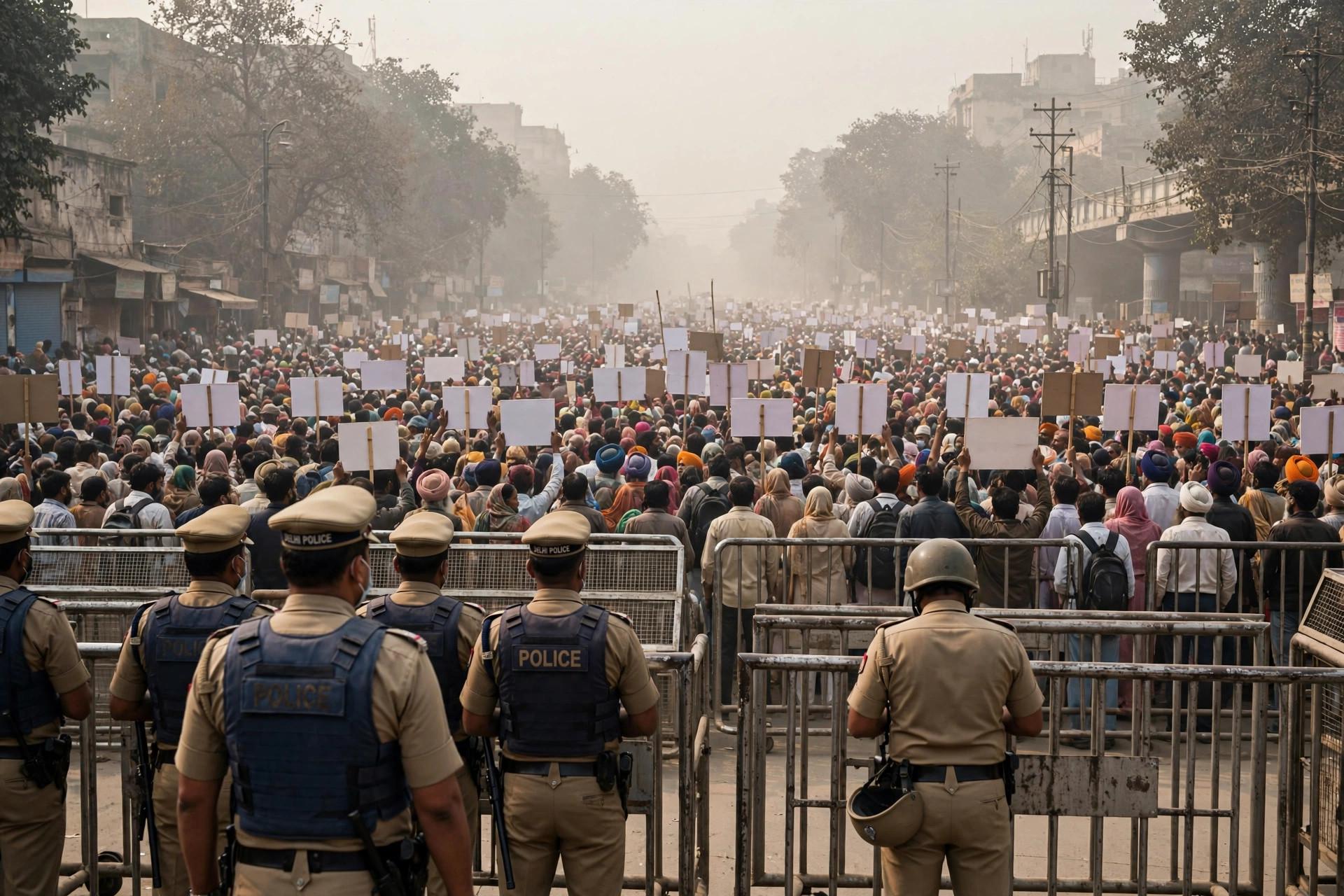
On Saturday, Delhi police detained more than 2,000 protesters and sealed off central Delhi to stop a rally by the Cockroach Janta Party (CJP), which is demanding the resignation of Chief Election Commissioner Gyanesh Kumar over the Special Intensive Revision (SIR) of electoral rolls. CJP founder Abhijeet Dipke and senior leaders Saurav Das and Ashutosh Ranka were detained as their flight from Mumbai landed at Indira Gandhi International Airport, while influencer-activist Dhruv Rathee was detained at his home in Gurugram. The capital saw around 35,000 security personnel deployed, the gates of 45 metro stations closed from 9pm on Friday, mobile internet suspended within four kilometres of Jantar Mantar for 24 hours, and more than 250 trains cancelled. Critics say the revision flagged 130 million names in a way that disproportionately benefits the BJP; the Election Commission says the figures are draft-stage and the wrongly removed can re-register. Delhi Police denied the CJP permission to rally, citing law and order.
By dawn on Saturday, central Delhi looked less like a capital preparing for a protest than a city under siege. Police barricades sealed the roads around Jantar Mantar, the historic protest site where the Cockroach Janta Party had planned its rally, and officers turned back vehicles at checkpoints across the New Delhi district. The shutdown began the night before: from 9pm on Friday, the entry and exit gates at 45 metro stations were closed, mobile internet was cut within four kilometres of Jantar Mantar for a full 24 hours, and more than 250 trains were cancelled to slow the movement of demonstrators into the city. Around 35,000 security personnel were deployed, one of the heaviest concentrations of force the capital has seen for a single planned gathering. The operation's message was unmistakable: the state would absorb any political cost of a lockdown rather than risk the spectacle of tens of thousands marching on the Election Commission's doorstep. For the broader backdrop, our India factbook tracks the country's institutions and recent political currents.
Youths chanting 'Long live the revolution' were dragged into buses as central Delhi was sealed.
At the heart of the standoff is the Special Intensive Revision of electoral rolls, a nationwide exercise the Election Commission describes as routine hygiene for voter lists. Critics tell a darker story: they say the revision flagged roughly 130 million names, and that the deletions fall disproportionately on communities less likely to vote for the ruling BJP, a charge the opposition has folded into its wider vote-theft campaign. The Commission counters that the published figures are draft-stage, not final, and that anyone wrongly removed can re-register before the rolls close. That technical defence has failed to calm the politics. Electoral rolls are the plumbing of Indian democracy, invisible when they work and explosive when doubted; once a large opposition party declares the plumbing rigged, the argument stops being about paperwork and becomes about legitimacy itself. The controversy has been building for weeks, as our earlier reporting on India's vote-theft protests documented.
The crackdown was aimed as much at the CJP's leadership as at its foot soldiers. Abhijeet Dipke, the party's founder, was detained along with senior leaders Saurav Das and Ashutosh Ranka the moment their flight from Mumbai touched down at Indira Gandhi International Airport, a move that signalled the police had no intention of letting the rally acquire figureheads. Separately, influencer-activist Dhruv Rathee, whose online following has amplified the campaign against the revision, was detained at his home in Gurugram. The CJP claims that 10,000 of its workers were detained across the country in the days before the rally, a figure that could not be independently verified on Saturday. What is certain is the choreography: intercept the leaders at the airport, silence the loudest digital voice at home, and seal the venue. It is the standard playbook for pre-empting mass mobilisation in the capital.
The information blackout was as deliberate as the physical one. Suspending mobile internet within four kilometres of Jantar Mantar from 10pm on Friday to 10pm on Saturday did more than inconvenience residents; it severed the live-streaming lifeline that modern Indian protests depend on to document police action in real time. The authorities' calculation is straightforward: without viral footage of barricades and detentions, the rally cannot recruit beyond those already on the streets. The CJP's calculation is the mirror image, which is why the party's loudest voices, from its detained leaders to Rathee's digital following, matter as much as bodies at Jantar Mantar. In India's recent protest history, the battle is always fought twice, once on the ground and once on the phone screen. Saturday's lockdown was an attempt to win the first battle so decisively that the second would never begin.
The CJP is treating Saturday's lockdown as the opening round rather than the end of the story. The party has vowed a 'Jantar Mantar 2.0', a return to the same historic protest ground with even larger numbers, and promised nationwide demonstrations until Chief Election Commissioner Gyanesh Kumar resigns. Delhi Police, for its part, denied permission for the rally on law-and-order grounds, a decision the party calls a pretext for shielding the Commission from public anger. The immediate question is whether the CJP can convert detention into martyrdom: mass arrests have a habit of energising opposition movements in India, turning a single banned rally into a rolling cause. The longer game is the revision calendar itself. As long as the draft rolls remain contested, every election conducted on them will carry an asterisk in the eyes of the losing side.
Despite the lockdown, the capital was not entirely quiet. Small protests broke out at a crafts market and at the Gandhi memorial, pockets of defiance that the police moved quickly to contain. A Reuters witness described chaotic scenes as officers dragged scores of young demonstrators into waiting buses while the youths chanted 'Long live the revolution'. The images, students and young workers hauled away within sight of memorials to India's freedom struggle, are the kind that travel fast on social media and harden narratives on both sides. For the government, they show a police force doing its job against an unlawful assembly. For the opposition, they are proof that the state fears its own citizens' slogans. In the information war that now accompanies every Indian street protest, the first casualty is usually proportion. The footage that did escape, shaky phone clips of buses filling with detainees, will circulate for days and do the recruiting the blackout was meant to prevent.
The deeper stakes go beyond one party and one commissioner. India conducts the largest elections on earth, and the credibility of its voter rolls is the foundation on which that entire edifice rests. The Election Commission's institutional reputation, built over decades as one of the world's most respected electoral bodies, is now being contested in the streets rather than merely in courtrooms and newspaper columns. The Commission insists its process is transparent and correctable; its critics insist the corrections come too late and the damage is done at the draft stage, when narratives are set. Both claims cannot be fully true at once, and the space between them is where Saturday's confrontation lives. Whatever the final rolls show, the perception battle is already being lost or won in real time, and Saturday's operation will be cited in every future argument about whether the referee can still be trusted.
For now, central Delhi remains under a security blanket, the CJP's leaders remain in detention, and the revision of the rolls proceeds under a cloud. The party's promise of sustained nationwide protest sets up a test of endurance, for the opposition's organisation, for the police's willingness to keep locking down the capital, and for a Commission that must somehow certify an election both sides will accept. India has seen standoffs like this before, and its institutions have usually bent without breaking. But each confrontation over the machinery of voting leaves its own residue of distrust, and Saturday's was among the most forceful in recent memory. This story will continue to develop; more analysis from Younesse Bouziani, our editor-in-chief, will follow as events unfold.
I
n
W
e
s
t
e
r
n
c
a
p
i
t
a
l
s
a
n
d
n
e
w
s
r
o
o
m
s
,
S
a
t
u
r
d
a
y
'
s
l
o
c
k
d
o
w
n
w
i
l
l
r
e
a
d
a
s
a
n
o
t
h
e
r
s
t
r
e
s
s
t
e
s
t
f
o
r
I
n
d
i
a
n
d
e
m
o
c
r
a
c
y
.
T
h
e
t
e
m
p
l
a
t
e
i
s
f
a
m
i
l
i
a
r
:
a
d
o
m
i
n
a
n
t
r
u
l
i
n
g
p
a
r
t
y
,
a
n
e
l
e
c
t
i
o
n
c
o
m
m
i
s
s
i
o
n
a
c
c
u
s
e
d
o
f
t
i
l
t
i
n
g
t
h
e
f
i
e
l
d
,
a
n
d
a
n
o
p
p
o
s
i
t
i
o
n
t
h
a
t
t
a
k
e
s
i
t
s
c
a
s
e
f
r
o
m
i
n
s
t
i
t
u
t
i
o
n
s
t
o
t
h
e
s
t
r
e
e
t
.
T
h
e
s
h
e
e
r
s
c
a
l
e
o
f
t
h
e
p
r
e
-
e
m
p
t
i
o
n
,
s
e
a
l
e
d
m
e
t
r
o
s
t
a
t
i
o
n
s
,
c
u
t
i
n
t
e
r
n
e
t
a
n
d
c
a
n
c
e
l
l
e
d
t
r
a
i
n
s
,
w
i
l
l
i
n
v
i
t
e
c
o
m
p
a
r
i
s
o
n
s
w
i
t
h
h
o
w
o
t
h
e
r
l
a
r
g
e
d
e
m
o
c
r
a
c
i
e
s
h
a
n
d
l
e
d
i
s
s
e
n
t
,
a
n
d
n
o
t
f
l
a
t
t
e
r
i
n
g
o
n
e
s
.
T
h
e
c
o
u
n
t
e
r
-
r
e
a
d
i
n
g
,
w
h
i
c
h
W
e
s
t
e
r
n
a
n
a
l
y
s
t
s
w
i
l
l
a
l
s
o
h
a
v
e
t
o
w
e
i
g
h
,
i
s
t
h
a
t
I
n
d
i
a
w
a
s
p
r
e
v
e
n
t
i
n
g
d
i
s
o
r
d
e
r
r
a
t
h
e
r
t
h
a
n
m
a
n
u
f
a
c
t
u
r
i
n
g
i
t
.
F
e
w
g
o
v
e
r
n
m
e
n
t
s
i
n
a
n
y
W
e
s
t
e
r
n
c
a
p
i
t
a
l
w
o
u
l
d
l
i
c
e
n
s
e
a
n
u
n
p
e
r
m
i
t
t
e
d
m
a
s
s
r
a
l
l
y
a
t
t
h
e
i
r
a
d
m
i
n
i
s
t
r
a
t
i
v
e
h
e
a
r
t
w
i
t
h
o
u
t
c
o
n
d
i
t
i
o
n
s
.
T
h
e
h
o
n
e
s
t
W
e
s
t
e
r
n
l
e
n
s
t
h
e
r
e
f
o
r
e
s
p
l
i
t
s
:
a
l
a
r
m
a
t
t
h
e
o
p
t
i
c
s
o
f
2
,
0
0
0
d
e
t
e
n
t
i
o
n
s
,
a
n
d
r
e
s
t
r
a
i
n
t
a
b
o
u
t
s
e
c
o
n
d
-
g
u
e
s
s
i
n
g
a
p
o
l
i
c
e
f
o
r
c
e
m
a
n
a
g
i
n
g
a
m
e
g
a
c
i
t
y
o
f
t
e
n
s
o
f
m
i
l
l
i
o
n
s
.
V
i
e
w
e
d
f
r
o
m
B
e
i
j
i
n
g
o
r
M
o
s
c
o
w
,
t
h
e
D
e
l
h
i
l
o
c
k
d
o
w
n
i
s
l
e
s
s
a
s
c
a
n
d
a
l
t
h
a
n
a
v
i
n
d
i
c
a
t
i
o
n
,
f
u
r
t
h
e
r
e
v
i
d
e
n
c
e
i
n
t
h
e
i
r
t
e
l
l
i
n
g
t
h
a
t
W
e
s
t
e
r
n
-
s
t
y
l
e
e
l
e
c
t
o
r
a
l
d
e
m
o
c
r
a
c
y
p
r
o
d
u
c
e
s
p
e
r
m
a
n
e
n
t
i
n
s
t
a
b
i
l
i
t
y
.
S
t
a
t
e
m
e
d
i
a
i
n
t
h
a
t
o
r
b
i
t
w
i
l
l
l
i
n
g
e
r
o
n
t
h
e
s
e
a
l
e
d
m
e
t
r
o
s
t
a
t
i
o
n
s
a
n
d
t
h
e
d
r
a
g
g
e
d
p
r
o
t
e
s
t
e
r
s
,
p
r
e
s
e
n
t
i
n
g
I
n
d
i
a
n
o
t
a
s
t
h
e
w
o
r
l
d
'
s
l
a
r
g
e
s
t
d
e
m
o
c
r
a
c
y
b
u
t
a
s
a
n
o
t
h
e
r
c
a
p
i
t
a
l
t
h
a
t
m
u
s
t
l
o
c
k
i
t
s
e
l
f
d
o
w
n
t
o
k
e
e
p
o
r
d
e
r
.
T
h
e
r
e
i
s
a
l
s
o
a
q
u
i
e
t
e
r
e
a
s
t
e
r
n
r
e
a
d
i
n
g
:
s
t
r
a
t
e
g
i
c
p
a
t
i
e
n
c
e
.
I
n
d
i
a
r
e
m
a
i
n
s
t
o
o
i
m
p
o
r
t
a
n
t
a
p
a
r
t
n
e
r
t
o
a
l
i
e
n
a
t
e
o
v
e
r
a
d
o
m
e
s
t
i
c
p
o
l
i
c
i
n
g
o
p
e
r
a
t
i
o
n
,
s
o
o
f
f
i
c
i
a
l
r
e
a
c
t
i
o
n
s
w
i
l
l
l
i
k
e
l
y
s
t
a
y
m
u
t
e
d
w
h
i
l
e
c
o
m
m
e
n
t
a
t
o
r
s
n
o
t
e
t
h
e
i
r
o
n
y
o
f
W
e
s
t
e
r
n
l
e
c
t
u
r
e
s
o
n
d
e
m
o
c
r
a
t
i
c
n
o
r
m
s
a
r
r
i
v
i
n
g
o
n
a
d
a
y
w
h
e
n
D
e
l
h
i
l
o
o
k
e
d
l
i
k
e
a
f
o
r
t
r
e
s
s
.
A
c
r
o
s
s
t
h
e
G
l
o
b
a
l
S
o
u
t
h
,
t
h
e
f
i
g
h
t
o
v
e
r
v
o
t
e
r
r
o
l
l
s
w
i
l
l
f
e
e
l
i
n
t
i
m
a
t
e
l
y
f
a
m
i
l
i
a
r
.
F
r
o
m
N
a
i
r
o
b
i
t
o
B
r
a
s
i
l
i
a
t
o
M
a
n
i
l
a
,
o
p
p
o
s
i
t
i
o
n
m
o
v
e
m
e
n
t
s
h
a
v
e
l
e
a
r
n
e
d
t
h
a
t
e
l
e
c
t
i
o
n
s
a
r
e
o
f
t
e
n
d
e
c
i
d
e
d
l
o
n
g
b
e
f
o
r
e
p
o
l
l
i
n
g
d
a
y
,
i
n
t
h
e
r
e
g
i
s
t
e
r
s
,
t
h
e
d
e
l
i
m
i
t
a
t
i
o
n
s
a
n
d
t
h
e
f
i
n
e
p
r
i
n
t
.
T
h
e
C
J
P
'
s
c
a
m
p
a
i
g
n
w
i
l
l
r
e
s
o
n
a
t
e
w
i
t
h
a
n
y
o
n
e
w
h
o
h
a
s
w
a
t
c
h
e
d
n
a
m
e
s
v
a
n
i
s
h
f
r
o
m
a
l
i
s
t
i
n
a
n
e
l
e
c
t
i
o
n
y
e
a
r
.
T
h
e
s
o
u
t
h
e
r
n
l
e
n
s
i
s
a
l
s
o
t
h
e
m
o
s
t
s
y
m
p
a
t
h
e
t
i
c
t
o
t
h
e
p
r
o
t
e
s
t
e
r
s
a
n
d
t
h
e
m
o
s
t
s
c
e
p
t
i
c
a
l
o
f
t
h
e
o
f
f
i
c
i
a
l
l
i
n
e
.
D
r
a
f
t
-
s
t
a
g
e
f
i
g
u
r
e
s
t
h
a
t
l
a
t
e
r
g
e
t
c
o
r
r
e
c
t
e
d
a
r
e
a
s
t
o
r
y
t
h
e
G
l
o
b
a
l
S
o
u
t
h
h
a
s
h
e
a
r
d
b
e
f
o
r
e
,
a
n
d
t
h
e
p
r
o
m
i
s
e
t
h
a
t
t
h
e
w
r
o
n
g
l
y
r
e
m
o
v
e
d
c
a
n
r
e
-
r
e
g
i
s
t
e
r
s
o
u
n
d
s
t
h
i
n
n
e
r
w
h
e
r
e
b
u
r
e
a
u
c
r
a
c
y
i
t
s
e
l
f
i
s
t
h
e
b
a
r
r
i
e
r
.
E
x
p
e
c
t
s
o
l
i
d
a
r
i
t
y
r
h
e
t
o
r
i
c
,
a
n
d
l
i
t
t
l
e
s
u
r
p
r
i
s
e
.
It is a nationwide exercise by the Election Commission of India to update voter lists, adding newly eligible voters and removing duplicates, the deceased, and those who have moved. The Commission calls it routine list hygiene. Critics argue the current round flagged about 130 million names and risks disenfranchising legitimate voters, which is why the CJP demands the chief election commissioner's resignation.
Police denied permission on law-and-order grounds, saying a mass rally at Jantar Mantar risked disorder in the heart of the capital. The CJP calls the ban a pretext to shield the Election Commission from protest. The denial was followed by detentions, sealed roads, closed metro gates, suspended mobile internet, and cancelled trains: a full pre-emptive lockdown.
More than 2,000 protesters were detained across Delhi, according to police. CJP founder Abhijeet Dipke and senior leaders Saurav Das and Ashutosh Ranka were detained when their Mumbai flight landed at IGI airport, and influencer-activist Dhruv Rathee was detained at his Gurugram home. The CJP claims 10,000 workers were detained nationwide in advance.
It is the party's vow to return to Jantar Mantar, Delhi's historic protest ground, with an even bigger mobilisation after Saturday's rally was blocked. The CJP says nationwide protests will continue until Chief Election Commissioner Gyanesh Kumar resigns over the disputed voter-roll revision.
