Nearly three years after an Israeli strike destroyed his family's five-storey home in Jabalia, killing 39 of his relatives, Mahmoud Khalla has finally buried them — by hand, over three months. He is one face of the roughly 8,000 Gazans still missing under the rubble, a year after a ceasefire that never quite ended the war.
Published 16 October 2026 · 09:07 GMT
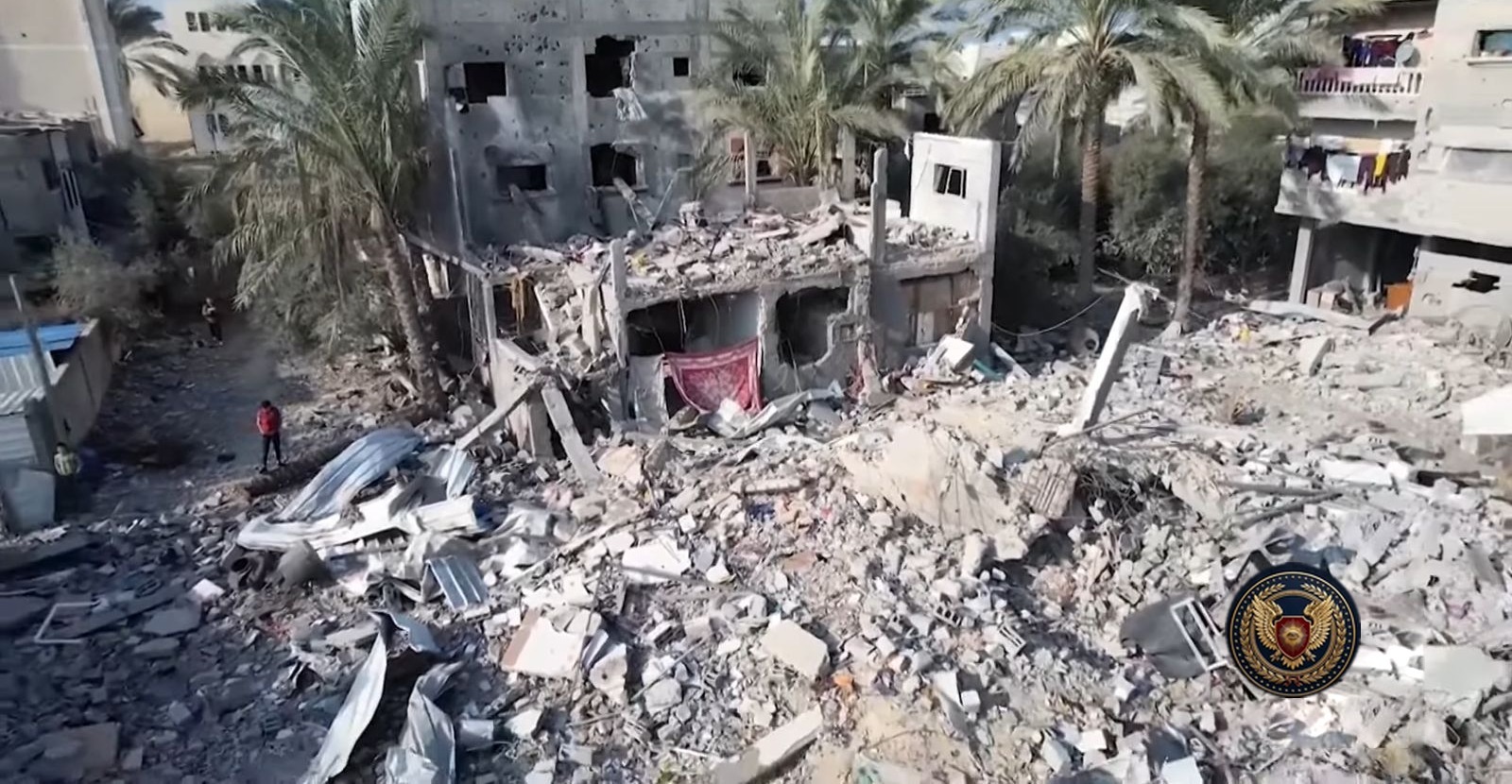
Every morning, Mahmoud Khalla walks to the cemetery near Jabalia an-Nazla in northern Gaza to visit the graves of his family. It is a routine he has kept in the months since he finally buried them — 29 months after they were killed. Khalla, 40, is the only surviving member of his family.
On December 21, 2023, his wife, his three children, his parents, his two brothers and their families, his sister and her children, and other relatives had gathered in the family's five-storey home in Jabalia. That evening, Khalla left the house to search for provisions — Israeli tanks had surrounded the area and food was already scarce under the siege. About fifteen minutes later, he heard a huge explosion. An Israeli strike had destroyed the building. All 39 people inside were killed.
With neighbours, Khalla tried to dig through the rubble that night, but Israeli air attacks kept targeting the area, and ambulances and civil defence teams could not reach the site. Nine days earlier, his uncles' house across the street had been struck too, killing 18 people; the rest of the family had fled south. For months afterwards, Khalla was displaced and alone, sleeping in streets and in any open car he could find.
After the October 2025 ceasefire reduced the bombing, he began recovering his family's remains himself — by hand, with friends and neighbours, starting around May 2026. It took three months. The first remains he found were two relatives who had been sheltering with the family; the last were his sister and her children, buried together. "I felt a great sense of relief when I finally buried them," he said.
Khalla's account, reported directly by Al Jazeera with photography from the scene, sits inside a documented pattern. December 21, 2023 was one of the deadliest days of the war in northern Gaza: Gaza medical sources, cited by al-Quds and reported even by the Israeli Amit Institute, recorded 55 deaths from IDF attacks in Jabalia, Khan Yunis and Rafah that day. UN humanitarian bulletins from the same weeks document residential buildings struck across Jabalia with dozens killed in single incidents.
The wider ledger is grim and convergent across outlets. The US-brokered ceasefire took effect on October 10, 2025, under a 20-point plan: Hamas released the 20 remaining living Israeli hostages on October 13, 2025, Israel freed nearly 2,000 Palestinian prisoners, and the UN Security Council endorsed the plan with Resolution 2803 that November. The war had already killed more than 67,000 Palestinians by then.
Twelve months later, the dying has not stopped. Gaza's Health Ministry counts at least 1,431 Palestinians killed and 5,026 injured in Israeli attacks since the ceasefire; Reuters reported at least 1,400 killed as of October 12, 2026, the Financial Times more than 1,400 including at least 300 children, and UNICEF reported at least 300 children killed in the 300 days after the truce — about one child a day. The overall toll now exceeds 74,000 killed and 175,000 injured, according to Palestinian authorities, with Israeli air attacks on Gaza continuing this week.
Then there is the second ledger: the missing. Gaza's Civil Defense reports around 8,000 people still missing, most believed buried under what the UN estimates at 61 million tonnes of rubble. The UNDP puts the range at 8,000 to 10,000 bodies. About 1,000 bodies have been recovered since October 2025; only some 1.5 percent of the rubble has been cleared. With no DNA testing available in Gaza, families identify remains by clothing.
The precise circumstances of the December 21, 2023 strike on the Khalla home have not been independently reconstructed: Al Jazeera's account rests on the survivor's testimony, and the feature cites no Israeli statement on the incident. The exact number of missing remains an estimate — between 8,000 and 10,000 — and the International Committee of the Red Cross warns that with each passing day, the chances of identifying the dead grow slimmer as evidence is lost. It is not known how many of the missing will ever be recovered, given the severe shortage of heavy machinery and restrictions on equipment entering Gaza. Nor is it known whether the truce will hold: Israeli forces continue to operate across large parts of Gaza, strikes remain near-daily, and the political chapters of the 20-point plan — reconstruction, demilitarisation, a new administration — have barely begun. A year after the "day after" was supposed to arrive, no one can say when, or whether, rebuilding starts.
Khalla's story matters because it converts an abstraction — "8,000 missing" — into a procedure: one man, three months, digging by hand. The missing are the war's second casualty count, and they will revise the first. Every body recovered under the rubble adds to a toll that already exceeds 74,000 dead, and the first anniversary of the ceasefire finds Gaza with 94 percent of its people needing shelter and 92 percent of its housing destroyed.
It matters, too, because the rubble is contested ground. UN Special Rapporteur Francesca Albanese warned in September 2026 that large-scale rubble removal under Israeli military control must not erase traces of atrocity crimes or prevent the recovery of human remains — "rubble is not just construction waste. It is part of a crime scene, a graveyard." Meanwhile the under-ceasefire "yellow line" demarcation blocks Palestinians from reaching areas where their relatives may lie buried. Who clears the rubble, with what machines, under whose control, and what happens to what is found there, is now one of the central unresolved questions of the post-war order — and of any future legal reckoning.
Strip the story to its mechanics and five dimensions emerge. Geopolitically, the October 2025 deal was a hostage exchange plus a pause, not a peace: Israel kept forces across most of Gaza, the "yellow line" moved at its discretion, and the political chapters of the 20-point plan — a new Palestinian administration, demilitarisation, reconstruction — stalled in their first year. Economically, the numbers describe a void: more than $70 billion needed to rebuild, $18 billion pledged at the anniversary, essentially nothing spent, and a rubble-clearance task the UN says could take 20 years. Demographically, the missing alone — 8,000 to 10,000 — are a permanent hole in Gaza's family structures. Historically, Jabalia is a 1948 refugee camp being destroyed twice over; Khalla's cemetery mornings are the Nakba's long tail. Technologically, the war's residue is a double trap: unexploded ordnance makes every dig dangerous, and without DNA labs or heavy machinery, identification relies on clothing, neighbours' memory and engineers' field notes. The asymmetry is the story's sharpest edge: in October 2025, Egyptian teams with heavy machinery entered Gaza to search for Israeli hostages' remains. Palestinian families got shovels.
The consequences are already moving through the region's machinery. The Board of Peace held its anniversary summit with reconstruction pledges and an International Stabilization Force drawing commitments from Kazakhstan, Morocco, Albania and Kosovo — while Washington pressed donors to abandon UNRWA funding and the UN defended the agency. Inside Israel, with elections in the air, the war's legacy is becoming domestic politics: analysis this week traces how the opposition forged by Netanyahu may define whatever comes next, and how any Israeli government will treat the Palestinians — and Gaza's shattered healthcare system. Beyond Gaza, the pattern spreads: Israeli strikes hit southern Lebanon this week, and the legal track grinds on — the ICJ's 2024 orders to preserve evidence and Albanese's warning that rubble-clearing itself could become evidence destruction. Every missing person recovered, or never recovered, feeds or starves those cases.
What happens next is, unusually, legible: families will keep digging by hand, because no one else will do it for them. Gaza's civil defence says the recovery of the missing could take 90 days with proper equipment — or years without it. The equipment remains the choke point: heavy machinery is barred, and the political condition attached to its entry shows no sign of being met. Reconstruction pledges will be tested against delivery in the coming months; the record of the first year — no reconstruction, no restored services, daily violence — is not encouraging. And the strikes will likely continue at their near-daily rhythm until either the truce's second phase begins in earnest or it collapses outright. For Mahmoud Khalla, the future is simpler and already decided: every morning, the cemetery near Jabalia an-Nazla, where 39 members of his family finally rest together.
The Western lens frames the war as Israel's campaign against Hamas following the October 7, 2023 attacks, in which Hamas-led fighters killed some 1,200 people in Israel and took around 250 captive, according to Israeli tallies. Civilian deaths are read as the catastrophic consequence of Hamas embedding fighters in dense civilian areas; Israel says post-ceasefire strikes target militants and respond to violations. A former Israeli negotiator said this week that Israel could have ended the war and freed the captives sooner. Washington's frame is the 20-point plan and its Board of Peace as the reconstruction vehicle; Europe's is humanitarian and increasingly restive, with EU officials pledging around $1 billion for early recovery.
The Eastern lens reads Gaza as evidence of a Western double standard. China — which this week told Israel to stop the "forced establishment" of West Bank settlements — has with Russia consistently called for a durable ceasefire. Iranian outlets describe the campaign as a genocidal war and read the post-ceasefire death toll as proof the truce changed little. In this lens, the Board of Peace is American stagecraft: pledged reconstruction money that is never delivered. The lens notes, pointedly, that Egyptian machinery was admitted to search for Israeli hostages' remains in October 2025, while Palestinian families still dig by hand.
The Global South lens is the human one, and it is where Khalla's story lands hardest. Al Jazeera's framing — a "genocidal war" — reflects a view now mainstream across much of Africa, Asia and Latin America, where the ICJ proceedings and UN experts' warnings outweigh Western official statements. In this lens, the missing are not a statistic but a debt: international humanitarian law obliges parties to search for the dead and return remains to families, and the ICRC says that obligation is honoured mostly in the breach. The lens asks the question the other two avoid: if a ceasefire leaves three years of devastation unaddressed, what exactly did it cease?
Mahmoud Khalla is a 40-year-old Palestinian from Jabalia in northern Gaza, profiled by Al Jazeera on October 16, 2026. He is the sole survivor of his family after an Israeli strike destroyed their five-storey home on December 21, 2023, killing 39 relatives. After months displaced and homeless, he recovered his family's remains by hand over three months in 2026 and buried them near Jabalia an-Nazla, which he now visits every morning.
Khalla's wife, three children, parents, two brothers and their families, his sister and her children, and other relatives had gathered in the family home in Jabalia when an Israeli strike destroyed the five-storey building, killing all 39 people inside. Khalla had left about fifteen minutes earlier to search for food. Nine days earlier, his uncles' house across the street was struck, killing 18 people, and the rest of the family fled south.
Gaza's Civil Defense reports around 8,000 people still missing, most believed buried under the rubble; the UNDP estimates 8,000 to 10,000 bodies remain under some 61 million tonnes of debris. About 1,000 bodies have been recovered since the October 2025 ceasefire, but only around 1.5 percent of the rubble has been cleared, and with no DNA testing available in Gaza, identification relies on clothing and witnesses.
No. The US-brokered ceasefire took effect on October 10, 2025, and Hamas freed the 20 remaining living hostages days later, but Israeli strikes have continued at a near-daily rhythm. Gaza's Health Ministry counts at least 1,431 Palestinians killed since the truce; Reuters and the Financial Times report more than 1,400 deaths including at least 300 children, and UNICEF says about one child a day has been killed.
