The Four Families: Who Really Sets the Price of Your Bread
Every morning, the price of bread moves — and neither the farmer nor the baker set it. Four houses move the grain of the world, a fifth is owned by a state, and the price is made where they meet. This is the map of the corridor.
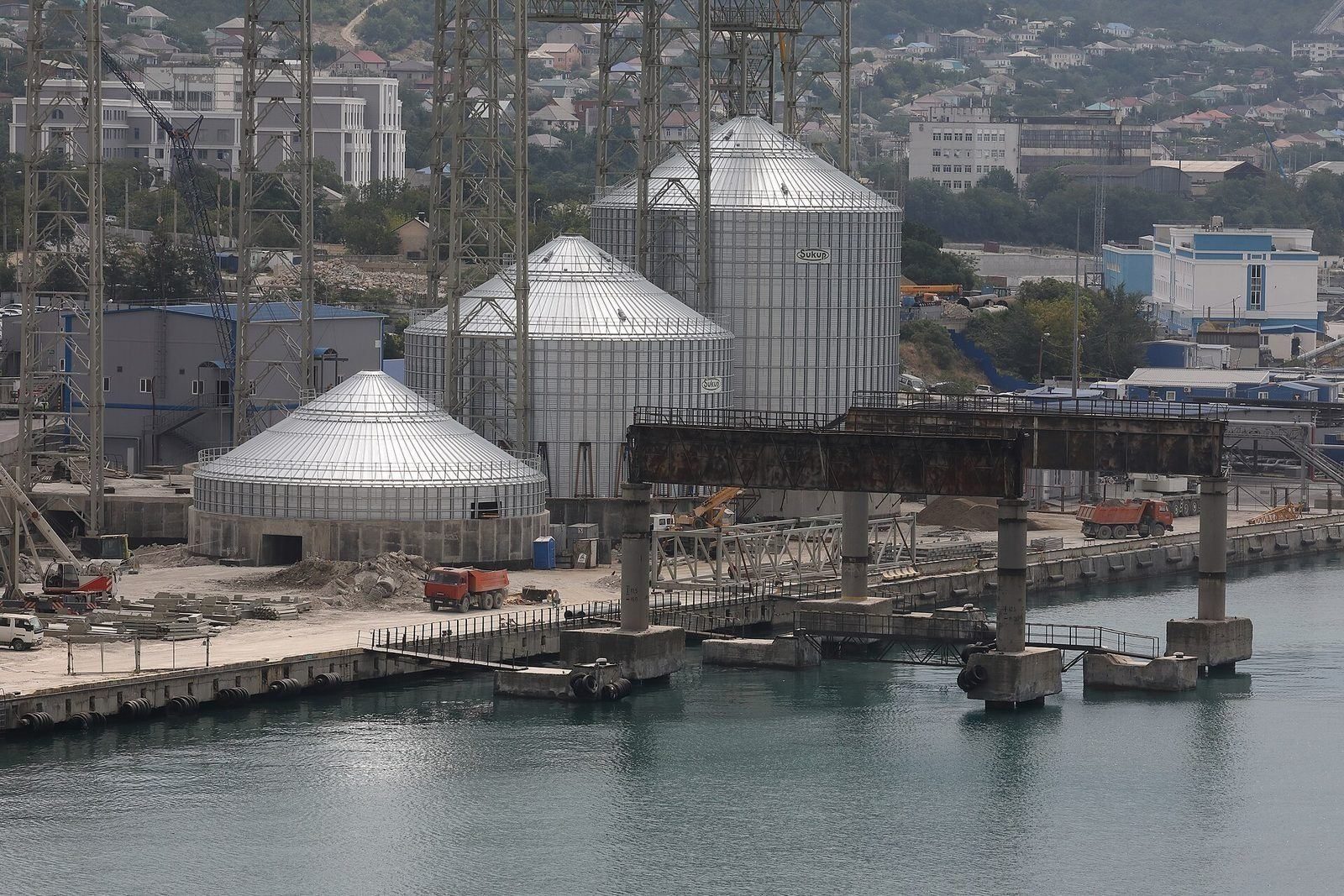
The corridor is not an abstraction: it is concrete, steel and port berths. Grain silos at the KSK export terminal on the Black Sea coast — the physical bottleneck the world's bread must pass through.
Share
Key findings
Four companies plus one state trader form the corridor. ADM, Bunge, Cargill and Louis Dreyfus — plus China's COFCO — control an estimated 70–80% of globally traded commercial grains and oilseeds; the world's eight leading traders piled up $730 billion in 2023 revenues. ETC Group, January 2025
The number is disputed — the shape is not. The classic 90% (Oxfam 2012) is dated; the European Parliament with Ernst & Young put the four at 50–60% of wheat, soy and corn trade (2024); newer academic work argues the four alone have fallen to ~30% as state-backed traders rose (Wilson/NDSU 2025). Every measure describes an oligopoly. Oxfam; EP/EY 2024; Wilson/NDSU 2025
Cargill is the largest privately held company on the planet's food system. Family-owned since 1865, roughly 90% still in family hands (Forbes), 21 family billionaires, $164 billion in FY2026 revenue, more than 160,000 employees. Its CEO is Brian Sikes. Cargill annual report; Forbes 2026
ADM is the public one. Revenue of $80.269 billion and net earnings of $1.078 billion in FY2025 (SEC 10-K, year ended December 31, 2025); some 42,000 employees; run by Juan Luciano, chairman, president and CEO. ADM Form 10-K; ADM Q2 2026 earnings call
Bunge just doubled its footprint in one signature. Its $8.2 billion acquisition of Viterra closed on July 2, 2025 — China's SAMR clearance in late June was the final regulatory hurdle — adding 300-plus storage facilities, 40-plus port terminals and 155-plus processing plants. CEO: Greg Heckman. World-Grain; Pymnts, July 2025
Louis Dreyfus sold a 45% stake to Abu Dhabi. The ADQ deal, completed September 10, 2021, was the first time in 170 years a non-family shareholder entered the house; controlling shareholder remains Margarita Louis-Dreyfus, via the Akira trust. CEO: Michael Gelchie. Net sales: $53.2 billion in 2025 ($50.6B in 2024); roughly 95 million tonnes a year. Reuters; LDC
The fifth column is a state. COFCO is a state-owned enterprise under the direct supervision of China's SASAC — the largest grain enterprise in China, and the corridor's state-backed challenger. SASAC
The price is made by a formula. Local cash price = futures price + basis. Chicago sets the benchmark; the elevator — increasingly the trader's own — sets the basis, and keeps it. Univ. of Nebraska-Lincoln CropWatch; Purdue Ag
The farmer's cut of the loaf: twelve cents. On a loaf retailing at $4.99, the wheat farmer who grew the grain gets roughly 12 cents (September 2024 prices, USDA/NASS Agricultural Prices basis). US farmers receive about 14.3 cents of every food dollar. National Farmers Union; USDA ERS, October 2024
Concentration is also fragility. ADM's 2024–25 accounting probe wiped roughly $12 billion from its market value, and a shareholder publicly called for CEO Juan Luciano to step down. When the corridor is four houses, a crack in one is a crack in the system. Bloomberg Law
The price of bread is set long before the flour.
Not by the farmer. Not by the baker. The price of the loaf you bought this morning was made twice — once in Chicago, on a screen, and once at a grain elevator somewhere in the American Midwest, the Brazilian interior, or the Black Sea basin — by people whose names rarely appear in the price.
Four of those people run houses older than most countries. The fifth answers to a state. Between them sits nearly everything the world eats that was not eaten where it was grown.
The mechanism: who prices the bushel
Before the families, the formula. It is worth learning, because it is the entire game in one line.
Cash price = futures price + basis.
The futures price is set in Chicago, where thousands of traders trade the world's opinion of supply and demand. The basis — the difference between the local cash price and the futures price — is set locally, by the elevator that buys the farmer's grain. Transport, storage, handling, quality, local supply and demand: all of it lives inside the basis. And the basis, as the University of Nebraska's CropWatch puts it, "represents factors influencing the local grain buyer" — it is, in practice, the elevator's margin, widened or narrowed at the elevator's discretion.
Now the part that matters: the farmer is a price-taker on the futures leg and a negotiator only on the basis — against a buyer who knows every bid in the county, owns the rail allocation, and can store the grain until the farmer cannot. Purdue's agricultural economists state it without varnish: local cash = futures + basis, and the two components move independently, which means the elevator can hold the cash price still while the board price moves.
The farmer sells wheat. The trader sells certainty — and keeps the spread.
Figure 1 · The mechanism
How a bushel is priced
The one equation that runs the grain trade. The farmer controls none of its three terms.
Academic extension services teach this formula to farmers as a survival skill. The traders do not need to be taught it — they wrote the infrastructure around it. Univ. of Nebraska-Lincoln CropWatch; Purdue Center for Commercial Agriculture.
The four families
The letters ABCD are the trade's oldest shorthand — Archer Daniels, Bunge, Cargill, Dreyfus — and they have outlived every attempt to retire them. Here is who they are now, in the order of their weight.
Cargill. Minneapolis, United States. Founded 1865 in an Iowa rail town by William Wallace Cargill; still privately held, roughly 90% in the hands of the Cargill and MacMillan families (Forbes), who count 21 billionaires among the heirs. Revenue: $164 billion in FY2026. Employees: more than 160,000 across 70 countries. The head: CEO Brian Sikes. Cargill is not so much a company inside the grain trade as the grain trade's operating system — origination, crush, feed, meat, logistics, finance. Its opacity is structural: no quarterly calls, no public filings, no shareholder letters. The family answers to no one, which is precisely the point of being private for 160 years.
ADM. Chicago, United States. The public one — NYSE-listed, reporting to the SEC like everyone else. Revenue: $80.269 billion in FY2025; net earnings $1.078 billion (Form 10-K, year ended December 31, 2025). Employees: about 42,000. The head: Juan Luciano, chairman, president and CEO — still in the chair at the Q2 2026 earnings call, despite everything (see below). ADM is the trader the market can actually watch, which makes it the family's canary: when something is wrong in the corridor, ADM's filings are where it shows up first.
Bunge. St. Louis by way of Amsterdam and Brazil — the house that made its name on South American soy. Publicly traded. The head: CEO Greg Heckman. And on July 2, 2025, Bunge closed the $8.2 billion acquisition of Viterra — China's SAMR clearance in late June was the last regulatory hurdle, as the two had warned — folding in 300-plus storage facilities, 40-plus port terminals and 155-plus processing and refining plants. The press releases called it a behemoth. They were not exaggerating: the corridor just got narrower.
Louis Dreyfus. Geneva, Switzerland. The oldest of the four in its current form — Léopold Louis-Dreyfus started trading grain in Alsace in 1851 — and the most family-guarded: for 170 years, no outsider held a share. Then, on September 10, 2021, Abu Dhabi's ADQ completed the purchase of 45%: the first non-family shareholder in the house's history, as Reuters reported. The controlling shareholder remains Margarita Louis-Dreyfus, through the Akira family trust. The head of operations: CEO Michael Gelchie. Net sales: $53.2 billion in 2025 ($50.6 billion in 2024); roughly 95 million tonnes of product moved a year. The Gulf now co-owns a European grain house. Read that again.
Three of the four disclose revenue; the fourth discloses power. Either way, the corridor's scale is sovereign-grade: Cargill alone moves more value than most countries' farm sectors. Cargill annual report; ADM Form 10-K (SEC); LDC (ldc.com).
The merger wave
The four families are not standing still. They are consolidating — and the buyers are getting stranger.
Bunge–Viterra is the clearest signal. Two grain giants, one $8.2 billion signature, and a combined network that put 300-plus storage facilities and 40-plus port terminals under a single board. The last approval came from Beijing's State Administration for Market Regulation in late June 2025 — the deal could not close until China said yes, which tells you who holds the leverage over the world's soy corridor. It closed on July 2, 2025.
But the more interesting transaction was quieter. In September 2021, ADQ — the sovereign wealth fund of Abu Dhabi, United Arab Emirates — bought 45% of Louis Dreyfus Company for an indirect stake the parties valued in the billions. Reuters called it what it was: the first time in 170 years that anyone outside the family owned part of the house. The logic was never hidden. The Gulf is water-poor and calorie-short; it has spent two decades buying farmland and food infrastructure across Africa and Asia. Buying the trader, not just the farm, is the upgrade: ADQ did not buy hectares, it bought the corridor.
The counterweight, meanwhile, wears a flag. COFCO — China National Cereals, Oils and Foodstuffs Corporation — is a state-owned enterprise under the direct supervision of the State-owned Assets Supervision and Administration Commission (SASAC), and, in SASAC's own words, China's largest agricultural grain enterprise. It built its international arm by buying: majority control of Noble Group's agribusiness in 2014, then the rest. COFCO is not a family, not a public company — it is Beijing's seat at the table where the price is made. The corridor the grain must pass through is owned, increasingly, by states as well as shareholders.
Figure 2 · Ownership
Who actually holds the paper
The corridor's five houses, by ownership form. No other strategic industry is this family-heavy.
Two publics, two families, one sovereign fund, one state. The price of your bread is set by a room with five doors — and three of them do not answer to any market. Forbes; SEC; Reuters; SASAC; Bureau analysis.
The farmer's twelve cents
Now the other end of the corridor. The National Farmers Union's "Farmer's Share" — calculated from USDA and National Agricultural Statistics Service data — found that the wheat farmer who grew the grain gets roughly 12 cents on a loaf of bread retailing at $4.99. September 2024 prices. Twelve cents for the harvest; the rest goes to milling, baking, transport, retail — and the corridor's margins in between.
The USDA's own Food Dollar series tells the same story at the system level: in October 2024, the Economic Research Service reported that farmers received about 14.3 cents of every dollar Americans spent on food. The number has been falling for a century. The farmer grows more, feeds more, and keeps less.
Put the two facts side by side — the corridor's $730 billion in trader revenue against the farmer's twelve cents — and the mechanism becomes a verdict. The basis is not a technicality. It is the toll.
Chart 2 · The loaf
A $4.99 loaf, and the farmer's share of it
Wheat farmer's share of the retail bread price · National Farmers Union "Farmer's Share," September 2024 prices (USDA/NASS Agricultural Prices basis)
The grain is the cheapest part of the bread. Everything between the field and the checkout is where the money is — and the corridor sits in the middle of it. National Farmers Union; USDA ERS.
The crack in the giant
Concentration has a second face, and ADM showed it. In early 2024, the company disclosed an accounting probe into its nutrition segment; the market's verdict was swift — roughly $12 billion wiped from the company's value in the days that followed, as Bloomberg Law later recounted. A shareholder and former executive, Hartwig Fuchs, publicly called for Juan Luciano to step down, citing the opacity of the disclosures and the failure to reverse the share loss.
Luciano survived — he was still chairing the Q2 2026 earnings call — but the episode is the investigation's warning label. When the corridor is four houses, a governance failure in one is not a company story. It is a food-system story. There is no spare corridor.
The arithmetic is now complete. The benchmark is set in Chicago. The basis is set at the elevator. The elevators, the crush plants, the ports and the ships belong to four families and a state. The farmer gets twelve cents. And the whole edifice rests on the assumption that none of the five ever stumbles at once.
The farmer sells wheat. The trader sells certainty — and keeps the spread.
Where the record agrees — and where it argues
The consensus ledger below is the Bureau's hater-proofing. Everything printed above survived it; the disagreements are printed too, because a ledger that hides its disputes is a ledger you cannot trust.
Agreement: the ABCD+COFCO group dominates traded grain — ETC Group (January 2025) estimates 70–80% of globally traded commercial grains and oilseeds; the top eight traders took $730 billion in 2023 revenue.
Agreement: Cargill is family-held at roughly 90% (Forbes 2026 billionaire-family profiles); FY2026 revenue $164 billion; founded 1865; 160,000-plus employees; CEO Brian Sikes.
Agreement: ADM's FY2025 revenue was $80.269 billion with $1.078 billion net earnings (SEC 10-K, year ended December 31, 2025); Juan Luciano remains chairman, president and CEO (Q2 2026 call).
Agreement: Bunge closed the $8.2 billion Viterra acquisition on July 2, 2025, with China's SAMR clearance (late June 2025) as the final hurdle; 300-plus storage facilities, 40-plus port terminals, 155-plus processing plants.
Agreement: ADQ completed its 45% acquisition in Louis Dreyfus on September 10, 2021 — the first non-family shareholder in 170 years (Reuters); Margarita Louis-Dreyfus remains controlling shareholder via the Akira trust; LDC net sales $53.2 billion in 2025.
Agreement: COFCO is a state-owned enterprise under SASAC's direct supervision and China's largest grain enterprise (SASAC).
Agreement: cash = futures + basis (UNL CropWatch; Purdue); the basis is set by the local grain buyer.
Agreement: the wheat farmer's share — ~12 cents on a $4.99 loaf (NFU, September 2024, USDA/NASS basis); ~14.3 cents per food dollar (USDA ERS, October 2024).
Dispute: the ABCD share itself — 90% (Oxfam 2012, dated), 50–60% (EP/EY 2024), ~30% for the four alone (Wilson/NDSU 2025). The investigation prints the range and dates each claim.
Dispute: whether the Big Four's share is structurally declining — Wilson's thesis holds that COFCO, Russian traders and sovereign-backed firms are eroding it; the corridor's defenders note that mergers like Bunge–Viterra consolidate it right back.
How this investigation was built
The Bureau's rule for investigations: every figure carries its source, and where sources disagree, both are printed. Nothing in this piece rests on a single origin.
Trader shares carry their vintage and their dissenter: Oxfam (2012), European Parliament/Ernst & Young (2024), ETC Group (2025), Wilson/NDSU (2025).
Revenue figures from primary filings and company reports: Cargill annual report (FY2026, ended May 31, 2026); ADM Form 10-K filed with the SEC (year ended December 31, 2025); LDC financial results (ldc.com).
Ownership facts from Forbes 2026 billionaire-family profiles (Cargill ~90%), Reuters (ADQ–LDC, September 2021), SASAC's own corporate description (COFCO), and pappers-style corporate records.
The merger from Bunge's closing announcements and contemporaneous trade press (World-Grain, Pymnts), July 2025; the China clearance from regulatory reporting in late June 2025.
The basis mechanism from university extension services (UNL CropWatch; Purdue Center for Commercial Agriculture) — the same material American farmers are taught.
The farmer's share from the National Farmers Union "Farmer's Share" (September 2024 prices, USDA/NASS Agricultural Prices) and USDA ERS Food Dollar (October 2024).
The ADM probe from Bloomberg Law's reporting on the shareholder's ouster call and the market-cap destruction.
Where the record is genuinely uncertain — private-company disclosures, parallel trade that never touches Western statistics — the investigation says so, and the disagreement sits in the consensus ledger rather than in the numbers.
Premium investigation
This investigation continues for members
You have read the key findings, the mechanism that prices the bushel, and the four families themselves. The rest of the investigation — the part that makes it an investigation — is behind the lock.
The merger wave: Bunge–Viterra's $8.2B close, ADQ's 45% of Louis Dreyfus, and the state-backed challengers
The ownership map: who actually holds the paper — family trusts, public floats, and one sovereign
The farmer's twelve cents: the full anatomy of a $4.99 loaf — plus the consensus ledger and the complete 17-source annex
No card required today — Premium launches soon. Sign in with your existing account to reserve your access; the investigation unlocks the moment Premium goes live.