In Oslo on Tuesday, Ukraine’s president said American intelligence on incoming Russian ballistic strikes is flowing again after a week of blind spots — and thanked Washington. The White House’s top diplomat, in remarks delivered in India, insisted there was never a pause at all.
Published 20 October 2026 · 23:24 GMT
On Tuesday, October 20, 2026, standing in Oslo beside Norwegian Prime Minister Jonas Gahr Støre and Finnish President Alexander Stubb, Ukrainian President Volodymyr Zelenskyy delivered the sentence Kyiv had been waiting a week to say: American early-warning intelligence on incoming Russian strikes is flowing again.
“We are thankful that intelligence works now, and I’m speaking about early warning, which is very important for our people, for children, adults, civilians, because we can hear when ballistic is coming,” he told reporters. “So we are thankful to the American side now that it works.”
The announcement capped a day of intensive diplomacy: meetings with US special envoy Steve Witkoff and — joining remotely — Jared Kushner, plus a phone call with Secretary of State Marco Rubio earlier in the day. Zelenskyy said the restoration followed those conversations directly.
But the relief came edged with a demand. Kyiv, he insisted, must be included in any future talks on its fate: “Ukraine wants peace more than anyone,” he said — even as Trump, speaking in Washington the same day, pressed him to “make a deal” with Moscow.
For at least a week, Zelenskyy says, Ukraine’s military received no early warnings of ballistic missiles aimed at the capital — the American satellite tip-offs that give air defenses and civilians precious minutes to react. He had already complained on Monday that Russian strikes on energy facilities in the Kyiv region arrived with no advance notice.
The blind spot turned deadly on the night of October 18–19. Ukraine’s Air Force said the first wave of the Russian attack arrived at around 23:00 with no information from partners; a warning came before the second wave, but the window was short. Zelenskyy said Russia fired 16 ballistic missiles at Kyiv and the surrounding oblast. The Air Force’s preliminary count did not list any ballistic missiles among the intercepted targets.
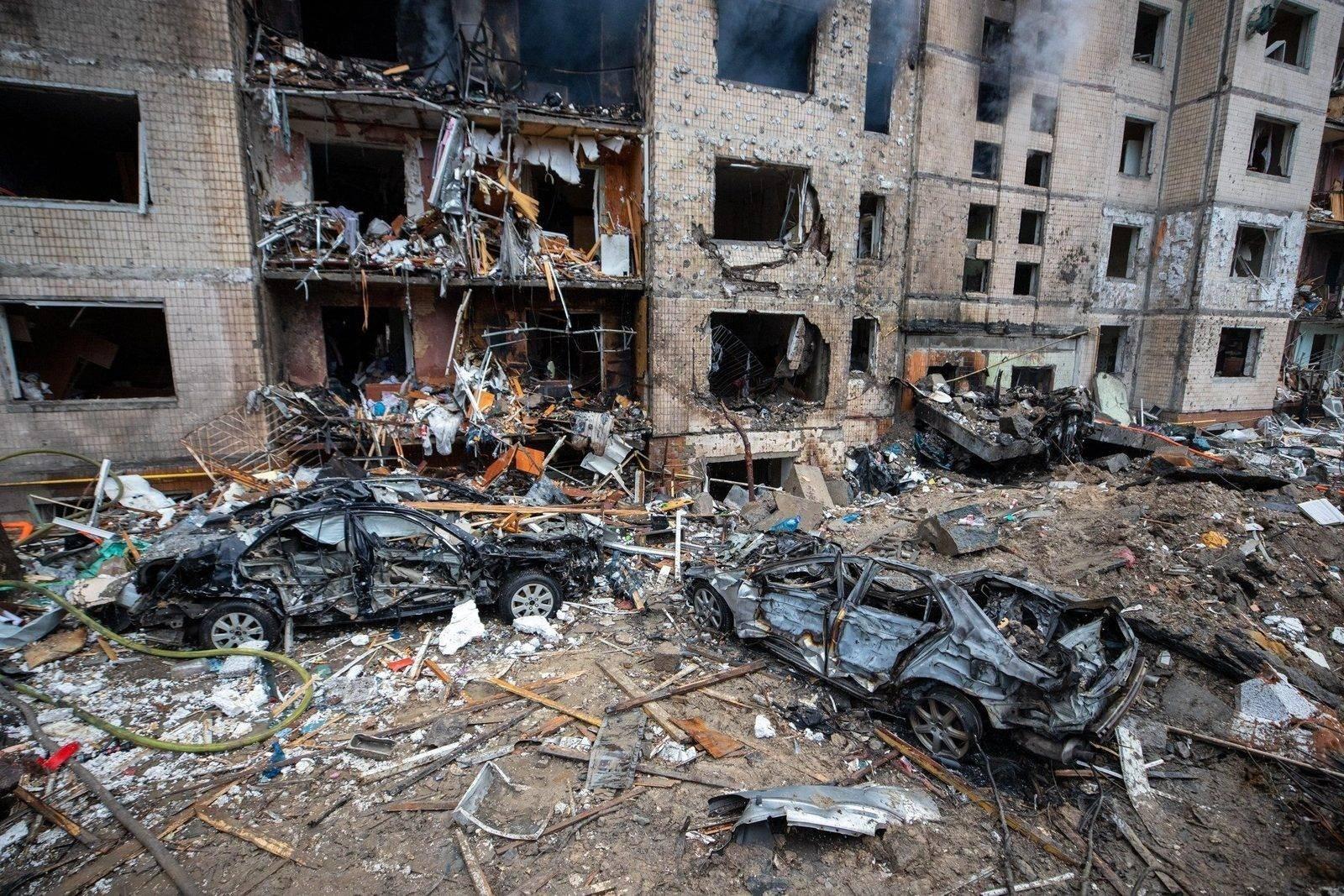
The toll: one person killed and eight injured in Kyiv, damaging a metro station, a 25-storey block, a clinic and a mall; six injured in Irpin, including three children; and at least 550,000 families left without power across the country. It was at least the third such strike on Kyiv in a week to begin without a partner warning.
On October 20 itself, Russian drones killed three people near the Kyiv–Odesa highway and one more near a Kyiv petrol station — a reminder that the missile-warning question sits inside a wider daily bombardment.
The central fact of this story is contested. Zelenskyy says Washington withheld — deliberately, in his earlier telling — vital intelligence. Rubio says there was “no pause” in intelligence sharing and no change of policy, attributing a recent gap to “a software problem” with the early-warning system. Neither side has published anything an outside observer could adjudicate.
There is also a timing puzzle. Zelenskyy told NBC’s Meet the Press on October 18 that interrupted US intelligence sharing had been restored — and then the October 18–19 night waves arrived with no warning. Was Oslo a re-restoration after a second blackout, or was the NBC statement premature? Kyiv has not said.
The Starshield question is equally unresolved. Ukraine claims SpaceX’s military satellite communications service was restricted this month, that the restriction came at Washington’s direction, and that it is still biting; Zelenskyy raised it with Rubio. The US side has not publicly confirmed any directive.
Finally, the 16-missile figure is Zelenskyy’s; the Air Force’s preliminary interception count listed no ballistic missiles at all — a discrepancy no official has explained.
Ballistic missiles reach Kyiv in minutes. The American early-warning feed — satellite infrared detection of launches, fused with radar tracks — is what turns those minutes into sirens, shelter, and interceptors in the air. Without it, air-defense batteries fire late or blind, and civilians learn of an attack when it lands. For a city under nightly bombardment, the feed is not a tactical luxury; it is the difference between a warning and a crater.
That is why the week’s gap was politically explosive in Kyiv — and why its restoration was announced as a presidential achievement abroad. The feed is also leverage: Washington can tighten or loosen it without moving a single sanction or shipment. Zelenskyy’s week of complaints, and Rubio’s week of denials, are the public surface of that quiet dial turning.
For Moscow, the lesson is being written in real time. If the warning feed can flicker, Russia has an incentive to time its heaviest waves to the flicker — which is precisely what the October 18–19 sequence looks like from Kyiv’s side of the glass.
Intelligence sharing is the most deniable instrument in Washington’s Ukraine toolkit: it can be throttled without a presidential order anyone can photograph, without a sanctions notice, without a shipment to track. A “software problem” and a policy pause look identical from the receiving end — which is exactly why both explanations can coexist in public indefinitely.
Consider the sequence through the Bureau’s five dimensions. Geopolitically, the feed is leverage over Kyiv and Moscow alike: tightened, it punishes Zelenskyy’s defiance; restored, it rewards his attendance in Oslo. Economically, it runs parallel to the diesel arrangement with Putin — pressure and accommodation from the same hand. Technologically, Starshield extends the logic to orbit: commercial constellations as sovereign switches. Historically, this is not the first time Washington has reached for the intelligence tap — and Kyiv’s fury suggests it remembers. Demographically, the cost is counted in civilians, who cannot see the dial, only its effects.
Zelenskyy’s Oslo performance was therefore two messages in one: gratitude for the restoration, and a warning — delivered with Støre and Stubb flanking him — that Kyiv will not accept being managed by flicker.
First, St. Petersburg. Witkoff flies there on October 21 to meet Russia’s leadership, carrying whatever was agreed — or refused — in Oslo. If Moscow reads the week’s flicker as American willingness to trade Ukrainian warning time for concessions, the price of the next wave goes down, not up.
Second, the Nordic front. That the talks happened in Oslo, with Norway’s and Finland’s leaders physically flanking Zelenskyy, is a signal to Moscow and Washington alike: Europe’s northern frontier now co-hosts Ukraine diplomacy. Expect more European initiative — and more European exposure — as Washington’s reliability wobbles.
Third, the commercial-space precedent. If Starshield can be throttled by directive, every military betting its communications on a private constellation just learned the real terms of service. Kyiv’s complaint will echo in procurement offices from Warsaw to Taipei.
Fourth, Ukraine’s diversification imperative. Every silent hour teaches Kyiv the same lesson: build non-American warning paths — European satellites, domestic radars — or live at the mercy of someone else’s software.
The restoration is announced; the proof arrives with the next Russian wave. Watch the Ukrainian Air Force’s morning readouts: if the next ballistic salvo comes with a timely partner warning, Oslo holds. If it arrives silent again, the “software problem” story collapses — and Kyiv’s fury returns with interest.
The envoy’s October 21 meetings with Russia’s leadership are the other half of this story. Any hint that Moscow was promised — or threatened with — changes to the intelligence flow will redraw the battlefield before a single missile flies. Watch, too, for movement on the Starshield restrictions and interceptor deliveries Zelenskyy raised with Rubio; those are the material tests of whether Oslo was substance or stagecraft.
Ukraine has now publicly accused its chief ally of switching its warning feed off twice in a week — and been publicly contradicted. That is not sustainable for a country under nightly attack. The deeper story, alongside the fraying US-Ukraine relationship and Russia’s campaign against Ukraine’s energy grid, is whether Kyiv accelerates its push for European and home-grown early-warning capacity — and what Washington does when its quietest lever slips from its hand.
How the West read it: a relief valve in the worst US-Ukraine crisis of the war Western coverage — the Associated Press , the Guardian , the AFP wire — framed Oslo as a small patch on a badly torn relationship. The context was the rupture: Trump’s partial lifting of sanctions for a diesel-supply arrangement with Vladimir Putin , his branding of Zelenskyy as a warmonger, and his Oval Office demand that Kyiv “make a deal.” In this telling, the early-warning feed is one more pressure instrument in a White House squeezing Kyiv on intelligence, weapons, and satellite links — and Oslo was Zelenskyy buying breathing room.
How East Asia read it: the Rubio call and the Starshield shadow Japanese and Korean coverage drilled into the mechanics . TBS/JNN led with Zelenskyy’s consultation with Rubio — interceptors, early warning, and the demand to restore Starshield , the military SpaceX service Ukraine says was restricted this month. The JoongAng Ilbo recalled the October 18 NBC interview, where Zelenskyy said only the US holds the data to catch a ballistic launch, and that Ukraine went three days without detecting one .
How the Global South read it: a country still begging for minutes of warning Southern coverage dwelled on the asymmetry . India’s Devdiscourse carried the Oslo statement straight; Ukraine’s own Euromaidan Press supplied the indictment beneath it — wave after wave with no partner warning, half a million families in the dark. The southern reading is unsentimental: a country nearly five years into a full-scale invasion remains dependent on one foreign power’s satellites to know when death is inbound — while that power bargains with its enemy over diesel.
On October 20, 2026, after meetings in Oslo with US envoy Steve Witkoff, Jared Kushner (joining remotely) and a call with Secretary of State Marco Rubio, Zelenskyy said US intelligence sharing on looming Russian strikes — above all early warning of ballistic missile attacks — was working again. “We are thankful that intelligence works now,” he said, “because we can hear when ballistic is coming.” He also insisted Kyiv must be included in any future talks on its fate.
Ballistic missiles reach Kyiv in minutes. The US feed — satellite infrared detection of launches fused with radar tracks — converts those minutes into sirens, shelter and interceptors in the air. Without it, air defenses fire late or blind and civilians learn of an attack when it lands. Kyiv says it went at least a week without these warnings, during which the October 18–19 waves killed one person in the capital and left 550,000 families without power.
Secretary of State Marco Rubio, speaking to reporters in India, emphatically denied any change of policy: “there’s been no pause” in intelligence sharing with Ukraine. He acknowledged mutual frustration over intelligence sharing and weapons supplies but attributed a recent gap to “a software problem” with the early-warning system a few nights earlier. Neither side has published logs or technical detail that would settle the dispute.
Three things to watch. First, whether the next Russian ballistic wave arrives with a timely partner warning — the only real test of the Oslo announcement. Second, what envoy Steve Witkoff hears from Russia’s leadership in St. Petersburg on October 21. Third, whether Washington moves on the Starshield satellite restrictions and interceptor deliveries Zelenskyy raised with Rubio, which are the material proof of whether Oslo was substance or stagecraft.
